Raden Saleh
“The Javanese painter who trained and worked in Europe for over twenty years and, back in Java, painted 'The Arrest of Pangeran Diponegoro' (1857): the pioneer of modern Indonesian painting.”
Raden Saleh Syarif Bustaman (about 1811–1880) was the first painter from what is now Indonesia to master European oil painting, and the first Indonesian to live for two decades in Europe. He was born about 1811 at Semarang on the north coast of Java, into the family of the town's regents. As a boy he was put into the care of the colonial government and apprenticed to its Belgian painter, Antoine Payen, whom he followed to Bandung in 1822. In 1829 the government sent him to the Netherlands for two years of study. He stayed in Europe for more than twenty.
In The Hague he learned portrait painting from Cornelis Kruseman and landscape from Andreas Schelfhout, and painted governors-general and the family of his patron Jean Chrétien Baud. After he saw the lions of the travelling animal trainer Henri Martin, he began to paint wild animals. In 1839 he moved to Dresden, then the cultural capital of the German lands. There the Norwegian romantic painter J. C. Dahl took him out to paint from nature, and society welcomed him as a 'Javanese prince'. He made his name with lion and tiger hunts, buffalo hunts and storms at sea. He became a friend of Duke Ernst II of Saxe-Coburg and Gotha, and lived for years with the Serre family, who built a small oriental pavilion on their estate at Maxen in his honour. From 1845 to 1848 he worked in Paris, where King Louis-Philippe bought two of his paintings.
He sailed home in October 1851 with the title of the Dutch king's painter, but colonial society had no settled place for a Javanese who had been educated in Europe. He wore a dress that was neither European nor Javanese, earned his living with portraits of officials and rich merchants, married a wealthy widow, Constancia von Mansfeldt, and built a white neo-Gothic villa at Cikini outside Batavia, with a zoological and botanical garden on his land. He also dug for fossils in Java, long before Eugène Dubois found 'Java Man'. In 1857 he painted 'The Arrest of Pangeran Diponegoro', his only history painting: an answer to Nicolaas Pieneman's Dutch picture of a 'submission', in which the prince stands upright and angry beside General De Kock. He gave it to King Willem III. He died at Buitenzorg (Bogor) on 23 April 1880.
Indonesia remembers him as the pioneer of its modern painting. His Diponegoro painting came back from the Netherlands in 1978 and belongs to the State Palace collection in Jakarta, and in 1953 President Sukarno's government restored his grave in Bogor. Scholars still argue about what the painting means: Werner Kraus reads it as an early, coded statement of Javanese pride against Dutch rule, while the historian Harsja Bachtiar saw a courtier's gift to his king. His works are held today by the Rijksmuseum, the Louvre, the National Gallery Singapore, the Smithsonian and the Latvian National Museum of Art in Riga.
What happened
- 1811
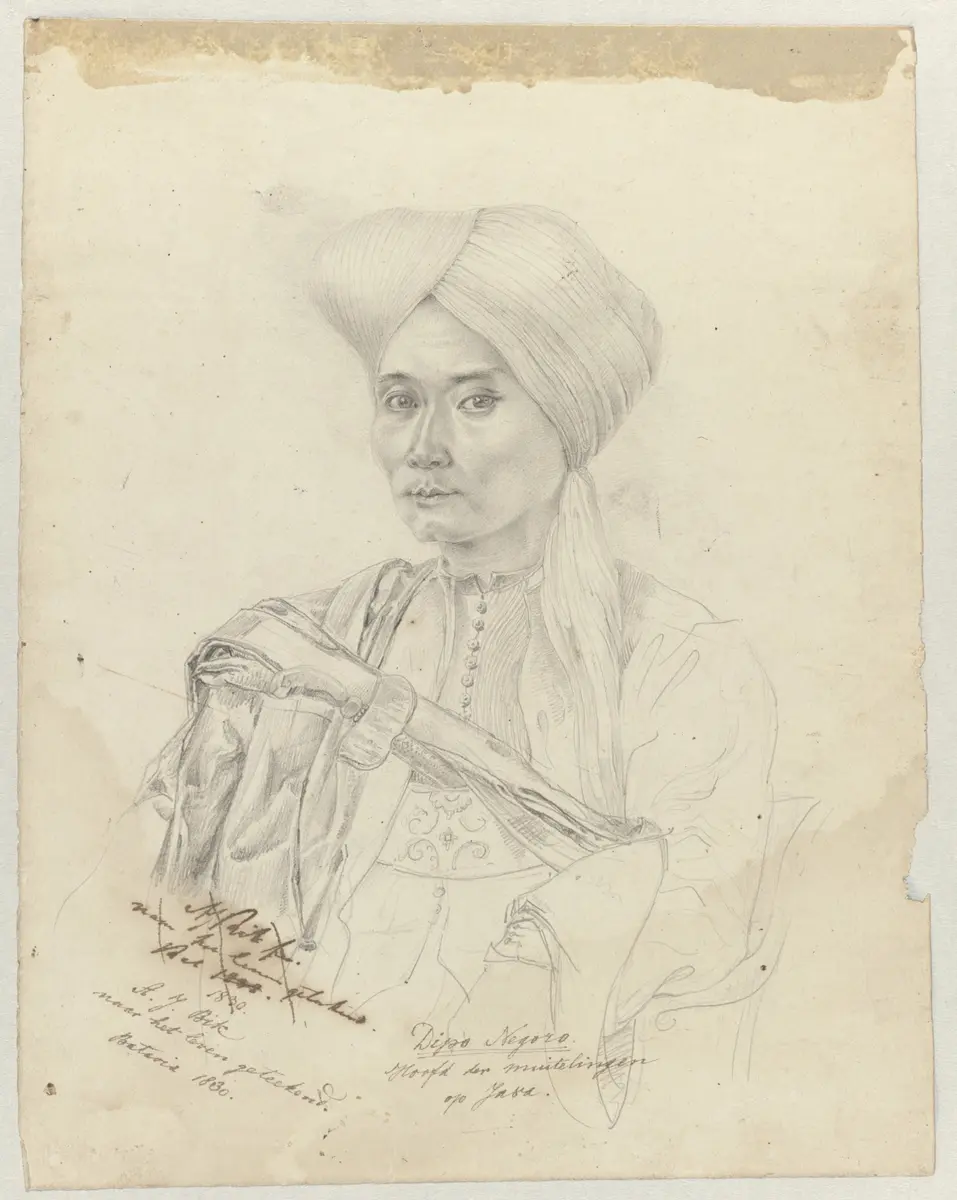
Raden Saleh is born at Semarang, on the north coast of Java, into the family of the town's regents. Years later he notes on a portrait drawing of himself that he was born at Semarang in May 1811.
Semarang, on the north coast of Central Java: where he was born about 1811, into the family of the town's regents - 1822
Placed in the care of the colonial government, the boy is apprenticed to the Belgian government painter Antoine Payen and follows him to Bandung.
- 1825
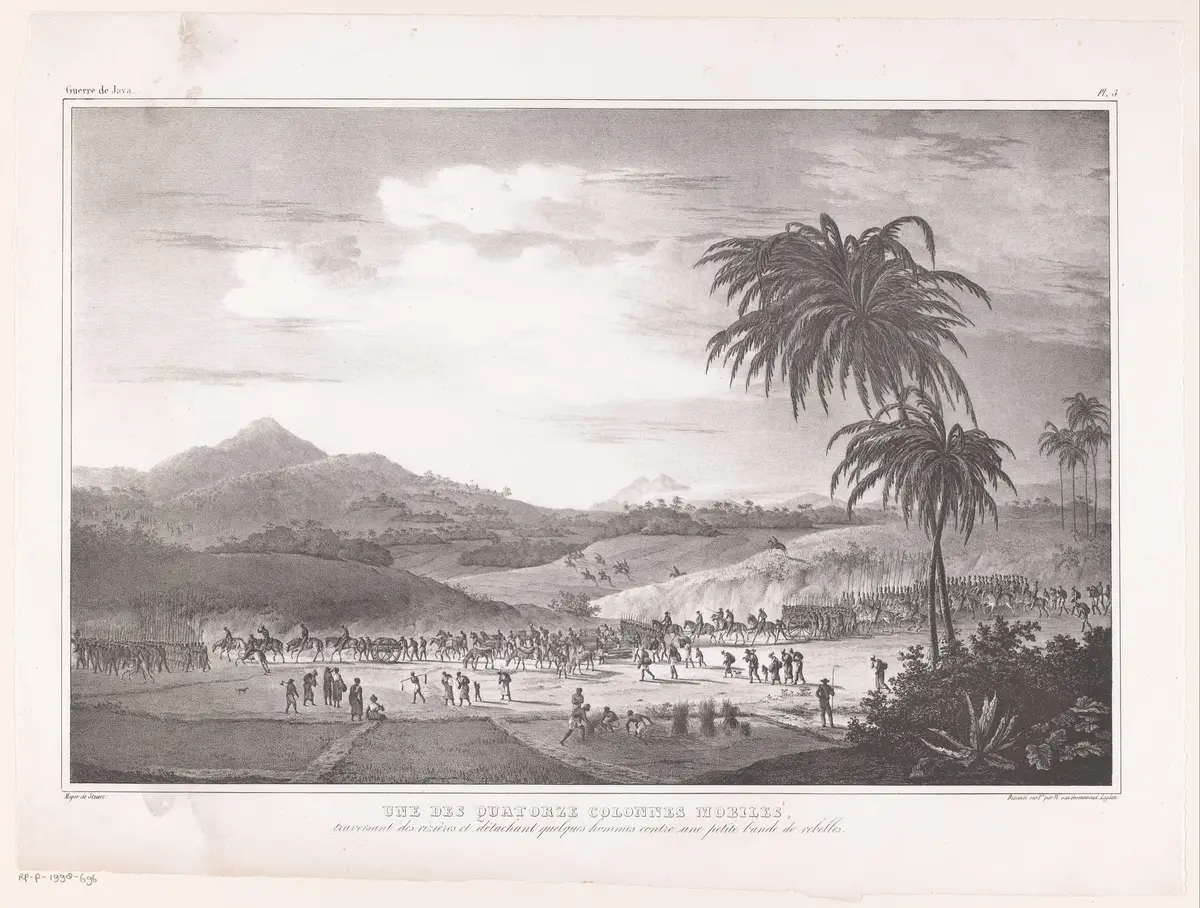
During the Java War his uncle, the regent of Semarang, and one of his cousins are arrested by the Dutch and sent into exile, because another cousin, Raden Sukur, has joined Diponegoro.
Semarang, on the north coast of Central Java: where he was born about 1811, into the family of the town's regents- 1827
Payen has left Java (1826); Raden Saleh stays behind in government service, probably in the residency office of the Priangan regencies at Cianjur, where the young scholar Carl Gericke meets him.
- 1829
The government sends him from Batavia to the Netherlands to study painting, for a stay meant to last two years; it is extended again and again, and he does not see Java for more than twenty years.
- 1830
When Diponegoro is arrested at Magelang on 28 March 1830, Raden Saleh is already a pupil of the portrait painter Cornelis Kruseman in The Hague; he also studies landscape with Andreas Schelfhout. De Kock himself, back in Holland at the end of 1830, has his portrait painted by Kruseman.
The Mauritshuis in The Hague, home of the royal picture gallery and the Royal Cabinet of Rarities: his city of study and work from 1830 to 1839- 1831
Asked by the director of the king's Royal Cabinet of Rarities, then housed in the Mauritshuis, he writes a note on Diponegoro's captured kris, Kyai Nogo Siluman: 'Magician King of the Snakes, as far as such a grand name can be translated'.
The Mauritshuis in The Hague, home of the royal picture gallery and the Royal Cabinet of Rarities: his city of study and work from 1830 to 1839- 1832
He paints the family of his patron Jean Chrétien Baud, twelve people and a dog, in their country house at Voorburg.
The Mauritshuis in The Hague, home of the royal picture gallery and the Royal Cabinet of Rarities: his city of study and work from 1830 to 1839 - 1836
He signs his portrait of the former governor-general Johannes van den Bosch, commissioned for the gallery of governors-general in Batavia. Around these years the animal trainer Henri Martin, touring the Netherlands with his lions and tigers, lets him study the animals, and he begins to paint lions in combat.
The Mauritshuis in The Hague, home of the royal picture gallery and the Royal Cabinet of Rarities: his city of study and work from 1830 to 1839 - 1839
After some weeks in Dusseldorf, Frankfurt and Berlin, he arrives in Dresden, the cultural capital of the German lands. The Norwegian romantic painter J. C. Dahl becomes his teacher and takes him out into the Elbe valley to paint from nature.
Dresden: his home and workplace from September 1839 to 1849, with long stays in Coburg, Maxen and Paris- 1840
At the Dresden Academy exhibition his lion hunt and a storm at sea draw attention; his portrait by Professor Schreuel hangs above the seascape. A German art journal praises his 'lion and tiger hunts'.
Dresden: his home and workplace from September 1839 to 1849, with long stays in Coburg, Maxen and Paris - 1841
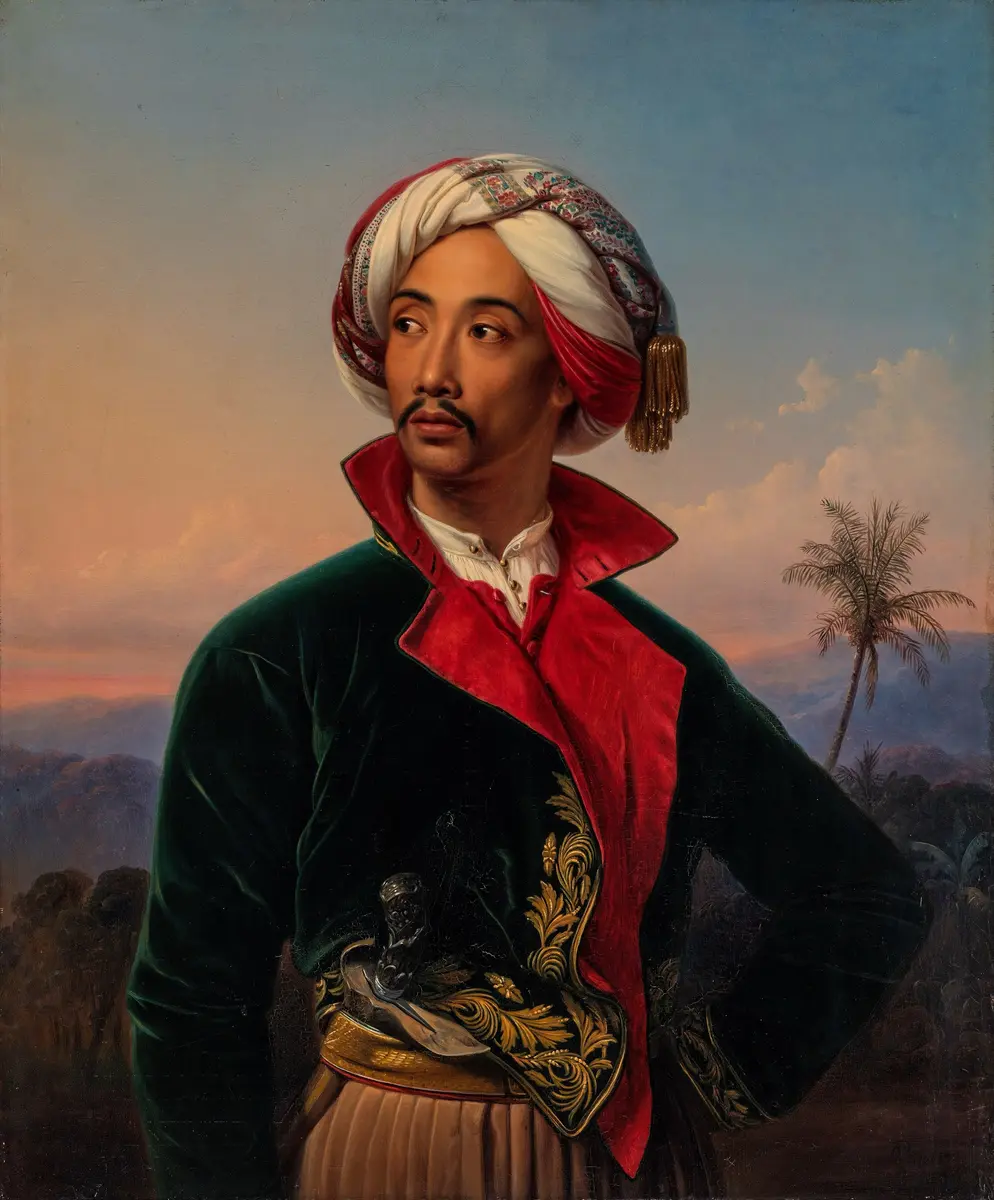
He paints 'The Lion Hunt', now in Riga, and Karl Johann Bähr portrays him in turban and velvet as the 'Javanese prince' Dresden society has made of him.
Dresden: his home and workplace from September 1839 to 1849, with long stays in Coburg, Maxen and Paris - 1845
In the summer he is a guest of his friend Duke Ernst II of Saxe-Coburg and Gotha when Queen Victoria visits Coburg; one of her ladies-in-waiting writes scornfully of the 'Java Prince' in Turkish dress.
Now living in Paris, he visits Horace Vernet's studio, where Vernet is working on his huge battle of Isly; Raden Saleh works for a while in Vernet's studio at Versailles but never travels with him to Algeria.
- 1847
King Louis-Philippe's household buys his 'Deer hunt on the island of Java', shown at that year's Salon, one of two paintings the king acquires.
In London he draws a tiger's head from life at the Surrey Zoological Gardens.
- 1848
His friends the Serres build an oriental-style garden pavilion, the 'Blue House', on their estate at Maxen near Dresden; Raden Saleh helps design it. In Paris he shows at the Salon of 1848, the year revolutions sweep Europe; his Dresden friends back the liberal cause.
- 1849
He paints 'Boschbrand' (Forest Fire), animals trapped by a burning forest, on a canvas three by four metres; it later belongs to the Dutch king's collection. Leaving Dresden, he gives his friends a 300-page illustrated memoir, lost when Maxen was looted in 1945.
- 1851
He boards the steamer Makassar for Java, with paints, brushes and prints, a barometer, a gun, a Turkish headdress, dictionaries and a French book on the revolution of 1848.
- 1852
Back in Java as the king's painter, he settles in Batavia with the rich widow Constancia Winckelhaagen, born von Mansfeldt, whom he marries; her money pays for the great neo-Gothic villa he designs at Cikini. In 1852 and 1853 he visits Magelang, where Diponegoro was arrested. To earn a living he paints portraits of officials, regents and Chinese and Armenian merchants, in a colony where, a friend warns him, only white faces count.
His villa at Cikini, Batavia (now Jakarta), begun in 1852, today part of the PGI Cikini hospital; his zoological garden lay beside it - 1857
Refused leave to sketch the battlefields of the Java War, he finishes 'The Arrest of Pangeran Diponegoro' from a sketch of 1856, calling it in a letter of 12 March 1857 'a historical tableau'. Diponegoro stands angry and upright on De Kock's level, the Dutch officers have oversized heads, and there is no Dutch flag. He gives it to King Willem III.
- 1860
He paints 'Javanese Temple in Ruins', one of the Javanese landscapes of his later years.
- 1862
He opens his house to show 'A Flood in Java', meant for King Willem III, and a view of Megamendung; hundreds of people come to see them, in a city with no museum, gallery or art dealer.
His villa at Cikini, Batavia (now Jakarta), begun in 1852, today part of the PGI Cikini hospital; his zoological garden lay beside it - 1864
The zoological and botanical garden laid out on his land at Cikini, the 'Planten- en Dierentuin', is named; it is later the site of the Taman Ismail Marzuki arts centre, and its animals end up at Ragunan Zoo.
His villa at Cikini, Batavia (now Jakarta), begun in 1852, today part of the PGI Cikini hospital; his zoological garden lay beside it - 1866
He travels to eastern Java to see a 'battlefield of the giants' and recognises its huge bones as fossils of ancient animals; his report later leads Eugène Dubois to search East Java, where he finds 'Java Man'.
- 1867
He marries his second wife, Raden Ayu Danudirdja, a young noblewoman.
- 1875
He goes back to Europe for three years with his wife, two of them as the guest of Duke Ernst II of Saxe-Coburg and Gotha.
- 1880
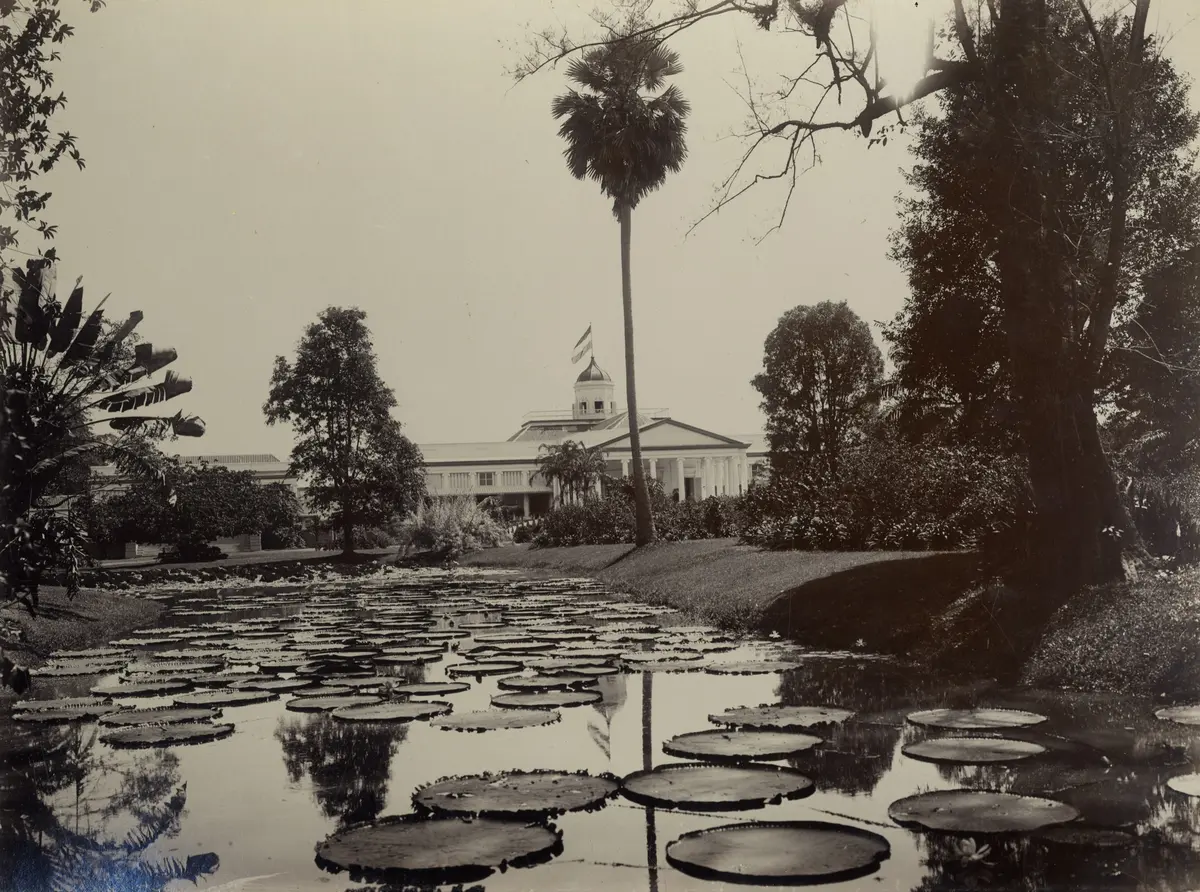
Raden Saleh dies at Buitenzorg (Bogor) and is buried in the kampong of Bondongan; in 1953 President Sukarno's government restores his neglected grave.
His grave at Bondongan, Bogor (Buitenzorg), the town where he died on 23 April 1880