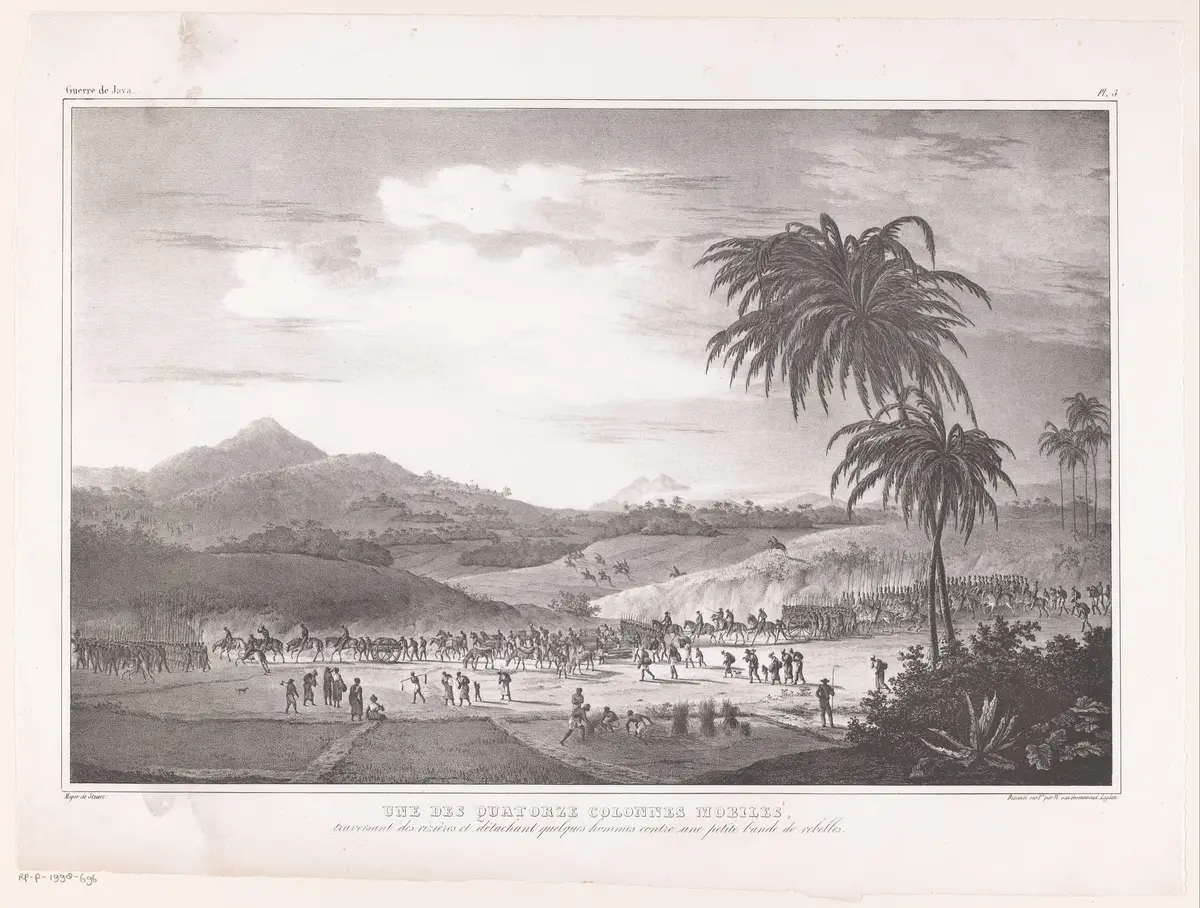
The Java War
“Prince Diponegoro's five-year rising against Dutch rule in central Java (1825–30), which ended when the Dutch seized him at peace talks; some 200,000 Javanese died.”
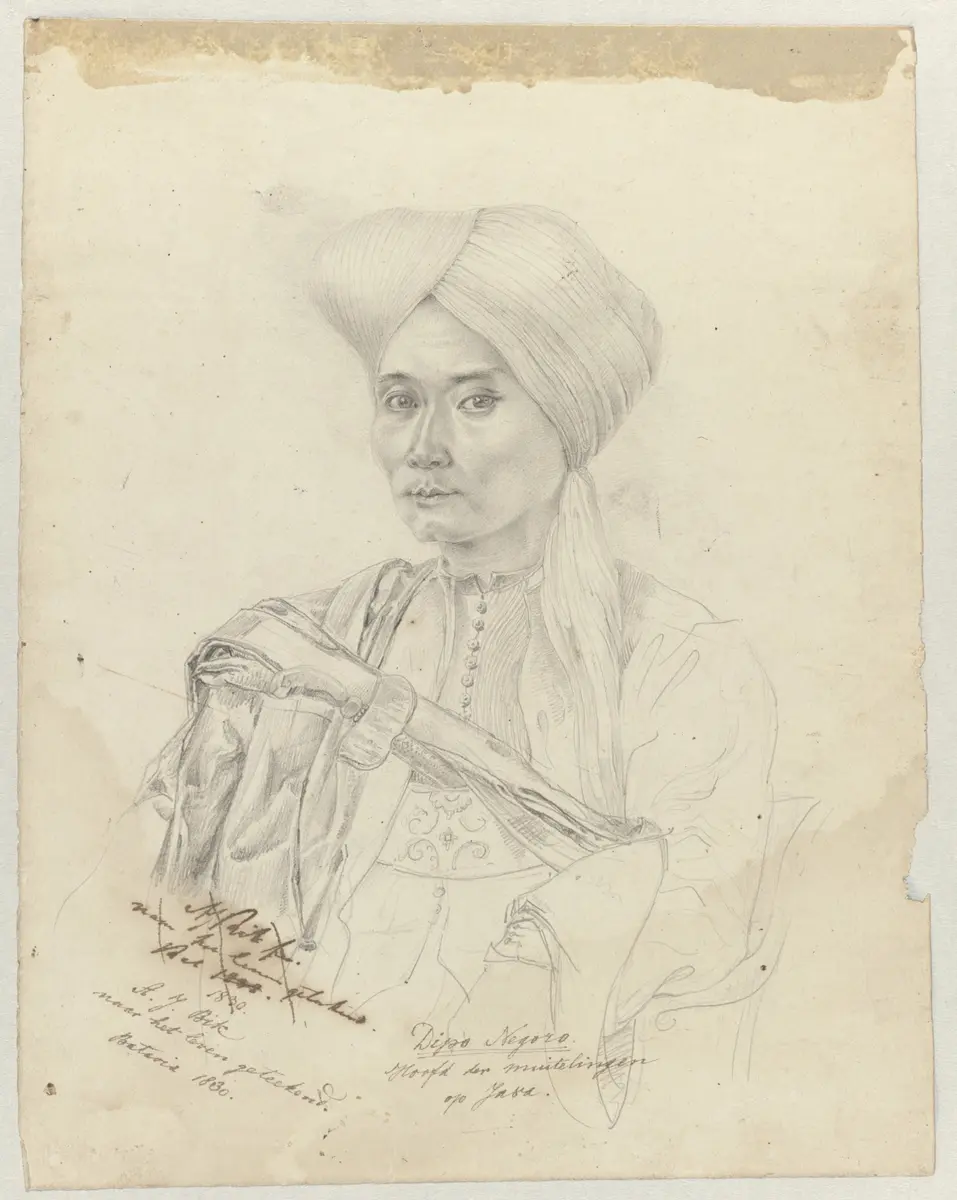
The Java War, which Indonesians call the Diponegoro War, was the great rising of central Java against Dutch rule, fought from July 1825 to March 1830. Its leader, Prince Diponegoro, the eldest son of the third sultan of Yogyakarta, was a devout Muslim who saw himself as the Ratu Adil, the Just King of Javanese prophecy, sent to restore Islam and the old order of Java. On 20 July 1825, after a quarrel over a road staked out across his land, a Dutch-led column came to his estate at Tegalrejo, west of Yogyakarta, to seize him. He escaped across the rice fields while his house burned, and the next day he and his uncle Mangkubumi raised their standard at Selarong, in the hills south of the city. Within weeks the countryside had risen and Yogyakarta was besieged until late September; before long the fighting reached from Bagelen in the west to Madiun and Rembang in the east.
The rising drew on many grievances. Diponegoro had been passed over for the throne and was at odds with the Dutch Resident and the chief minister who ran the court for a child sultan. In May 1823 Governor-General Van der Capellen had ordered that all land leased to European and Chinese planters in the princely states be handed back, which cost many nobles the rents they lived on and left them in disputes over compensating the planters. Peasants groaned under taxes and the tollgates on the roads, farmed out to Chinese collectors; Islamic teachers such as Kyai Maja hoped for a Muslim order; and talk of a coming Just King ran through the villages. Diponegoro gave his commanders Ottoman titles such as Ali Basah (Ali Pasha), and his war was at once a holy war and a defence of Javanese ways against the colonial state the Dutch had built since their return in 1816.
For two years the Dutch were outfought. Their army was small and wasted by disease: of 6,000 European infantry in central Java, more than a quarter were dead by April 1827. Diponegoro's bands moved fast, set ambushes and lived off the land. In June 1826 the Dutch needed 4,200 men to storm the ruined old palace at Plered, and that July and August his young commander Sentot won a run of victories that carried the war to the edge of Surakarta, until a defeat at Gawok on 15 October 1826, where the prince was twice hit, ended the advance. From 1827 General Hendrik Merkus de Kock answered with the benteng system: small forts of palm-trunk stockades, linked by roads, 258 of them by March 1830, from which eleven to fourteen mobile columns hunted the rebels while the villages around the forts were won back with lower taxes. In November 1828 the Islamic teacher Kyai Maja, who had fallen out with the prince, surrendered; in October 1829 Sentot followed, and Diponegoro, hemmed in between the Progo and Bogowonto rivers, was left wandering the forests with two servants.
The new governor-general, Johannes van den Bosch, landed in January 1830 with King William I's order that there be no bargaining, only surrender, but De Kock won leave to talk. Diponegoro came to Magelang on 8 March 1830 and spent the fasting month there as a guest. On 28 March, when he called on De Kock at the Resident's house at the end of the fast, he was arrested, an act De Kock himself called ignoble and dishonest, and sent into exile in Sulawesi, where he died in 1855. The cost was terrible: about 200,000 Javanese had died, two million, a third of the island's people, had suffered from the war, and a quarter of Java's farmland had been damaged. The Dutch lost 8,000 of their own soldiers and 7,000 Indonesian auxiliaries, and spent some 20 million guilders.
The war was the last stand of old Java. In 1830 the Dutch took the courts' outlying provinces, leaving Yogyakarta and Surakarta as small principalities, and their rule over the island went unchallenged for more than a century. To fill the empty treasury Van den Bosch brought in the Cultivation System, which made Javanese farmers grow export crops for the state and brought the Netherlands some 832 million guilders by 1877. Diponegoro's own chronicle of the war, dictated in exile, is on UNESCO's Memory of the World register; independent Indonesia made him a national hero, and his war, joining Javanese identity and Islam, is remembered as a forerunner of the national movement. Two paintings fix its end: Nicolaas Pieneman's 'submission', made for De Kock, and Raden Saleh's 'arrest' of 1857, in which the prince stands unbowed.
What happened
- 1825
In the afternoon a mixed Dutch and Javanese column, sent from Yogyakarta to seize Diponegoro and his uncle Mangkubumi, reaches Tegalrejo. After a hard skirmish the estate falls and is set on fire, but the princes escape through the western gate with most of their followers and ride off across the flooded rice fields.
Tegalrejo, west of Yogyakarta: Diponegoro's estate, attacked and burned by a Dutch-led column on 20 July 1825; the Sasana Wiratama monument museum stands on itDiponegoro and Mangkubumi reach Selarong, in the limestone hills south of Yogyakarta where the prince kept a cave for his retreats, and raise the standard of revolt. He comes as the Ratu Adil fighting a holy war, and nobles, Islamic teachers and peasants join him there.
Selarong, in the hills south-west of Yogyakarta: where Diponegoro raised his standard on 21 July 1825, his first headquarters until OctoberIn the east, forces led by Raden Ayu Yudakusuma, a noblewoman who becomes one of Diponegoro's cavalry commanders, attack the Chinese community of Ngawi. Across central Java the Chinese, hated as the farmers of the tollgates and taxes, are attacked in the first months of the war.
Ngawi, where the Solo and Madiun rivers meet: its Chinese community attacked on 17 September 1825The siege of Yogyakarta, where the Europeans and the sultan's court have been shut in since late July, is lifted by a heavily armed Dutch column from Surakarta, where the army commander Hendrik Merkus de Kock has his headquarters.
The kraton of Yogyakarta: the sultan's capital, besieged by Diponegoro's forces from late July to September 1825After three expeditions since July, Dutch and Javanese troops take Selarong and destroy the prince's meditation cave, Guwa Secang; he has already slipped away. The same month Colonel Frans David Cochius builds the first benteng, a small fort at Kalijengking on the road from Magelang to Yogyakarta.
Selarong, in the hills south-west of Yogyakarta: where Diponegoro raised his standard on 21 July 1825, his first headquarters until OctoberDiponegoro moves his headquarters across the Progo to Dekso, where it stays until August 1826, and splits his army into fast-moving battle groups that roam the countryside almost unchecked through the rainy season.
Dekso in Kulon Progo: Diponegoro's headquarters from November 1825 to August 1826- 1826
Colonel Cochius brings 4,200 men against the crumbling walls of Plered, the old palace of Mataram, where some 400 of Diponegoro's troops hold out. The kraton is stormed and all but forty of its defenders are killed.
Plered: the ruined old palace of Mataram, stormed by the Dutch on 9 June 1826At Lengkong, Diponegoro's forces under the eighteen-year-old Sentot win a battle in which the flower of the Yogyakarta nobility dies. It is one of a run of victories, from Kasuran on 28 July to Delanggu on 28 August, that carries the war to the outskirts of Surakarta by October.
Hoping to win back the Javanese, the Dutch restore the old sultan Hamengkubuwono II, whom the British had exiled in 1812, in a hurried ceremony at Bogor presided over by Commissioner-General Du Bus de Gisignies. The 76-year-old returns to Yogyakarta on 20 September, but his return does not draw the princes away from Diponegoro.
Quarrelling with Kyai Maja over tactics, Diponegoro is defeated at Gawok, west of Surakarta, and hit twice, in the chest and the hand; his followers believe the bullets left no mark. The defeat ends his great offensive, though his forces hold much of the countryside for another year.
Gawok, west of Surakarta: Diponegoro's defeat of 15 October 1826- 1827
The Dutch put De Kock's new strategy into practice: forts (benteng) of palm-trunk stockades on hilltops, built wherever a district is taken back and linked by roads, from which mobile columns of some 500 men hunt the rebels, while villagers near the forts are offered lower taxes and free ploughs and seed. The same month the first reinforcements from the Netherlands arrive, and Du Bus lifts the ban of 1823 on leasing land in the princely states.
Peace talks at Salatiga, opened in August by Kyai Maja and the Scottish land-renter William Stavers, bring Du Bus to central Java in person. They fail, and so does his appeal of 26 September for a popular rising against Diponegoro.
Salatiga: the failed peace talks of September 1827; Kyai Maja was drawn here as a prisoner in December 1828Diponegoro's brother-in-law Raden Aria Sasradilaga rises in Rembang on the north coast. Until his defeat in March 1828 the government's road between Semarang and Surabaya is cut for weeks.
- 1828
Sentot destroys Major Buschkens's 8th mobile column at Kroya in eastern Bagelen, but the tide is turning: the forts are closing round the prince's last country between the Progo and Bogowonto rivers.
Kyai Maja, the Islamic teacher who had been the prince's chief religious ally until they fell out over the kingdom Diponegoro was building, is cornered on the slopes of Mount Merapi by Lieutenant-Colonel Le Bron de Vexela's column and surrenders with several hundred men. He will die in exile at Tondano in North Sulawesi.
- 1829
With an elite force of about 800 men under Sentot, short of food and watched by seven mobile columns, Diponegoro slips across the Progo below Gamplong by night. For three weeks he marches as far as the outskirts of Yogyakarta and is caught and scattered ten times, his men living on fruit and roots.
Diponegoro's uncle and adviser Pangeran Ngabehi and two of his sons are killed in the Kelir mountains on the Bagelen-Mataram border. That day De Kock offers 20,000 guilders for the prince, dead or alive. By the end of September organized resistance in the rice plains is over.
Sentot, now twenty-one, surrenders on good terms: he keeps a troop of 500 men paid by the government and later fights for the Dutch in Sumatra, before he is exiled to Bengkulu.
Nearly caught by Major Michiels's 11th mobile column in the Gowong mountains west of Kedu, Diponegoro leaps into a ravine and hides in tall grass, losing his horses, his holy pike Kyai Rondan and his clothes for the holy war. For three months he wanders the forests of western Bagelen, sick with malaria, with only two retainers.
- 1830
The new governor-general, Johannes van den Bosch, lands at Batavia with King William I's order: no more negotiations, only unconditional surrender. De Kock hurries to Batavia at the end of the month and wins his grudging leave to talk.
Diponegoro rides down from his mountain camp to meet Colonel Jan Baptist Cleerens at Remakamal in western Bagelen. The meeting goes well, and he agrees to wait at Menoreh, where a Dutch army doctor treats his malaria, until De Kock is back from Batavia.
Diponegoro rides into Magelang with several hundred armed followers. De Kock receives him, promises to leave him in peace during the fasting month, and lodges him in a camp prepared for him at Metesih.
The Kedu Residency house, Magelang: where De Kock received Diponegoro on 8 March 1830 and arrested him on 28 March; the Diponegoro museum is in it todayOn the Sunday after the fast Diponegoro calls on De Kock at the Kedu Resident's house. When he insists that he will be sultan and head of Islam in Java, De Kock has troops surround the house and arrests him, though he had come under a promise of safe conduct; his followers are disarmed and the Resident's carriage takes him away towards Semarang and exile. The war is over. De Kock himself later called the act ignoble and dishonest.
The Kedu Residency house, Magelang: where De Kock received Diponegoro on 8 March 1830 and arrested him on 28 March; the Diponegoro museum is in it today