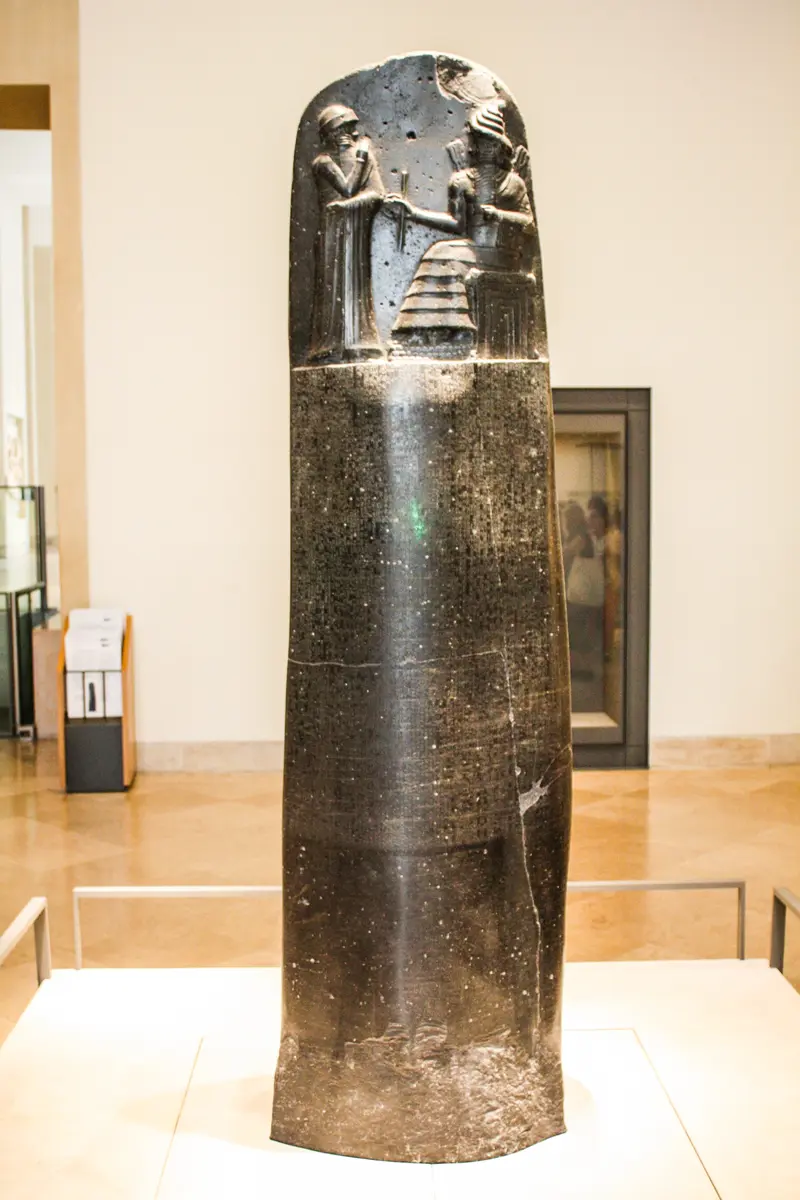
Code of Hammurabi
“Hammurabi of Babylon, about 1750 BCE, has some 280 laws carved on a stele under an image of the sun god: 'an eye for an eye', the longest law text of the ancient world, found at Susa in 1901 and now in the Louvre.”
Hammurabi was king of Babylon from about 1792 to 1750 BCE, the sixth of an Amorite dynasty that had ruled a middling city on the Euphrates for a century. For thirty years he built walls and canals and watched the balance between Larsa, Eshnunna, Mari and Ashur; then, in the last fourteen years of his reign, he beat them one by one, Larsa in 1763, Mari in 1761, Eshnunna in 1755, and made Babylon the capital of all Mesopotamia for the first time since Sargon of Akkad. Near the end of that reign he had his legal decisions, some 280 of them, carved on a black stone stele more than two metres high and set up in the temple of Marduk in Babylon.
The stone shows the king standing before Shamash, god of the sun and of justice, who hands him the ring and staff of rule. Below it the laws run in some 4,000 lines of cuneiform, each an 'if ... then' case: if a man accuses another without proof, if a builder's house falls and kills its owner, if a surgeon's knife kills a patient, if a wife is caught with another man. Prices, wages, rents, the hire of oxen and boats, marriage, dowries, adoption, debt and slavery are all there, and punishments differ by the rank of the victim and the offender: a free man, a commoner, a slave. The best-known lines, 'if a man puts out the eye of another man, his eye shall be put out', and the same for bones and teeth, are the principle later called 'an eye for an eye'. The prologue lists the cities the king had restored; the epilogue says he set up the stone so that the strong should not harm the weak and any wronged man might come and read his case, and curses the king who alters it.
It was not the first law code. Ur-Nammu of Ur had issued one about 2100 BCE, Lipit-Ishtar of Isin another around 1930, and Eshnunna had laws of its own, all of the same shape, but Hammurabi's is by far the longest and the best preserved, and scribes copied it in school for more than a thousand years. Oddly, no surviving court record quotes it. Many historians now read the stele as a monument to a just king rather than a statute book: a picture of the justice Hammurabi's judges were expected to give, not a text they looked up. Its likeness to the laws of Moses, once taken as proof of borrowing, is now seen as a shared inheritance of the ancient Near East.
The Louvre's stele was probably set up at Sippar, Shamash's city. About 1155 BCE the Elamite king Shutruk-Nahhunte raided Babylonia and carried it to his capital Susa with other trophies, among them the victory stele of Naram-Sin, on which he carved his own boast; the lower columns of Hammurabi's stone were ground away, perhaps for an inscription that was never cut. There, on the acropolis of Susa, Jacques de Morgan's French expedition dug it up in three pieces in December 1901 and January 1902, and the Assyriologist Jean-Vincent Scheil read, translated and published the whole text within the year. It went to the Louvre, where it still stands, the longest and most famous legal text of the ancient world.
What happened
- 1792 BCE
Hammurabi, still young, succeeds his father Sin-muballit as the sixth king of the Amorite dynasty of Babylon, then one of several middling kingdoms on the Euphrates. In the same year Rim-Sin of Larsa, ruler of the whole south, takes Isin, the buffer between Larsa and Babylon, and becomes Hammurabi's chief rival.
Babylon: Hammurabi's capital, where the stele stood in Esagila, the temple of Marduk - 1787 BCE
Hammurabi takes Uruk and Isin from Rim-Sin, following his father's policy of controlling the Euphrates waters on which Larsa, downstream, depended; he clashes with Rim-Sin again the next year.
Isin: the city of Lipit-Ishtar's laws, taken by Hammurabi in 1787 BCE - 1784 BCE
He turns his arms north-west and east instead, and for almost twenty years no great war is recorded: Mari, Ashur, Eshnunna, Babylon and Larsa shift between coalitions. A diplomat reports that no king is powerful by himself: ten or fifteen kings follow Hammurabi 'the man of Babylon', as many follow Rim-Sin, and twenty follow the man of Eshnunna.
Mari (Tell Hariri): Zimri-Lim's palace, attacked in 1761 BCE and razed soon after - 1776 BCE
Hammurabi begins eight years of fortifying cities on his northern border (1776–1768 BCE), the quiet work of walls, canals and temples that his year-names mostly record.
Babylon: Hammurabi's capital, where the stele stood in Esagila, the temple of Marduk - 1764 BCE
A coalition of Ashur, Eshnunna and Elam, the powers east of the Tigris that could block his road to the metals of Iran, is defeated. Livius adds that Hammurabi annexed Elam, that is Susa, the city that would one day hold his stele.
Eshnunna (Tell Asmar): the rival kingdom east of the Tigris, with laws of its own, destroyed in 1757–1755 BCE - 1763 BCE
Hammurabi moves against Rim-Sin, apparently damming the river to flood or starve the south as his father had tried; Larsa, Rim-Sin's last stronghold, falls after a siege of several months, and the whole of southern Babylonia is his.
Larsa: Rim-Sin's capital, taken after a siege of months in 1763 BCE - 1762 BCE
At Larsa a high official, Lu-Nanna, dedicates a kneeling copper figure with a gilded face to the god Amurru 'for the life of Hammurabi, king of Babylon': the new master's name already on the altars of the conquered city.
Larsa: Rim-Sin's capital, taken after a siege of months in 1763 BCEFighting with the eastern powers again, whether as his own move or theirs after the balance of power shifted.
Eshnunna (Tell Asmar): the rival kingdom east of the Tigris, with laws of its own, destroyed in 1757–1755 BCE- 1761 BCE
Hammurabi turns on his long-time ally Zimri-Lim of Mari, 400 kilometres up the Euphrates, perhaps over water, perhaps for Mari's place on the overland trade routes; the palace with its wall paintings and its archive of letters is taken, and razed a few years later.
Mari (Tell Hariri): Zimri-Lim's palace, attacked in 1761 BCE and razed soon after - 1760 BCE
He rebuilds the western branch of the Euphrates as a canal to resettle the people uprooted by the war with Larsa. His letters to Sin-iddinam, his governor at Larsa, about boatmen, canals and law cases show him handling the details of government himself.
Larsa: Rim-Sin's capital, taken after a siege of months in 1763 BCE - 1757 BCE
A third campaign eastward begins (1757–1755 BCE).
Eshnunna (Tell Asmar): the rival kingdom east of the Tigris, with laws of its own, destroyed in 1757–1755 BCE - 1755 BCE
Eshnunna is destroyed, again by damming the waters. Britannica calls it a pyrrhic victory: the buffer between Babylonia and the peoples of the east, among them the Kassites who would rule Babylon 160 years later, was gone.
Eshnunna (Tell Asmar): the rival kingdom east of the Tigris, with laws of its own, destroyed in 1757–1755 BCEThe text of the laws is drafted: a clay tablet in the Louvre carries the prologue in a version whose list of cities leaves out some Hammurabi annexed late, so the Louvre takes it to be older than the stele. The year is a guess within 'the end of the reign'.
Babylon: Hammurabi's capital, where the stele stood in Esagila, the temple of MardukHammurabi's legal decisions, collected toward the end of his reign, are carved on a basalt stele crowned by the king before Shamash and set up in Esagila, Marduk's temple in Babylon, 'that the strong might not injure the weak', so that anyone with a case can come and read it; copies on other steles and on clay follow. The year is approximate.
Babylon: Hammurabi's capital, where the stele stood in Esagila, the temple of Marduk- 1752 BCE
His last two years go to building defences; he is a sick man and his son Samsu-iluna already carries the burden of government.
Babylon: Hammurabi's capital, where the stele stood in Esagila, the temple of Marduk - 1750 BCE
Hammurabi dies, about 1750 BCE, and Samsu-iluna succeeds him; within a generation much of the south is lost again, though Babylon stays the first city of Mesopotamia for more than a thousand years.
Babylon: Hammurabi's capital, where the stele stood in Esagila, the temple of Marduk