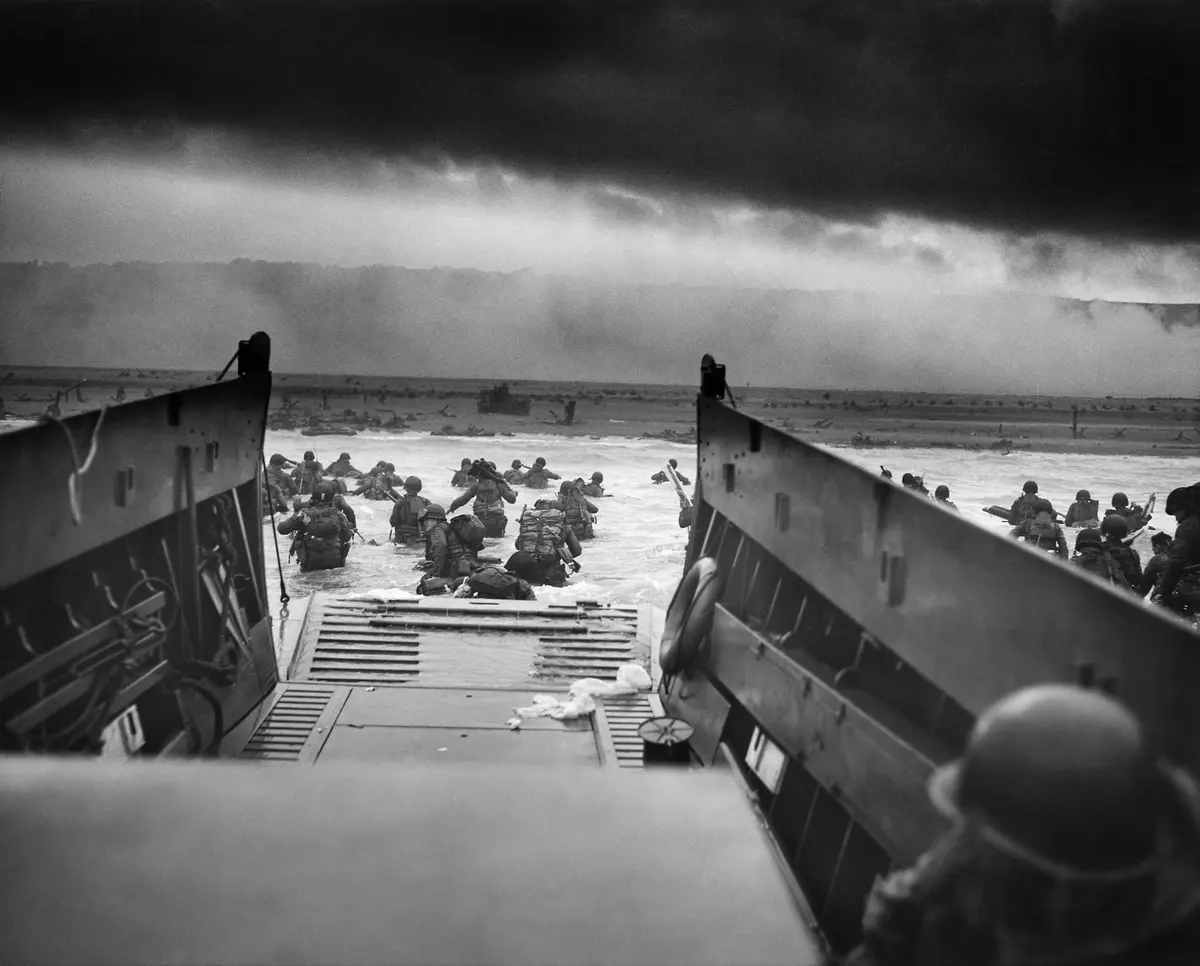
D-Day
“On 6 June 1944, D-Day, about 156,000 American, British and Canadian troops landed in Normandy by sea and air, the largest seaborne invasion in history, opening the second front that freed Western Europe.”
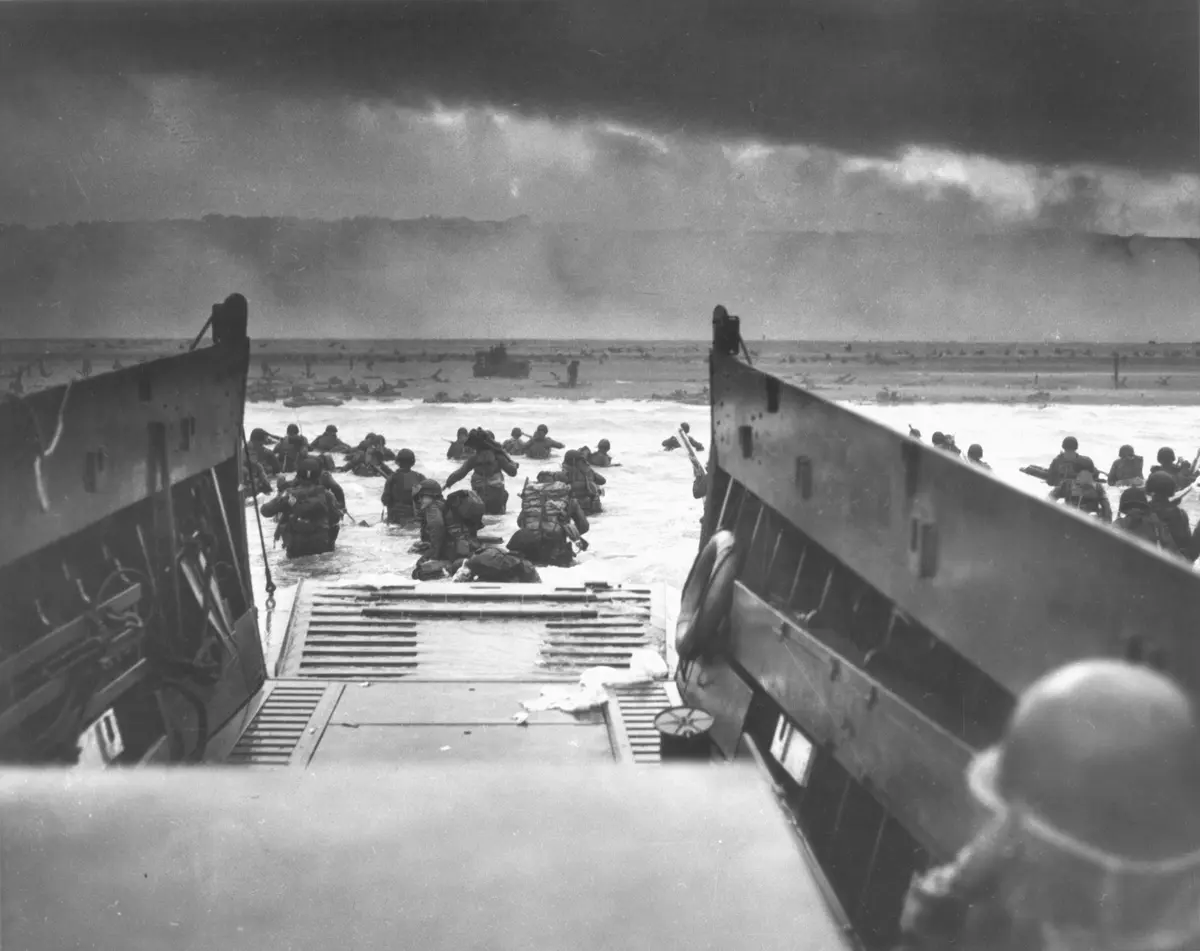
D-Day was the first day of the Allied invasion of German-occupied France, on 6 June 1944, and the largest seaborne invasion in history. Shortly after midnight three airborne divisions, the American 82nd and 101st and the British 6th, came down by parachute and glider behind the coast of Normandy to seize bridges, crossroads and causeways and to guard both ends of the landing zone; at 00:16 British glider troops took the bridges over the Caen Canal and the River Orne, today's Pegasus Bridge, within minutes. At first light a fleet of almost 7,000 warships, transports and landing craft lay offshore, and from 6:30 in the morning American, British and Canadian troops landed on five beaches code-named Utah, Omaha, Gold, Juno and Sword, between the Cotentin peninsula and the mouth of the Orne. By midnight about 156,000 men had come ashore by sea and by air.
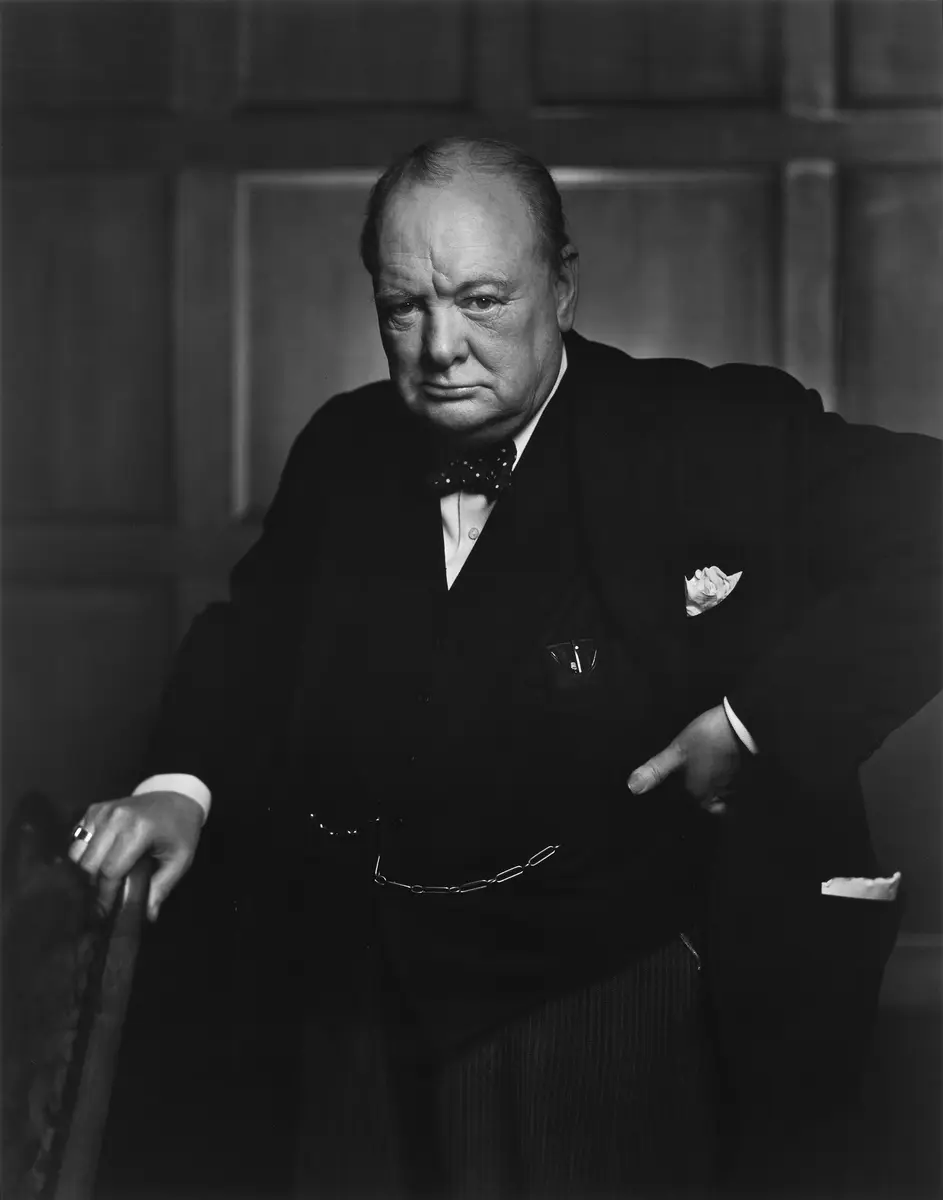
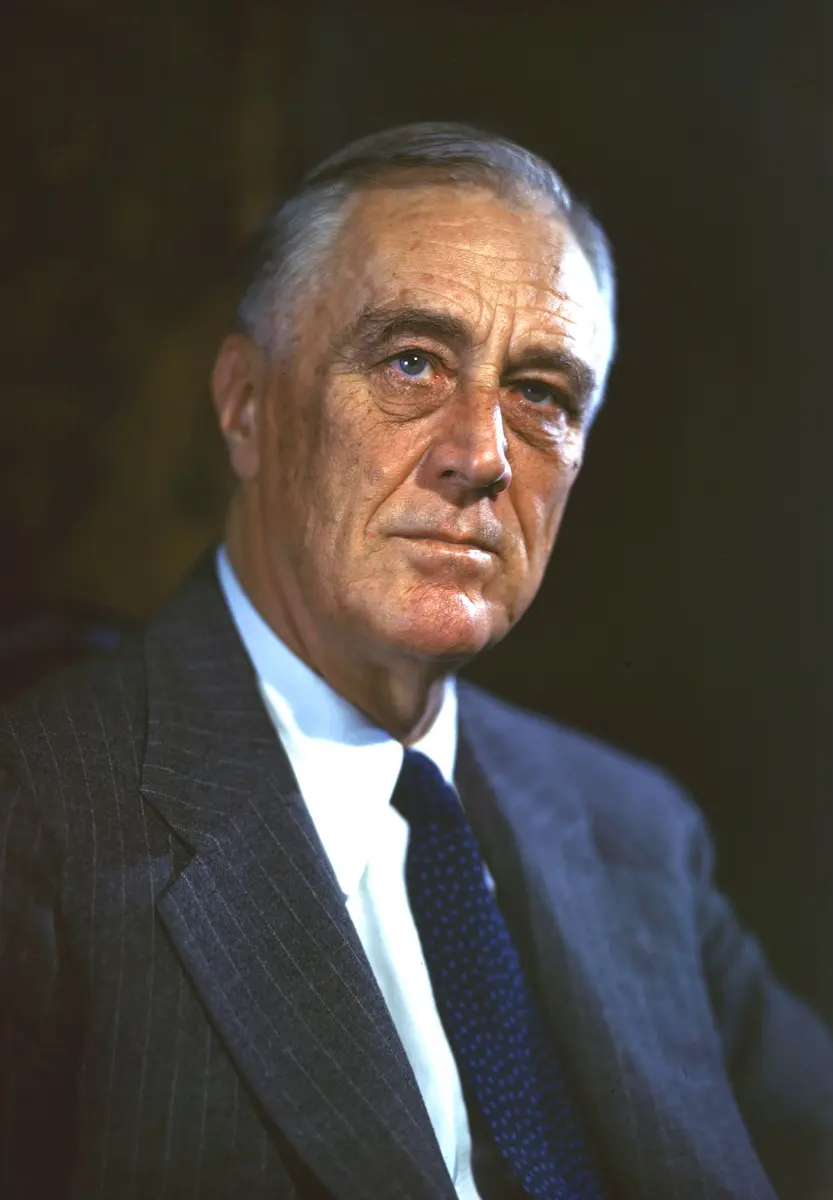
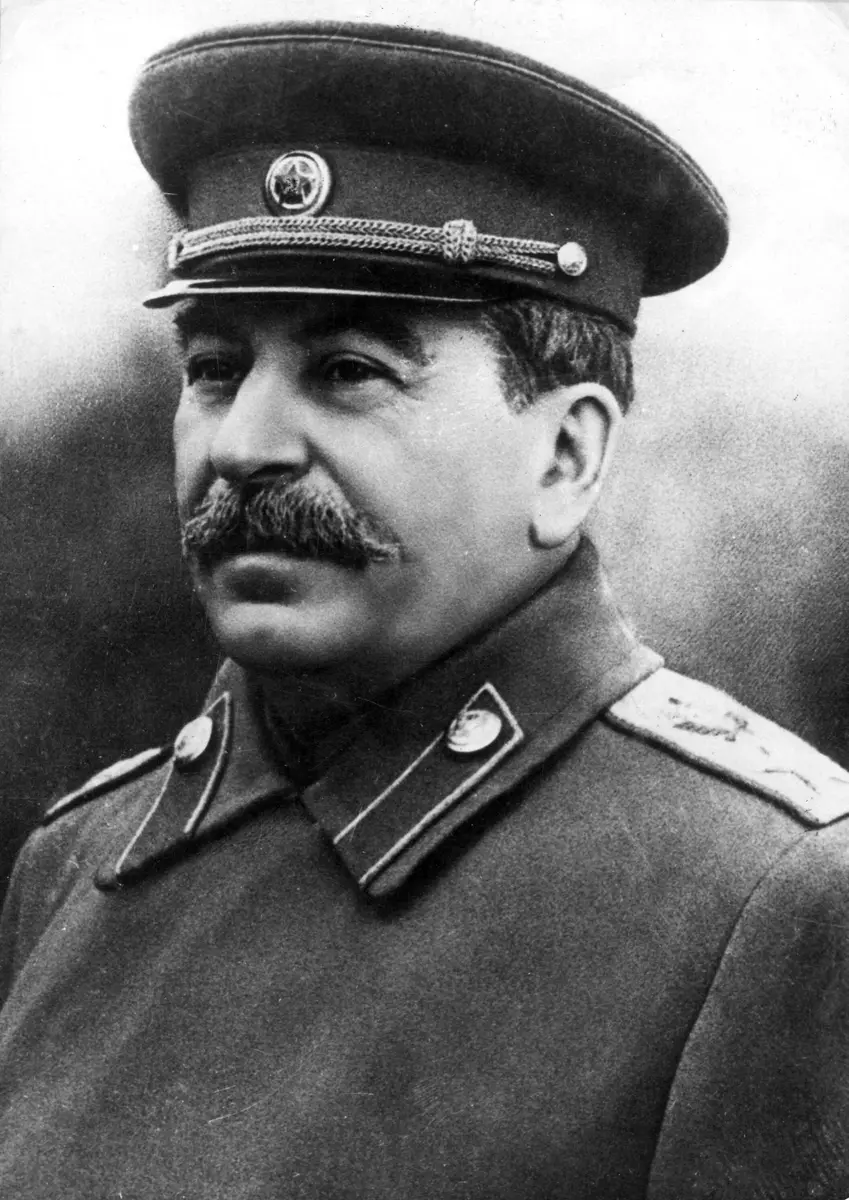
The landing was the 'second front' that Stalin had demanded since 1942 to take German pressure off the Red Army. The Americans wanted to cross the Channel early; the British, who remembered the slaughter in the trenches of the First World War and had seen a raid on Dieppe fail in 1942, preferred to fight first in North Africa and Italy, until at Tehran in late 1943 Roosevelt and Stalin pressed Churchill into accepting May 1944. General Dwight D. Eisenhower became supreme commander, with General Bernard Montgomery in command of the land forces. The planners chose Normandy over the Pas-de-Calais, the shortest crossing, because it was less heavily fortified, and a deception plan with a dummy army in eastern England kept the Germans expecting the main blow at Calais. Storms forced a day's delay: early on 5 June, at Southwick House near Portsmouth, Eisenhower trusted his weathermen's forecast of a short break and ordered the invasion for the next morning, then wrote a note taking all the blame should it fail.
The day went very differently on each beach. At Utah the current carried the 4th Infantry Division to a lightly held stretch of sand, and it got ashore with few losses. At Omaha the bombs fell too far inland, many of the amphibious tanks sank in the rough sea, and a strong German division in bunkers on the bluffs pinned the first waves at the water's edge; for a time General Bradley thought of giving the beach up, until small groups led by junior officers and sergeants fought their way to the top. Rangers climbed the cliffs of Pointe du Hoc, and the British and Canadians fought through fortified seaside villages on Gold, Juno and Sword, where a German armoured counter-attack briefly reached the sea. The German reaction was slow: Rommel, who commanded on the coast, was at home in Germany for his wife's birthday, and the reserve panzer divisions could not move without Hitler's approval, which came only after midday. Some 10,000 Allied soldiers, sailors and airmen were killed, wounded or missing; the National D-Day Memorial has named 4,436 who died that day. Caen, the main British objective, held out for weeks, but by the end of 11 June more than 326,000 men had landed, and on 12 June, with the capture of Carentan, the five beachheads joined into a single front.
D-Day opened the Battle of Normandy, which ended in August with the German armies in France broken and Paris free on 25 August. Caught between the Western Allies and the Red Army, Germany surrendered eleven months after the landing. Stalin, who had waited two years for the second front, sent Roosevelt a signed portrait dated 6 June 1944 'in memory of the day of the invasion of northern France'. The name D-Day, army jargon for the first day of any operation, has come to mean this one day above all. Its traces are still there: the concrete of the Mulberry harbour off Arromanches, the bomb craters of Pointe du Hoc, and the Normandy American Cemetery above Omaha Beach with 9,389 graves; in July 2026 UNESCO made the landing beaches a World Heritage Site.
What happened
- 1944
In the quiet after the decision Eisenhower writes a short press statement in pencil, to be used if the landings fail, and keeps it in his wallet: 'If any blame or fault attaches to the attempt it is mine alone.' In his haste he dates it 'July 5'; a month later he finds it and an aide persuades him to keep it.
In the evening Eisenhower drives to Greenham Common near Newbury to see the paratroopers of the 101st Airborne Division before they take off, among them Company E of the 502nd Parachute Infantry; he expects up to 80 per cent losses among the airborne troops. Meanwhile the invasion fleet is already crossing the Channel.
Greenham Common airfield, near Newbury: where Eisenhower talked with the paratroopers of the 101st on the evening of 5 June- 4:15 a.m.
In the former library of Southwick House, Group Captain James Stagg, the chief weather forecaster, confirms that the storm will ease for about a day and a half. Montgomery, Admiral Ramsay and the air commander Leigh-Mallory say go, and at about 4:15 Eisenhower decides: the invasion, already put off once, will land on 6 June. Witnesses remember his words differently; in 1963 he recalled 'OK, we'll go'.
Southwick House, near Portsmouth: the Allied naval headquarters, in whose library Eisenhower decided early on 5 June to go - 10:15 p.m.
From seven airfields in England, 432 C-47 transport planes begin taking off with 6,600 paratroopers of the 101st Airborne Division; with the 82nd, more than 13,000 American paratroopers fly in about 925 aircraft, and the British 6th Airborne Division leaves for the eastern flank.
Greenham Common airfield, near Newbury: where Eisenhower talked with the paratroopers of the 101st on the evening of 5 June In the first hours of the day the American paratroopers jump into cloud and flak over the Cotentin peninsula. Most land far from their drop zones and many drown in the marshes the Germans had flooded; but the scattered landings also confuse the Germans, whose Seventh Army logs reports of paratroopers all over the area from 1:30 without knowing what they mean.
Eisenhower's Order of the Day, handed in print to the men of the invasion force and recorded for the radio, tells them: 'You are about to embark upon the Great Crusade ... The eyes of the world are upon you.'
With Omaha in crisis, General Omar Bradley considers moving the rest of his troops to Utah. Destroyers come in close to fire point-blank at the bunkers, and officers and sergeants such as Colonel George Taylor ('Two kinds of people are staying on this beach, the dead and those who are going to die') and General Norman Cota lead small groups up the bluffs; by midday they are on top, and by nightfall 34,000 men are ashore.
Omaha Beach: the bloodiest of the five beaches, where the US 1st and 29th Infantry Divisions landed at 06:30In London, Churchill tells the House of Commons that the first landings in force on the Continent have taken place, with 'upwards of 4,000 ships, together with several thousand smaller craft', massed airborne landings behind the enemy's lines and about 11,000 first-line aircraft.
On the night of 6 June, Washington time, President Roosevelt goes on national radio and leads Americans in a prayer for the troops: 'Our sons, pride of our Nation, this day have set upon a mighty endeavor.' The evening before he had spoken of the fall of Rome without a word about the fleet already at sea.
- 12:16 a.m.
Horsa gliders carrying D Company of the 2nd Oxfordshire and Buckinghamshire Light Infantry with a party of sappers, 181 men under Major John Howard, land beside the bridges over the Caen Canal and the River Orne. Taking the Germans by surprise, they capture both bridges intact within minutes; the canal bridge is later named Pegasus Bridge after the airborne forces' winged-horse badge.
Pegasus Bridge over the Caen Canal at Bénouville: taken by British glider troops at 00:16 on 6 June - 4:00 a.m.
Field Marshal von Rundstedt, the German commander in the west, orders two panzer divisions towards Caen, but the high command holds them back until Hitler, who is asleep and does not like to be woken, agrees. Rommel, who commands on the coast, is at home in Germany for his wife's birthday. The armour is released only after midday.
- 4:30 a.m.
The 3rd Battalion of the 505th Parachute Infantry, 82nd Airborne Division, under Lieutenant Colonel Edward Krause, occupies Sainte-Mère-Église and raises over it the American flag it had raised over Naples; the men cut the main German communications cable to Cherbourg, and by 9:30 the whole town is cleared.
Sainte-Mère-Église: the crossroads town occupied by American paratroopers by 04:30 on 6 June - 5:50 a.m.
At first light the horizon off Normandy is filled with ships. Battleships, cruisers and destroyers open fire on the German batteries and strongpoints (at about 5:30 off the British beaches, at 5:50 off Omaha), while heavy bombers attack the coast.
- 6:30 a.m.
On Utah Beach the first troops of the US 4th Infantry Division land on time, but the current has carried them at least 1,500 yards south of their sector, to a stretch that is more lightly defended. Brigadier General Theodore Roosevelt Jr., who has landed with the first wave, decides to bring the rest in there. Within three hours the defenders give up; by night 23,000 men are ashore.
Utah Beach: the western beach, where the US 4th Infantry Division landed at 06:30 - 6:30 a.m.
On Omaha Beach the US 1st and 29th Infantry Divisions land into disaster. High seas swamp landing craft, many amphibious tanks sink, the bombs have fallen too far inland, and a strong German division in bunkers on the bluffs sweeps the open sand; perhaps only a third of the first wave reaches dry land, and survivors shelter behind a low sea wall while the tide rises.
Omaha Beach: the bloodiest of the five beaches, where the US 1st and 29th Infantry Divisions landed at 06:30 - 7:10 a.m.
Forty minutes late, three companies of the 2nd Ranger Battalion under Lieutenant Colonel James Rudder land below the cliffs of Pointe du Hoc and climb them with ropes and ladders under fire; most are on top by 7:40. The big guns have been moved from their emplacements, but by 9:30 the Rangers find them inland and destroy them.
Pointe du Hoc: the clifftop battery stormed by the US 2nd Ranger Battalion from 07:10 on 6 June - 7:25 a.m.
On Gold Beach the British 50th Division's engineers land first with their special tanks to clear obstacles and mines, and the infantry follows ten minutes later; the strongpoints in the seaside villages hold them up for hours, but by evening the division is several miles inland and has taken Arromanches.
Gold Beach: where the British 50th Division landed from 07:25 - 7:25 a.m.
On Sword Beach the British 3rd Division lands on a narrow front, its amphibious tanks arriving with the infantry; heavy fire from the strongpoint 'Cod' costs the first waves dearly before the troops get behind the defences and push inland towards Caen.
Sword Beach: the eastern beach, where the British 3rd Division landed at 07:25 - 7:50 a.m.
Delayed by rough seas, the 3rd Canadian Division lands on Juno Beach, at 7:50 on its western half and at 8:09 on its eastern half, some of its tanks arriving after the infantry. The Canadians take heavy losses crossing the beach and clearing Courseulles, Bernières and Saint-Aubin house by house.
Juno Beach: where the 3rd Canadian Division landed from 07:50 - 8:40 a.m.
Lord Lovat's 1st Special Service Brigade of commandos comes ashore on Sword, piped in by Lovat's piper Bill Millin, and sets off inland at speed to join the airborne troops holding the bridges.
Sword Beach: the eastern beach, where the British 3rd Division landed at 07:25 - 11:40 a.m.
The Canadian reserve brigade, the 9th, begins to land at Bernières, some battalions with bicycles; the beach is narrow at high tide and the few exits are jammed with vehicles, so the advance inland is slow, but by evening the leading Canadians are six miles from the sea.
Juno Beach: where the 3rd Canadian Division landed from 07:50 - 1:00 p.m.
Lovat's commandos reach Pegasus Bridge and cross over to the east to reinforce the 6th Airborne Division, which has held the bridges and the high ground beyond against German attacks since the night.
Pegasus Bridge over the Caen Canal at Bénouville: taken by British glider troops at 00:16 on 6 June - 4:00 p.m.
The 21st Panzer Division counter-attacks north from Caen. Stopped by British anti-tank guns, part of it drives into the gap between Sword and Juno and some tanks reach the coast; at about 9 p.m., as 248 gliders of the 6th Airlanding Brigade fly over to land behind them, the Germans pull back.
No. 47 (Royal Marine) Commando, which landed on Gold and fought its way west, captures the small port of Port-en-Bessin, closing the gap between the British beaches and Omaha.
Port-en-Bessin: the small port between Gold and Omaha, taken by 47 (Royal Marine) Commando on 7 JuneRangers from Omaha and troops of the 29th Infantry Division reach Pointe du Hoc; of Rudder's men, who have held the cliff top against counter-attacks for two days, only about 90 are still able to fight.
Pointe du Hoc: the clifftop battery stormed by the US 2nd Ranger Battalion from 07:10 on 6 JuneThe US First Army opens a temporary cemetery at Saint-Laurent, above Omaha Beach, the first American military cemetery on European soil in the war; it is the origin of today's Normandy American Cemetery at Colleville-sur-Mer.
Normandy American Cemetery, Colleville-sur-Mer: 9,389 graves on the bluff above Omaha BeachOff Arromanches and Omaha the outer breakwaters of sunken ships for the two artificial Mulberry harbours are in place. By the end of the day 326,547 men, 54,186 vehicles and over 100,000 tons of supplies have been landed in Normandy.
Arromanches: the remains of the British Mulberry harbour, 'Port Winston', off Gold BeachAfter a bitter fight, US troops capture Carentan, and the two American corps from Utah and Omaha join hands: for the first time all the Allied beachheads form one continuous front, its deepest point some 15 miles (25 km) inland, south-west of Bayeux.
Carentan: the town whose capture on 12 June joined the American beachheads into one frontChurchill crosses to Normandy with Field Marshal Brooke and visits Montgomery at his mobile headquarters behind the beaches.