Deep Blue beats Kasparov
“In May 1997 IBM's Deep Blue beat the world chess champion Garry Kasparov 3½–2½ in New York, the first match a reigning champion lost to a computer, searching up to 200 million positions a second.”
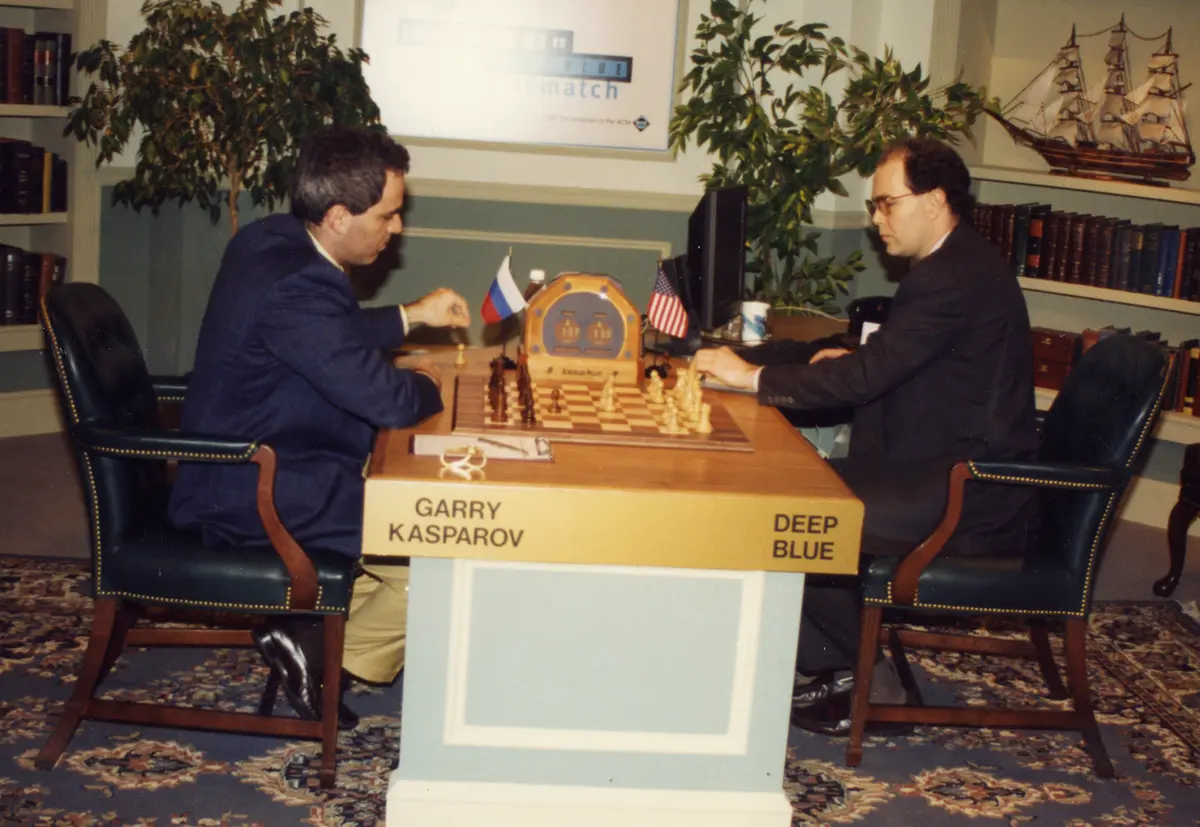
On 11 May 1997 Garry Kasparov, world chess champion since 1985 and the highest-rated player in the history of the game, stood up from the board after only 19 moves and resigned. His opponent was Deep Blue, a supercomputer built by IBM. The game was the last of a six-game rematch played in a small television studio at the Equitable Center in Midtown Manhattan, while an audience of about 500 watched on screens in a theatre several floors below and millions followed it on IBM's website. Deep Blue won the match by 3½ games to 2½: two wins, one loss and three draws. It was the first time a reigning world champion had lost a match to a computer under the normal time limits of tournament chess.
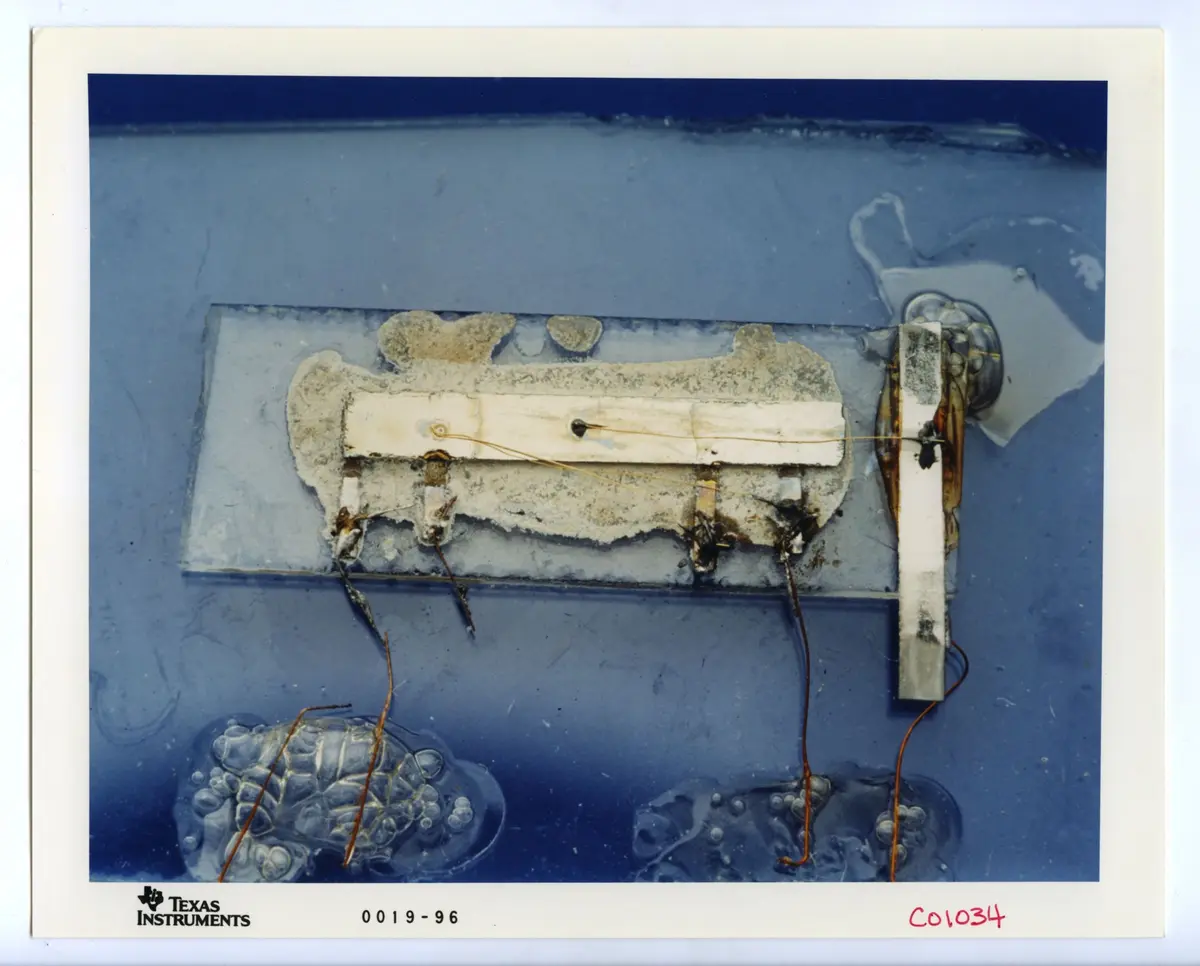
Chess had been the classic test of machine intelligence since the first computers: it has simple rules but an enormous number of possible games. Deep Blue grew out of a student project. In 1985 Feng-hsiung Hsu, a graduate student at Carnegie Mellon University in Pittsburgh, began building ChipTest, a chess machine whose move generator sat on a single custom chip. With Murray Campbell, Thomas Anantharaman and others he turned it into Deep Thought, which in 1988 became the first machine to beat a grandmaster in a tournament game and in 1989 won the World Computer Chess Championship. In 1989 IBM Research hired Hsu and Campbell to build a machine that could beat the world champion; that October Kasparov beat Deep Thought 2–0 in New York. Joe Hoane joined them in 1990, and the project took the name Deep Blue, after IBM's nickname, Big Blue.
Deep Blue was a team effort of hardware and chess knowledge, not a program that learned by itself. The 1997 machine was an IBM RS/6000 SP supercomputer with 30 processors in two tall black cabinets, connected to 480 chess chips designed by Hsu. Each chip held about 1.5 million transistors and could judge 2 to 2.5 million positions a second, so the whole system searched 100 to 200 million positions a second. Its judgement of a position added up some 8,000 features, from king safety to pawn structure, whose weights the team tuned with the help of the American grandmaster Joel Benjamin; it also used a library of grandmaster openings and databases of solved endgames.
The two men and the machine met twice. In February 1996, at the Pennsylvania Convention Center in Philadelphia, an earlier Deep Blue won the first game, the first game a computer had ever won against a reigning world champion at normal time controls, but Kasparov adapted and won the match 4–2. IBM doubled the machine's power for the rematch of 3 to 11 May 1997. Kasparov won the first game, but in the second the machine played so convincingly that he resigned a position which was later shown to be a draw, and he never recovered. Three draws followed, and in game six he let Deep Blue sacrifice a knight early in the opening and his position collapsed. Afterwards he hinted that humans might have helped the machine and asked to see its logs; IBM denied any help. Deep Blue never played again: IBM retired it to the Smithsonian Institution, and one of its two cabinets is now on show at the Computer History Museum in California.
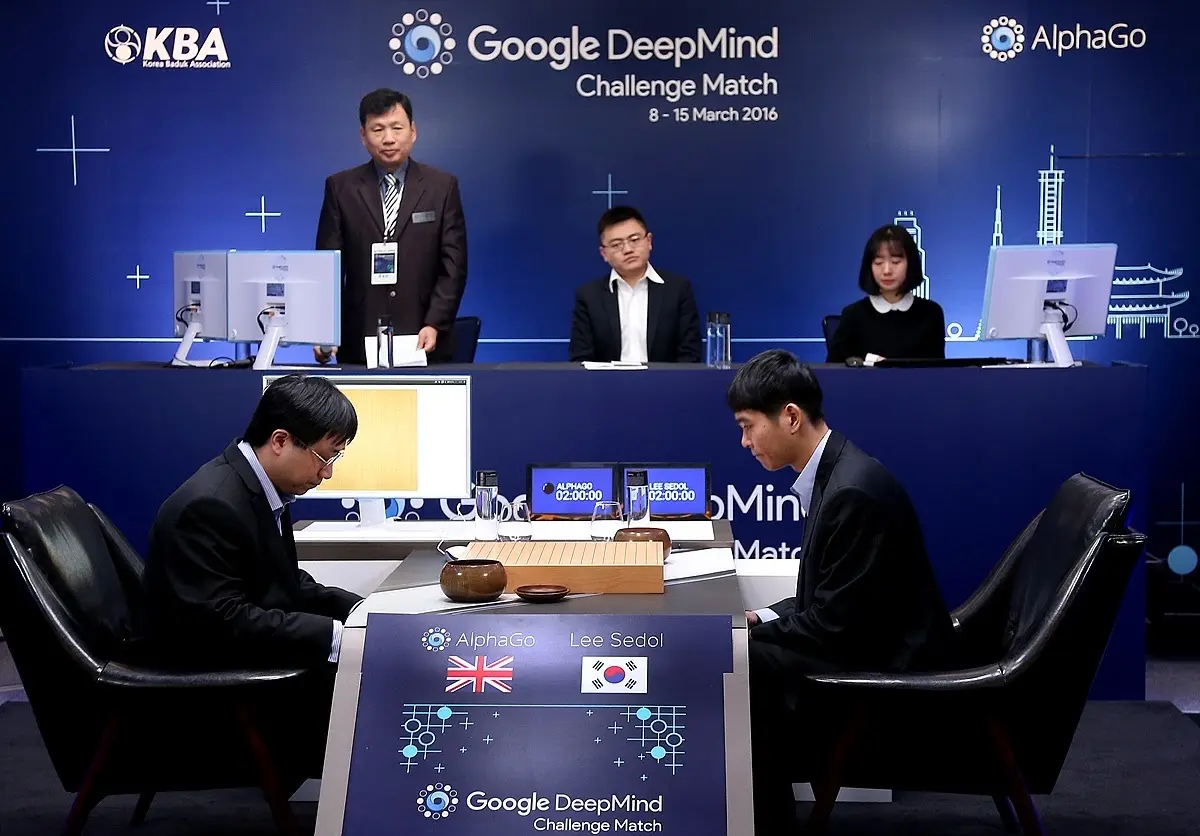
The match became a symbol of 'man against machine' and made headlines around the world, although Deep Blue was a calculating machine filled with human chess knowledge rather than a thinking one. IBM used what it had learned in supercomputers such as Blue Gene and later built Watson, which beat two champions of the quiz show Jeopardy! in 2011. By the end of the 1990s chess programs on ordinary personal computers were reaching the same strength, and players began to use them as training partners. Nineteen years after Deep Blue's win, a very different machine, DeepMind's AlphaGo, which learned from experience instead of being given expert rules, beat Lee Sedol at the much harder game of Go.
What happened
- 1985
Feng-hsiung Hsu, a graduate student at Carnegie Mellon University in Pittsburgh, starts building ChipTest, a chess machine whose move generator is a single custom chip; Murray Campbell, Thomas Anantharaman and Andreas Nowatzyk join him.
Carnegie Mellon University, Pittsburgh: ChipTest (1985–87) and Deep Thought (1988–89) - 1987
ChipTest-M, the faster version, wins the ACM North American Computer Chess Championship in Dallas, ahead of Cray Blitz.
Carnegie Mellon University, Pittsburgh: ChipTest (1985–87) and Deep Thought (1988–89) - 1988
Deep Thought, the team's new machine, wins the ACM championship in Orlando and becomes the first computer to beat a grandmaster in a tournament game; the team wins the Fredkin Intermediate Prize for grandmaster-level play.
Carnegie Mellon University, Pittsburgh: ChipTest (1985–87) and Deep Thought (1988–89) - 1989
Deep Thought wins the World Computer Chess Championship in Edmonton, and Claude Shannon hands Hsu the first prize. The same year IBM Research hires Hsu and Campbell, with Anantharaman, to build a machine that can beat the world champion.
Edmonton, Alberta: Deep Thought wins the World Computer Chess Championship, 1989Garry Kasparov, 26 and rated 2795, beats Deep Thought 2–0 at the New York Academy of Art on Lafayette Street. Computers, he says, 'have their psychology too'.
419 Lafayette Street, Manhattan, then the New York Academy of Art: Kasparov beats Deep Thought, 22 October 1989- 1991
Deep Thought II, the IBM prototype of Deep Blue with 24 chess processors, wins the ACM championship in Albuquerque; Joe Hoane has joined the team in place of Anantharaman.
IBM Thomas J. Watson Research Center, Yorktown Heights, New York: Deep Blue's home from 1989; in 1996 the machine played from here - 1994
Deep Thought II wins its last ACM championship, at Cape May, New Jersey; meanwhile Hsu designs a new, far more knowledgeable chess chip for Deep Blue.
IBM Thomas J. Watson Research Center, Yorktown Heights, New York: Deep Blue's home from 1989; in 1996 the machine played from here - 1995
IBM accepts the ACM's invitation to a six-game match with Kasparov at full tournament time controls, to be played in Philadelphia the next February as part of the ACM's 50th anniversary.
IBM Thomas J. Watson Research Center, Yorktown Heights, New York: Deep Blue's home from 1989; in 1996 the machine played from hereThe first Deep Blue chess chips arrive from the factory; problems are found, and a revised chip arrives in January 1996, only weeks before the match.
IBM Thomas J. Watson Research Center, Yorktown Heights, New York: Deep Blue's home from 1989; in 1996 the machine played from here- 1996
- 3:00 p.m.
Game 1 of the ACM Chess Challenge at the Pennsylvania Convention Center: Deep Blue, playing white from Yorktown Heights over the Internet, beats Kasparov, the first game a reigning world champion has lost to a computer at normal time controls.
Pennsylvania Convention Center, Philadelphia: the first match, 10–17 February 1996 - 3:00 p.m.
Game 2: Kasparov, with white, changes his approach and wins; 1–1.
Pennsylvania Convention Center, Philadelphia: the first match, 10–17 February 1996 - 3:00 p.m.
Game 3 is drawn.
Pennsylvania Convention Center, Philadelphia: the first match, 10–17 February 1996 - 3:00 p.m.
Game 4 is drawn: 2–2 after four games.
Pennsylvania Convention Center, Philadelphia: the first match, 10–17 February 1996 - 3:00 p.m.
Game 5: Kasparov switches plans in the middle of the game and wins; 3–2.
Pennsylvania Convention Center, Philadelphia: the first match, 10–17 February 1996 - 3:00 p.m.
Game 6: Kasparov fends off Deep Blue's attacks and wins, taking the match 4–2. He challenges the machine to a rematch in 1997, and IBM accepts at once.
Pennsylvania Convention Center, Philadelphia: the first match, 10–17 February 1996 - 1997
IBM announces the rematch, 3 to 11 May at the Equitable Center in New York, for a $1.1 million purse ($700,000 to the winner). The new Deep Blue has a redesigned chip with over 8,000 features of chess knowledge, tuned with grandmaster Joel Benjamin, and 480 chips on a 30-processor SP: twice the speed of 1996.
The Equitable Center, 787 Seventh Avenue, Manhattan: the 1997 rematch, 3–11 May 1997Game 1 of the rematch: Kasparov, with white, chooses a quiet, closed opening meant to keep the machine out of sharp tactics, and wins in 45 moves.
The Equitable Center, 787 Seventh Avenue, Manhattan: the 1997 rematch, 3–11 May 1997Game 2: Deep Blue, with white, outplays Kasparov in a long Ruy Lopez, and he resigns after 45 moves; analysts later find he could have saved a draw by perpetual check. 1–1, and the champion never regains his composure.
The Equitable Center, 787 Seventh Avenue, Manhattan: the 1997 rematch, 3–11 May 1997Game 3 is drawn after 48 moves.
The Equitable Center, 787 Seventh Avenue, Manhattan: the 1997 rematch, 3–11 May 1997Game 4 is drawn after 56 moves ('Almost a win for Kasparov', the Washington Post headlined).
The Equitable Center, 787 Seventh Avenue, Manhattan: the 1997 rematch, 3–11 May 1997Game 5 is drawn after 49 moves, the third draw in a row: 2½–2½. Kasparov later says that after this game he felt the match was already over.
The Equitable Center, 787 Seventh Avenue, Manhattan: the 1997 rematch, 3–11 May 1997At the press conference a bitter Kasparov says he 'lost my fighting spirit', asks why the machine missed a simple perpetual check in game 2, wants to see its logs and promises to 'tear it to pieces' in a fair contest; C. J. Tan calls him 'a very brave man'.
The Equitable Center, 787 Seventh Avenue, Manhattan: the 1997 rematch, 3–11 May 1997- 3:00 p.m.
Game 6: Kasparov, with black, plays a Caro-Kann defence, lets Deep Blue sacrifice a knight on move 8, loses his queen ten moves later and resigns after 19 moves. Deep Blue wins the match 3½–2½.
The Equitable Center, 787 Seventh Avenue, Manhattan: the 1997 rematch, 3–11 May 1997