Euclid writes the Elements
“Around 300 BCE Euclid of Alexandria turned Greek geometry into one chain of proofs from a few stated assumptions; his Elements taught mathematics for over 2,000 years.”
Around 300 BCE a teacher named Euclid, working in Alexandria, the new Greek capital of Egypt, put together the Elements: a course of mathematics in thirteen 'books', each of them once a roll of papyrus. It starts from very little. Book I opens with 23 definitions, such as 'a point is that which has no part' and 'a line is a length without breadth', five postulates, among them that a straight line can be drawn between any two points and a circle drawn with any centre and radius, and five 'common notions', such as 'things equal to the same thing are equal to each other'. From these it proves, one step at a time, more than 460 propositions, each resting only on what has already been shown. Books I to VI are plane geometry, and Book I ends with the theorem we name after Pythagoras. Books VII to IX are about whole numbers: they contain the method for finding the greatest common divisor that is still called Euclid's algorithm, and the proof that the prime numbers never run out. Book X sorts out irrational lengths, and Books XI to XIII move into three dimensions and end by building the five regular solids and proving that there can be no others.
Of Euclid himself almost nothing is known. Nearly all of it comes from Proclus, a philosopher who wrote a commentary on Book I some 750 years later: Euclid lived in the time of the first Ptolemy, the Macedonian general who ruled Egypt from 323 BCE; he was younger than Plato's pupils and older than Archimedes; and when the king asked whether there was a shorter way into geometry than the Elements, he answered that there is no royal road. Nor was the book the first of its kind. Hippocrates of Chios had written an 'Elements' around 440 BCE, and Euclid took his theory of proportion (Book V) from Eudoxus and much of Books X and XIII from Theaetetus, mathematicians of the century before him. What was his own was the design: a single chain of proof from a few stated starting points. It drove the older textbooks out of use, and they are lost. Medieval and Renaissance scholars confused him with Euclid of Megara, a philosopher who lived a century earlier, so the first English translation still calls him 'Euclide of Megara'.
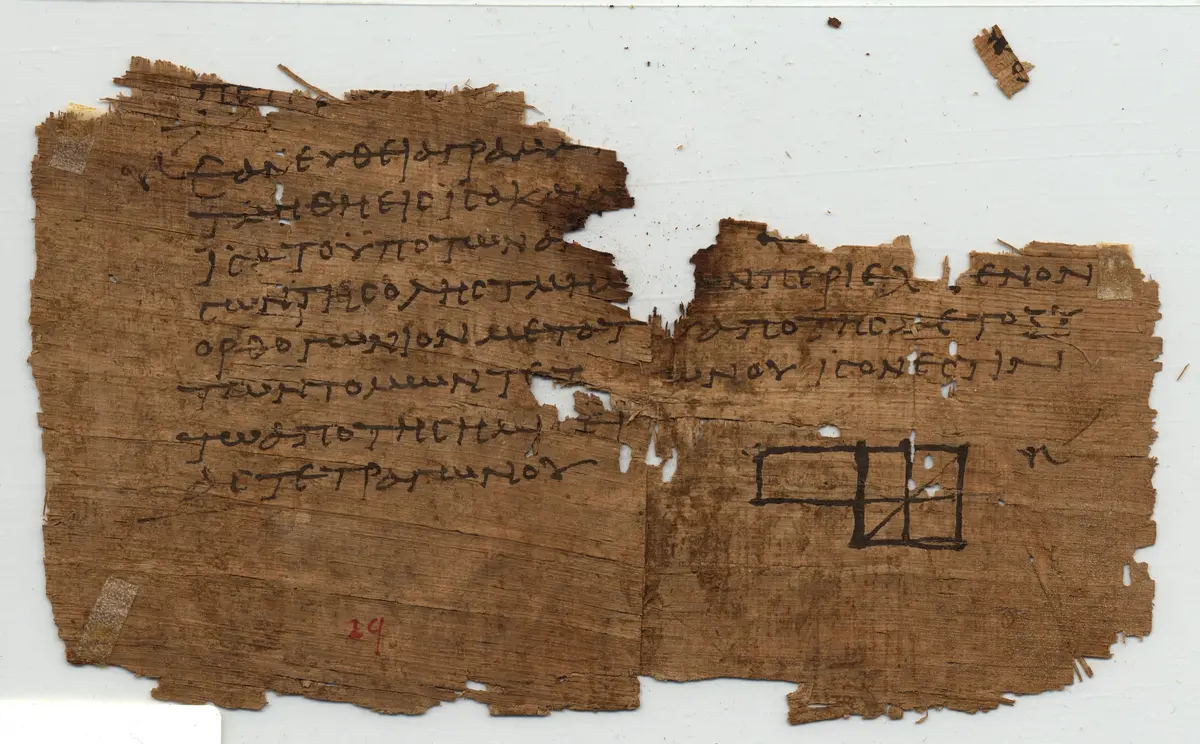
No copy from Euclid's lifetime survives. The earliest glimpse is a handful of potsherds from Elephantine, more than 800 kilometres up the Nile from Alexandria, on which someone in the third century BCE worked through problems from Book XIII; then come papyrus scraps from Roman Egypt. In the fourth century CE Theon of Alexandria, the father of Hypatia, re-edited the text, and his version pushed out all the others: only in 1808 was a manuscript in the Vatican recognised as older than Theon. The oldest complete copy with a date was finished in September 888, probably in Constantinople. Around 800 al-Hajjaj translated the Elements into Arabic for the caliphs in Baghdad, and the version of Ishaq ibn Hunayn, revised by Thabit ibn Qurra, became the standard text of the Islamic world. From Arabic, Adelard of Bath made the first Latin translation that survives, around 1120, and Campanus of Novara's Latin version was the first to be printed, by Erhard Ratdolt in Venice on 25 May 1482. More than a thousand editions have followed, among them Henry Billingsley's English one of 1570, Christopher Clavius's Latin textbook of 1574, which Matteo Ricci and Xu Guangqi used for the first Chinese translation in 1607, and Oliver Byrne's of 1847, which replaced letters with coloured shapes.
For two thousand years the Elements was how Europe, and much of the Islamic world, learned what a proof is. Britannica writes that the ideas of Kepler, Fermat, Descartes and Newton were rooted in it, and it is sometimes said that only the Bible has been more translated, printed and studied in the Western world. Its one weak-looking point turned out to be its deepest. The fifth postulate, which says when two straight lines will meet, seemed less obvious than the others, and for centuries mathematicians from Ptolemy and Proclus to Saccheri tried to prove it from the rest. In the early nineteenth century Gauss, Nikolai Lobachevsky and János Bolyai saw that it cannot be proved: a geometry in which it is false is just as consistent. Such non-Euclidean geometries later proved essential to Einstein's general theory of relativity. Yet the method of the Elements, to say exactly what you assume and then prove everything else, is still how mathematics is done.
What happened
- 323 BCE
Alexander the Great dies at Babylon, and his general Ptolemy becomes governor (satrap) of Egypt, where Alexander had founded Alexandria nine years before. Proclus would later date Euclid by Ptolemy's reign.
Alexandria, where Euclid taught in the reign of Ptolemy I - 305 BCE
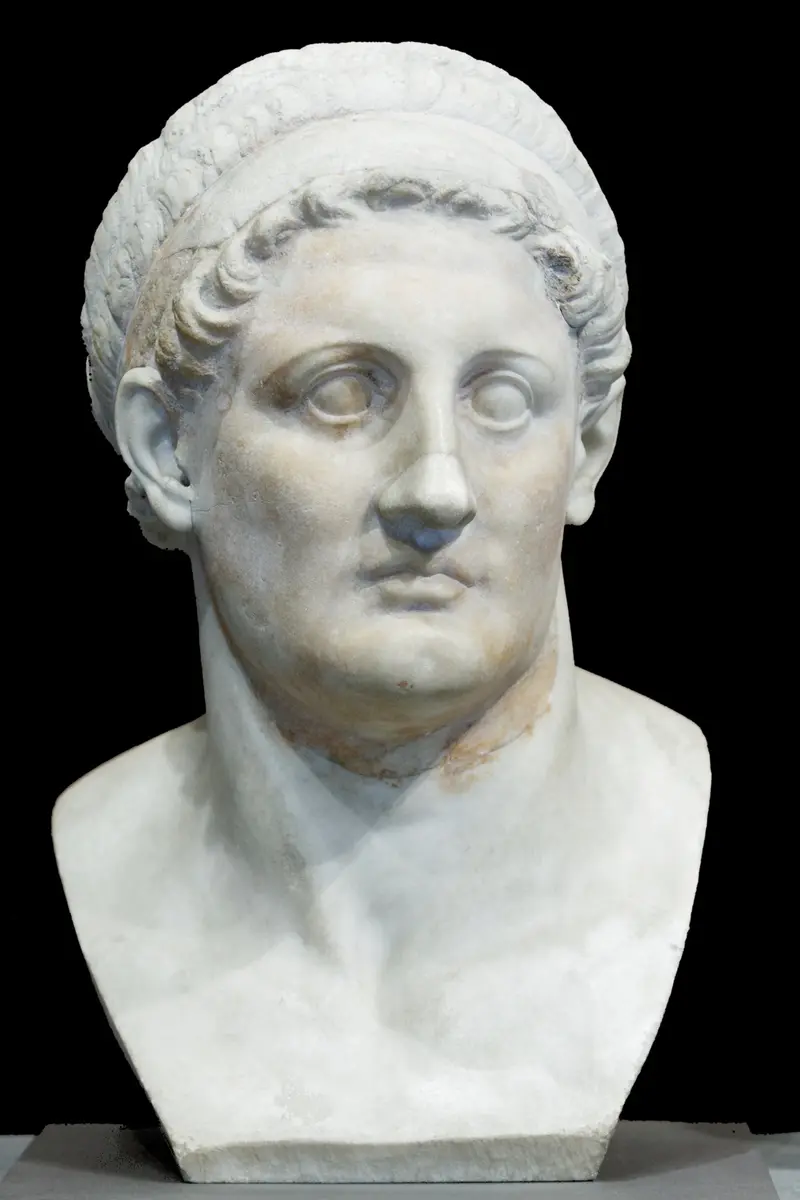
Ptolemy, like the other heirs of Alexander, takes the title of king (305-304 BCE). His coins from Alexandria carry his own portrait and the words 'of King Ptolemy'.
Alexandria, where Euclid taught in the reign of Ptolemy I - 300 BCE
About now Euclid, teaching in Alexandria, writes the Elements in thirteen books: definitions, five postulates and five common notions, then more than 460 propositions, each proved from the ones before, from triangles and the theorem of Pythagoras to whole numbers, irrational lengths and the five regular solids.
Alexandria, where Euclid taught in the reign of Ptolemy IProclus tells that Ptolemy asked Euclid whether there was a shorter way to learn geometry than the Elements, and Euclid answered that there is no royal road to geometry. Another story, in Stobaeus, has a pupil ask what he will gain from learning it; Euclid tells his slave to give him a coin, since he must make a profit from what he learns.
Alexandria, where Euclid taught in the reign of Ptolemy I- 295 BCE
Ptolemy charges Demetrius of Phaleron, an Athenian exile at his court, with founding the Library and the Museum, the 'shrine of the Muses' where scholars lived and worked. Whether Euclid himself worked there is not recorded.
Alexandria, where Euclid taught in the reign of Ptolemy I - 283 BCE
Ptolemy I dies, in 283 or 282 BCE, after ruling Egypt from 323 to 285. Proclus's 'in the time of the first Ptolemy' is the basis of the usual date for Euclid, about 300 BCE.
Alexandria, where Euclid taught in the reign of Ptolemy I - 250 BCE
Between about 250 and 225 BCE, at Elephantine on the Nile at Aswan, someone works in ink on potsherds through the pentagon, the decagon and the icosahedron of Book XIII, not copying Euclid's words but trying to understand them: the earliest glimpse of the Elements that survives.
Elephantine, the island at Aswan where potsherds with notes on Book XIII, the oldest trace of the Elements, were found - 212 BCE
Archimedes, who as a young man probably studied with Euclid's successors in Alexandria, is killed when the Romans take Syracuse. His book On the Sphere and Cylinder holds the one mention of Euclid in his works, which Proclus used to date Euclid; some historians think it was added later.
- 200 BCE
Around 200 BCE Apollonius of Perga, who had studied in Alexandria under the followers of Euclid, writes in a preface to his Conics that Euclid had not fully worked out the locus with respect to three and four lines: one of the earliest mentions of Euclid by a later mathematician.
Alexandria, where Euclid taught in the reign of Ptolemy I