GPS opens to everyone after Korean Air Lines Flight 007 is shot down
“After the Soviets shot down the stray airliner KAL 007 in September 1983, the US promised its military GPS satellites to civilian aircraft; the full public signal, unblurred, finally came on 2 May 2000.”
In the early hours of 1 September 1983 a Soviet Su-15 interceptor shot down Korean Air Lines Flight 007, a Boeing 747 flying from New York to Seoul by way of Anchorage, over the sea west of Sakhalin. All 269 people on board died, among them 61 Americans and a US congressman, Larry McDonald. The airliner had drifted hundreds of kilometres off its route and twice crossed Soviet territory, over the Kamchatka peninsula and then Sakhalin, while Soviet air defence tracked it for more than two hours. In the dark the Soviet pilot took it for a spy plane, fired two missiles, and the 747 fell into the sea near Moneron Island.
Washington learned of the attack within hours from American and Japanese radio intercepts. Secretary of State George Shultz denounced it that same morning, President Reagan called it a 'massacre' in a television address on 5 September, and Ambassador Jeane Kirkpatrick played the Soviet pilot's words to the UN Security Council, where the Soviet Union vetoed a resolution deploring the attack. Moscow at first denied everything, then insisted the plane had been on a spying mission. Only after the Soviet Union fell did Boris Yeltsin hand over the flight recorders; in 1993 the International Civil Aviation Organization concluded that the crew had almost certainly left the autopilot on a fixed compass heading instead of letting the inertial navigation system steer, a small mistake that put the plane on a straight line into Soviet airspace.
On 16 September 1983 the White House turned the disaster into a promise. At the daily press briefing the deputy press secretary, Larry Speakes, read a statement that the President had decided to make the facilities of the Global Positioning System available to civilian aircraft 'when it becomes operational in 1988', so that airliners would know their position in three dimensions. GPS was then a military project of the US Air Force, called Navstar: the first test satellite had gone up from Vandenberg on 22 February 1978, and only a handful of experimental satellites were in orbit. Reagan himself did not announce it in a speech, and the statement said nothing about the signal being free.
The promise took far longer than 1988. The first operational Block II satellite was launched in February 1989, the Air Force declared the system initially operational in December 1993 and fully operational in 1995, and in March 1996 President Clinton's GPS policy promised the civilian signal worldwide 'free of direct user fees'. But the military kept a switch called Selective Availability, which deliberately blurred the public signal to about 100 metres. Clinton turned it off at midnight on 1 May 2000, and overnight every receiver in the world became about ten times more accurate.
That night is why GPS is everywhere today. A free, worldwide position accurate to a few metres made possible car navigation, precision farming, the timing that runs mobile networks and banks, and the blue dot in every smartphone map. A system the Pentagon built to guide soldiers and bombs became, through a Cold War tragedy and two presidents' decisions, a public utility used by billions of people who never think of it as American or military at all.
What happened
- 1983
Korean Air Lines Flight 007, a Boeing 747 from New York to Seoul with 269 people on board, takes off from Anchorage at about 4 a.m. local time. From the start it drifts north of its route: over Bethel it is already 12 miles off, and it flies on for five hours on a fixed heading of 245 degrees, straight towards Soviet territory.
Anchorage International Airport, Alaska: KAL 007's refuelling stop, from which it left for Seoul- 3:26 a.m.
Over the sea west of Sakhalin, at 3:26 a.m. Tokyo time, Major Gennadiy Osipovich fires two missiles from his Su-15 at the airliner, which has crossed Kamchatka and Sakhalin while Soviet air defence tracked it. 'The target is destroyed,' he radios; the 747 stays in the air for at least 12 minutes more before it falls into the sea near Moneron Island. No one survives.
Moneron Island, west of Sakhalin: the airliner fell into the sea near it - 10:45 a.m.
In Washington, still 1 September, Secretary of State George Shultz holds a press conference at the State Department and gives the times from American and Japanese intercepts: 'We can see no excuse whatsoever for this appalling act.' Moscow's first statement, through TASS, speaks only of an unidentified intruder.
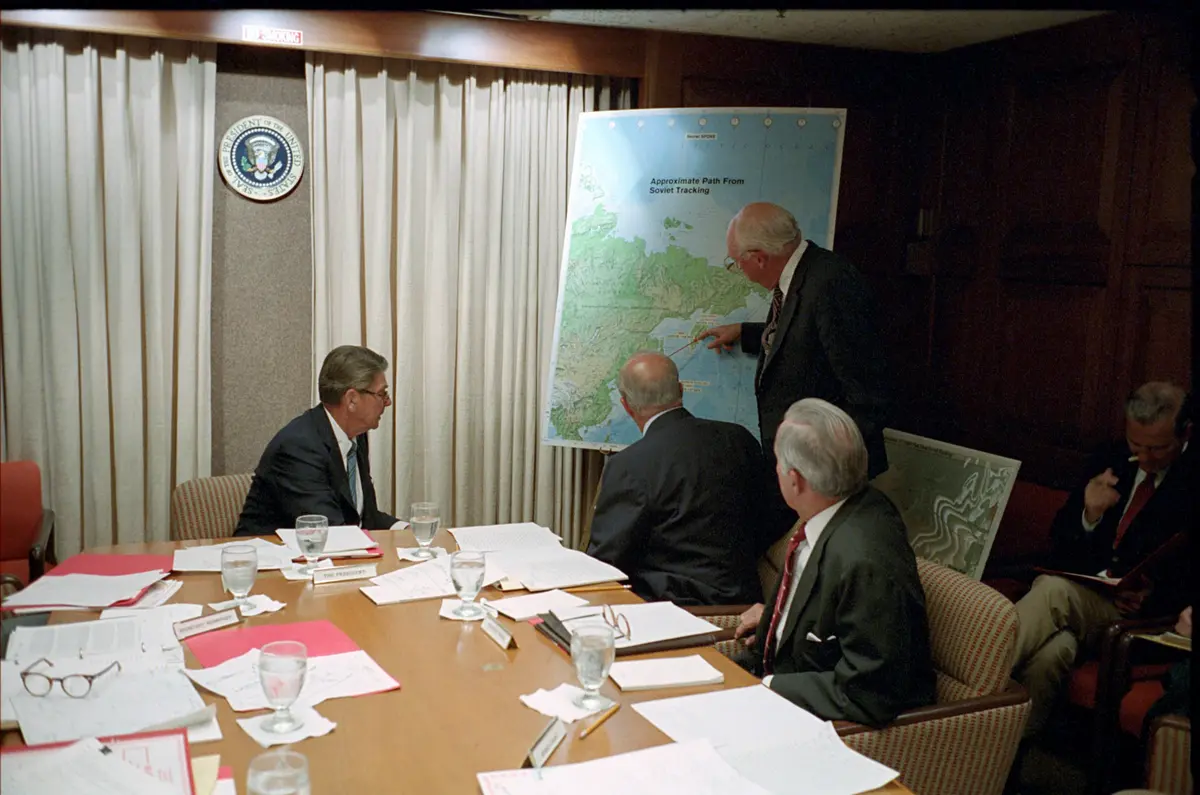
The White House, Washington: the Situation Room meeting, the Oval Office address and Speakes's statement promising GPS to civil aviation Reagan, back from California, meets the National Security Planning Group in the Situation Room, where CIA Director William Casey shows him the map of the attack.
The White House, Washington: the Situation Room meeting, the Oval Office address and Speakes's statement promising GPS to civil aviation- 8:00 p.m.
Reagan signs National Security Decision Directive 102 on the US response and in the evening speaks to the nation from the Oval Office about 'the Korean airline massacre', playing part of the Soviet pilot's tape. He says the 747 had the most modern navigation computers but flew a course further west than it should have.
The White House, Washington: the Situation Room meeting, the Oval Office address and Speakes's statement promising GPS to civil aviation Ambassador Jeane Kirkpatrick plays the tapes and shows a map of the flight path to the UN Security Council. The same day Moscow acknowledges the shootdown for the first time, while Soviet ships search the sea off Moneron.
United Nations headquarters, New York: Kirkpatrick's tape and the Soviet veto in the Security CouncilMarshal Nikolai Ogarkov, chief of the Soviet General Staff, holds a two-hour live press conference in Moscow, insisting that the plane was on an American spying mission and that the air defence commander acted correctly.
The Soviet Union vetoes a Security Council resolution deploring the destruction of the airliner, backed by nine of the fifteen members. Korean Americans demonstrate in Los Angeles.
United Nations headquarters, New York: Kirkpatrick's tape and the Soviet veto in the Security Council- 12:30 p.m.
At the daily White House briefing Larry Speakes reads a statement: the President has decided that the United States will make the facilities of its Global Positioning System available to civilian aircraft when it becomes operational, expected in 1988. The same day, in Montreal, the ICAO Council passes a resolution deploring the attack and calling for an investigation.
The White House, Washington: the Situation Room meeting, the Oval Office address and Speakes's statement promising GPS to civil aviation Soviet boats shadow the US Navy's salvage ships searching for the wreck in the Sea of Japan. At Camp David, Reagan's radio address reports the ICAO resolution and the steps against Aeroflot.
Camp David, Maryland: Reagan's radio address of 17 September 1983- 1989
The first operational Block II GPS satellite is launched from Cape Canaveral, the start of the constellation that would serve the world.
Launch Complex 17, Cape Canaveral: the Delta II pad from which the Block II satellites went up- 1992
Boris Yeltsin, president of the new Russia, releases the Soviet memos on the shootdown and the sea search, and later in the year the airliner's flight recorders, which Soviet divers had secretly recovered.
- 1993
The International Civil Aviation Organization reports on the recorders: the crew had failed to notice that the autopilot was left on a fixed heading, or switched to the inertial navigation system too late, so the plane never followed its planned track.
Air Force Space Command declares GPS initially operational, with 24 Block I and Block II satellites working.
Falcon Air Force Station (now Schriever), Colorado: the GPS master control station that switched Selective Availability off- 1994
- 10:40 p.m.
The 24th Navstar satellite lifts off on a Delta II from Complex 17A at Cape Canaveral at 10:40 p.m. Eastern time.
Launch Complex 17, Cape Canaveral: the Delta II pad from which the Block II satellites went up - 1995
GPS is declared fully operational: the constellation of operational satellites is complete and tested.
Falcon Air Force Station (now Schriever), Colorado: the GPS master control station that switched Selective Availability off- 1996
President Clinton approves a national GPS policy: the civilian signal will stay free of direct user fees worldwide, and Selective Availability, the deliberate blurring of that signal, is to end within ten years.
The White House, Washington: the Situation Room meeting, the Oval Office address and Speakes's statement promising GPS to civil aviation- 2000
Clinton announces that the United States will stop degrading the public GPS signal at midnight, making civilian receivers up to ten times more accurate. 'We are unscrambling the GPS signal,' his science adviser Neal Lane tells reporters.
The White House, Washington: the Situation Room meeting, the Oval Office address and Speakes's statement promising GPS to civil aviationA few minutes after midnight in Washington (about 04:05 UTC) Air Force Space Command sets Selective Availability to zero on every satellite at once. Over the next days a NOAA station in Kentucky sees 95 percent of its fixes fall within 6.3 metres instead of 45.
Falcon Air Force Station (now Schriever), Colorado: the GPS master control station that switched Selective Availability off