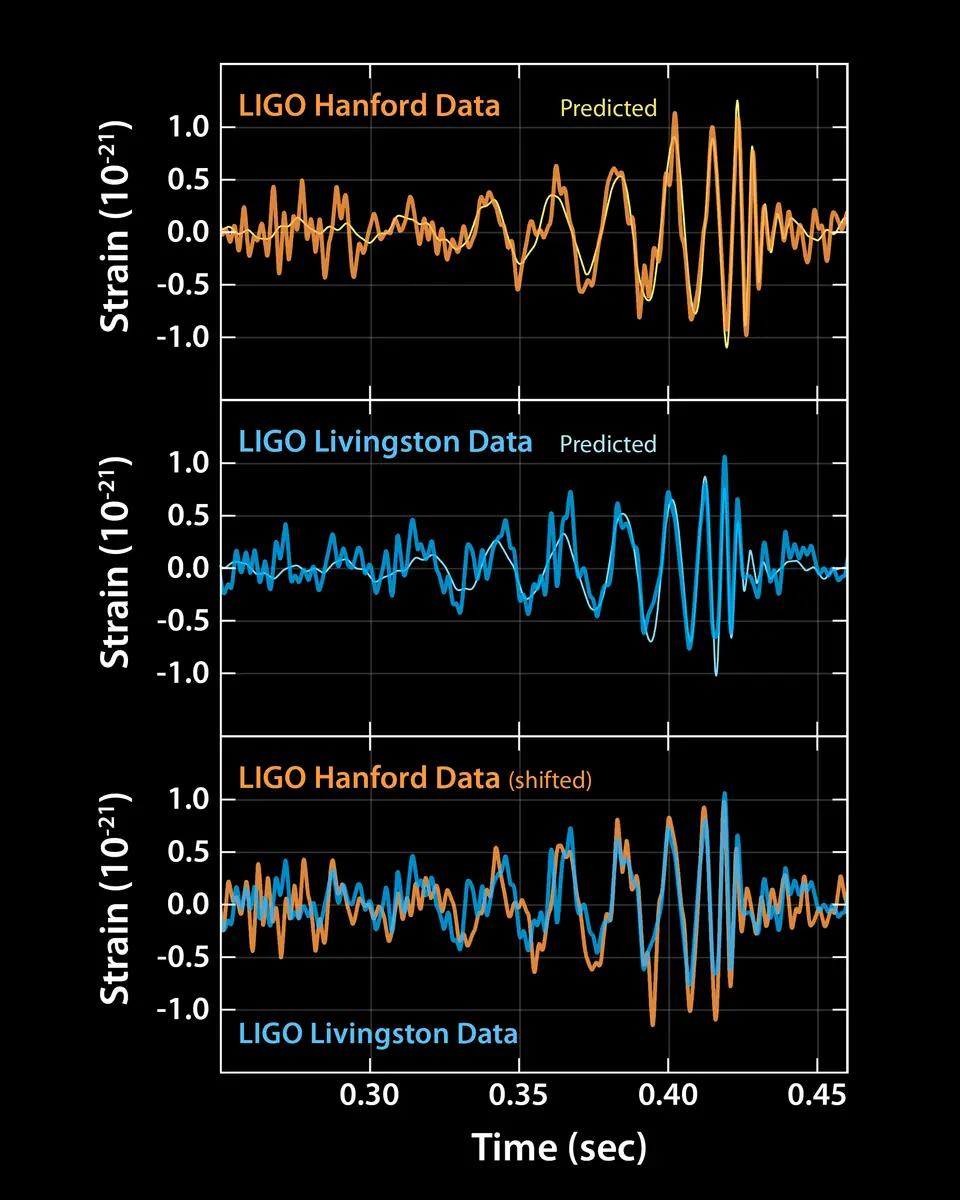
Gravitational waves are detected
“On 14 September 2015 LIGO's two detectors felt two black holes merge 1.3 billion years ago: the first direct detection of gravitational waves, a century after Einstein predicted them.”
At 09:50:45 UTC on 14 September 2015 the two detectors of LIGO, one in Livingston, Louisiana and one in Hanford, Washington, recorded the same tiny shiver. It reached Livingston first and Hanford about 7 thousandths of a second later. The signal rose in pitch from 35 to 250 hertz in about a fifth of a second, like a short chirp, and then stopped. It was caused by two black holes, of about 36 and 29 times the mass of the Sun, circling each other, merging into one black hole of about 62 Suns. About 3 Suns of mass left as gravitational waves. The collision happened some 1.3 billion years ago.
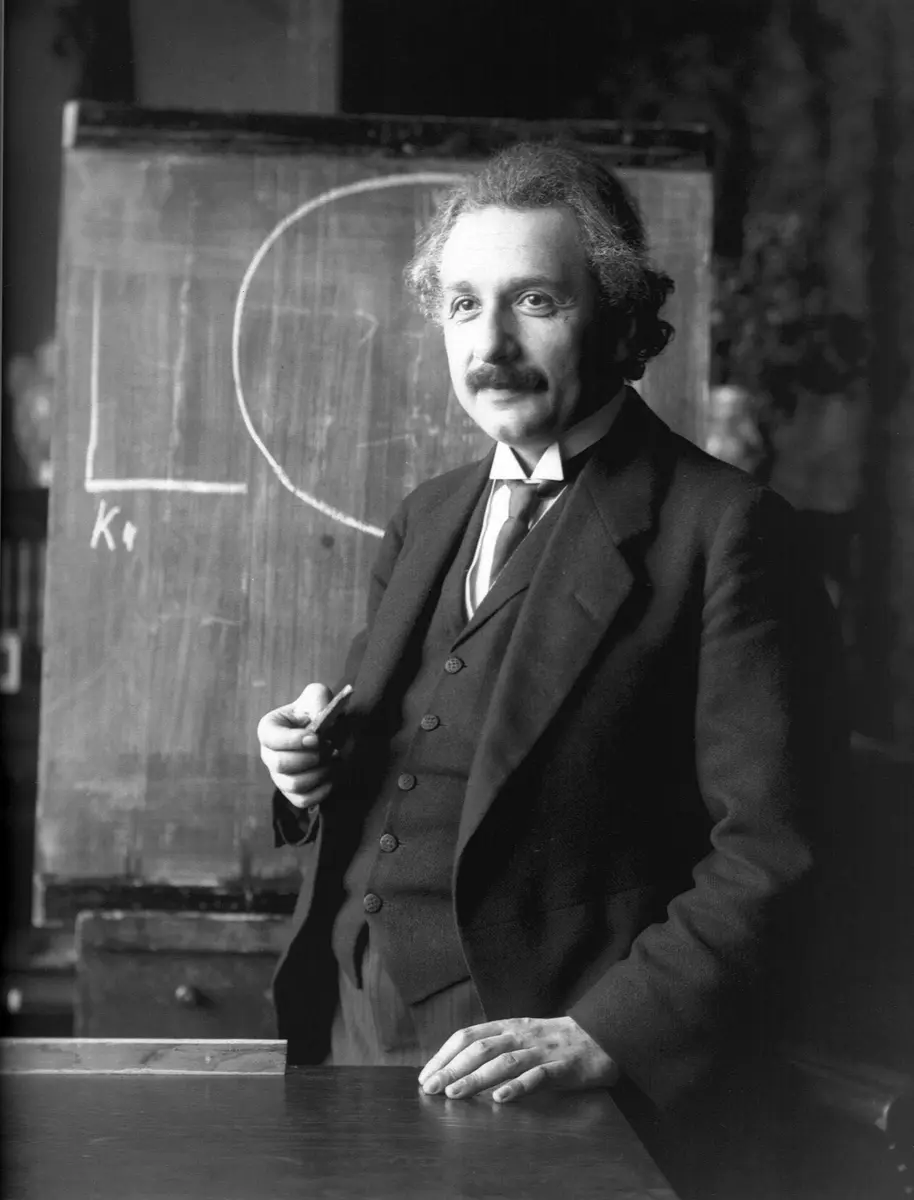
Einstein had predicted such waves in 1916, a year after his general theory of relativity, but he doubted anyone could ever measure them. In 1974 a pair of stars, a pulsar and a neutron star, was found whose orbit shrinks exactly as lost gravitational waves would make it shrink, which was strong indirect proof. To catch a wave itself, Rainer Weiss, Kip Thorne and Ronald Drever proposed in the 1980s a huge laser instrument with arms 4 kilometres long. The US National Science Foundation approved LIGO's first funding in 1992, the largest investment it had ever made, and the physicist Barry Barish later led the project to completion. The signal came just as the upgraded Advanced LIGO was starting its first official run. The arms had to sense a change smaller than one ten-thousandth of the width of a proton.
At first nobody was sure it was real. An automatic search flagged the signal within three minutes, and many in the team feared it was a secret test signal planted to train them. Operators confirmed that no one had injected anything, and the team spent weeks on checks; on 5 October the results of the offline searches were opened in a telephone conference. The paper was received by Physical Review Letters on 21 January 2016, after months of rumours, and on 11 February 2016 LIGO and the Virgo collaboration announced it in Washington. The signal was more than 5.1 standard deviations above noise, a chance of less than one in 203,000 years of data.
The first detection was followed by a second black-hole merger on 26 December 2015, and by a third detector joining in: on 14 August 2017 Italy's Virgo and the two LIGO detectors saw a merger together, which pinned its position in the sky far better. On 17 August 2017 they heard two neutron stars collide, and a gamma-ray flash arrived 1.7 seconds later, so telescopes could watch the fireball. On 3 October 2017 the Nobel Prize in Physics went to Rainer Weiss (one half), Barry Barish and Kip Thorne (one quarter each) for decisive contributions to LIGO and the observation of gravitational waves.
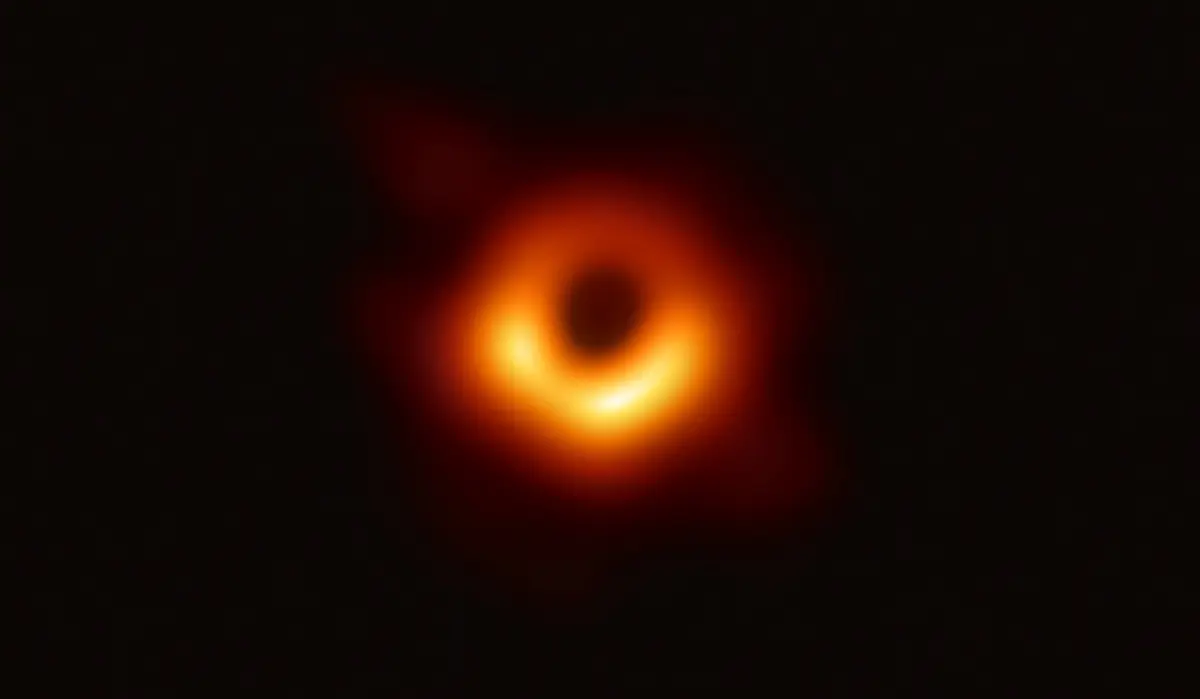
It matters because gravitational waves are a new sense. Light and particles had been the only messengers from space; now astronomers can also feel ripples of space and time itself, from places that give off no light, such as pairs of black holes. GW150914 also showed that black holes of this heavy kind exist in pairs and merge, and it passed a first test of general relativity where gravity is at its strongest.
What happened
- 2015
- 9:50 a.m.
The signal reaches Livingston, Louisiana, at 09:50:45 UTC (4:50 in the morning there). The wave has travelled about 1.3 billion years, and the detector's mirrors, 4 km apart, move by far less than the width of a proton.
LIGO Livingston Observatory, Louisiana: the detector that felt GW150914 first, at 09:50:45 UTC; the OSM outline is the site building, not the 4 km arms - 9:50 a.m.
About 7 thousandths of a second later, 6.9 ms in the paper, the same wave passes Hanford, Washington, some 3,000 km away. Only the two LIGO detectors were observing: Virgo was being upgraded and GEO 600 was not in observing mode.
LIGO Hanford Observatory, Washington: the detector with 4 km arms on the Hanford Site that saw GW150914 about 7 ms after Livingston - 9:53 a.m.
At 09:53:51 UTC an automatic search at Livingston (coherent WaveBurst) posts the event to LIGO's database, three minutes after the signal. A data-quality program wrongly labels it a glitch four seconds later and the automatic alerts stop; that label is traced to an uncalibrated channel and removed within 2.5 hours.
LIGO Livingston Observatory, Louisiana: the detector that felt GW150914 first, at 09:50:45 UTC; the OSM outline is the site building, not the 4 km arms - 10:00 a.m.
In Hannover, Germany, at about 10:00 UTC, Marco Drago reads the alert mail. The picture is so clean and so loud that he and his colleagues think it must be a test signal, and his first question to Andrew Lundgren is whether anyone is making an injection.
Albert Einstein Institute (Max Planck Institute for Gravitational Physics), Hannover: where Marco Drago and Andrew Lundgren first looked at the alert at about 10:00 UTC - 10:27 a.m.
At 10:27 UTC Lundgren telephones the operator in Livingston, William Parker. The detector is in a strong, steady lock and no injection is being made.
LIGO Livingston Observatory, Louisiana: the detector that felt GW150914 first, at 09:50:45 UTC; the OSM outline is the site building, not the 4 km arms - 10:55 a.m.
At 10:55 UTC Drago sends the collaboration's burst group the mail 'Very interesting event on ER8' with links to the plots. Rainer Weiss, at his holiday home in Maine, sees that all maintenance at Livingston has been cancelled and fears something has gone wrong; in fact it had gone right.
LIGO's first observing run, put off by a week, is declared officially open on Friday 18 September, moved up at the collaboration's recommendation in light of the event; the blind-injection team, which would have planted fake signals, is told to stand down.
LIGO Livingston Observatory, Louisiana: the detector that felt GW150914 first, at 09:50:45 UTC; the OSM outline is the site building, not the 4 km armsWithin days the rumour is out: the cosmologist Lawrence Krauss, who is not in LIGO, tweets on 25 September that there may be a detection. LIGO says nothing; the collaboration's rule is to check for months before speaking.
On a Monday telephone conference the collaboration opens the 'box', the closed record of the offline searches. Weiss, at MIT, and colleagues around the world see that the event stands out far above the noise. It marks the end of the first checks and the start of the detailed analysis; in Germany the long-awaited whisky is poured.
Massachusetts Institute of Technology, Cambridge: LIGO's co-operator, where Rainer Weiss was when the closed data 'box' was opened on 5 October 2015- 3:38 a.m.
At 03:38:53 UTC a second black-hole merger crosses the detectors, found by the online search within 70 seconds; the black holes are lighter, 14 and 8 Suns. It is announced on 15 June 2016.
- 2016
The rumour returns. Krauss tweets on 11 January that he has independent confirmation that LIGO has a paper in the works. The LIGO spokesperson, Gabriela Gonzalez, says only that the data are being analysed and that any news will come when it is ready.
The paper reporting GW150914 is received by Physical Review Letters.
- 3:30 p.m.
At 10:30 in the morning in Washington (15:30 UTC) the National Science Foundation, Caltech, MIT and the LIGO collaboration tell the world, at the National Press Club, that gravitational waves have been seen. David Reitze, LIGO's executive director, says that they have detected them; the paper appears the same day.
National Press Club, Washington, D.C.: where LIGO, Caltech, MIT and the National Science Foundation announced the detection on 11 February 2016 LIGO announces GW151226, the second merger of two black holes: the measurements show that at least one of the black holes was spinning.
- 2017
- 10:30 a.m.
At 10:30:43 UTC GW170814 crosses LIGO Livingston, then LIGO Hanford 8 ms later and Virgo in Italy 6 ms after that. With three detectors the source is placed in an area of the sky of 60 square degrees, instead of 1,160 for LIGO alone.
Virgo, European Gravitational Observatory, Cascina near Pisa, Italy: the 3 km detector, not observing in September 2015, which joined the network in August 2017 for GW170814 - 12:41 p.m.
At 12:41:04 UTC the detectors record GW170817, the merger of two neutron stars about 40 megaparsecs (130 million light years) away. 1.7 seconds after the coalescence the Fermi satellite sees a burst of gamma rays from the same patch of sky, and in the following hours and days telescopes on Earth find the glow of the explosion in the galaxy NGC 4993. The result is held back until 16 October.
The paper on GW170814 is posted: the first signal seen by three detectors,.
Virgo, European Gravitational Observatory, Cascina near Pisa, Italy: the 3 km detector, not observing in September 2015, which joined the network in August 2017 for GW170814The Royal Swedish Academy of Sciences awards the Nobel Prize in Physics, one half to Rainer Weiss of MIT and one quarter each to Barry Barish and Kip Thorne of Caltech, 'for decisive contributions to the LIGO detector and the observation of gravitational waves'.
Royal Swedish Academy of Sciences, Stockholm: the body that announced the 2017 Nobel Prize in Physics on 3 October 2017