Gunpowder in China
“Chinese alchemists found the mix of saltpetre, sulphur and charcoal by about 850; by 1300 China had bombs and the first metal guns, and the secret was reaching Europe.”
Gunpowder, a mixture of saltpetre, sulphur and charcoal, was the world's first explosive, and it was found in China. Its Chinese name, huoyao, means 'fire medicine', and many historians think it came out of the workshops of alchemists, often Daoists, who heated minerals in search of medicines and elixirs of long life. The oldest sign of it is a Daoist text of about 850 that warns against one such experiment: people who heated sulphur, realgar and saltpetre with honey had burned their hands and faces, and even their houses. Nobody set out to invent a weapon; the mixture announced itself by catching fire.
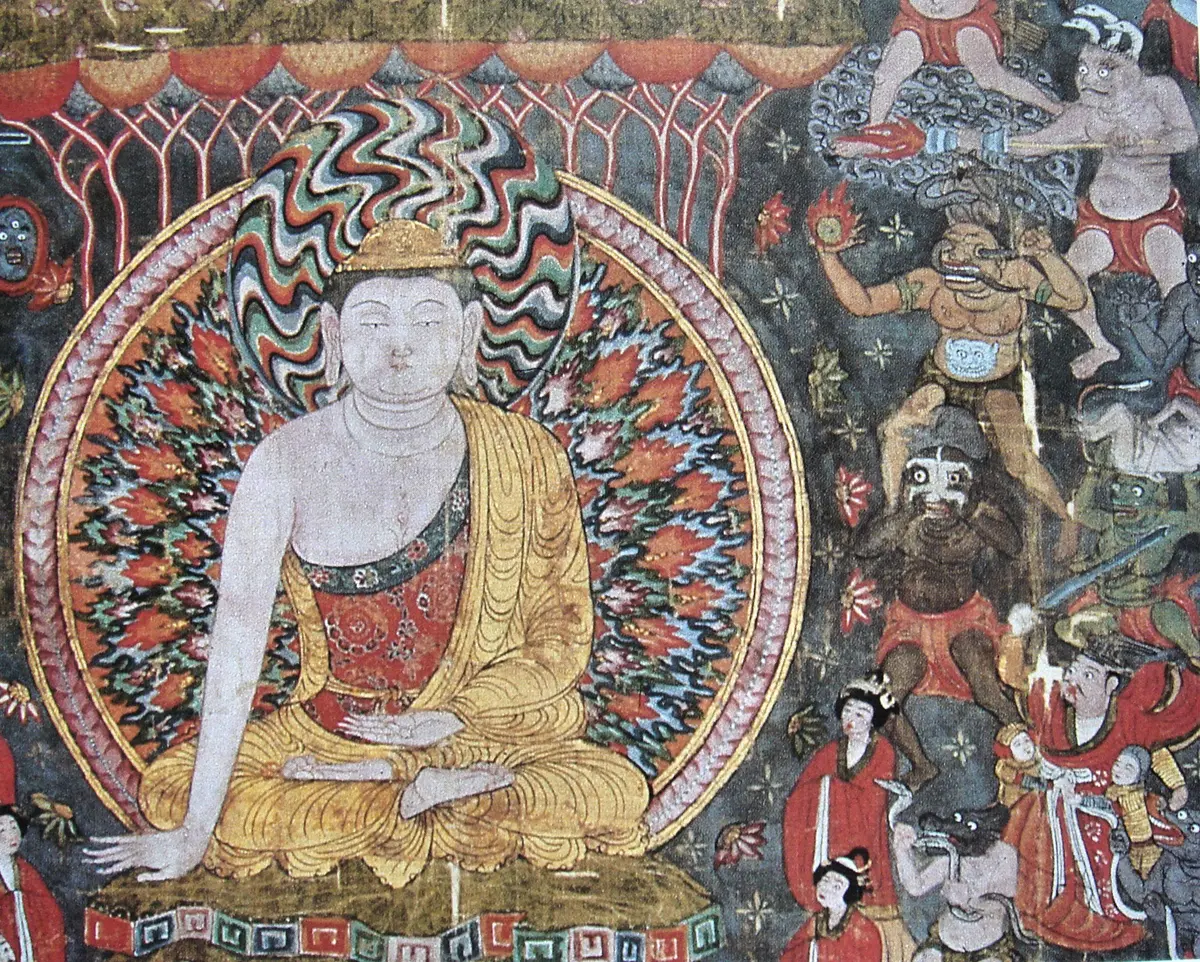
Soldiers saw its use quickly. By the 10th century gunpowder served in China for signals, fireworks and fire arrows, and a Buddhist painting on silk from Dunhuang, made in the first half of that century, seems to show a demon holding a fire lance, a tube that spits flame, and another holding a bomb. In 1044 the Song court finished the Wujing zongyao, a military encyclopedia compiled by Zeng Gongliang and Ding Du at the order of Emperor Renzong. It printed the first true gunpowder formulas, for fire balls and bombs to be thrown by catapults. This early powder had too little saltpetre to blow anything apart; it burned fiercely, and its first job was to set things on fire.
The long wars between the Song and their northern neighbours, the Jurchen Jin and then the Mongols, made it an explosive. When the Jin besieged the Song capital Kaifeng in 1126, the defenders threw 'thunderclap bombs' at them; in 1132 the defenders of De'an turned bamboo fire lances on the men pushing the attackers' siege towers; by the 1230s the Jin threw iron 'heaven-shaking thunder' bombs at the Mongols outside the same Kaifeng. The Mongols took the new weapons with them: Kublai Khan's fleets carried ceramic bombs filled with powder and iron scraps to Japan in 1274 and 1281, and divers have found them in a wreck off the island of Takashima. Fire lances loaded with pellets slowly became guns. The oldest metal gun with a firm date, cast in 1298, was found in the ruins of Xanadu, Kublai's summer capital, and its serial number shows that guns were already being made in series.
Knowledge of the powder travelled west along the roads of the Mongol empire. In 1267 the English friar Roger Bacon described a children's firecracker of saltpetre whose bang was louder than thunder; the later story that he hid a gunpowder recipe in a secret code was taken apart by historians long ago. By 1326 the city of Florence was having cannon made, and an English manuscript of the same year shows the first picture of a gun in Europe: a vase-shaped pot on a trestle, firing a great arrow at a castle gate. Twenty years later English guns were fired at the battle of Crécy.
Gunpowder changed the world more than almost any other invention. It brought down castle walls and helped end the age of the armoured knight, it gave rise to the 'gunpowder empires' of the Ottomans, Safavids and Mughals and to the European conquests that followed, and later it blasted mines and roads. It is counted among China's Four Great Inventions, with paper, printing and the compass. The old idea that China used it only for fireworks is wrong: as historians such as Tonio Andrade stress, Chinese armies used it in war almost as soon as its power was known, centuries before Europe.
What happened
- 850
A Daoist alchemical text, the Zhenyuan miaodao yaolüe, warns against an experiment: some who heated sulphur, realgar and saltpetre with honey saw smoke and flames burn their hands and faces, and even their whole house. It is the first sign of gunpowder.
- 950
At Dunhuang a painter shows Mara's demons attacking the Buddha; one of them holds a tube spitting flame, read as the first picture of a fire lance, and another a flaming ball.
Mogao Caves, Dunhuang: the painting with the oldest picture of a fire lance came from Dunhuang, brought to Paris by Paul Pelliot's mission of 1906–09 - 1044
The Wujing zongyao, the military encyclopedia compiled by Zeng Gongliang and Ding Du for Emperor Renzong, is finished: it records the first true gunpowder formulas, for fire balls and bombs thrown by catapults.
Kaifeng (Bianjing), the Northern Song capital, where the Wujing zongyao was compiled; besieged by the Jin in 1126–27 (thunderclap bombs) and by the Mongols in 1232 (heaven-shaking thunder bombs) - 1126
The Jurchen Jin besiege Kaifeng, the Song capital; the defenders hurl 'thunderclap bombs' with catapults and drive them off for a while.
Kaifeng (Bianjing), the Northern Song capital, where the Wujing zongyao was compiled; besieged by the Jin in 1126–27 (thunderclap bombs) and by the Mongols in 1232 (heaven-shaking thunder bombs) - 1127
The Jin come back, now with gunpowder bombs of their own, and take Kaifeng; the Song court flees south and rebuilds its state below the Yangtze.
Kaifeng (Bianjing), the Northern Song capital, where the Wujing zongyao was compiled; besieged by the Jin in 1126–27 (thunderclap bombs) and by the Mongols in 1232 (heaven-shaking thunder bombs) - 1132
At De'an, commander Chen Gui's men attack the Jin siege towers with more than twenty long bamboo fire lances loaded with 'fire-bomb powder': the first sure use of the fire lance, ancestor of the gun.
De'an, today's Anlu in Hubei: the first sure use of fire lances, by its defenders in 1132 - 1161
At Caishi on the Yangtze a Song fleet of paddle-wheel ships stops a Jin army from crossing; its catapults throw thunderclap bombs.
Caishi on the Yangtze: the Song fleet's victory over the Jin in 1161, with bombs thrown from ships - 1232
The Mongols besiege Kaifeng, now the Jin capital; the defenders lower and throw iron 'heaven-shaking thunder' bombs and use 'flying fire lances' against them. The city falls the next year, and the Jin soon after.
Kaifeng (Bianjing), the Northern Song capital, where the Wujing zongyao was compiled; besieged by the Jin in 1126–27 (thunderclap bombs) and by the Mongols in 1232 (heaven-shaking thunder bombs) - 1267
In his Opus maius for the pope, the English friar Roger Bacon describes a children's toy 'as large as the human thumb' in which saltpetre makes a bang louder than thunder: Europe's first description of gunpowder.
- 1274
Kublai Khan's first fleet lands at Hakata Bay in Kyushu; in the fighting the samurai Takezaki Suenaga charges the invaders, who carry gunpowder bombs.
Hakata Bay, Kyushu: the Mongol landing of November 1274, where the scroll shows a bomb bursting over a samurai- 1280
The gunpowder arsenal of Yangzhou catches fire: fire lances shoot about 'like frightened snakes', the bombs go off together, a hundred people die and a ten-foot crater is left.
Yangzhou: its gunpowder arsenal blew up in 1280, killing about a hundred people - 1281
A typhoon wrecks Kublai's second, far larger fleet in Imari Bay; one of its ships, sunk off Takashima, will be found in 2001 with six ceramic bombs filled with gunpowder and iron, the oldest exploding shells known.
Takashima Kōzaki underwater site: the wreck of a ship of Kublai Khan's 1281 fleet, with the world's oldest known exploding bombs- 1287
Yuan troops under the Jurchen commander Li Ting attack the camp of the rebel prince Nayan in Manchuria with hand guns; a bronze hand gun found at Acheng in Heilongjiang is dated to this campaign, one of the oldest guns known.
Acheng, Heilongjiang: where a bronze hand gun of about 1288, one of the oldest guns known, was found in 1970 - 1293
Takezaki Suenaga has the scrolls of his deeds against the Mongols painted; one scene shows a bomb bursting over him, though Thomas Conlan has found that this detail was painted in later.
Hakata Bay, Kyushu: the Mongol landing of November 1274, where the scroll shows a bomb bursting over a samurai - 1298
A small bronze gun, 35 cm long and weighing 6.2 kg, is cast with an inscription giving its year and a serial number; found in the ruins of Xanadu, it is the oldest gun with a firm date.
Xanadu (Shangdu), Kublai Khan's summer capital: the ruins where the oldest gun with a firm date, cast in 1298, was found - 1326
Walter de Milemete finishes his book of advice for the young Edward III; one page shows a vase-shaped gun firing a great arrow at a castle, the first picture of a gun in Europe.
Christ Church, Oxford: its library keeps Walter de Milemete's manuscript of 1326 with the first picture of a gun in EuropeThe government of Florence appoints two officers to have metal cannon and iron balls made for the city's defence, one of the first records of guns in Europe.
Florence: the city had metal cannon and iron balls made in 1326