Kublai Khan
“Genghis Khan's grandson, great khan from 1260, who conquered the Song in 1279 and ruled all of China as the first emperor of the Yuan dynasty, from Beijing and his summer capital, Xanadu.”
Kublai Khan was a grandson of Genghis Khan, born in 1215, the fourth son of Genghis's youngest son Tolui and of Sorghaghtani Beki, a Nestorian Christian. He played no great part in the Mongol conquests until 1251, when his elder brother Möngke became great khan and put him in charge of the Mongols' lands in China. Kublai never learned to read Chinese, but he gathered Chinese advisers around him and listened when one of them told him that an empire could be conquered on horseback but not governed on horseback. In 1253 he led an army into the far south-west and took Dali, capital of the kingdom that ruled Yunnan, urging his generals to spare the conquered, and in 1256 his adviser Liu Bingzhong laid out for him a city on the grassland north of the Great Wall: Kaiping, later Shangdu, the Xanadu of Marco Polo and of Coleridge's poem.
When Möngke died at a siege in Sichuan in August 1259, Kublai was fighting the Song dynasty on the Yangtze. He made a truce, hurried north, and on 5 May 1260 an assembly of his supporters at Shangdu elected him great khan; ten days later he announced his accession in classical Chinese and gave his reign a Chinese era name. His younger brother Ariq Böke had himself proclaimed at the old capital, Karakorum, and only in 1264, after four years of civil war, was he forced to submit. By then Genghis Khan's empire had split into four: the khans of Persia, Central Asia and the Russian steppe acknowledged Kublai at most in name, and his own realm was China, Mongolia, Korea and Tibet. He ruled it as a Chinese emperor. In 1267 he began a new capital at Beijing, Dadu, the 'Great Capital', which the Mongols called Khanbaliq, the khan's city; Shangdu became his summer residence; and in 1271 he gave his dynasty a Chinese name, Da Yuan, the 'Great Origin'.
Then he finished what his grandfather had begun. The war against the Southern Song resumed in 1267; the river fortress of Xiangyang held out until 1273; in 1276 his general Bayan took the Song capital, Hangzhou, and the child emperor; and in March 1279 the last Song fleet was destroyed at Yamen, in the Pearl River delta. China, divided since the fall of the Tang, was one country again, and Kublai was the first conqueror from the steppe to rule all of it. Unlike his grandfather he treated the fallen dynasty's family well and forbade his generals indiscriminate slaughter. Beyond China he failed. Two great fleets sent against Japan, in 1274 and 1281, were beaten back by the samurai and wrecked by storms, the 'divine winds' (kamikaze) of Japanese legend; armies sent into Vietnam and Burma won battles but had to withdraw; and the fleet that sailed in 1292 to punish King Kertanagara of Java helped a Javanese prince, Raden Wijaya, to found the kingdom of Majapahit, and was then driven out by him.
The Mongols could not rule China alone. Kublai kept the old Chinese ministries and provinces, but he ranked his subjects in four classes, Mongols first, then their mostly Muslim helpers from Central Asia, then the northern Chinese, with the southern Chinese at the bottom; the civil service examinations lapsed, and foreigners, Marco Polo among them, held office. He made paper money the only legal currency, first in 1260 and again in 1287 with new notes worth five of the old; had the Tibetan lama Phags-pa design a script for all the languages of his empire; extended the Grand Canal to feed his capital; and protected Buddhists, Muslims, Christians and Confucians alike, though he sided with the Buddhists against the Daoists. Court painters such as Liu Guandao and Zhao Mengfu worked for him, and Chinese drama flourished under his rule.
His last years were lonely: his empress Chabi died in 1281 and his chosen heir, their son Zhenjin, a few years later. Yet in 1287, at seventy-two, he led an army in person against the rebel prince Nayan, directing the battle, Marco Polo says, from a wooden tower carried by four elephants. He died at Dadu in February 1294, was buried in Mongolia, and was succeeded by his grandson Temür. The Mongols remember him as Setsen Khan, the Wise Khan, and the Chinese count him among their great emperors; Europe knows him through Marco Polo, who served him for some seventeen years and left the only personal account of him. But his wars, his building and his printing of money weighed heavily on the Chinese, and in 1368, seventy-four years after his death, the Ming drove his descendants back to the steppe.
What happened
- 1215
Born, the fourth son of Tolui, Genghis Khan's youngest son, and of Sorghaghtani Beki, a Nestorian Christian. His grandfather is at war with the Jin empire in northern China, whose capital at Beijing falls that year.
- 1251
His elder brother Möngke is elected great khan and puts Kublai, now in his mid-thirties, in charge of the Mongols' lands in China; he gathers Confucian advisers around him and governs his estates through them.
- 1253
Ordered to outflank the Song from the south-west, he leads an army into Yunnan and takes Dali, the capital of its kingdom, sparing its people, then hands the command to his general Uriyangqadai.
Dali, capital of the kingdom of Yunnan, which he conquered in person in 1253 - 1256
His Chinese adviser Liu Bingzhong lays out a city for him at Kaiping, on the grassland north of the Great Wall, planned to the rules of Chinese geomancy with hills to the north and a river to the south: the future Shangdu, Xanadu.
Shangdu (Xanadu): the city laid out for him in 1256, where he was elected great khan in 1260; his first capital, then his summer capital - 1258
At Kaiping he presides over a great debate between Buddhist and Daoist clergy; the Daoists lose, and Daoist temples are handed over to the Buddhists.
Shangdu (Xanadu): the city laid out for him in 1256, where he was elected great khan in 1260; his first capital, then his summer capital - 1259
Möngke dies during the siege of a town in Sichuan. Kublai, besieging a Song city on the Yangtze, keeps fighting for a while, then makes a truce and hurries north when he hears that his younger brother Ariq Böke is gathering support.
- 1260
An assembly of his supporters at Shangdu elects him great khan. His brother Ariq Böke holds an assembly of his own at Karakorum and is proclaimed too: the civil war that splits the Mongol empire begins.
Shangdu (Xanadu): the city laid out for him in 1256, where he was elected great khan in 1260; his first capital, then his summer capitalTen days later he announces his accession in a proclamation in classical Chinese and names his reign Zhongtong, in the Chinese manner; that year he also issues his first paper money, the Zhongtong notes.
- 1261
He leads an army north against Ariq Böke and defeats him; Karakorum, cut off from the grain of China, cannot be held against him.
Karakorum, the old Mongol capital, where his brother Ariq Böke was proclaimed great khan against him in 1260 - 1264
Beaten in battle and abandoned by his allies, Ariq Böke submits; Kublai pardons him but executes his chief supporters. Ariq Böke dies two years later, but the cousins of the house of Ögedei, led by Kaidu, never accept Kublai.
- 1267
He begins building a new capital at Beijing, Dadu, the 'Great Capital', which the Mongols call Khanbaliq, the khan's city; in the same year the war against the Southern Song is resumed.
Khanbaliq (Dadu), now Beijing: his capital, begun in 1267, where he died in 1294 - 1269
The Tibetan lama Phags-pa, his friend and adviser, completes a new alphabet, the 'square script', for writing all the languages of the empire; it is used on seals, paper money and passes, but never catches on.
- 1271
He gives his dynasty a Chinese name, Da Yuan, the 'Great Origin'. In the same year he orders a great white stupa over the relics of a ruined temple at his new capital; his Nepalese artist Anige builds it, and it is consecrated in 1279.
- 1273
After a siege of some five years the Song river fortress of Xiangyang surrenders, its walls broken by siege engines built by engineers from the Ilkhanate, and the way to the Yangtze lies open.
- 1274
His first fleet, Mongol, Chinese and Korean troops in Korean ships, lands at Hakata Bay in Kyushu after Japan's rulers have twice refused his envoys; after a day's fighting with the samurai the invaders re-embark, and a storm wrecks many of their ships.
Hakata Bay in Kyushu, where his armies landed in 1274 and were held at the stone wall in 1281- 1275
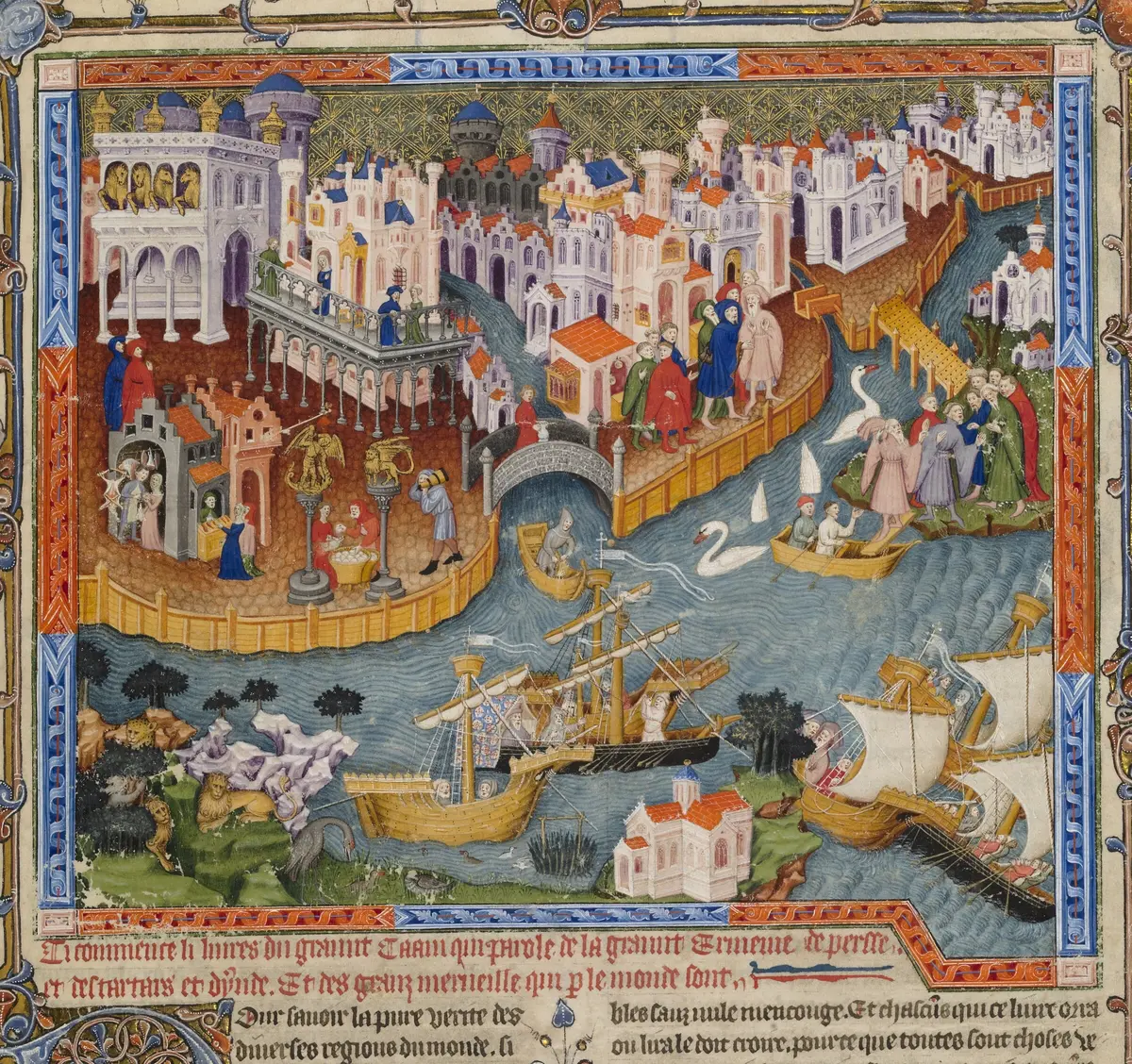
The Venetians Niccolò and Maffeo Polo return to his court at Shangdu with the pope's letters, bringing Niccolò's son Marco, about twenty, who will serve Kublai for some seventeen years.
Shangdu (Xanadu): the city laid out for him in 1256, where he was elected great khan in 1260; his first capital, then his summer capital - 1276
His general Bayan takes the Song capital, Hangzhou, and the boy emperor; the captive Song family is brought north and treated well, while loyalists carry the surviving princes south.
- 1279
At Yamen in the Pearl River delta his fleet destroys the last Song fleet; the minister Lu Xiufu leaps into the sea with the child emperor. China is united again, and Kublai is the first conqueror from the steppe to rule all of it.
- 1280
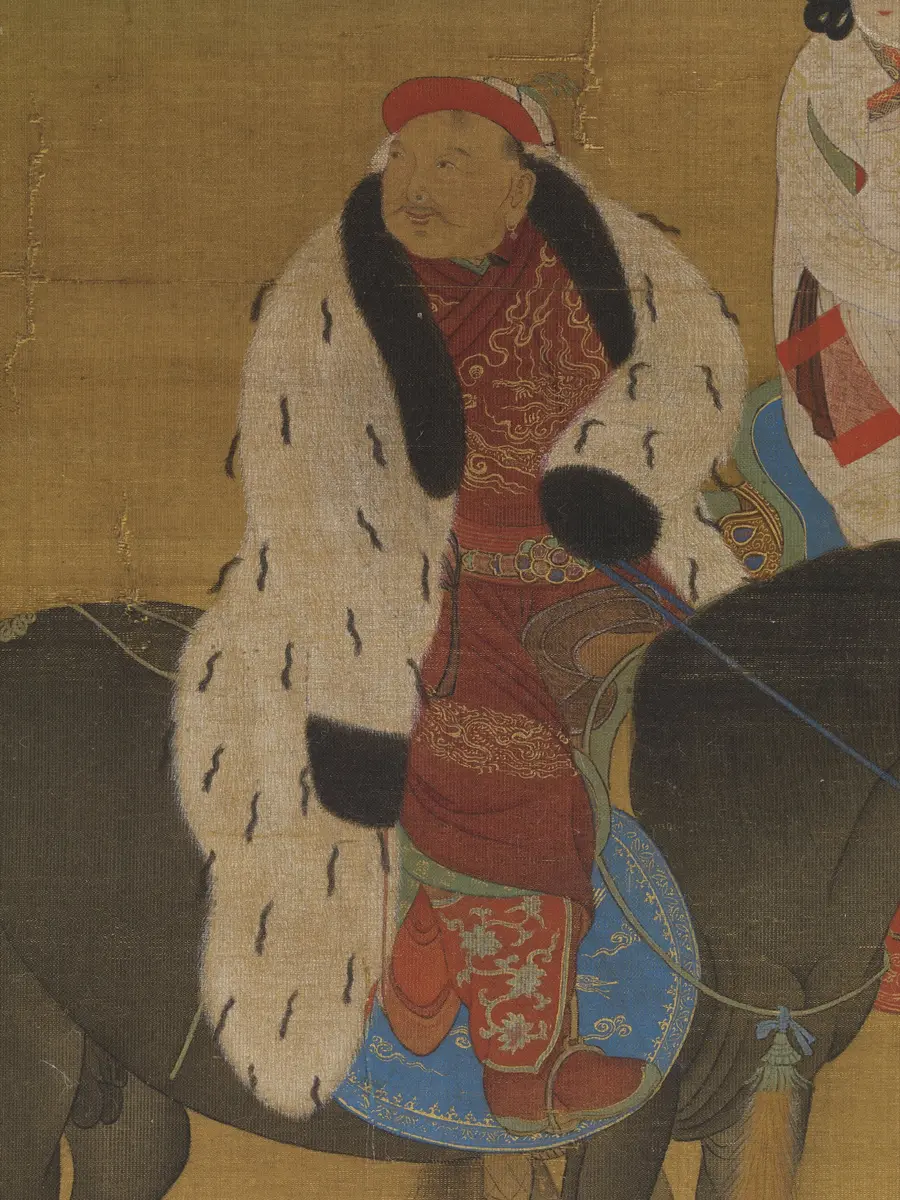
Early in the year his court painter Liu Guandao, appointed to the Imperial Wardrobe Service the year before, paints him out hunting in a white fur coat beside his empress Chabi: the one dated portrait of him made in his lifetime.
- 1281
His chief empress Chabi dies; in his last years he withdraws more and more from his advisers.
A second, far larger invasion of Japan, from Korea and from southern China, is held for weeks at the stone wall on Hakata Bay and on the islands; then a typhoon, the kamikaze or 'divine wind', wrecks the fleet at anchor.
Hakata Bay in Kyushu, where his armies landed in 1274 and were held at the stone wall in 1281- 1286
His son and chosen heir Zhenjin, raised on Confucian learning, dies before him; Kublai later names Zhenjin's son Temür his successor.
- 1287
To pay for his wars he issues a new paper currency, the Zhiyuan notes, each worth five of the old; the old notes keep circulating, and their value falls.
The Mongol prince Nayan rebels in Manchuria with Kaidu's encouragement. Kublai, seventy-two, marches against him in person and wins; Nayan is put to death. Marco Polo says the old emperor watched the battle from a wooden tower carried by four elephants.
- 1288
On the Bạch Đằng river in northern Vietnam the Vietnamese catch his fleet on stakes driven into the riverbed at falling tide and destroy it; his third invasion of Đại Việt ends in retreat.
- 1289
His envoy Meng Qi reaches Java to demand tribute from King Kertanagara of Singhasari, who refuses and sends him back; Kublai prepares a fleet to punish him.
- 1293
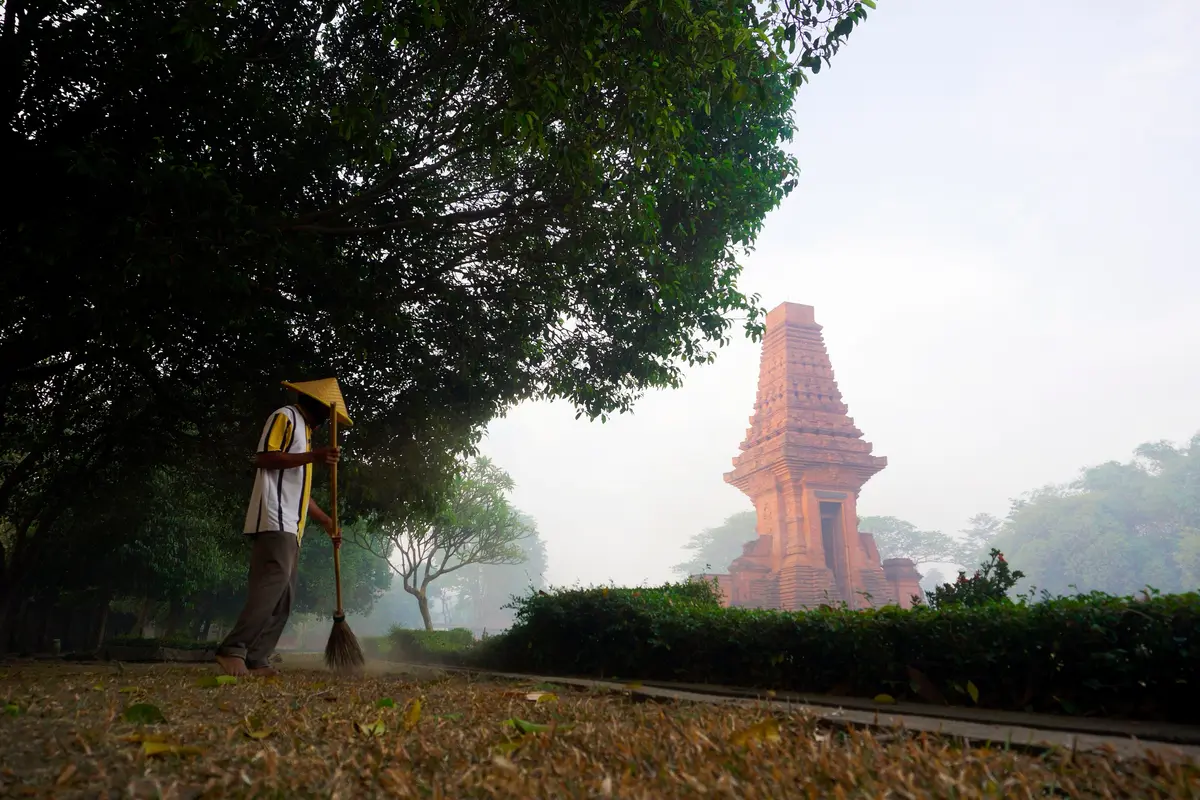
His fleet of some 20,000 men lands in Java to find Kertanagara already killed by a rival. Kertanagara's son-in-law Raden Wijaya joins the invaders to defeat the usurper, then turns on them and drives them out, and founds the kingdom of Majapahit.
- 1294
He dies at Dadu, in the Zitan hall of his palace, aged seventy-eight by Western reckoning; his body is taken to Mongolia to be buried where the khans lie, and his grandson Temür succeeds him.
Khanbaliq (Dadu), now Beijing: his capital, begun in 1267, where he died in 1294