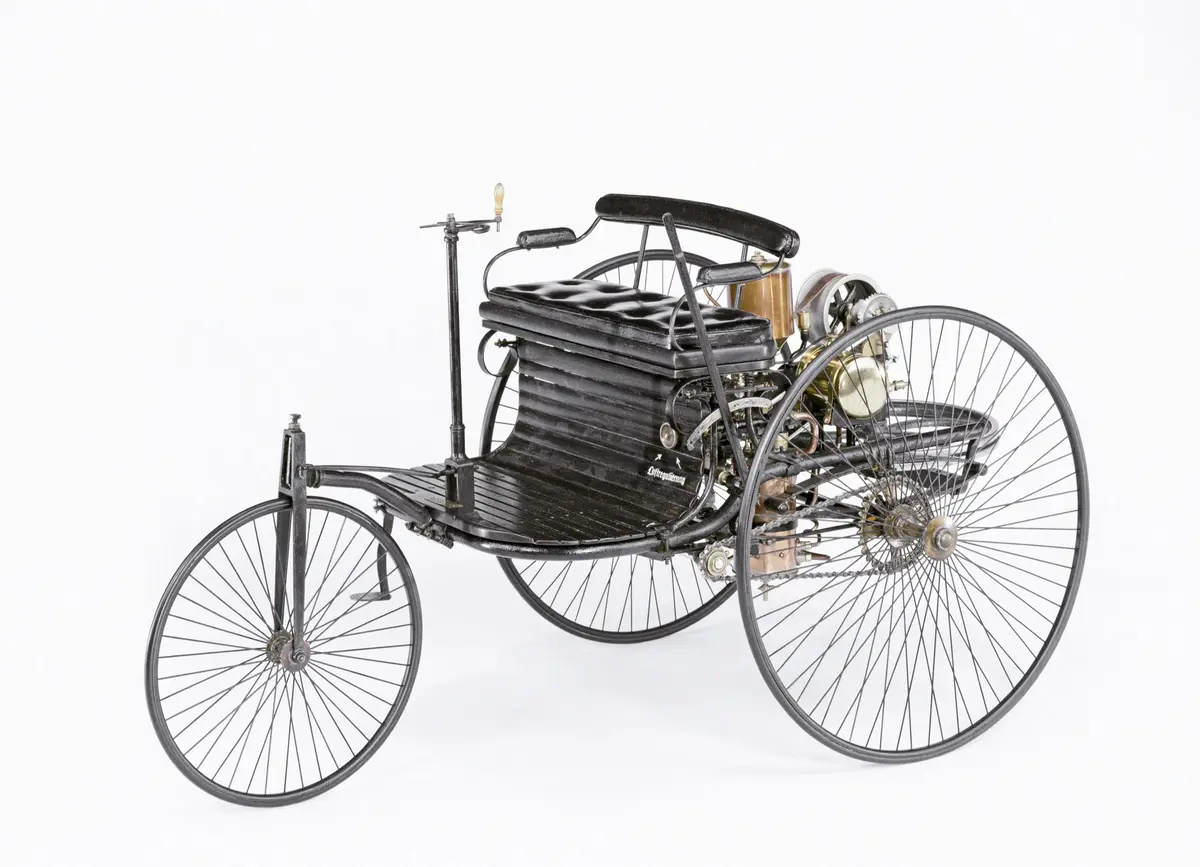
Karl Benz patents the automobile
“In 1886 Carl Benz patented his three-wheeled petrol car, the first real automobile; in 1888 his wife Bertha proved it with the first long drive.”
On 29 January 1886 a small Mannheim engine maker, Benz & Co., asked the Imperial Patent Office in Berlin to protect a 'vehicle with gas-engine drive'. The patent, No. 37435, was printed on 2 November 1886 and counted from the January date. Its drawings show a light three-wheeled carriage for two people, driven by a small engine at the back that made its own fuel gas from ligroin, a light petroleum spirit sold by chemists, and kept its cylinder cool by boiling off water. This was Carl Benz's Patent-Motorwagen, or patent motor car: not a coach with an engine added, but a new machine designed around the engine, with a frame of steel tubes, wire wheels, one cylinder lying flat, a big flywheel turning flat behind the seat, and a belt and chains to the rear wheels. It gave less than one horsepower; later versions reached about 16 kilometres (10 miles) an hour.
Benz, born in 1844 near Karlsruhe, the son of a railway engine driver, was a trained mechanical engineer who had long wanted to build a 'horseless carriage'. First he needed an engine and money. His two-stroke gas engine first ran properly on New Year's Eve 1879, and its sales let him found Benz & Cie. in Mannheim in October 1883 with two businessmen who sold bicycles, Max Rose and Friedrich Wilhelm Esslinger. For the car he turned to the four-stroke principle, whose Deutz patent had been partly struck down in 1884, and built a smaller, faster engine. He finished the car in October 1885, tried it in the works yard and on dark early-morning streets, and drove it in public on Mannheim's Ring road on 3 July 1886. The local paper reported it, but almost nobody wanted one. Less than a hundred kilometres away, in Cannstatt near Stuttgart, Gottlieb Daimler and Wilhelm Maybach had built their own fast petrol engine and put it on a wooden two-wheeler in 1885 and in a horse carriage in 1886. The two teams worked apart; Benz later said he never once spoke to Daimler.
What the car still lacked was proof that it was useful. At dawn on 5 August 1888 Bertha Benz, who had put her dowry into her husband's business, took the improved Model 3 without telling him and set off with their sons Eugen, 15, and Richard, 13, to visit her mother in Pforzheim, about 100 kilometres away. It was the first long journey ever made by car. She bought ligroin at the town pharmacy in Wiesloch, cleared a blocked fuel line with her hatpin, fixed the ignition with her garter, had a blacksmith mend the chain and a cobbler put new leather on the brakes, and pushed the car up the hills. After about thirteen hours they arrived, and a few days later they drove home. Her report led Benz to add a gear for climbing hills. In September he showed the car at the Munich engineering exhibition, drove it through the city several times a day and won the top gold medal. The Model 3 became the first car built in series for sale, at 3,000 marks, and in France the engineer Émile Roger took over the selling.
Sales stayed slow for years, but Benz kept improving his design: four wheels with proper steering in 1893, then the light and cheap Velo of 1894, of which about 1,200 were built, and by 1900 Benz & Cie. was the largest car factory in the world. In 1926 it joined Daimler's company to form Daimler-Benz, the maker of Mercedes-Benz cars. Patent 37435 is often called the birth certificate of the automobile, and in 2011 UNESCO added it to its Memory of the World register. The original car went to the Deutsches Museum in Munich in 1906 and is still on show there, and Bertha's road is signposted today as the Bertha Benz Memorial Route. Every petrol car since has the same basic parts that Benz first put together as one design: engine, fuel supply, ignition, cooling, gears and brakes.
What happened
- 1885
After months of work in his workshop in Mannheim, Carl Benz finishes his three-wheeled motor car and begins to test it: first in the works yard, then on short runs in the streets nearby, at night or early in the morning.
Benz's workshop in block T6, Mannheim: where Carl Benz built the Patent-Motorwagen in 1885 (a plaque at T6 33 marks the spot)- 1886
Benz & Co. of Mannheim apply to the Imperial Patent Office in Berlin for a patent on a 'vehicle with gas-engine drive': a light tricycle for two people with a small engine that makes its own gas from ligroin.
Early in the morning Benz drives the car in public for the first time, round the Ring road of Mannheim's old town. That day's morning edition of the Neue Badische Landeszeitung reports that the 'velocipede running on ligroin gas' was tested on the ring road and 'is said to have performed satisfactorily'.
Mannheim: the old town inside the Ring, where Benz first drove in public on 3 July 1886 and where Bertha Benz set out on 5 August 1888In Cannstatt, near Stuttgart, Gottlieb Daimler takes delivery of a horse carriage, brought secretly to his house at night, officially as a birthday present for his wife; Wilhelm Maybach then fits it with their fast petrol engine, a few months after Benz's car. The year before they had put the engine on a wooden two-wheeler, the 'riding car'. The two teams never work together.
Gottlieb Daimler's garden house, Cannstatt: the workshop where Daimler and Maybach built their engine and vehicles at the same timeThe Imperial Patent Office issues patent No. 37435 to Benz & Co., valid from 29 January 1886; its two drawing sheets show the three-wheeler and its engine in detail.
- 1888
The Grand Ducal Baden District Office gives Carl Benz written permission to drive his car on public roads, which the German patent office calls the world's first driving licence.
Mannheim: the old town inside the Ring, where Benz first drove in public on 3 July 1886 and where Bertha Benz set out on 5 August 1888At first light Bertha Benz leaves Mannheim in the improved Model 3 with her sons Eugen, 15, and Richard, 13, without telling her husband, to visit her mother in Pforzheim, about 100 kilometres to the south: the first long journey by car.
Mannheim: the old town inside the Ring, where Benz first drove in public on 3 July 1886 and where Bertha Benz set out on 5 August 1888On the way Bertha buys ligroin at the town pharmacy in Wiesloch, clears a blocked fuel line with her hatpin, fixes the ignition with her garter, has a blacksmith mend the chain and a cobbler put new leather on the brakes, and the three push the car up the hills.
Stadt-Apotheke, Wiesloch: the town pharmacy where Bertha Benz bought ligroin on 5 August 1888, called the world's first filling stationAfter about thirteen hours on the road they reach Pforzheim; telegrams sent on the way have told Carl that all is well. A few days later they drive home to Mannheim by car, and Bertha's report leads Benz to add a gear for climbing hills.
Pforzheim: Bertha Benz's home town, where she and her sons reached her mother's house at the end of 5 August 1888Benz shows the Patent-Motorwagen at the Power and Work Machines Exhibition in Munich, drives it between the grounds and the city several times a day and wins the exhibition's highest award, the Grand Gold Medal. The Model 3 goes on sale as the first car built in series, and in France the engineer Émile Roger takes over the selling.
Munich: the Power and Work Machines Exhibition of September 1888, where the car won the top gold medal and drove through the streets