The Wright brothers fly
“On 17 December 1903 at Kill Devil Hills, near Kitty Hawk, Orville and Wilbur Wright made the first controlled, powered airplane flights; the longest lasted 59 seconds.”
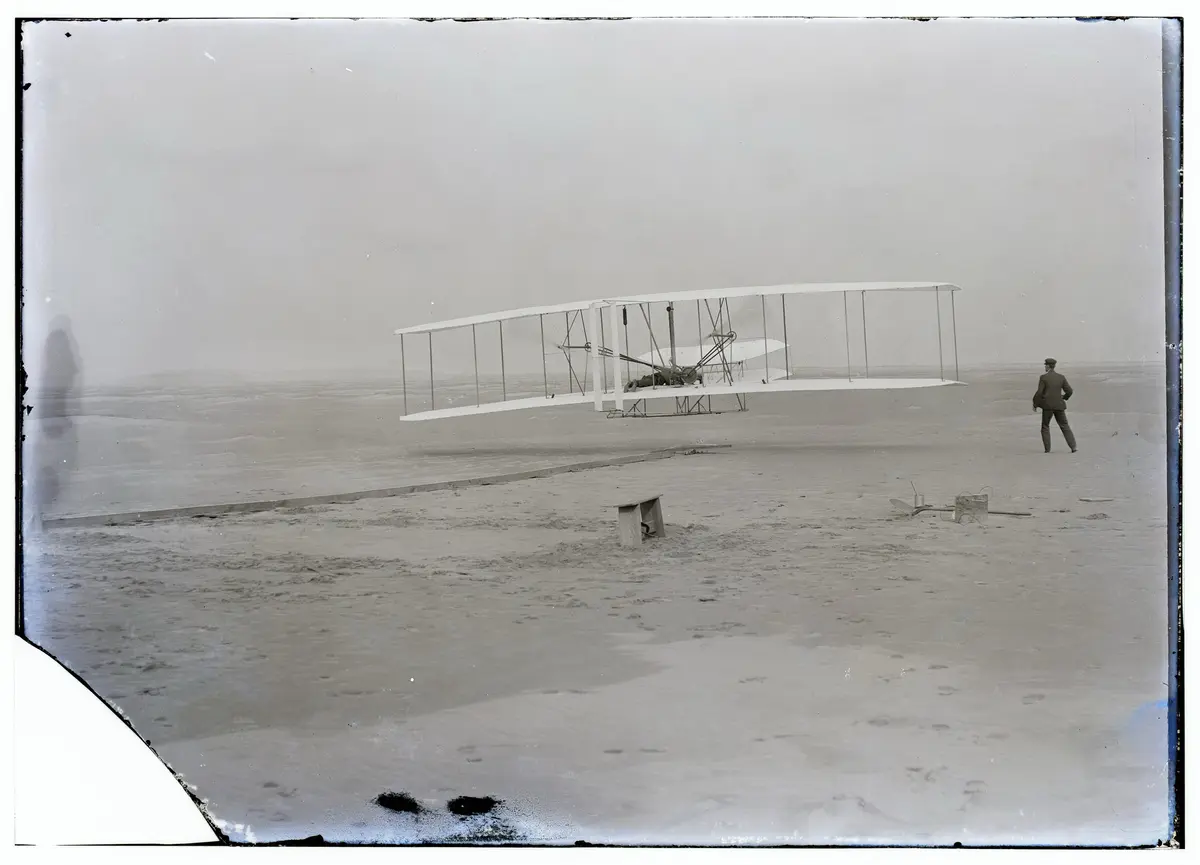
On the morning of 17 December 1903, on the windswept sand at Kill Devil Hills, near the fishing village of Kitty Hawk in North Carolina, Orville Wright lay on the lower wing of a machine he and his brother Wilbur had built and flew it for 12 seconds and 120 feet into a freezing wind of about 27 miles an hour. It was the first time a powered machine heavier than air carried a person off the ground under its own power, flew under the pilot's control and came down safely. The brothers took turns and made four flights before noon; the last, by Wilbur, covered 852 feet in 59 seconds. Then a gust of wind rolled the Flyer over and wrecked it. Five local men watched, and one of them, John T. Daniels of the lifesaving station, took the famous photograph with Orville's camera.
Wilbur (1867–1912) and Orville (1871–1948) were sons of a bishop of the United Brethren church in Dayton, Ohio. They never went to college; they ran a printing business and, from 1892, a bicycle shop whose profits paid for their experiments. News of the death of the German glider pioneer Otto Lilienthal in 1896 turned their curiosity into a project, and in May 1899 Wilbur wrote to the Smithsonian Institution for whatever it had on flight. Others were building engines; the Wrights saw that the real problem was control. They tested 'wing-warping', twisting the wing tips in opposite directions to bank the machine, on a kite in 1899, then took gliders to the empty dunes of the Outer Banks, chosen with the help of the Weather Bureau for their strong, steady winds. When their 1901 glider lifted only a third of what the published tables promised, they built a wind tunnel in the shop, measured model wings themselves and made new tables. Their 1902 glider, with a movable rudder linked to the warping, was the first aircraft that could be controlled in all three directions: climbing and diving, rolling, and turning left and right.
For powered flight they needed a light engine, which their shop mechanic Charlie Taylor built with them (about 12 horsepower, with the first aluminium crankcase used in an aircraft), and propellers, which they designed as spinning wings. The newspapers that reported Kitty Hawk got the facts wrong, and few people believed them. At Huffman Prairie, a cow pasture outside Dayton, the brothers learned to turn and circle in 1904, and on 5 October 1905 Wilbur flew 24 miles in 39 minutes: the first practical airplane. Then, to protect their patent (filed in March 1903, granted on 22 May 1906) and to find buyers, they stopped flying for two and a half years and showed the machine to no one; a New York paper wrote that they were 'either fliers or liars'. The doubt ended on 8 August 1908, when Wilbur flew in public at a racecourse near Le Mans in France and the French aviator Léon Delagrange admitted, 'We are beaten.' In September Orville flew for more than an hour at Fort Myer near Washington for the US Army, until on 17 September a propeller split and his passenger, Lieutenant Thomas Selfridge, became the first person killed in a powered airplane. Orville finished the Army's trials in July 1909, and on 2 August the Army bought the airplane for $30,000, the first flying machine bought by any government.
The airplane changed the world within one lifetime. Armies were its first customers; by the First World War it was a weapon, and in 1969 Neil Armstrong carried pieces of the 1903 Flyer's fabric and propeller to the Moon. The Wrights' method, wind-tunnel data, control in three directions, propeller theory and careful testing in the air, is still the base of aeronautical engineering. Their own story ended less happily: they spent years in patent lawsuits, above all against Glenn Curtiss, and Wilbur died in 1912, aged 45. Orville quarrelled with the Smithsonian, which for years labelled the failed 1903 'Aerodrome' of its former head, Samuel Langley, as the first airplane capable of carrying a man in sustained flight; in protest he sent the Flyer to the Science Museum in London in 1928. The Smithsonian corrected itself in 1942, and the Flyer came home after Orville's death, on 17 December 1948. It hangs today in the National Air and Space Museum in Washington, while the Dayton shop where its parts were made stands in Henry Ford's Greenfield Village in Michigan.
What happened
- 1899
In their Dayton bicycle shop, Wilbur writes to the Smithsonian Institution asking for its papers on flight and a list of further reading; on 2 June the Smithsonian sends four pamphlets and a list of books.
Wright Cycle Company building, Dayton: the only one of the brothers' bicycle-shop buildings still in Dayton; the shop at 1127 West Third Street round the corner, where they wrote to the Smithsonian and built the parts of their gliders and the Flyer, now stands in Greenfield VillageIn the summer the brothers build a biplane kite five feet across and fly it before a dozen schoolboys, twisting its wings with four cords to tilt it left and right: the first test of their 'wing-warping' control.
Wright Cycle Company building, Dayton: the only one of the brothers' bicycle-shop buildings still in Dayton; the shop at 1127 West Third Street round the corner, where they wrote to the Smithsonian and built the parts of their gliders and the Flyer, now stands in Greenfield Village- 1900
After weather data from the US Weather Bureau, William Tate of Kitty Hawk writes recommending the place for their experiments and promising 'a hospitable people'; two days earlier the village's weather observer, Joseph Dosher, had sent details of the winds.
Kitty Hawk, North Carolina: the village where Wilbur stayed with William Tate in 1900 and the brothers flew their first glider; the telegram of 17 December 1903 went out from its Weather Bureau stationAfter travelling by train and boat via Elizabeth City, Wilbur reaches Kitty Hawk, stays with the Tates and starts assembling their first full-size glider; Orville arrives on 28 September.
Kitty Hawk, North Carolina: the village where Wilbur stayed with William Tate in 1900 and the brothers flew their first glider; the telegram of 17 December 1903 went out from its Weather Bureau stationThey fly the glider mostly as a kite and make about a dozen free glides, only two minutes in the air in all; the controls work, but the lift is less than they calculated. They leave on 23 October.
Kitty Hawk, North Carolina: the village where Wilbur stayed with William Tate in 1900 and the brothers flew their first glider; the telegram of 17 December 1903 went out from its Weather Bureau station- 1901
Back on the Outer Banks, now camped at the Kill Devil Hills, they first try the larger 1901 glider; in 50 to 100 glides it gives only a third of the lift they predicted and turns unpredictably. Octave Chanute visits from 4 to 11 August.
Wright Brothers National Memorial, Kill Devil Hills: Big Kill Devil Hill, where they made their glides of 1901–03, and the site of their campFrom October to December, in their Dayton shop, they test dozens of model wings in a wind tunnel of their own design and find that the accepted figures, including Lilienthal's tables and Smeaton's coefficient, are wrong.
Wright Cycle Company building, Dayton: the only one of the brothers' bicycle-shop buildings still in Dayton; the shop at 1127 West Third Street round the corner, where they wrote to the Smithsonian and built the parts of their gliders and the Flyer, now stands in Greenfield Village- 1902
They begin gliding in the 1902 glider, longer and thinner-winged after the tunnel tests; by 24 October they have made 700 to 1,000 glides, the longest 622 1/2 feet and 26 seconds.
Wright Brothers National Memorial, Kill Devil Hills: Big Kill Devil Hill, where they made their glides of 1901–03, and the site of their campTo stop the glider spinning into the sand in turns, they replace its fixed double fin with a single movable rudder linked to the wing-warping: the first aircraft controlled in all three directions.
Wright Brothers National Memorial, Kill Devil Hills: Big Kill Devil Hill, where they made their glides of 1901–03, and the site of their campIn Dayton they begin propeller experiments and the building of a light four-cylinder petrol engine with their mechanic, Charlie Taylor; it first runs on 12 February 1903.
Wright Cycle Company building, Dayton: the only one of the brothers' bicycle-shop buildings still in Dayton; the shop at 1127 West Third Street round the corner, where they wrote to the Smithsonian and built the parts of their gliders and the Flyer, now stands in Greenfield Village- 1903
The brothers apply for a US patent on their flying machine, its wing-warping and rudder control; it will take more than three years to be granted.
They return to Kill Devil Hills, build a new shed and from 9 October assemble the powered Flyer; propeller shafts break on 5 and 28 November, and Orville fetches new ones from Dayton, returning on 11 December.
Wright Brothers National Memorial, Kill Devil Hills: Big Kill Devil Hill, where they made their glides of 1901–03, and the site of their campOn the Potomac near Washington, the Smithsonian Secretary Samuel Langley's government-funded Great Aerodrome collapses at launch for the second time, nine days before Kitty Hawk.
Wilbur wins a coin toss and makes the first attempt from the slope of Big Kill Devil Hill; he climbs too steeply, stalls after three and a half seconds and lands 105 feet below, damaging the front elevator.
Wright Brothers National Memorial, Kill Devil Hills: Big Kill Devil Hill, where they made their glides of 1901–03, and the site of their campIn the late afternoon Orville telegraphs their father, 'Success four flights thursday morning … inform Press home Christmas'; Kitty Hawk's weather observer sends it to Norfolk, and Western Union carries it to Dayton.
Kitty Hawk, North Carolina: the village where Wilbur stayed with William Tate in 1900 and the brothers flew their first glider; the telegram of 17 December 1903 went out from its Weather Bureau station- 10:35 a.m.
Into a freezing 27-mile-an-hour wind, Orville takes off from the level rail and flies for 12 seconds and 120 feet while Wilbur runs alongside: the first powered, controlled flight. John T. Daniels of the lifesaving station takes the photograph.
The take-off spot of 17 December 1903 at Kill Devil Hills, marked since 1928 by a granite boulder: all four flights started here - 11:00 a.m.
Wilbur makes the second flight, about 175 feet in about 12 seconds; at 11:40 Orville makes the third, a little over 200 feet in 15 seconds.
The take-off spot of 17 December 1903 at Kill Devil Hills, marked since 1928 by a granite boulder: all four flights started here - 12:00 p.m.
On the fourth flight Wilbur stays up for 59 seconds and 852 feet, landing hard. Soon afterwards a gust overturns the Flyer and wrecks it; it never flies again.
The take-off spot of 17 December 1903 at Kill Devil Hills, marked since 1928 by a granite boulder: all four flights started here The Norfolk Virginian-Pilot, the New York American, the Cincinnati Enquirer and Dayton's afternoon papers print the first, inaccurate accounts of the flights; few readers take them seriously.
- 1904
The brothers give the Associated Press a statement correcting the reports, in which they say they came home 'knowing that the age of the flying machine had come at last'.
At Huffman Prairie, a pasture outside Dayton, Orville makes the first short hop in their new, heavier machine, after failed attempts on 23 and 25 May; by December they have made 105 starts.
Huffman Prairie Flying Field, near Dayton: where the brothers learned to turn and circle in 1904 and flew 24 miles in 1905Launched by the weight-driven catapult they first used on 7 September, Wilbur flies the first complete circle in an airplane, watched by Amos Root, who publishes the first eyewitness account in his beekeeping journal.
Huffman Prairie Flying Field, near Dayton: where the brothers learned to turn and circle in 1904 and flew 24 miles in 1905- 1905
In the Flyer III, Wilbur flies 24 miles in 39 minutes, more than 29 laps of the field: a practical airplane at last.
Huffman Prairie Flying Field, near Dayton: where the brothers learned to turn and circle in 1904 and flew 24 miles in 1905The US Army's Board of Ordnance and Fortification again declines to act on the brothers' offer to sell it a flying machine; they now make no more flights until 1908.
- 1906
The US Patent Office grants the brothers patent 821,393 for a 'flying-machine', the basis of years of lawsuits.
- 1908
The War Department accepts the Wrights' bid to deliver an airplane that can carry two men at 40 miles an hour, for $25,000; by the spring a French syndicate has also signed for their machine.
Practising at Kill Devil Hills for the coming trials, Wilbur takes up the first airplane passenger, Charles W. Furnas of Dayton.
Wright Brothers National Memorial, Kill Devil Hills: Big Kill Devil Hill, where they made their glides of 1901–03, and the site of their campAt the Hunaudières racecourse near Le Mans, Wilbur makes the Wrights' first flight in Europe, 1 minute 45 seconds before a crowd and the Paris press; doubt vanishes overnight, and Léon Delagrange says, 'We are beaten.'
Hippodrome des Hunaudières, Le Mans: the racecourse where Wilbur first flew in public, on 8 August 1908At Fort Myer, Virginia, Orville begins the Army trials with a flight of 1 minute 11 seconds, one and a half times round the parade ground.
Fort Myer, Virginia (today Joint Base Myer–Henderson Hall): the Army trials of September 1908, the crash that killed Lieutenant Selfridge, and the trials of July 1909Orville stays up for 57 minutes and then for 1 hour 2 minutes, and carries Lieutenant Frank Lahm for 6 minutes: three records in a day, watched by the Secretary of War and the Secretary of Commerce and Labor.
Fort Myer, Virginia (today Joint Base Myer–Henderson Hall): the Army trials of September 1908, the crash that killed Lieutenant Selfridge, and the trials of July 1909- 5:14 p.m.
Orville takes off with Lieutenant Thomas Selfridge as passenger; after four and a half circuits a propeller blade splits and the airplane falls from about 75 feet. Orville is badly hurt; Selfridge dies within hours, the first person killed in a powered airplane.
Fort Myer, Virginia (today Joint Base Myer–Henderson Hall): the Army trials of September 1908, the crash that killed Lieutenant Selfridge, and the trials of July 1909 At Camp d'Auvours, Wilbur flies for 1 hour 31 minutes and 66.6 kilometres, a world record, before the American ambassador.
Camp d'Auvours, east of Le Mans: Wilbur's flying field from 21 August to 31 December 1908, where he set world records and won the Michelin CupOn the last day of the year Wilbur flies for 2 hours 20 minutes and 124.7 kilometres, winning the Michelin Cup and 20,000 francs.
Camp d'Auvours, east of Le Mans: Wilbur's flying field from 21 August to 31 December 1908, where he set world records and won the Michelin Cup- 1909
Wilbur moves to Pau in the south of France to train French pilots; Orville, recovered, and their sister Katharine join him two days later.
At Centocelle near Rome, where he is training Italian officers, Wilbur flies before King Victor Emmanuel III, and a cameraman on board shoots the first film taken from an airplane.
Dayton holds two days of parades, fireworks and receptions for the brothers; on 18 June they receive gold medals from Congress, the State of Ohio and the city.
Wright Cycle Company building, Dayton: the only one of the brothers' bicycle-shop buildings still in Dayton; the shop at 1127 West Third Street round the corner, where they wrote to the Smithsonian and built the parts of their gliders and the Flyer, now stands in Greenfield VillageBack at Fort Myer with a new machine, Orville flies with Lieutenant Lahm for 1 hour 12 minutes, meeting the Army's endurance test before President Taft and some 10,000 spectators.
Fort Myer, Virginia (today Joint Base Myer–Henderson Hall): the Army trials of September 1908, the crash that killed Lieutenant Selfridge, and the trials of July 1909With Lieutenant Benjamin Foulois, Orville flies the speed test to Shuter's Hill in Alexandria and back, about ten miles across country at an average of 42.5 miles an hour, earning a $5,000 bonus.
Fort Myer, Virginia (today Joint Base Myer–Henderson Hall): the Army trials of September 1908, the crash that killed Lieutenant Selfridge, and the trials of July 1909The Army's board of officers reports on the trials and the Chief Signal Officer approves the purchase for $30,000: the first flying machine bought and put into service by any government.