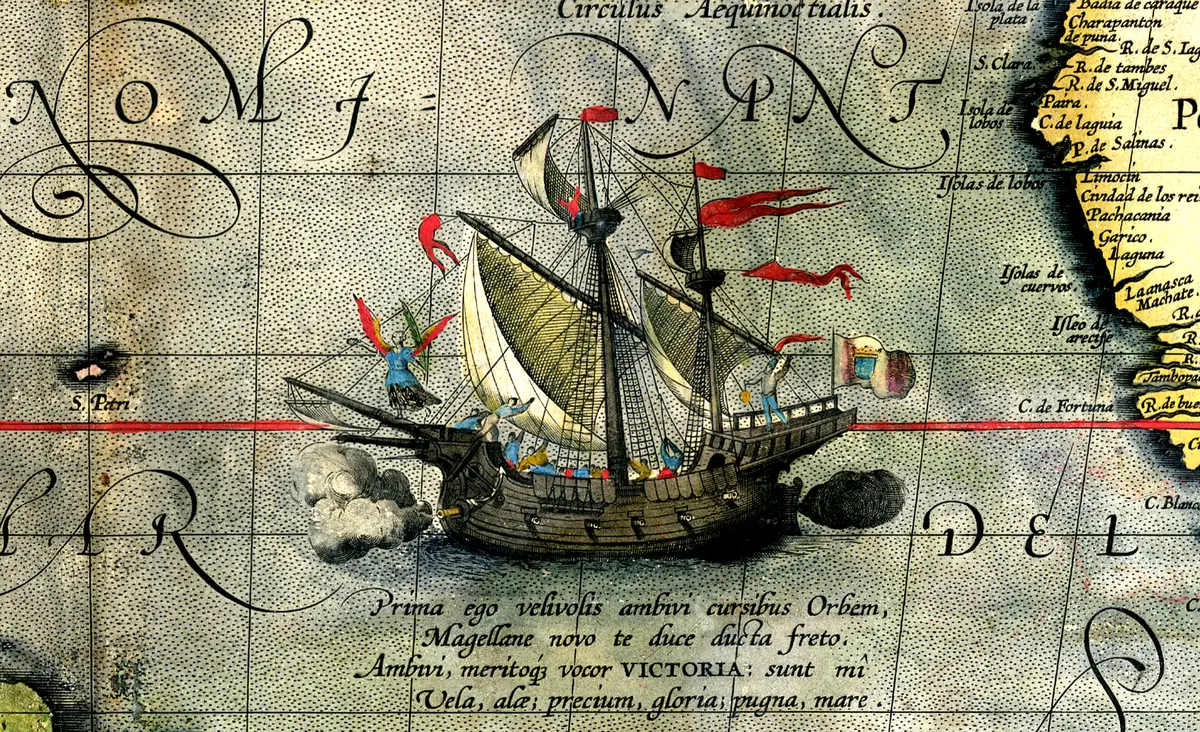
Magellan's expedition sails around the world
“The first voyage around the world (1519–1522): Magellan's Spanish fleet sailed west to the clove islands of Maluku; Magellan was killed in the Philippines, and Elcano brought one ship, the Victoria, home with 18 men.”
The first voyage around the world was a Spanish expedition of five ships led by a Portuguese captain, Ferdinand Magellan (Fernão de Magalhães in Portuguese). It set out in September 1519 to reach the Moluccas, the clove islands of what is now eastern Indonesia, by sailing west instead of east, and so to show that they lay in the half of the world that the Treaty of Tordesillas had given to Spain. Almost three years later a single ship, the Victoria, came back to Spain from the opposite direction with eighteen exhausted European survivors and a hold full of cloves. Magellan was not among them: he had been killed in the Philippines in 1521, and the Basque seaman Juan Sebastián Elcano brought the ship home.
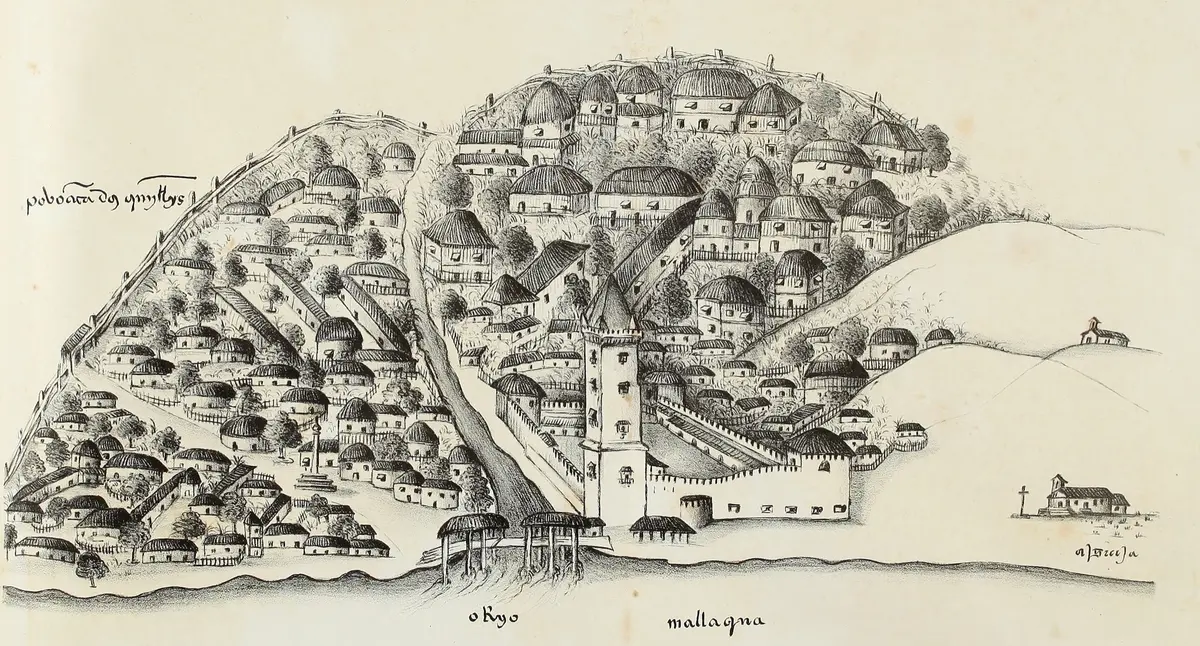
Magellan had fought for Portugal in India and at the taking of Malacca in 1511, and his friend Francisco Serrão, who settled on Ternate, sent him news of the spice islands. When King Manuel of Portugal refused to reward him, he moved to Seville in 1517, and on 22 March 1518 the young King Charles I of Spain, soon to be Emperor Charles V, accepted his plan. Five old ships, the Trinidad, San Antonio, Concepción, Victoria and Santiago, with roughly 240 to 270 men from many nations, left Sanlúcar de Barrameda on 20 September 1519. While the fleet wintered on the coast of Patagonia in 1520, the Spanish captains mutinied against their Portuguese commander; Magellan crushed the revolt, executed one captain and left another behind. The Santiago was wrecked, and on 21 October 1520 he found the passage at the tip of South America that now bears his name. In the strait the San Antonio deserted and sailed home.
The three remaining ships came out into an ocean so calm that they called it the Pacific, and took more than three months to cross it, eating rotten biscuit, rats and the leather from the rigging while scurvy killed the men, until they reached Guam on 6 March 1521. In the Philippines Magellan made an alliance at Limasawa, where the first Mass was said on Easter Sunday, and baptised the ruler of Cebu and many of his people. But when he tried to force Lapulapu, a chief of the island of Mactan, to submit, he was killed in the shallows on 27 April 1521. Days later the ruler of Cebu turned on the Spaniards and some two dozen were killed at a feast. Too few to sail three ships, the survivors burned the Concepción, wandered by way of Borneo and on 8 November 1521 anchored at Tidore in Maluku, whose sultan welcomed them as allies against Ternate and the Portuguese and sold them cloves.
The Trinidad sprang a leak and stayed behind; her crew tried to sail back across the Pacific, failed, and were taken prisoner by the Portuguese. The Victoria, commanded by Elcano, left Tidore on 21 December 1521 and went home the Portuguese way, across the Indian Ocean and round the Cape of Good Hope, keeping away from Portuguese ports while hunger and scurvy killed twenty-one of her men. At Santiago in the Cape Verde Islands in July 1522 the crew learned that their carefully kept log was one day behind the calendar: by sailing west all the way round the globe they had lost a day. On 6 September 1522 the Victoria entered Sanlúcar, and on 8 September she anchored at Seville with eighteen Europeans on board. The spices she carried were worth more than the four lost ships, and Charles V gave Elcano a coat of arms with a globe and the words 'Primus circumdedisti me', 'You were the first to go around me'.
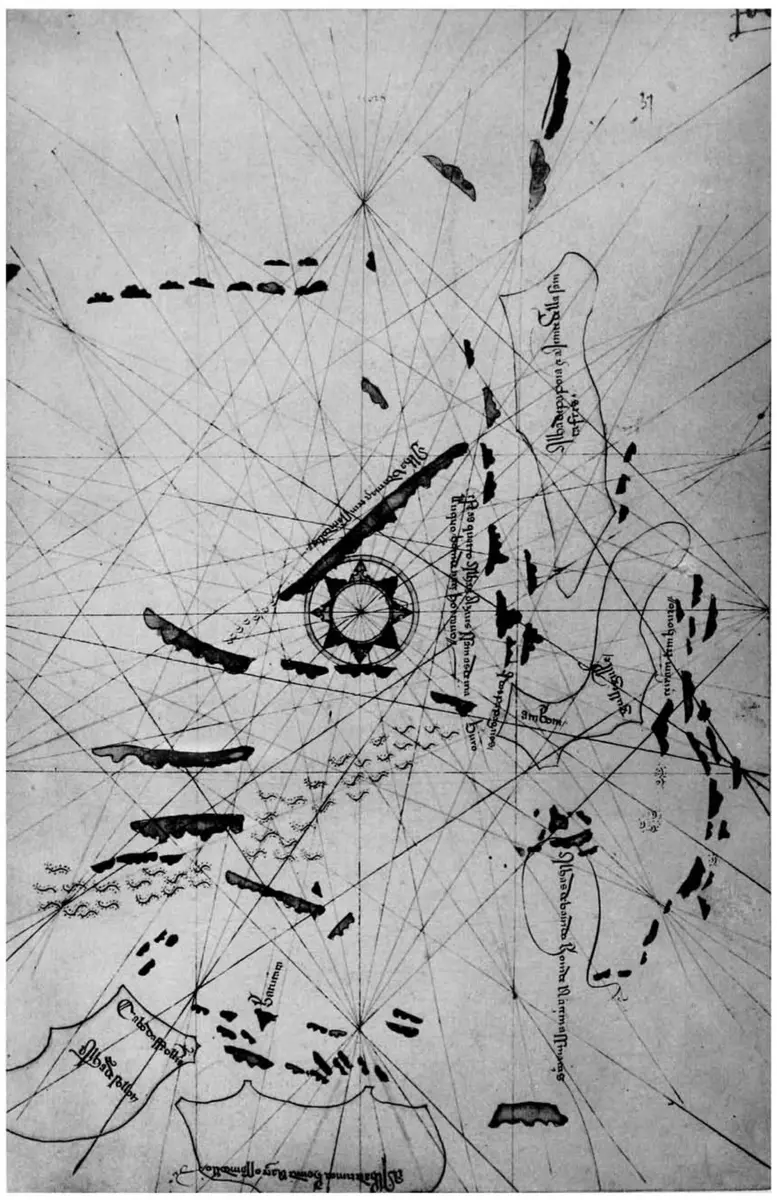
The voyage proved in practice that a ship could sail around the Earth and that the oceans are joined, and it showed that the Pacific was far wider than anyone in Europe had imagined. Its chronicler, the Italian Antonio Pigafetta, kept a day-by-day account, with hand-drawn maps of the islands and the first word lists of Malay and of the Visayan language of the central Philippines, that is still the main source for the voyage. For Maluku it was the start of a long contest: Spain and Portugal quarrelled over who owned the clove islands until the Treaty of Saragossa of 1529 left Asia to Portugal, and in the next century the Dutch fought both for the same trade.
What happened
- 1518
King Charles I of Spain accepts the plan of Magellan and the cosmographer Rui Faleiro to reach the Moluccas by sailing west, names them joint captains general and promises them a twentieth of the profits.
- 1519
With guns firing, the five ships leave Seville and go down the Guadalquivir to Sanlúcar, carrying 237 men by Pigafetta's count.
Seville: where the expedition was fitted out and where the Victoria anchored on 8 September 1522The fleet, the Trinidad, San Antonio, Concepción, Victoria and Santiago, sails from Sanlúcar de Barrameda into the Atlantic.
Sanlúcar de Barrameda, at the mouth of the Guadalquivir: where the fleet sailed on 20 September 1519 and the Victoria came back on 6 September 1522After crossing the Atlantic, Magellan enters the bay of Rio de Janeiro, then sails south along the coast looking for a passage.
- 1520
The fleet enters Port San Julián in Patagonia to wait out the southern winter, and Magellan cuts the rations.
Puerto San Julián, Patagonia: where the fleet wintered in 1520 and Magellan put down the mutiny of his Spanish captainsIn the night of Palm Sunday three Spanish captains seize the San Antonio, the Concepción and the Victoria. Magellan strikes back the next day: Luis de Mendoza is stabbed to death, the ships are retaken, Gaspar de Quesada is beheaded on 7 April and Juan de Cartagena is later left ashore.
Puerto San Julián, Patagonia: where the fleet wintered in 1520 and Magellan put down the mutiny of his Spanish captainsThe Santiago, sent ahead to explore the coast, is wrecked near the Santa Cruz River; her crew is saved and shared among the other ships.
The four remaining ships leave Port San Julián and sail south, leaving the mutineer Cartagena behind.
Rounding the Cape of the Virgins, Magellan enters the passage at the tip of South America that will bear his name.
Cabo Vírgenes, the Cape of the Virgins: the eastern entrance of the Strait of Magellan, reached on 21 October 1520The Trinidad, the Concepción and the Victoria come out into the 'Sea of the South', which they call the Pacific for its calm. The San Antonio has deserted in the strait and sails back to Spain, where she arrives in May 1521.
- 1521
After eight weeks at sea they sight their first land in the Pacific, probably Pukapuka in the Tuamotus, but cannot anchor; scurvy and hunger are killing the crews.
Landfall at Guam in the Marianas, with fresh food for the first time in 99 days; after islanders take a ship's boat, Magellan's men burn houses and kill several of them, and the fleet sails on.
Umatac, Guam: by local tradition the bay where the starving crews made their first landfall across the Pacific on 6 March 1521At dawn they sight Samar, the first of the Philippines; the next day Magellan lands his sick on the uninhabited island of Homonhon.
Homonhon, the Philippines: the uninhabited island where Magellan landed his sick on 17 March 1521On Easter Sunday the first Mass in the Philippines is said on Limasawa, and a cross is raised on the island's highest hill; its ruler becomes Spain's first ally in the Pacific.
Limasawa: the island where the first Mass in the Philippines was said on Easter Sunday, 31 March 1521The ships enter the harbour of Cebu, a trading town; with Magellan's slave Enrique of Malacca as interpreter, peace is made with its ruler.
The ruler of Cebu, his queen and many of his people are baptised; the queen is given a small image of the Christ child, still venerated in Cebu as the Santo Niño.
Magellan's Cross, Cebu City: where the ruler of Cebu and his people were baptised in April 1521On Mactan, Magellan wades ashore with 49 men against more than 1,500 warriors of the chief Lapulapu; wounded by arrows and spears, he is killed in the shallows with eight of his men.
The Liberty Shrine at Punta Engaño, Mactan: the memorial to Lapulapu by the shore where Magellan was killed on 27 April 1521The ruler of Cebu invites the Spaniards to a banquet and has some two dozen of them killed, among them their new commanders Duarte Barbosa and João Serrão.
Off Bohol the survivors burn the Concepción, too few now to sail three ships, and go on in the Trinidad and the Victoria, by way of Mindanao, Palawan and Brunei.
The Trinidad and the Victoria anchor at Tidore in Maluku, 27 months after leaving Spain. Its sultan welcomes them and promises all the cloves they want; they learn that Magellan's friend Francisco Serrão has died on Ternate.
Tidore, Maluku: the sultan's island where the Trinidad and the Victoria loaded cloves from 8 November to 21 December 1521The first cloves are stowed in the holds to the sound of the guns; trading goes on into December, the crews bartering even their clothes for cloves.
Tidore, Maluku: the sultan's island where the Trinidad and the Victoria loaded cloves from 8 November to 21 December 1521The Trinidad springs a leak and must stay to be repaired. The Victoria, under Juan Sebastián Elcano, sails from Tidore with 47 Europeans and 13 islanders to go home westward round Africa.
Tidore, Maluku: the sultan's island where the Trinidad and the Victoria loaded cloves from 8 November to 21 December 1521- 1522
The Victoria leaves Timor and heads out across the Indian Ocean, keeping south of Sumatra to avoid the Portuguese.
Repaired, the Trinidad sails east from Tidore for Panama with some fifty men; beaten back by winds and hunger, she returns to Maluku in the autumn and is seized by the Portuguese. Only four of her men ever see Spain again.
After weeks of storms the Victoria rounds the Cape of Good Hope, then sails north for two months without fresh food or water; twenty-one men die.
At Santiago in the Cape Verde Islands the crew buys rice from the Portuguese and finds it is Thursday ashore but Wednesday in their log: sailing west round the world has cost them a day. Thirteen men sent ashore are arrested, and the Victoria flees.
Cidade Velha (Ribeira Grande) on Santiago, Cape Verde: where the Victoria's crew found they had lost a day, 9 July 1522The Victoria enters the bay of Sanlúcar de Barrameda with eighteen men, most of them sick: the first ship to sail around the world.
Sanlúcar de Barrameda, at the mouth of the Guadalquivir: where the fleet sailed on 20 September 1519 and the Victoria came back on 6 September 1522She anchors at the quay of Seville and fires all her guns; the next day the survivors walk barefoot in their shirts, candles in hand, to give thanks at the shrine of Santa María de la Victoria.
Seville: where the expedition was fitted out and where the Victoria anchored on 8 September 1522