Mendel discovers the rules of heredity
“In an abbey garden in Brno the friar Gregor Mendel crossed peas for eight years and found that traits pass on as paired units in fixed ratios; he lectured on it in 1865, was ignored, and was rediscovered in 1900.”
In the garden of St Thomas's Abbey in Brünn (today Brno, in the Czech Republic), an Augustinian friar named Gregor Mendel spent eight seasons, from 1856 to 1863, crossing varieties of the garden pea and counting their offspring. He showed that characters such as the shape or the colour of a seed are not blended in the offspring but passed on as separate units that come in pairs: one of them can hide the other in the first generation of hybrids, then reappears, unchanged, in about a quarter of the next. From his counts he worked out the rules now called Mendel's laws, segregation and independent assortment, and so laid the foundation of genetics. He presented them in two lectures in February and March 1865 and printed them in 1866, and almost nobody understood what he had done until 1900.
Mendel was the son of poor farmers in Silesia and had joined the monastery in 1843 because it let him study. His abbot, Cyril Napp, believed in scientific farming and sent him to the University of Vienna from 1851 to 1853, where he learned physics from Christian Doppler, mathematics, and plant physiology and the use of the microscope from the botanist Franz Unger. Back in Brünn he taught at the Realschule, a secondary school, and in 1854 Napp allowed him to plan a large programme of crosses. For two years he tested 34 pea varieties bought from seed dealers to make sure that each bred true, kept 22 of them, and chose seven pairs of contrasting characters, such as round or wrinkled seeds, yellow or green seeds, and tall or dwarf plants. Peas suited the work: the varieties were distinct, the plants were easy to grow, and their flowers normally fertilise themselves, so he could make every cross by hand.
His method made the difference: he followed each character separately, raised thousands of plants and counted them. When round-seeded plants were crossed with wrinkled ones, all the hybrids had round seeds; but the hybrids' own seeds came out 5,474 round and 1,850 wrinkled, a ratio of 2.96 to 1, and his seven characters together gave 2.98 to 1. In the next generation one third of the round-seeded plants bred true and two thirds behaved like the hybrids, so the 3 to 1 was really 1 to 2 to 1. He explained this with a model drawn from his training in physics and combinatorics: a hybrid makes egg and pollen cells of both kinds in equal numbers, and they meet at random, which gives A + 2Aa + a; and different pairs of characters are passed on independently of each other.
He read his results to the Natural Science Society of Brünn on 8 February and 8 March 1865, and the paper, 'Versuche über Pflanzen-Hybriden' (Experiments on Plant Hybrids), appeared in the Society's proceedings in 1866, which were exchanged with more than 120 libraries and societies; Mendel also ordered 40 offprints and sent some to well-known botanists. The most important of them, Carl Nägeli in Munich, wrote back for years but stayed sceptical and encouraged him to work on hawkweed, a plant whose unusual way of making seeds, unknown at the time, hid the pattern. Readers took the paper as one more study of hybrids returning to their parent forms, and Darwin never saw it. In 1868 Mendel was elected abbot; administration and a long fight with the state over taxes on the monastery slowly ended his experiments, and he died on 6 January 1884.
In 1900 three botanists, Hugo de Vries in Amsterdam, Carl Correns in Germany and Erich von Tschermak in Vienna, published crossing experiments that gave Mendel's ratios and pointed back to his paper, partly in a contest over who had been first. In England William Bateson became Mendel's champion: he told the Royal Horticultural Society about the work on 8 May 1900, published an English translation in 1901, defended it in a book in 1902 and gave the new science its name, genetics. Mendel's units became Wilhelm Johannsen's 'genes' in 1909, were located on the chromosomes, and from the 1930s were joined with Darwin's natural selection; the double helix of 1953 showed what they are made of. His rules still underlie medical genetics and the breeding of plants and animals, and his paper is still read as a model of how to design an experiment and test a theory.
What happened
- 1854
Abbot Cyril Napp allows Mendel, now teaching at the Brünn Realschule, to plan a large programme of crosses in the abbey garden. For two years Mendel grows 34 pea varieties bought from seed dealers to check that each breeds true, and keeps 22 of them.
St Thomas's Abbey, Old Brno: the Augustinian monastery where Mendel lived from 1843 until his death and was elected abbot in 1868 - 1856
In the spring the crosses begin, in the garden and its greenhouse. Mendel pairs varieties that differ in one of seven characters, such as round or wrinkled seeds, opens each bud before it can pollinate itself, removes the stamens with forceps and dusts on pollen of the other variety. In May he falls ill and abandons a teaching examination in Vienna; the later story that a quarrel there started his experiments is a myth.
The abbey garden and the site of Mendel's greenhouse, now the Mendel Museum: where he grew and crossed his peas from 1856 to 1863 - 1862
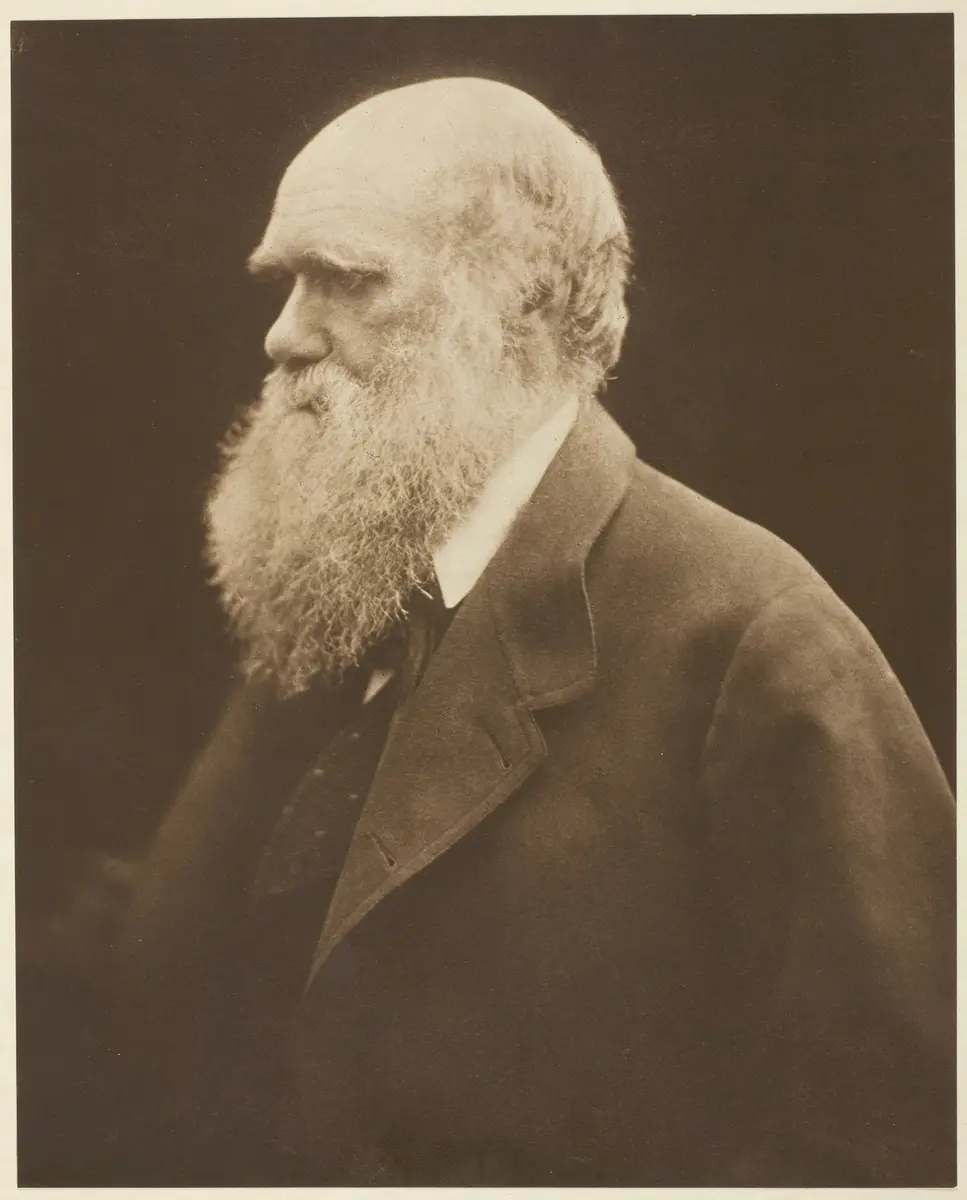
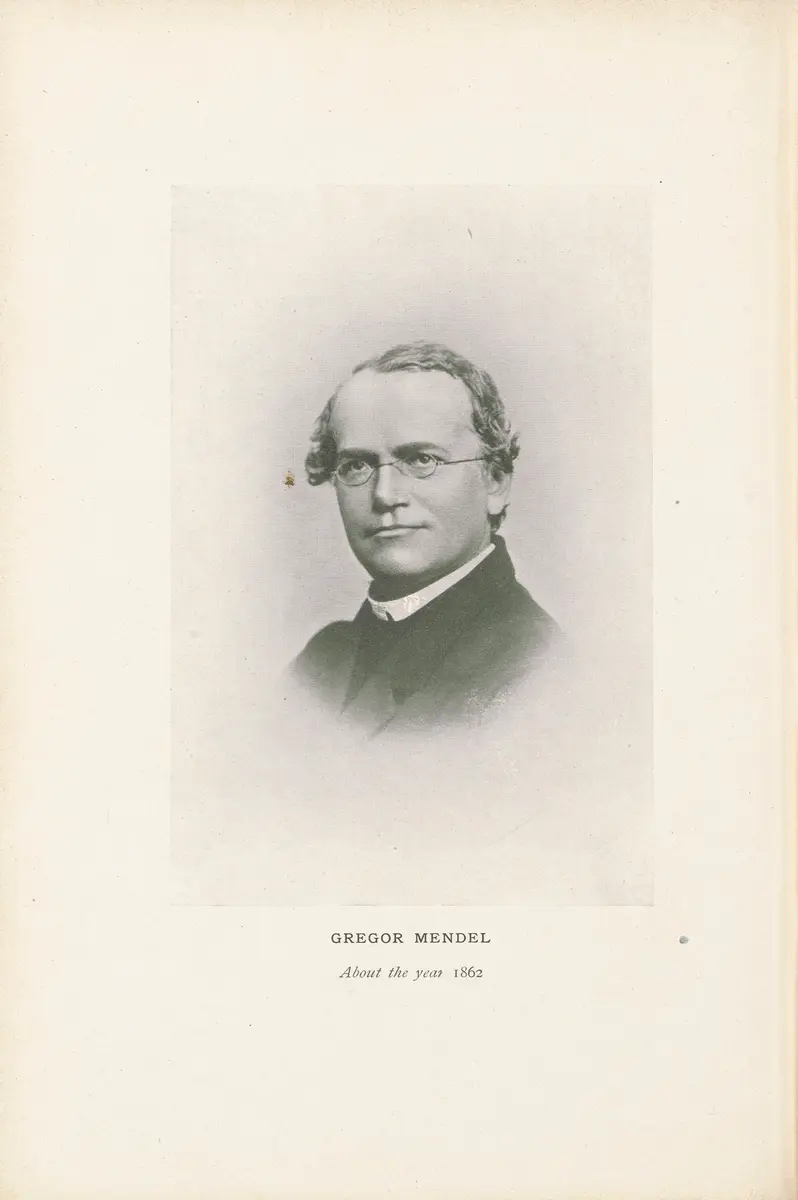
Mendel travels to London to see the International Exhibition, his only visit to England. The best-known photograph of him dates from about this year.
- 1863
The last of the pea crosses. Over eight seasons Mendel has examined more than 10,000 plants and counted their seeds: from 253 round-by-wrinkled hybrids came 5,474 round and 1,850 wrinkled seeds, 2.96 to 1. This year he also obtains Darwin's On the Origin of Species in German and annotates it.
The abbey garden and the site of Mendel's greenhouse, now the Mendel Museum: where he grew and crossed his peas from 1856 to 1863 - 1865
At the monthly meeting of the Natural Science Society of Brünn, Mendel's friend and fellow teacher Alexander Makowsky lectures on Darwin's theory.
The Realschule, Johannesgasse (today Jánská 22): the school where Mendel taught and where the Natural Science Society heard his two lectures in February and March 1865Mendel gives the first of two lectures on his experiments to the Natural Science Society: the characters, the hybrids and the counts of their offspring. A local newspaper reports it.
The Realschule, Johannesgasse (today Jánská 22): the school where Mendel taught and where the Natural Science Society heard his two lectures in February and March 1865In the second lecture Mendel explains his numbers: a hybrid forms egg and pollen cells of both kinds, which combine at random. This time there is a discussion, and the botanist Gustav von Niessl supports him from his own work with the microscope; Mendel later recalled that opinion was divided.
The Realschule, Johannesgasse (today Jánská 22): the school where Mendel taught and where the Natural Science Society heard his two lectures in February and March 1865- 1866
'Versuche über Pflanzen-Hybriden' is printed on pages 3 to 47 of the Society's Verhandlungen for 1865. The volume goes to more than 120 libraries and societies, and Mendel orders 40 offprints, some of which he sends to well-known botanists; only eight have been traced.
Mendel sends an offprint with a long letter to Carl Nägeli, professor of botany in Munich. Nägeli replies with doubts; their correspondence lasts until 1873, and Nägeli keeps Mendel's letters, the main record of his later work.
The University of Munich: Carl Nägeli, professor of botany, received Mendel's offprint and letters from 1866 to 1873- 1867
In his second letter to Nägeli, Mendel explains that he lectured in the hope that others would repeat the experiments, met divided opinion, and knew of nobody who had tried; he agreed to print the lecture only after checking his records again.
- 1868
After Napp's death the friars elect Mendel abbot of St Thomas's. He hopes to go on with his crosses, but the duties of the office leave him less and less time.
St Thomas's Abbey, Old Brno: the Augustinian monastery where Mendel lived from 1843 until his death and was elected abbot in 1868 - 1870
His paper on hawkweed hybrids is printed: unlike the pea's, their offspring seem to breed true, and he warns against treating the pea rules as universal laws. He also tells Nägeli of an experiment with the four-o'clock flower (Mirabilis) showing that a single pollen grain is enough to fertilise an egg.
- 1871
Mendel has a beehouse of his own design built in the abbey garden; bees and the weather, which he records three times a day, become his main science.
St Thomas's Abbey, Old Brno: the Augustinian monastery where Mendel lived from 1843 until his death and was elected abbot in 1868 - 1873
In his last letter to Nägeli he regrets having to neglect his plants and his bees completely. A bitter dispute with the state over a new tax on the monastery takes over his last years.
- 1881
Wilhelm Focke's survey of plant hybrids mentions Mendel's work. Darwin owns a copy and lends it to George Romanes, but its pages on Mendel are still uncut: Darwin never read him.
- 1884
Mendel dies in Brünn, aged 61, of Bright's disease, a kidney illness. Three days later he is buried in the Augustinians' tomb in the Central Cemetery.
Brno Central Cemetery: Mendel was buried in the Augustinians' tomb on 9 January 1884- 1900
Hugo de Vries in Amsterdam publishes hybrid crosses that give Mendel's ratios, first in French without naming him, then in German with credit to him. Carl Correns, who had read Mendel years before, answers with a paper on 'Mendel's rule' that puts Mendel first.
Amsterdam: Hugo de Vries, professor of botany at the university, published his Mendelian ratios in 1900William Bateson of Cambridge tells the Royal Horticultural Society in London about Mendel's work, the first account of it in English. He goes on to publish a translation in 1901 and a Defence of Mendel in 1902; the story that he first read Mendel on the train to this lecture is a legend.
Erich von Tschermak of the Hochschule für Bodenkultur in Vienna publishes his pea crosses, written after he had read de Vries and Correns, and becomes the third 'rediscoverer'.
Vienna, the Hochschule für Bodenkultur (today's BOKU University): Erich von Tschermak's pea paper of June 1900