CRISPR gene editing
“In 2012 Jennifer Doudna and Emmanuelle Charpentier turned CRISPR-Cas9, a bacterial defence against viruses, into scissors that cut DNA at any chosen spot, so genes can be rewritten; Nobel Prize 2020.”
In June 2012 the American biochemist Jennifer Doudna, at the University of California, Berkeley, and the French microbiologist Emmanuelle Charpentier, then at Umeå University in Sweden, showed with four colleagues that a bacterial protein called Cas9 can be programmed to cut DNA at any place a researcher chooses. Cas9 is guided by a short piece of RNA whose twenty 'letters' match the target, like an address; the only other condition is a short signal, two Gs, next to it. Once the cut is made, the cell repairs it, and the repair either switches the gene off or, if the scientist supplies a template, writes in a new sequence. Older tools had to be rebuilt as a new protein for every target; with CRISPR-Cas9 one only writes a new guide. That is why the method is said to edit DNA almost like text, and why the Nobel committee called it genetic scissors.
The scissors came from a strange pattern in bacterial DNA. In 1987 Yoshizumi Ishino and colleagues in Osaka noticed five repeats of 29 DNA letters, separated by stretches of 32, in the gut bacterium E. coli, and wrote that their meaning was unknown. In 1993 Francisco Mojica at the University of Alicante found similar repeats in Haloferax mediterranei, a salt-loving microbe from the salt ponds near the city, and in 2000 he saw that they formed one family across many microbes. In 2002 they were named CRISPR, clustered regularly interspaced short palindromic repeats, and the 'Cas' genes beside them were identified. In 2005 Mojica and two French groups found that the pieces between the repeats match the DNA of viruses: the repeats looked like an immune memory. In 2007 scientists at the food company Danisco, who worked with the bacteria used to make yogurt and cheese, proved it: bacteria that survived a virus attack had added a piece of that virus to their CRISPR list and resisted it afterwards.
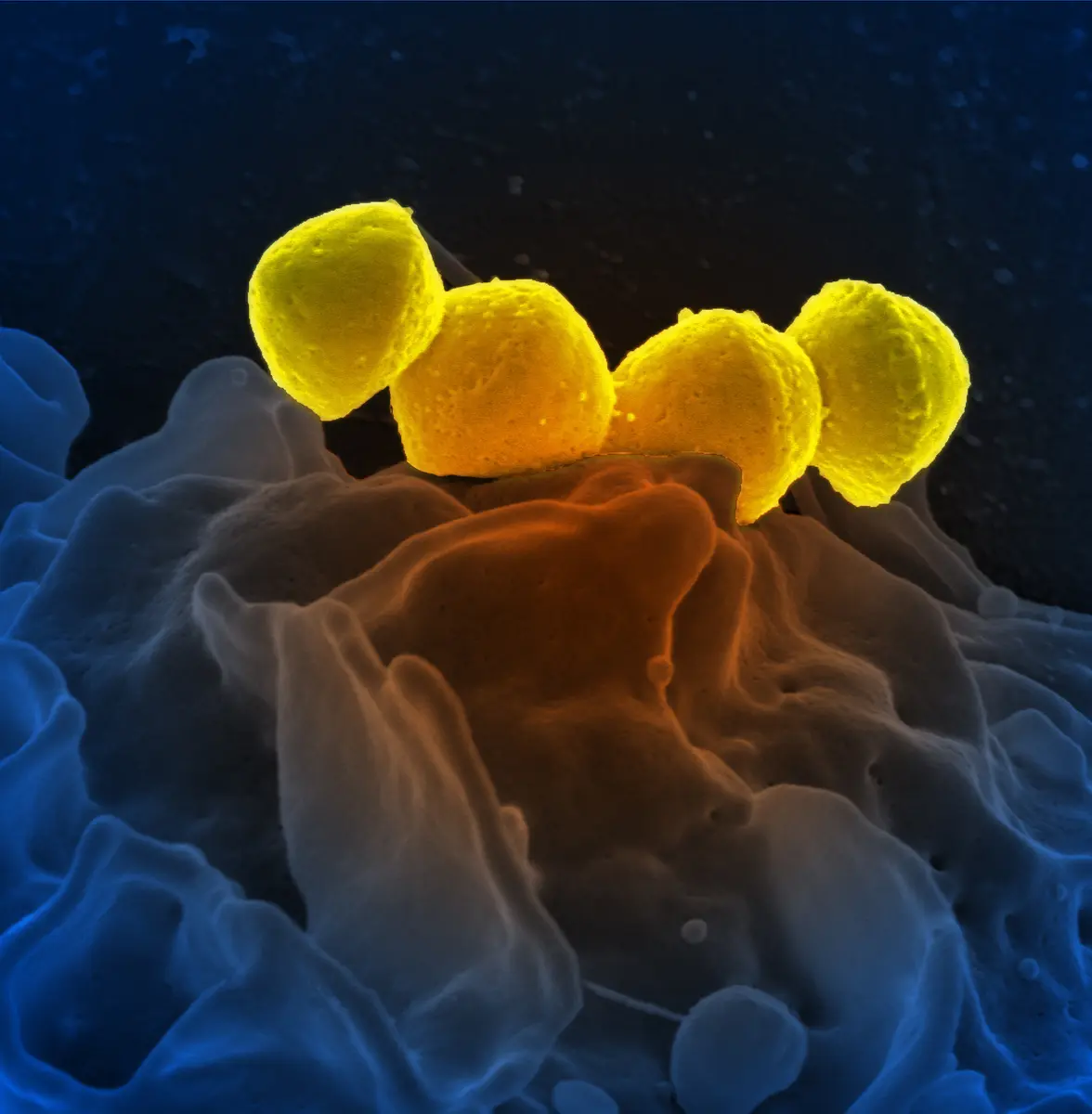
Charpentier, who had studied the dangerous bacterium Streptococcus pyogenes since starting her own group in Vienna in 2002, found in 2011 that it needs a second, unknown RNA, which she called tracrRNA, to make its CRISPR guides. That spring she met Doudna, an expert on RNA, at a microbiology meeting in San Juan, Puerto Rico, and they agreed to work together. Cas9 cut nothing in the test tube until they added tracrRNA; then they joined the two RNAs into one 'single guide' and showed that it could be rewritten to cut a gene at five places of their choice. The paper appeared online in Science on 28 June 2012. Virginijus Šikšnys in Vilnius had independently found much of the same, in a paper that appeared in September. In January 2013 Feng Zhang at the Broad Institute and George Church at Harvard showed that the scissors work in human cells; the Broad's patents on that use led to a long patent battle with the University of California.
The method spread to laboratories everywhere within a few years and is now used to study genes in cells and animals, to breed crops and to develop new treatments for cancer and inherited diseases. It also raised fears of editing human embryos, whose changes would pass to later generations. In 2015 a team in China edited embryos that could not develop, and scientists met in Washington to call for restraint. In November 2018 the Chinese scientist He Jiankui announced that twin girls had been born from embryos he had edited; scientists around the world condemned the experiment, and in December 2019 a court in Shenzhen sent him to prison for three years.
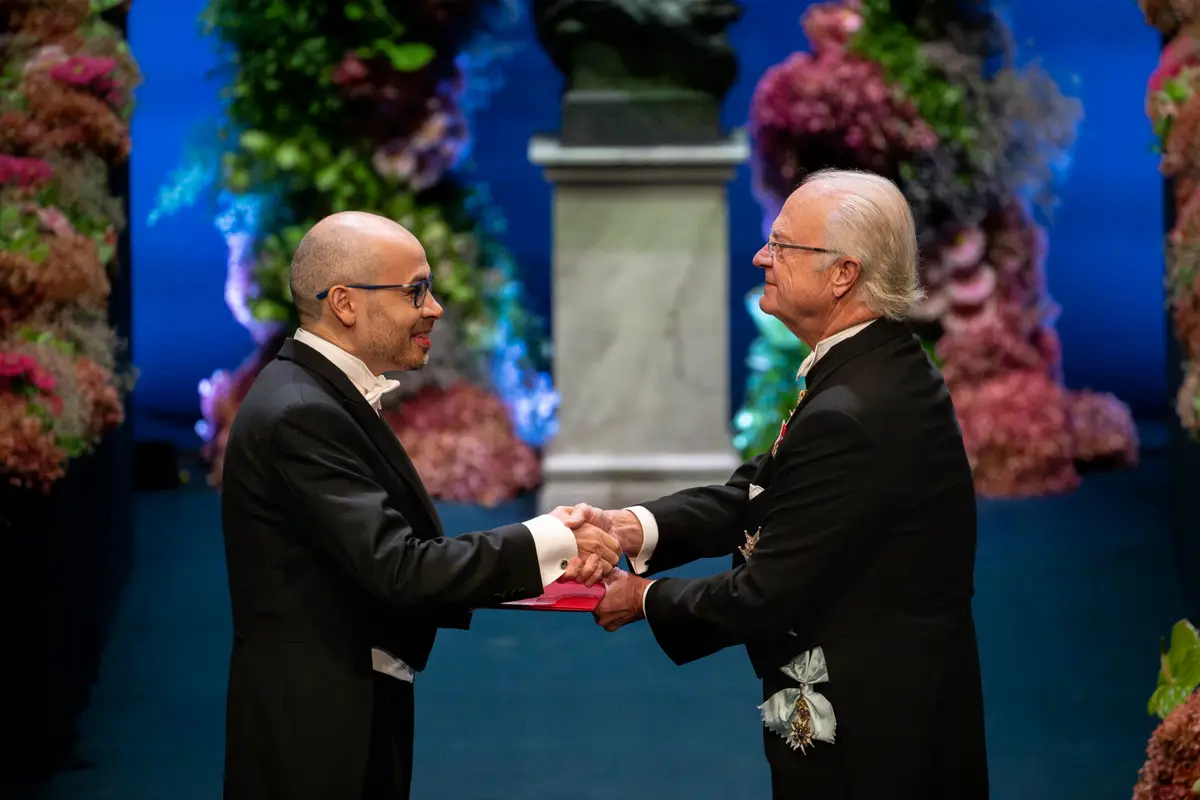
Charpentier and Doudna received the Nobel Prize in Chemistry in 2020; that December their medals were handed to them in Berlin and in Berkeley, and only two years later were they applauded at the ceremony in Stockholm. Three years later the first medicine made with the method was approved, in Britain on 16 November 2023 and in the United States on 8 December 2023: Casgevy, which edits a patient's own blood stem cells so that they make a form of haemoglobin that prevents the painful attacks of sickle cell disease. Seventy years after the double helix showed how DNA carries its code, CRISPR made it possible to change that code, one chosen letter-string at a time.
What happened
- 1987
In the Journal of Bacteriology, Yoshizumi Ishino and colleagues at Osaka University describe a gene of the gut bacterium E. coli and, beside it, five repeats of 29 DNA letters separated by stretches of 32. Nothing like them is known, and they write that their meaning is unknown. It is the first CRISPR ever seen.
Osaka University: where Yoshizumi Ishino and colleagues found the first CRISPR repeats in E. coli, published in December 1987- 1993
Francisco Mojica and colleagues at the University of Alicante find fourteen nearly identical repeats of 30 letters, regularly spaced, in Haloferax mediterranei, a microbe of the archaea that lives in salt ponds: the same kind of pattern in a second domain of life.
University of Alicante: Francisco Mojica's laboratory, where the repeats were studied from 1993 and their link to viruses was found- 2000
Mojica's group shows that repeats reported in many different bacteria and archaea share the same features and belong to one family, which suggests they matter.
University of Alicante: Francisco Mojica's laboratory, where the repeats were studied from 1993 and their link to viruses was found- 2002
Emmanuelle Charpentier, back in Europe after years in New York and Memphis, starts her own research group at the University of Vienna and turns to Streptococcus pyogenes, a bacterium that infects millions of people every year.
Max Perutz Labs, Vienna: where Emmanuelle Charpentier led her own group from 2002 to 2009 and began studying Streptococcus pyogenesRuud Jansen and colleagues at Utrecht University give the repeats the name CRISPR, clustered regularly interspaced short palindromic repeats, agreed with Mojica by correspondence, and identify the 'CRISPR-associated' (cas) genes that always sit beside them.
- 2005
Mojica's group reports that the pieces between the repeats match the DNA of viruses and plasmids, and that microbes carrying a piece appear protected from the matching virus: CRISPR may be an immune system that remembers past infections. Christine Pourcel's group in Orsay and Alexander Bolotin's at INRA, both in France, publish the same finding in March and August.
University of Alicante: Francisco Mojica's laboratory, where the repeats were studied from 1993 and their link to viruses was found- 2006
At Berkeley the microbiologist Jillian Banfield calls Jennifer Doudna, an expert on RNA, to tell her about CRISPR and to propose working on it together; over the next years Doudna's group works out what several Cas proteins do.
University of California, Berkeley: Jennifer Doudna's laboratory, where the experiments of the 2012 paper were done with Charpentier's group - 2007
Rodolphe Barrangou, Philippe Horvath and colleagues at the food company Danisco show in Science that Streptococcus thermophilus bacteria that survive a virus attack have added a piece of the virus to their CRISPR and resist it afterwards, and that a cas gene, later called cas9, is needed: CRISPR is an acquired immune system.
Dangé-Saint-Romain, France: the Danisco research site of Philippe Horvath, where the yogurt-bacteria experiment that proved CRISPR is an immune system was made, published in March 2007- 2009
Charpentier moves from Vienna to the Laboratory for Molecular Infection Medicine Sweden at Umeå University, in the north of Sweden, where she maps the small RNAs of Streptococcus pyogenes with colleagues in Berlin.
Umeå University, Sweden: the Laboratory for Molecular Infection Medicine Sweden (MIMS), Charpentier's base from 2009, where tracrRNA was found - 2011
On 31 March Nature publishes the discovery of Charpentier's group: S. pyogenes makes an unknown RNA, tracrRNA, that pairs with the CRISPR RNA and is needed to turn it into working guides, with the help of Cas9. That spring, at the American Society for Microbiology's meeting in San Juan, Puerto Rico, a colleague introduces her to Doudna in a café; the next day, walking through the old town, Charpentier proposes that they study Cas9 together.
Old San Juan, Puerto Rico: where Charpentier and Doudna met at a microbiology meeting in the spring of 2011 and walked through the old town - 2012
Science publishes online the paper of Martin Jinek, Krzysztof Chylinski, Ines Fonfara, Michael Hauer, Doudna and Charpentier: Cas9 cuts DNA only when guided by both RNAs, each of its two cutting parts cuts one strand, and the two RNAs can be joined into one 'single guide' that can be rewritten to cut a chosen sequence, as they show on a gene at five places. The abstract points to the potential for 'RNA-programmable genome editing'. The printed issue follows on 17 August.
University of California, Berkeley: Jennifer Doudna's laboratory, where the experiments of the 2012 paper were done with Charpentier's groupPNAS publishes online the paper of Giedrius Gasiunas, Barrangou, Horvath and Virginijus Šikšnys in Vilnius, received in May: working with the Cas9 of S. thermophilus, they too show that it cuts DNA where the guide directs and can be reprogrammed by changing the guide, though they miss the role of tracrRNA.
Institute of Biotechnology, Vilnius University (V. A. Graičiūno 8): Virginijus Šikšnys's group, which found the same mechanism independently in 2012- 2013
Science publishes online two papers in which Feng Zhang's group at the Broad Institute and George Church's at Harvard use CRISPR-Cas9 to cut and edit chosen genes in human cells, Zhang's group also in mouse cells; the tool spreads to laboratories everywhere.
The Broad Institute of MIT and Harvard, Cambridge, Massachusetts: Feng Zhang's laboratory, which showed in January 2013 that CRISPR-Cas9 edits human cells- 2014
The first crystal structures of Cas9 are published: of the protein alone by Doudna's group in Science on 6 February, and of Cas9 holding its guide RNA and target DNA by Osamu Nureki's group at the University of Tokyo with Zhang's in Cell on 13 February.
- 2015
A team at Sun Yat-sen University in Guangzhou reports in Protein & Cell that it has used CRISPR-Cas9 on human embryos that could not develop; the paper causes a worldwide outcry and calls for restraint on editing embryos.
The first International Summit on Human Gene Editing meets at the National Academy of Sciences in Washington, with Doudna among its organisers; it concludes that conditions must be met before any editing of embryos for pregnancy is allowed.
- 2017
In the patent fight over who owns CRISPR in the United States, the Patent Trial and Appeal Board rules against the University of California, holding that the Broad Institute's patents on use in animal and plant cells are a separate invention; the Federal Circuit court upholds the ruling the next year.
- 2018
MIT Technology Review reveals that a team led by He Jiankui at the Southern University of Science and Technology in Shenzhen has edited human embryos to disable the gene CCR5, hoping to make children resistant to HIV; He then tells the Associated Press, and announces in videos, that twin girls have been born.
Southern University of Science and Technology, Shenzhen: He Jiankui's university, where the embryo-editing project was basedHe presents his work at the Second International Summit on Human Genome Editing at the University of Hong Kong. Scientists condemn it at once; the director of the US National Institutes of Health calls it 'a deeply disturbing willingness ... to flout international ethical norms'.
The University of Hong Kong: where He Jiankui presented his gene-edited twins to the Second International Summit on Human Genome Editing on 28 November 2018- 2019
A court in Shenzhen's Nanshan district sentences He Jiankui to three years in prison and a heavy fine for illegal medical practice, and two colleagues to shorter terms; he is released in April 2022.
Southern University of Science and Technology, Shenzhen: He Jiankui's university, where the embryo-editing project was based- 2020
The Royal Swedish Academy of Sciences awards the Nobel Prize in Chemistry to Emmanuelle Charpentier, now director of the Max Planck Unit for the Science of Pathogens in Berlin, and Jennifer Doudna of Berkeley 'for the development of a method for genome editing'.
Charpentier receives her Nobel medal and diploma at the Swedish Ambassador's Residence in Berlin; Doudna receives hers at home in Berkeley the next day. They are applauded at the ceremony in Stockholm two years later, on 10 December 2022.
- 2023
Britain's Medicines and Healthcare products Regulatory Agency announces the world's first licence for a CRISPR medicine: Casgevy, made by Vertex Pharmaceuticals and CRISPR Therapeutics, for patients aged 12 and over with sickle-cell disease or transfusion-dependent beta-thalassaemia. The patient's own bone-marrow stem cells are edited in a laboratory and given back.
The US Food and Drug Administration approves Casgevy for sickle cell disease, the first American approval of a treatment that uses CRISPR-Cas9: the edited stem cells make fetal haemoglobin, which stops red cells from sickling. In the trial, 29 of 31 patients who could be assessed were free of severe pain crises for at least a year.