The human genome is fully mapped
“From 1990 to 2003 the public Human Genome Project, racing the company Celera, read almost all 3 billion letters of human DNA and gave them away free; the last 8 percent was filled only in 2022.”
The human genome is the full set of DNA instructions in our cells: about 3 billion chemical 'letters', A, C, G and T, spread over 23 pairs of chromosomes. The Human Genome Project set out to read them all, in order. It officially began on 1 October 1990, paid for in the United States by the National Institutes of Health and the Department of Energy and in Britain mainly by the Wellcome Trust, and it grew into a consortium of 20 laboratories in the United States, Britain, France, Germany, Japan and China. On 14 April 2003, in the month of the double helix's 50th anniversary, the consortium announced that the work was done, more than two years ahead of schedule and below budget: about $2.7 billion in 1991 dollars, against the $3 billion promised to Congress.
The idea grew out of new tools. In 1977 Frederick Sanger's team in Cambridge read the whole genome of a small virus, 5,375 letters long, and published the method of reading DNA that would be used for the next quarter of a century. At meetings in Santa Cruz in 1985 and Santa Fe in 1986, scientists asked whether the same could be done for a human being, a text more than half a million times longer. Many doubted it, and feared that the money would be taken from ordinary research. The project first mapped the chromosomes, then read them: the DNA was cut into pieces, copied in bacteria, read by machines that detect coloured dyes, and put back together by computers. The cost of reading one letter fell from about $10 to 10 or 20 cents. Most of the DNA came from anonymous volunteers in Buffalo, New York.
In 1996, at a meeting in Bermuda, the public scientists agreed to put every new stretch of sequence on the internet within a day, free for anyone. In May 1998 the biologist Craig Venter announced a private company, Celera Genomics, which would read the genome in three years with a faster 'whole-genome shotgun' method and sell access to its data. The public project sped up, and the Wellcome Trust's Sanger Centre took on a third of the genome. The race ended in a truce: on 26 June 2000 President Bill Clinton, with Venter and the public project's leader Francis Collins beside him and Prime Minister Tony Blair on a satellite link from London, announced at the White House that a first 'working draft' was complete. The two drafts were published in February 2001, the public one in Nature and Celera's in Science.
'Fully mapped' needs care. The draft of 2000 covered about 90 percent of the genome and had some 150,000 gaps. The finished sequence of 2003 covered about 92 percent: 99 percent of the parts that hold genes, read with 99.99 percent accuracy, but with nearly 400 gaps in long repetitive stretches that the machines of the time could not read. That last 8 percent, about the size of a whole chromosome, was filled only on 31 March 2022, when the Telomere-to-Telomere consortium published the first truly gapless human genome, read with new machines that handle much longer pieces of DNA. Since 2023 a 'pangenome' built from 47 people of different ancestries has begun to complement the single reference.
The project changed how biology works. It showed that humans have only about 20,000 to 25,000 genes, far fewer than expected, and that any two people share about 99.9 percent of their DNA. It turned biology into a science of data, done by large teams with robots and computers, and its rule of releasing data at once became the norm. The reference genome is the base on which disease genes are found, cancers are studied and genes are edited; reading a whole human genome, which first took thirteen years and billions of dollars, now costs a few hundred dollars.
What happened
- 1990
The Human Genome Project officially begins. Under a five-year plan, the first part of an expected fifteen years, the National Institutes of Health and the Department of Energy fund work to map the human chromosomes, read all of their 3 billion letters, read the genomes of simpler organisms such as bacteria, yeast, worms, flies and mice, and build the tools. James Watson, co-discoverer of the double helix, heads the NIH's new genome centre.
National Institutes of Health, Bethesda, Maryland: home of the NIH's genome centre (from 1997 the National Human Genome Research Institute), which led the project in the United States with the Department of Energy- 1992
James Watson resigns as director of the NIH's genome centre; Michael Gottesman of the National Cancer Institute takes over for the time being.
National Institutes of Health, Bethesda, Maryland: home of the NIH's genome centre (from 1997 the National Human Genome Research Institute), which led the project in the United States with the Department of Energy- 1993
Near Cambridge, England, the Sanger Centre, founded the year before with money from the Wellcome Trust and the Medical Research Council and led by John Sulston, is officially opened by Fred Sanger, whose way of reading DNA it will use on an industrial scale.
Wellcome Sanger Institute, Hinxton, near Cambridge: the Sanger Centre of 1993, which read nearly a third of the human genome, more than any other centreFrancis Collins, a medical geneticist from the University of Michigan who had helped find the genes behind cystic fibrosis and other diseases, is appointed director of the NIH's genome centre. He becomes the de facto leader of the whole international project.
National Institutes of Health, Bethesda, Maryland: home of the NIH's genome centre (from 1997 the National Human Genome Research Institute), which led the project in the United States with the Department of Energy- 1994
The project meets its first goal a year early: a detailed genetic linkage map, markers spaced along every chromosome that help researchers home in on the genes behind diseases.
- 1995
A physical map follows, with more than 15,000 landmarks placed at known points along the chromosomes: the scaffold on which the sequence will be hung.
- 1996
At a meeting in Bermuda paid for by the Wellcome Trust, the leaders of the sequencing centres, with John Sulston and Robert Waterston to the fore, agree the 'Bermuda Principles': every new stretch of human sequence is to be released free to the public within 24 hours, long before publication. It turns the usual habits of science upside down.
Bermuda: where the sequencing centres agreed in February 1996 to release all their data within a day- 1997
In Buffalo, New York, the Roswell Park Cancer Institute advertises for volunteers to give blood for the Human Genome Project. The samples are made anonymous. Most of the DNA that will be read comes from such Buffalo volunteers; about 70 percent of the reference sequence comes from a single person of mixed ancestry, the rest from 19 others, mostly of European ancestry.
Roswell Park Cancer Institute, Buffalo, New York: it recruited the anonymous volunteers whose blood gave most of the DNA that was read- 1998
Craig Venter, a former NIH scientist whose institute had read the first genome of a free-living organism, a bacterium, in 1995, announces a company, Celera Genomics, that will read the human genome in three years with his faster 'whole-genome shotgun' method and sell access to the data. In Britain the Wellcome Trust answers by doubling its share: the Sanger Centre will read a third of the genome.
Rockville, Maryland: headquarters of Celera Genomics, Craig Venter's company, founded in 1998- 1999
After pilot projects that have produced 15 percent of the sequence, the public consortium switches to full-scale production. In May its 20 centres, meeting at Cold Spring Harbor, promise again that all their data will stay free, and the target for a rough 'working draft' is brought forward from 2001 to 2000.
The first human chromosome is finished: the 33.5 million letters of chromosome 22, read by a team of British, Japanese and American scientists and published in Nature.
- 2000
President Clinton and Prime Minister Blair declare together that the raw data of the human genome, the DNA sequence and its variations, should be freely available to scientists everywhere.
- 10:19 a.m.
In the East Room of the White House, President Clinton, with Francis Collins and Craig Venter beside him and Tony Blair on a satellite link from London, celebrates 'the completion of the first survey of the entire human genome', which he calls 'the most important, most wondrous map ever produced by humankind'. Both the public project and Celera have rough drafts; the public one covers about 90 percent of the genome, with some 150,000 gaps.
The White House, Washington: in its East Room on 26 June 2000 President Clinton, Francis Collins and Craig Venter announced the first working draft of the human genome - 2001
- 10:00 a.m.
At a press conference in Washington the two teams present their papers. The first surprise: humans seem to have only 30,000 to 40,000 genes, about twice as many as a worm or a fly. (The finished sequence will lower the count to 20,000 to 25,000.)
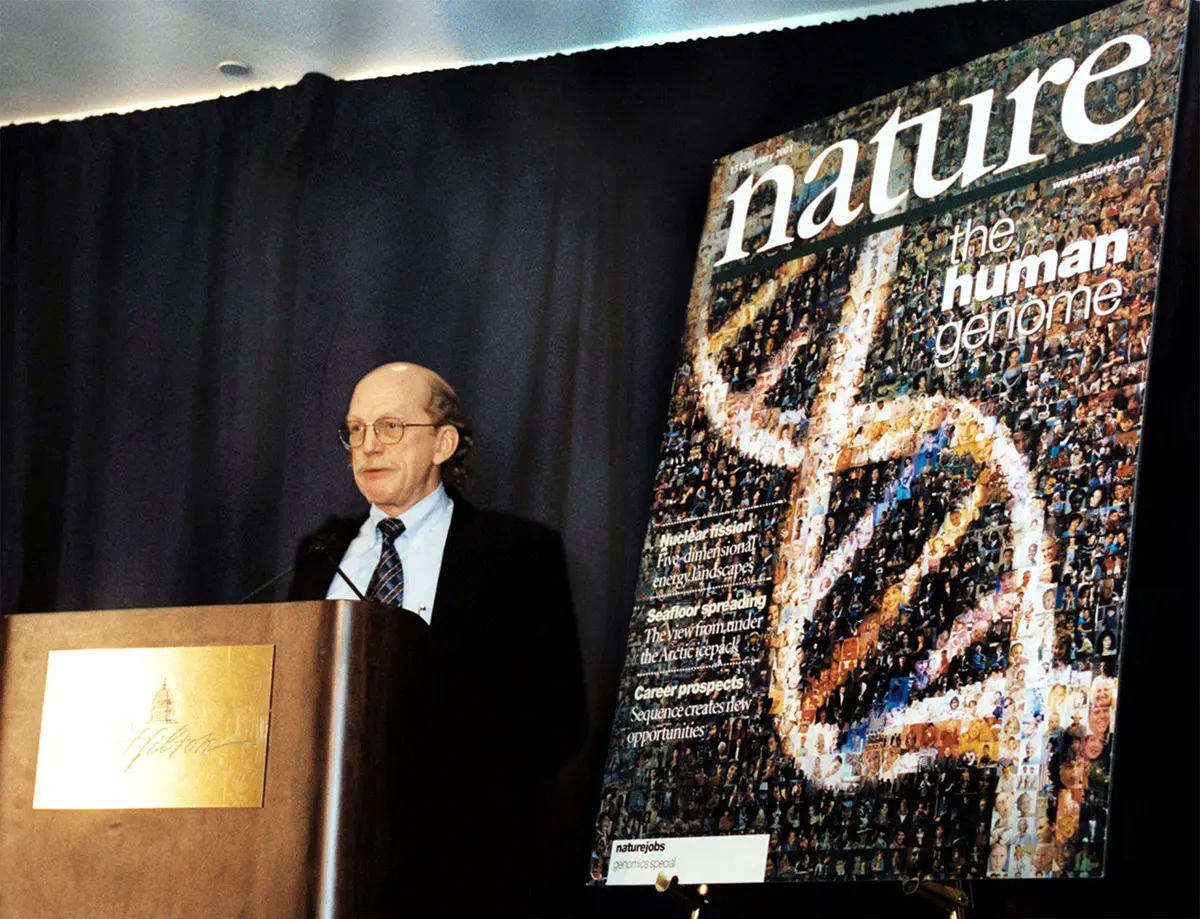
Nature publishes the public consortium's draft and its first analysis, 62 pages by 20 groups in six countries; the next day Science publishes Celera's version.
- 2002
The consortium's members meet again at Cold Spring Harbor Laboratory while they turn the draft into a finished sequence, closing gaps and checking every letter.
Cold Spring Harbor Laboratory, Long Island, New York: the consortium met here in May 1999 and again in 2002 - 2003
The consortium announces that the Human Genome Project is complete, more than two years ahead of schedule, in the month of the double helix's 50th anniversary; the heads of government of the six countries issue a joint proclamation. The finished sequence covers 99 percent of the gene-containing parts, about 92 percent of the whole, with 99.99 percent accuracy and fewer than 400 gaps where the DNA could not yet be read.