Le Mercure Galant reports on fashion
“Le Mercure galant, founded in Paris in 1672, was the first periodical to report fashion as news, and from 1678 it printed engraved fashion plates of the court's latest clothes.”
Le Mercure galant was a Paris periodical started in 1672 by Jean Donneau de Visé, a writer of plays and stories. Each issue was written as a long, chatty letter to a lady living in the provinces: news of the court and the war, marriages and deaths, poems, songs, love stories, theatre reviews, and what people in Paris were wearing. Its very first volume was dedicated to Louis XIV. In its first year it already told readers that 'nobody knows how to dress any more; fashions die before they are born', and it reported on men's clothes as well as women's.
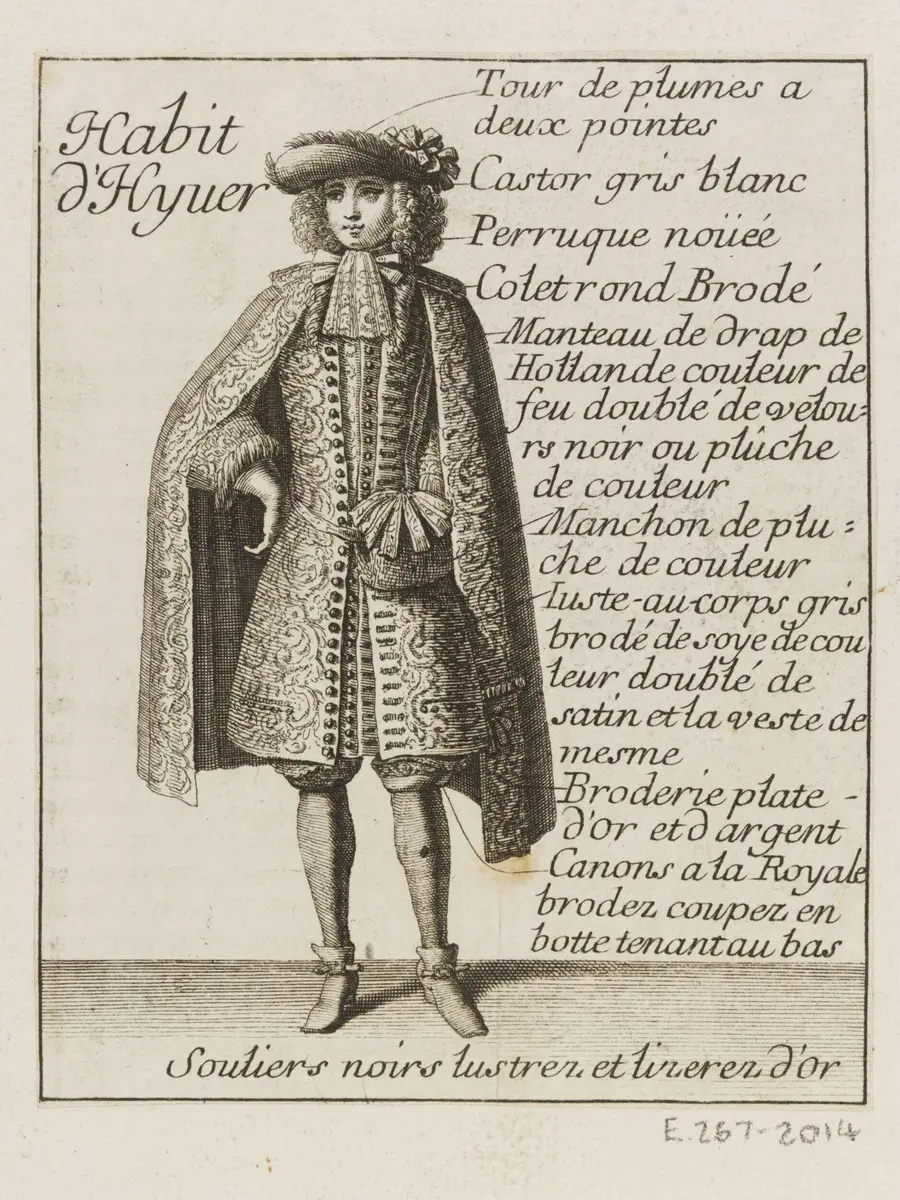
After a pause from 1674 the paper came back in 1677 as a monthly, with the king's support. In January 1678 it added a supplement, the Extraordinaire, with something new: engraved fashion plates. Jean Bérain, the king's own designer, drew a man and a woman in the season's clothes, and Jean Le Pautre engraved them, with each part of the outfit named beside the figure: the hat, the wig, the lace headdress, the colour and cloth of the coat, the muff, the shoes. A further plate showed the inside of a Paris shop full of ribbons, gloves and lace, and the text explained every numbered item and where it could be bought.
This mattered because fashion was becoming an industry. Under Louis XIV and his minister Colbert, France built up its own luxury trades, from silk weaving in Lyon to the 'point de France' lace workshops founded in 1665, and the court set a calendar of what to wear in each season. The Mercure turned that calendar into news. Tailors, merchants and readers far from Paris could see what was new, copy it and order it, and the paper sometimes named the merchants who sold it.
Donneau de Visé ran the paper until his death in 1710, from 1682 together with the playwright Thomas Corneille; later, as the Mercure de France, it outlived the old monarchy. Its plates set off a flood of fashion prints sold in the rue Saint-Jacques, and its formula of seasonal news, pictures and shopping advice is still the formula of the fashion magazine.
What happened
- 1672
Jean Donneau de Visé publishes the first volume of Le Mercure galant in Paris, dedicated to Louis XIV and sold in the Grand'Salle of the Palais: news, stories and verse from 1 January 1672 up to the king's departure for the war, written as a letter to a lady in the provinces.
Palais de la Cité, Paris: the old royal palace, home of the law courts, whose Grand'Salle and galleries were lined with booksellers' and fashion shops; the first volumes of the Mercure galant were sold here by Théodore GirardIn its third volume, on the summer of 1672, the paper reports the latest women's styles ('fashions die before they are born'), and a lady named Lucresse asks for equal space for men's fashions: the narrator agrees that men are no less slaves to fashion.
Palais de la Cité, Paris: the old royal palace, home of the law courts, whose Grand'Salle and galleries were lined with booksellers' and fashion shops; the first volumes of the Mercure galant were sold here by Théodore Girard- 1673
The editor apologises to his women readers for so much war news; at first he assumes women want stories and fashion and men want battles.
- 1674
Jean Bérain becomes designer to Louis XIV. The same year the Mercure's first series ends with its sixth volume, and the paper falls silent.
- 1677
The paper returns as Le Nouveau Mercure galant, now monthly, dedicated to the Dauphin and published with the king's support; Jean Le Pautre engraves a series of costume prints partly for it.
Cimetière des Innocents, Paris: Jean Le Pautre sold his costume prints, partly made for the Nouveau Mercure galant, 'under the charnel-house of the Holy Innocents'The editor writes that people first took the Mercure for a book only for ladies, but it has become 'the book of scholars and soldiers' as well.
- 1678
The first Extraordinaire, a quarterly supplement, appears with engraved fashion plates of the winter's dress, two men and two women, drawn by Jean Bérain and engraved by Jean Le Pautre, each garment named beside the figure, for readers, tailors and merchants alike.
Palais de la Cité, Paris: the old royal palace, home of the law courts, whose Grand'Salle and galleries were lined with booksellers' and fashion shops; the first volumes of the Mercure galant were sold here by Théodore GirardThe women's plates show the season's dress: velvet, plush and brocade, fur muffs and ermine, and the ruffled lace cornette of point de France as the fashionable headdress.
The same supplement prints a view inside a Paris shop of ribbons, lace and trimmings for women and men, and its text explains every numbered item: the paper as a shopping guide.
Palais de la Cité, Paris: the old royal palace, home of the law courts, whose Grand'Salle and galleries were lined with booksellers' and fashion shops; the first volumes of the Mercure galant were sold here by Théodore GirardThe monthly drops 'Nouveau' and returns to its first title, Le Mercure galant, which it keeps for the rest of Donneau de Visé's life.
- 1681
The January issue, dedicated to the Dauphin, is reprinted in Lyon by Thomas Amaulry in the rue Mercière, so that provincial readers get the Paris news, fashions included.
Lyon: France's silk-weaving capital, whose makers the Mercure named, and where printers such as Thomas Amaulry reissued the paper for readers in the provinces- 1682
The playwright Thomas Corneille joins Donneau de Visé at the head of the Mercure galant; they run it together until Corneille's illness around 1700.
- 1686
The editor announces that each month's issue will list the newly printed engravings and say where they can be bought.
- 1687
Donneau de Visé writes in the Mercure that nothing is as fleeting as fashion, the idea on which the seasonal fashion trade would run.
- 1693
The Mercure describes Jean Dieu de Saint-Jean's new print of a lady of quality in casual undress, one of the hundreds of fashion plates now sold in Paris.
- 1710
Jean Donneau de Visé dies, after 38 years as editor; the dramatist Charles Rivière Dufresny takes over the paper, which later becomes the Mercure de France.