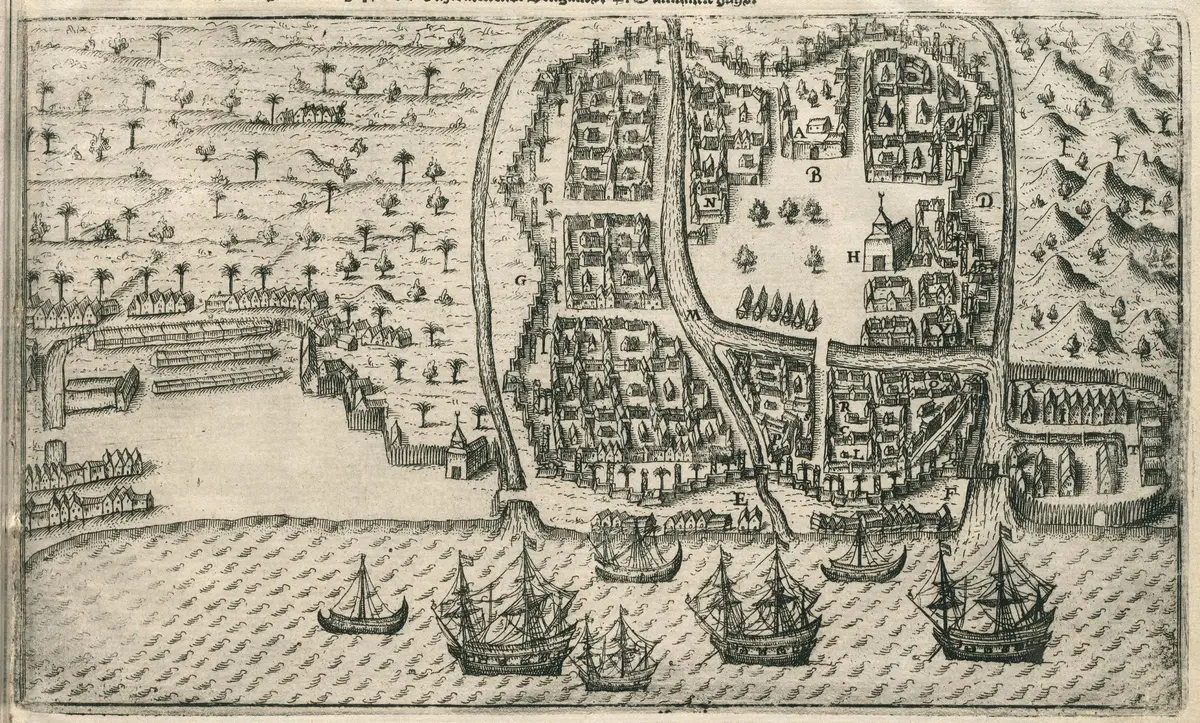
The first Dutch ships reach Java
“In June 1596 Cornelis de Houtman's four ships reached Banten, Java's pepper port: a violent, badly led voyage that still made a profit and set off the race that ended in the VOC of 1602.”
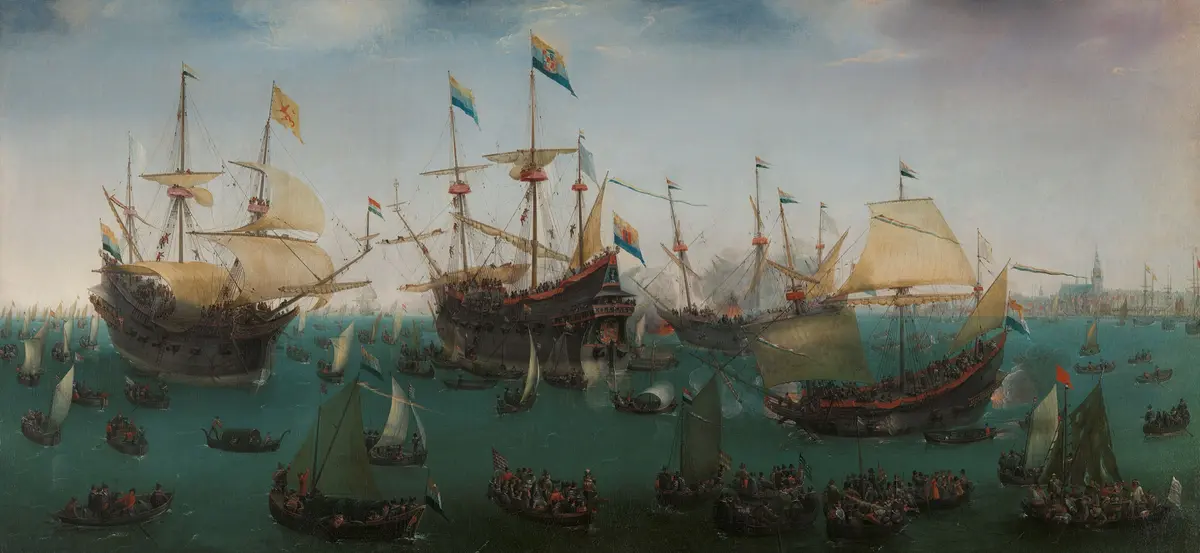
In June 1596 four Dutch ships dropped anchor off Banten, the main pepper port of Java, after fourteen months at sea. They were the first Dutch ships to reach the islands of today's Indonesia. The fleet was made up of the Mauritius, the Hollandia, the Amsterdam and the small pinnace Duyfken. It had left the roads of Texel on 2 April 1595 with 249 men and 64 guns. The money came from the Compagnie van Verre, the 'Company of Far Lands', which nine Amsterdam merchants had founded in 1594. Its chief merchant was Cornelis de Houtman, who had spent many years in Lisbon and claimed to know what the Portuguese knew. The voyage was hard from the start. Near the equator the food rotted and the water went bad, scurvy spread, and the fleet then spent months on the coasts of Madagascar. By the time it left St Augustine's Bay there in December 1595, only about half of the 249 men were still alive.
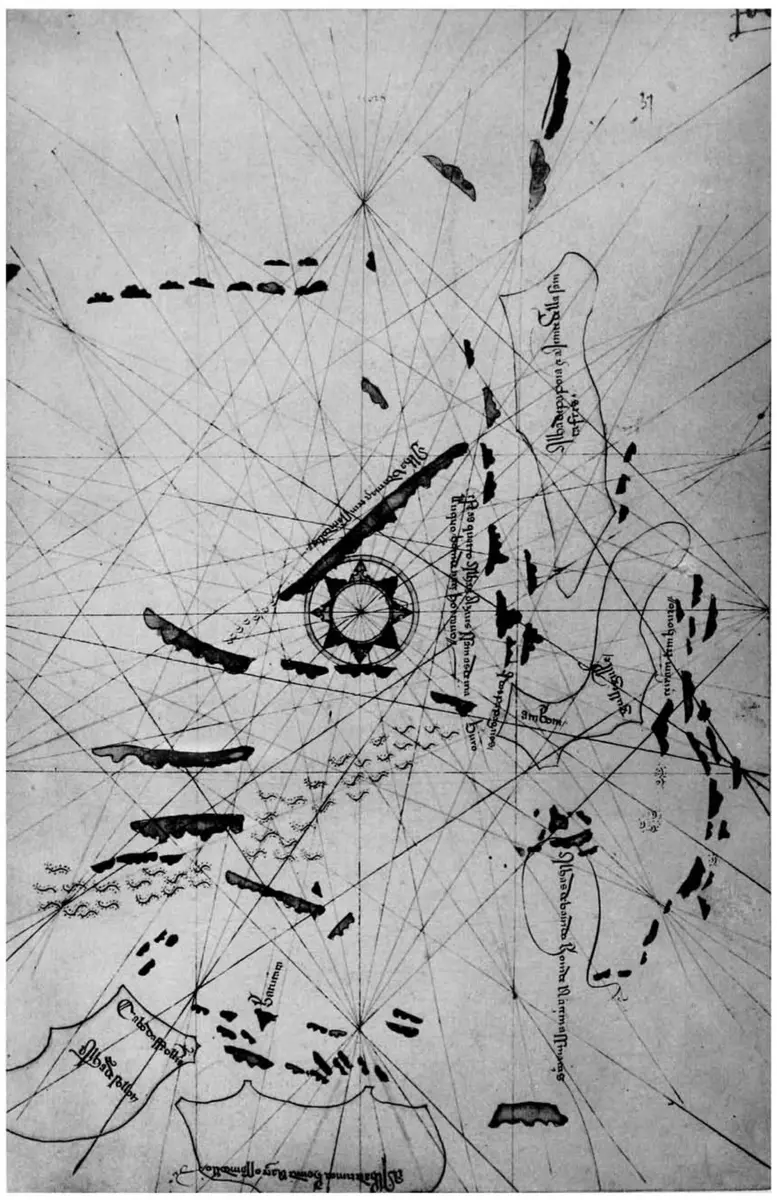
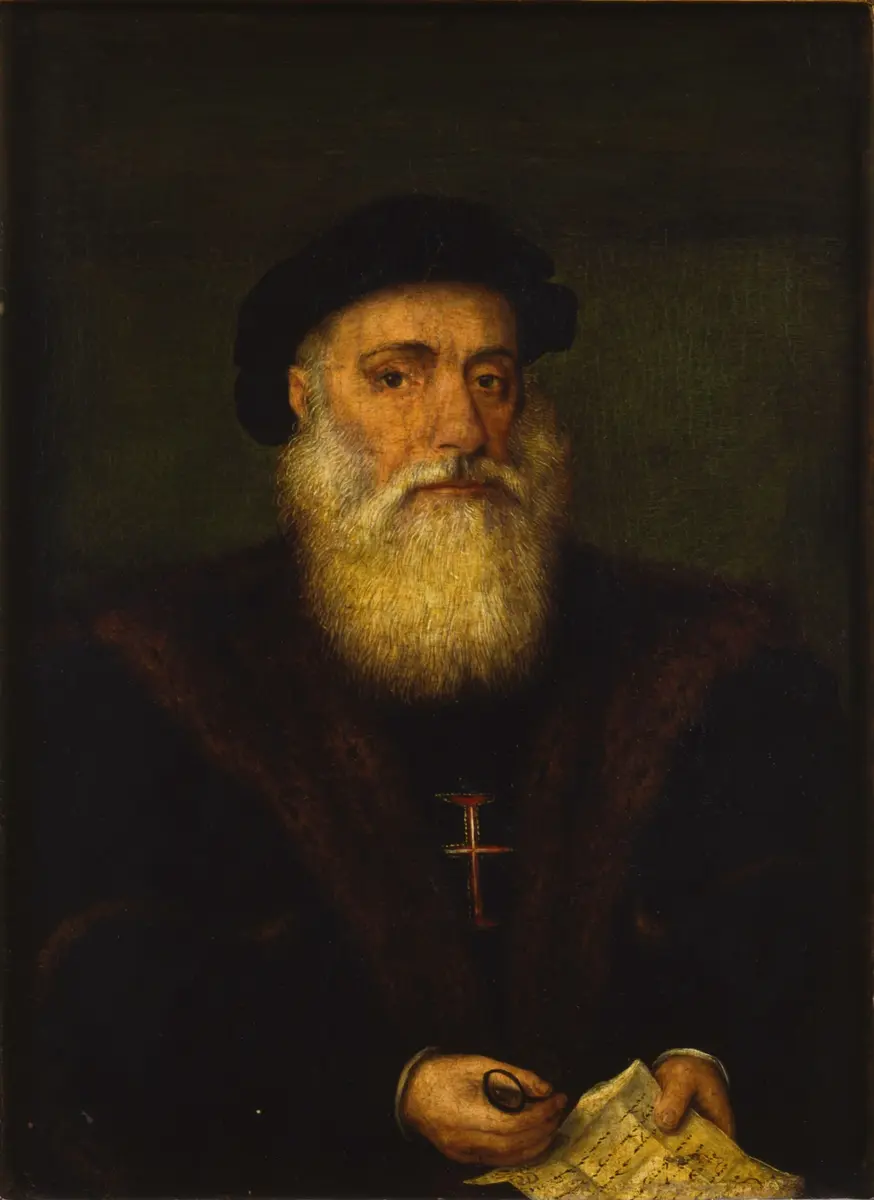
The Dutch went because their old way to the spices was closing. For decades Dutch merchants had bought pepper and spices in Lisbon and sold them on in northern Europe. But their war of independence against Spain, and the union of the Spanish and Portuguese crowns in 1580, cut them off. To sail to Asia themselves they needed the route that the Portuguese kept secret. Part of it came from Jan Huygen van Linschoten, a Dutchman who had served the Portuguese in Goa: in 1595 and 1596 he published his Itinerario, with maps and detailed descriptions of the Portuguese trade in the East. The Amsterdam theologian and map-maker Petrus Plancius supplied the fleet with its sea charts. He also asked the chief pilot, Pieter Dirkszoon Keyser, to measure the stars around the south pole. Keyser died at Banten in September 1596, but his notes came home and gave the southern sky twelve new constellations, among them the Phoenix and the Toucan.
Banten was a rich and crowded port where Chinese, Arab, Indian, Malay and Portuguese merchants met. About a month before the Dutch came, its king had been killed attacking Palembang in Sumatra; his son was a baby, and a regent governed for him. On 1 July the regent signed a contract with de Houtman, and the Dutch opened a house in the town. But they bargained too hard, the Portuguese worked against them, and by the end of August de Houtman and eight of his men were held prisoner on shore. The Dutch seized Javanese ships and fired their guns into the town, and in October they bought their men free for 2,000 reals of eight. In November the fleet left with only part of a cargo. Sailing east along the north coast of Java it fought at almost every stop: at Sidayu, Javanese boarders killed twelve men on the Amsterdam, and off Madura the Dutch fired on the boats of a local ruler who was coming out to meet them and killed him. Leaking and short of men, the Amsterdam was emptied and burnt off the island of Bawean in January 1597. Only on Bali, whose king rode in a carriage drawn by two white buffaloes, were the Dutch welcomed; two of the sailors chose to stay there.
The three remaining ships reached Texel in August 1597 with 89 of the 249 men, and with enough pepper and spices to show a profit. As the historian M. C. Ricklefs puts it, the voyage showed that even an incompetent expedition could make money, and that was enough. In 1598 twenty-two ships of five Dutch companies sailed for the East; in 1601 fourteen separate expeditions set out, and in Banten alone four rival Dutch agents competed for pepper, driving prices up in Asia and down in Europe. To end this, the States General merged the rival 'pre-companies' in March 1602 into the United East India Company, the VOC. The news of the Dutch profits also persuaded the English, who chartered their own East India Company in 1600; its first fleet reached Banten in 1602.
The voyage began the Dutch presence in Indonesia that lasted until the twentieth century, and it set its tone: armed merchants, short of patience, ready to use their guns. Cornelis de Houtman did not see what followed; he led a second voyage and was killed at Aceh in 1599. Banten kept its independence and stayed the great pepper port of the region, the rival of the VOC after the company moved to Batavia, until a civil war in 1682 let the Dutch in. The best record of the town in 1596 is Willem Lodewijcksz's account of the voyage, printed in Amsterdam in 1598, whose engravings show Banten's market, its rulers, its merchants and even its money.
What happened
- 1595
The Mauritius, the Hollandia, the Amsterdam and the pinnace Duyfken sail from the roads of Texel for the East Indies, with 249 men and 64 guns. Cornelis de Houtman is the chief merchant.
The roads of Texel, where the fleet sailed from on 2 April 1595 and came home in August 1597After four months at sea, with the food spoiled and scurvy spreading, the fleet anchors in Mossel Bay in South Africa; thirty or more men are sick in one ship alone.
The fleet reaches St Augustine's Bay in Madagascar and lies there until 13 December. When it sails on, only 127 of the 249 men are still alive.
St Augustine's Bay, Madagascar, where the fleet lay from October to December 1595 while its men died of scurvy- 1596
After stops at Ste Marie and in the Bay of Antongil, the fleet leaves Madagascar and crosses the Indian Ocean.
First landfall in the Indies: the island of Enggano, off the south-west coast of Sumatra.
Enggano, the island off Sumatra that was the fleet's first landfall in the Indies, on 6 June 1596Guided by a pilot taken on off Sumatra, the fleet anchors before Banten, the main pepper port of Java; the next day it moves close to the town. Chinese and other traders crowd the decks to sell their goods.
Banten (Old Banten), Java's chief pepper port, where the Dutch arrived on 22 June 1596The governor of Banten comes aboard to see the Dutch wares. He rules as regent: the king was killed a month earlier attacking Palembang, and his heir is a baby.
Surosowan, the royal palace of Banten, the court the Dutch dealt with in 1596De Houtman comes back from the town with a contract signed by the governor that gives the Dutch freedom to trade; on 13 July they open a house in the town to sell their goods and buy pepper.
Banten (Old Banten), Java's chief pepper port, where the Dutch arrived on 22 June 1596The Portuguese of Banten press the governor to stop the Dutch trade, saying they are not merchants but spies; the Dutch, holding out for cheaper pepper, buy little.
Banten (Old Banten), Java's chief pepper port, where the Dutch arrived on 22 June 1596The governor stops all rice for the ships and holds the Dutchmen who are in the town: nine of their best merchants and captains, de Houtman among them.
Banten (Old Banten), Java's chief pepper port, where the Dutch arrived on 22 June 1596The Dutch bring their ships close to the town and seize three Javanese ships; on the 6th and 7th they fire into the town, and two dozen Javanese boats attack their pinnace.
Banten (Old Banten), Java's chief pepper port, where the Dutch arrived on 22 June 1596A ransom is agreed: the prisoners are freed for 2,000 reals of eight, paid in two halves, and each side keeps what it has taken from the other.
Banten (Old Banten), Java's chief pepper port, where the Dutch arrived on 22 June 1596After the governor has broken off all trade and the Dutch have taken two Javanese ships laden with nutmeg and mace, the fleet leaves Banten and sails east.
Banten (Old Banten), Java's chief pepper port, where the Dutch arrived on 22 June 1596The fleet calls at Jacatra, the old port of Sunda Kalapa, where the Dutch will found Batavia in 1619.
Off Sidayu, Javanese who have come aboard the Amsterdam as if to trade draw their daggers and kill twelve of her men, among them her master; the Dutch drive them off and kill many in the water.
Sidayu, on the north coast of East Java, where twelve men of the Amsterdam were killed on 5 December 1596Off Madura, boats come out carrying the local ruler, a religious leader, to meet the Dutch. The Amsterdam's crew fire on them, and the ruler is killed.
Madura, off whose coast the Dutch killed the local ruler on 8 December 1596Jan Meulenaer, master of the Mauritius, dies suddenly; Hendrik Jansz takes his place.
- 1597
The Amsterdam, leaking on every side, is emptied and set on fire near Bawean; her men are shared among the other three ships.
Bawean, the island near which the Amsterdam was burnt on 11 January 1597After passing the strait between Java and Bali, the fleet reaches Bali.
The ships anchor in Padang Bay, where they find a stream of fresh water, cattle, pigs and fruit; the king comes to the shore to hear them fire their guns.
Padangbai, Bali, the bay where the fleet took water and food in February 1597Two of the sailors, Emanuel Rodenburgh of Amsterdam and Jacob Cuyper of Delft, stay behind on Bali, whose king, riding in a carriage drawn by two white buffaloes, likes to have foreigners about him.
Padangbai, Bali, the bay where the fleet took water and food in February 1597The three ships leave Bali for home, with about ninety men left aboard.
Padangbai, Bali, the bay where the fleet took water and food in February 1597The Hollandia, separated from the others in a storm on 26 April, finds them again at St Helena.
The Mauritius and the Duyfken reach Texel.
The roads of Texel, where the fleet sailed from on 2 April 1595 and came home in August 1597The Hollandia comes in last. Of the 249 men who sailed, 89 are home, and the pepper, nutmeg, cloves and mace they bring show a profit: the start of the race for the Indies.
The roads of Texel, where the fleet sailed from on 2 April 1595 and came home in August 1597