The four-stroke engine
“In 1876 Nicolaus Otto's gas engine at Deutz, near Cologne, first made the four-stroke cycle work: suck, squeeze, burn, blow. Nearly every car engine since runs on it.”
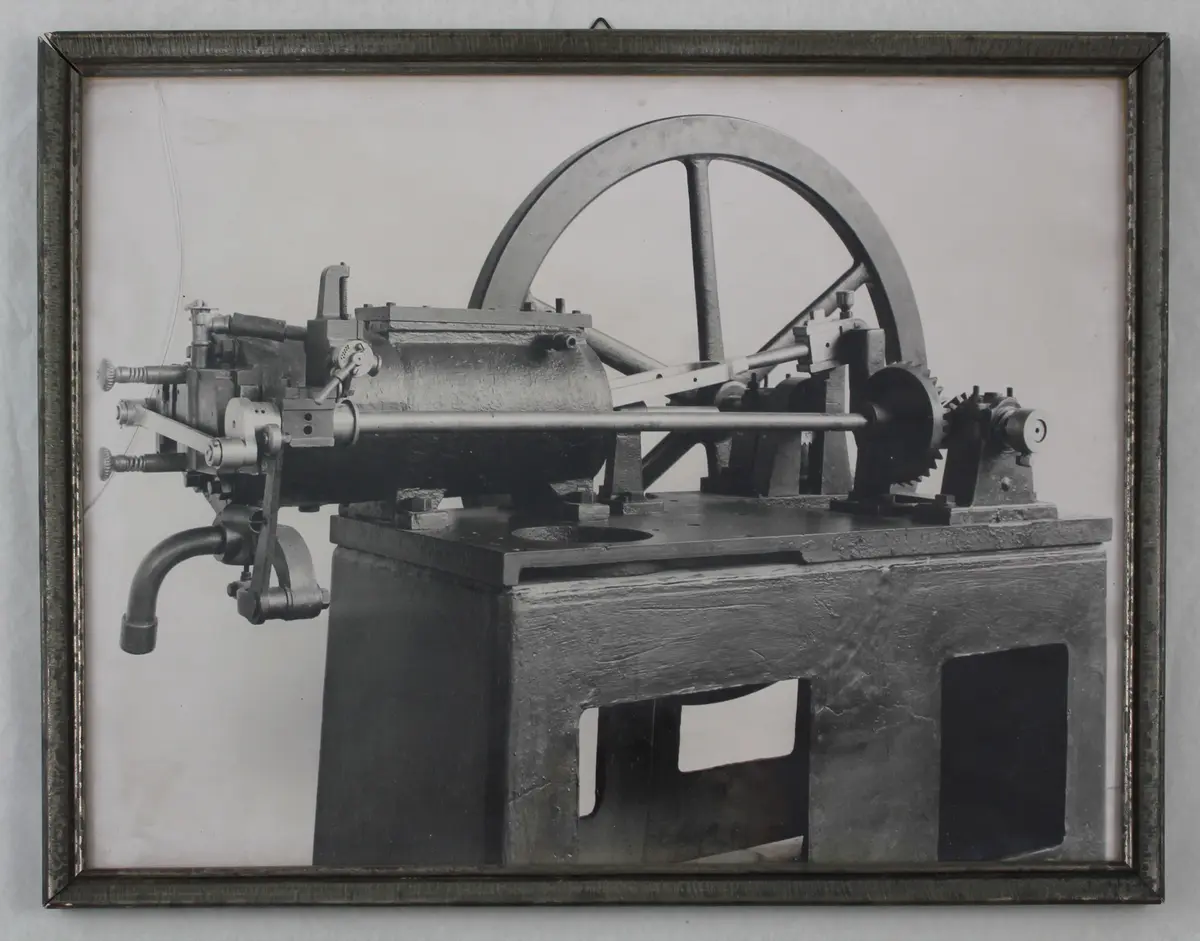
A four-stroke engine makes its power in four movements of the piston. It draws a mixture of fuel and air into the cylinder, pushes it back into a small space to compress it, fires it so that the hot gas drives the piston out, and then pushes the burnt gas away; the crank turns twice for every working stroke. The first engine to do this in practice was built in 1876 by Nicolaus August Otto at the Gasmotoren-Fabrik Deutz, across the Rhine from Cologne. It burned the coal gas of the town's street lamps and gave about 3 horsepower at 180 turns a minute. The key step was the squeeze: a compressed charge burns with far more effect, so the engine gave more power from less gas than anything before it.
Otto was a travelling grocery salesman, not an engineer. In 1860 he heard about the gas engine of Étienne Lenoir in Paris, had a Cologne mechanic build him a model, and in 1862 tried compression, but his engine knocked itself to pieces. In 1864 he and Eugen Langen, a Cologne engineer and sugar manufacturer, founded N. A. Otto & Cie, the first company built only to make engines. Their tall, noisy 'atmospheric' engine won a gold medal at the Paris Exposition of 1867, because it used less than half the gas of Lenoir's. Langen turned the firm into the Gasmotoren-Fabrik Deutz in 1872 and hired Gottlieb Daimler to run the works, with Wilhelm Maybach in the drawing office. In 1876 Otto went back to compression, working with Franz Rings, and this time it worked within months. Sold as 'Otto's new engine' from 1877, and made under licence by Crossley Brothers in Manchester, the quiet 'Silent Otto' sold by the thousand to small workshops and factories.
Otto was not the only one with the idea. In Florence, Eugenio Barsanti and Felice Matteucci had described a gas engine in 1853 and patented it in England; it worked like Otto and Langen's later free-piston engine. Lenoir's engine of 1860 was the first internal-combustion engine sold in numbers, but it did not compress its charge. In 1862 the French engineer Alphonse Beau de Rochas set out exactly the four strokes in a French patent and a printed pamphlet, but he never built an engine. Otto himself thought his engine's secret was a layered charge that burned slowly, not the compression. Otto's German patent No. 532 of 1877 was fought in court by rivals who did not want to pay Deutz, and in 1886 the Reichsgericht, Germany's highest court, struck out his claim to the four-stroke cycle, because Beau de Rochas had described it first. The engine remained Otto's achievement and the cycle still carries his name.
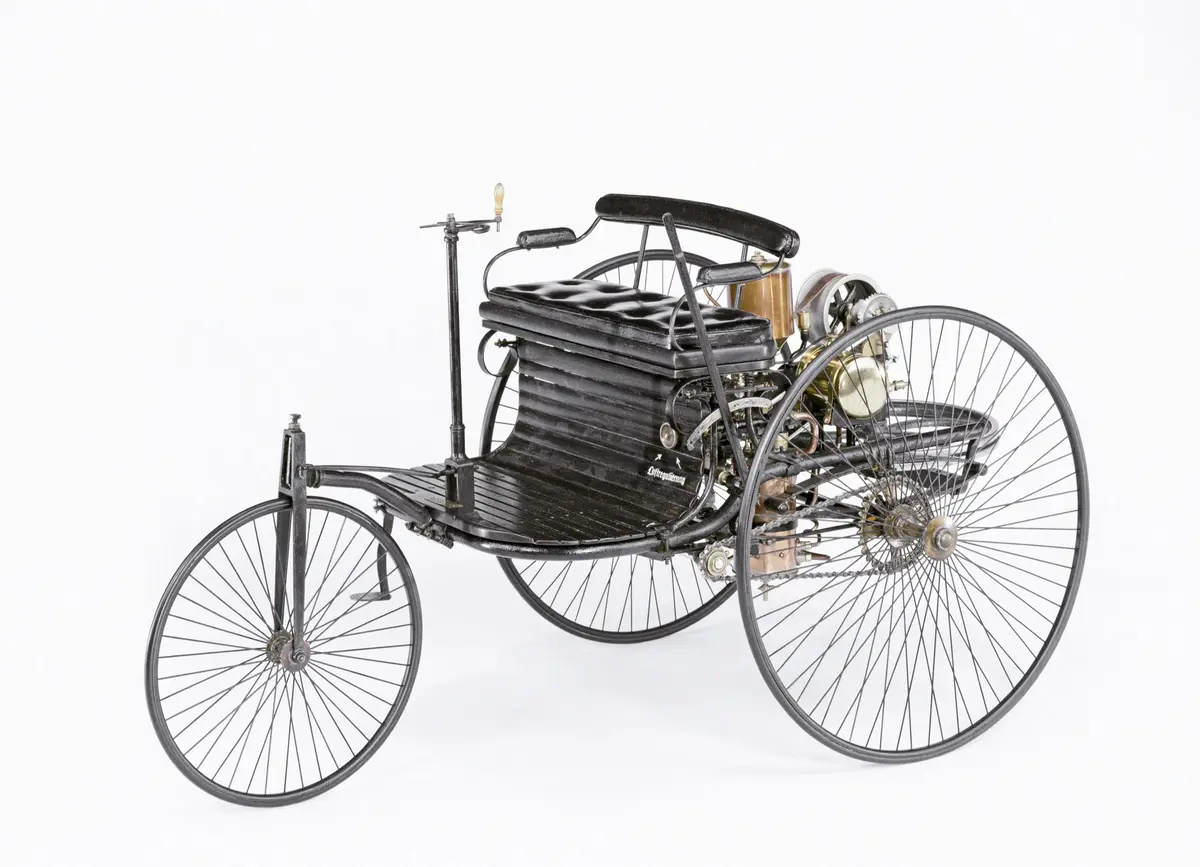
The four-stroke engine was the first practical alternative to the steam engine: it needed no boiler, and a small workshop could afford one. Its next step was to become smaller and faster. Daimler and Maybach left Deutz in 1881–82 and built a light, fast four-stroke petrol engine at Cannstatt; on 29 January 1886, the day before the court's final ruling, Carl Benz applied for his patent on a motor car with a four-stroke engine. Most diesel engines and the first aircraft engines used the same four strokes. Otto's engine of 1876 survives in the DEUTZ engine museum in Cologne, and nearly every car engine of the twentieth century worked on its cycle.
What happened
- 1864
Nicolaus Otto, a salesman who has spent four years building gas engines in his spare time, and Eugen Langen, an engineer in his family's Cologne sugar business, found N. A. Otto & Cie in a workshop in the Servasgasse: the first company set up only to make engines. Otto brings the ideas, Langen the money.
Servasgasse, in the old town of Cologne: the workshop where Otto and Langen founded N. A. Otto & Cie on 31 March 1864- 1867
At the Paris Exposition (1 April – 3 November), Professor Henri Tresca tests a half-horsepower Otto & Langen engine at the Exposition: it uses 44 cubic feet of gas per horsepower an hour, less than half of what Lenoir's and Hugon's engines need. The jury gives it a gold medal as the most economical engine for small trades.
Champ de Mars, Paris: the Exposition universelle of 1867, where the Otto & Langen engine won a gold medalThe Exposition universelle opens on the Champ de Mars in Paris. Among the machines is Otto and Langen's tall, clattering free-piston engine, in which each explosion throws a piston upward and the weight of the air drives it back down.
Champ de Mars, Paris: the Exposition universelle of 1867, where the Otto & Langen engine won a gold medalThe United States grants Langen and Otto patent 67,659 for their free-piston 'air-engine'.
- 1869
Crossley Brothers of Manchester buy the rights to the Otto & Langen engine for the whole world outside Germany and build their engine No. 1. Over the next years they make about 1,300 of them; in Germany the firm gains a new partner, Roosen-Runge of Hamburg.
Great Marlborough Street, Manchester: the works of Crossley Brothers, who built Otto & Langen's engine from 1869 and the four-stroke 'Otto Silent' from 1877 - 1872
The firm has just become a share company, the Gasmotoren-Fabrik Deutz AG. Gottlieb Daimler arrives in Cologne as its technical director, in charge of the workshops and the drawing office, and makes his friend Wilhelm Maybach head of design.
Deutz, across the Rhine from Cologne: the Gasmotoren-Fabrik Deutz, where the four-stroke engine was built and first ran in 1876- 1876
After six months' work with Franz Rings, Otto completes his four-stroke engine with compressed charge. It gives about 3 horsepower at 180 turns a minute on coal gas; DEUTZ calls the working diagram of this experimental engine the 'birth certificate' of the Otto engine. Daimler had thought the project a waste of time.
Deutz, across the Rhine from Cologne: the Gasmotoren-Fabrik Deutz, where the four-stroke engine was built and first ran in 1876Otto files his application for the American patent on the four-stroke engine. In Britain he has already patented it (specification No. 2081 of 1876), and Crossley's licence is extended to the new engine. Otto explains its economy by a layered charge that burns slowly and hardly mentions compression, which engineers later saw as the real cause.
- 1877
Deutz starts series production of 'Otto's new engine', prepared for production by Daimler and Maybach. In Manchester, Crossley replaces the atmospheric engine with the four-stroke 'Otto Silent'; licensees also build it in the United States.
Deutz, across the Rhine from Cologne: the Gasmotoren-Fabrik Deutz, where the four-stroke engine was built and first ran in 1876The new Imperial Patent Office, created by the Patent Act of 25 May 1877 for the whole of the new German Empire, opens in Berlin; Langen had helped to shape the law.
The Imperial Patent Office grants Otto German patent No. 532, 'Gasmotor', one of the first patents of the new German Empire; it dates from 4 August 1877. Deutz will defend it against every rival.
Deutz, across the Rhine from Cologne: the Gasmotoren-Fabrik Deutz, where the four-stroke engine was built and first ran in 1876The United States grants Otto patent 194,047. Its claims cover drawing in gas and air on one outstroke, compressing them on the instroke and then firing them.
- 1881
Professor Adolf Slaby of Berlin makes a careful trial of a four-horsepower Otto engine at the Deutz works, which Dugald Clerk later prints as the standard measure of the engine. By now rivals in Germany, Britain and France are challenging Otto's patents in court.
Deutz, across the Rhine from Cologne: the Gasmotoren-Fabrik Deutz, where the four-stroke engine was built and first ran in 1876- 1882
After quarrels with Otto, Daimler leaves Deutz, and Maybach follows him to Cannstatt, where they set out to build a small, fast engine that could drive a vehicle.
Cannstatt, near Stuttgart: Daimler and Maybach's workshop from 1882, where they built a small, fast four-stroke engine - 1884
After actions for annulment brought by rival engine builders, the Imperial Patent Office declares a decisive point of Otto's patent No. 532 null and void. Deutz appeals.
Deutz, across the Rhine from Cologne: the Gasmotoren-Fabrik Deutz, where the four-stroke engine was built and first ran in 1876Otto introduces a low-voltage magneto ignition, which lets the engine run on liquid fuels and frees it from the gas mains.
Deutz, across the Rhine from Cologne: the Gasmotoren-Fabrik Deutz, where the four-stroke engine was built and first ran in 1876- 1885
In Cannstatt, Daimler registers his upright 'grandfather clock' engine: a four-stroke that runs at about 600 turns a minute, small enough for a vehicle.
Cannstatt, near Stuttgart: Daimler and Maybach's workshop from 1882, where they built a small, fast four-stroke engine- 1886
In Mannheim, Benz & Co. apply for a patent on a 'vehicle with gas-engine drive', a three-wheeler whose small engine works on the four-stroke principle, which Benz could use because Otto's patent was already under attack: the motor car.
Mannheim: Carl Benz's works, whose motor-car patent was filed on 29 January 1886Deutz's rivals win the patent fight for good: on appeal, the Reichsgericht in Leipzig upholds the annulment of the part of Otto's patent that claimed the four-stroke cycle, because Beau de Rochas had published it in 1862. From now on anyone in Germany may build four-stroke engines.
Leipzig: seat of the Reichsgericht, Germany's highest court, which ended the fight over Otto's patent in 1886