The Second Industrial Revolution
“From about 1870 to 1914 steel, electricity, chemicals and the petrol engine, led by Germany and the United States, built the modern industrial world.”
The Second Industrial Revolution is the name historians give to a new wave of invention and industry that the economic historian Joel Mokyr dates, as most do, from about 1870 to 1914. The first Industrial Revolution had been British and built on cotton, iron and steam. The second was built on steel, electricity, chemistry and the internal-combustion engine, and on new ways of organising work. It spread across Britain, continental Europe, North America and Japan, and its leaders were no longer British: Germany, united in 1871, and the United States grew fastest. Science now guided invention more often than before, and inventors worked in laboratories and for large companies.
Steel came first. Henry Bessemer's converter and the Siemens-Martin open-hearth furnace made it cheap, and in 1878 two British amateurs, Sidney Thomas and Percy Gilchrist, found how to use the phosphorus-rich iron ores of Lorraine and the Ruhr; Mokyr judges that German steel could never have grown as it did without them. Steel rails, ships, bridges and guns followed. In 1870 the United States made 69,000 long tons of steel and Britain 215,000; the United States passed Britain in 1886 and Germany passed it in 1893, and in 1913 the Americans made 31 million long tons, the Germans 19 million metric tons and the British under 8 million. Krupp at Essen and Carnegie's mills around Pittsburgh were the giants. In chemistry Germany led the world by 1900: its chemists made the red dye alizarin in 1869 and synthetic indigo in 1897, and in 1913 BASF began to make ammonia from the nitrogen of the air at Oppau, by the process of Fritz Haber and Carl Bosch.
Electricity changed daily life. Zénobe Gramme's ring dynamo of 1870 gave a steady current; Edison's carbon-filament lamp of 1879 and his Pearl Street power station, opened in New York on 4 September 1882, sold light by the meter; Werner von Siemens ran the first electric tram at Lichterfelde near Berlin in 1881. Alternating current, with Tesla's motors and the transformer, sent power over long distances: in 1891 it travelled 175 kilometres from Lauffen to Frankfurt. Nicolaus Otto's four-stroke engine of 1876 led to the cars of Benz and Daimler and to Rudolf Diesel's engine of 1897. The telephone (1876) and wireless (from the mid-1890s) carried voices and messages. Firms became huge: Siemens and Emil Rathenau's AEG in Berlin, General Electric, and in 1901 United States Steel, formed around Carnegie's company.
The period peaked in mass production. Frederick Winslow Taylor timed every movement of a worker and in 1911 published The Principles of Scientific Management; at Highland Park near Detroit, Henry Ford's engineers set the whole car chassis moving past the workers in 1913. The cost was long hours, child labour, which the photographer Lewis Hine recorded in mills and glass works, and violent strikes such as Homestead in 1892. The period is usually ended with the First World War in the summer of 1914, when the same industries turned to shells, explosives and engines of war; the Haber process let Germany keep making nitrates after its supply from Chile was cut. Its legacy is the electric, chemical and motorised world of the twentieth century, the large science-based company with its research laboratory, and the shift of industrial leadership from Britain to the United States and Germany.
What happened
- 1870
In Paris the Belgian Zénobe Gramme builds his ring dynamo, which gives a steady current without overheating; with it electricity can be made cheaply by machines rather than batteries.
- 1872
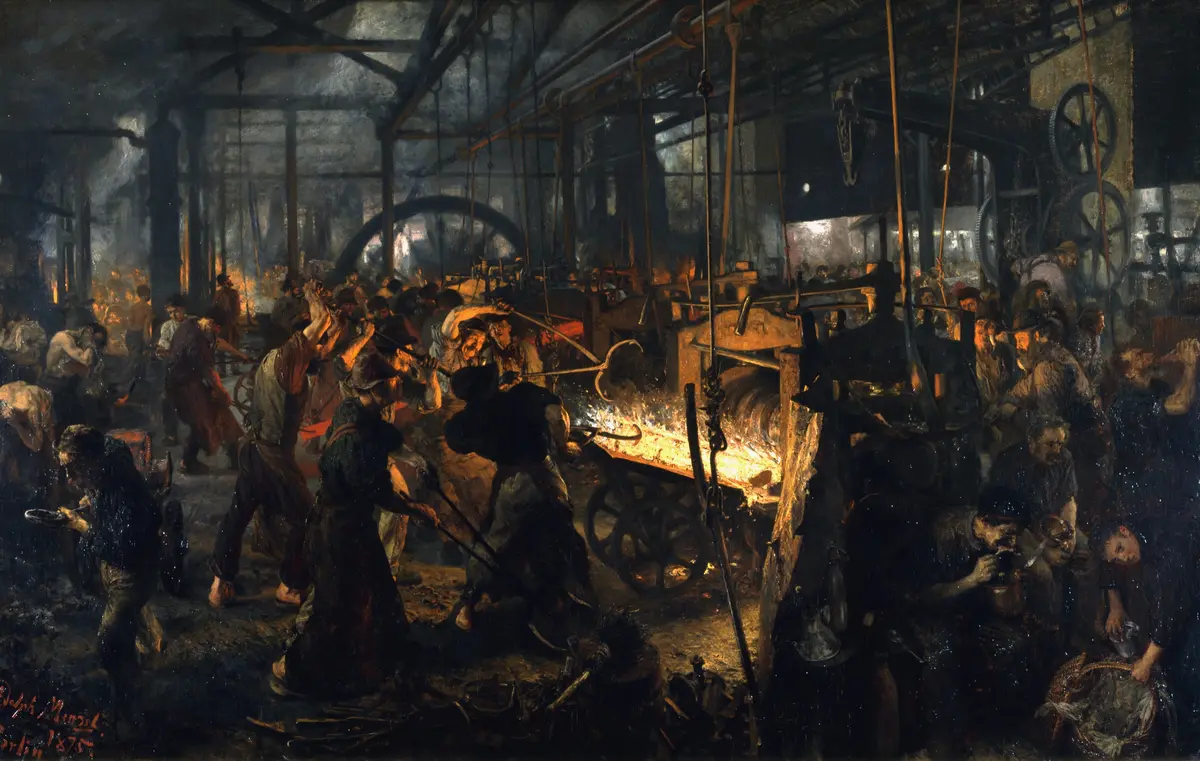
In late summer the Berlin painter Adolph Menzel travels to the ironworks at Königshütte in Upper Silesia and makes hundreds of sketches of workers and machines; from them he paints The Iron Rolling Mill (1872-75).
Königshütte (now Chorzów), Upper Silesia: the ironworks Menzel studied in 1872 for The Iron Rolling Mill - 1876
Nicolaus Otto, a German travelling salesman turned engine builder, makes the four-stroke gas engine, the 'silent Otto', the basis of the engines that will drive cars, boats and later aircraft.
In Boston Alexander Graham Bell speaks to his assistant Thomas Watson through his telephone; the switchboard follows in 1878.
- 1878
Two British amateurs, Sidney Thomas and his cousin Percy Gilchrist, line the Bessemer converter with limestone, which takes the phosphorus out of the iron; the phosphoric ores of Lorraine and the Ruhr can now make good steel, and German steel takes off.
- 1879
At Menlo Park, Edison and Charles Batchelor test a lamp with a filament of carbonised cotton thread; it glows for about thirteen and a half hours.
Menlo Park, New Jersey: Edison's laboratory, where the carbon-filament lamp burned on 22 October 1879- 1881
Siemens & Halske's electric tram at Lichterfelde near Berlin is officially tested and approved. The inspectors allow only 20 km/h, though the cars, full with 20 passengers, reach 30 to 40 km/h even uphill, Werner von Siemens writes that day; regular service begins days later.
Lichterfelde, Berlin: Siemens & Halske's electric tram of 1881 ran from the station to the cadet schoolA census at Krupp counts 19,605 workers, 11,211 of them at the cast-steel works in Essen, which covers more than 500 acres of the town.
Krupp's cast-steel works, Essen: some 19,600 workers by 1881, the largest steel and arms works in Europe- 1882
In the afternoon, from J. P. Morgan's office, Edison gives the signal that starts the Pearl Street station in Lower Manhattan, the first central power station: about 85 customers and 400 lamps the first day, 10,000 lamps within a year.
Pearl Street Station, New York: Edison's first central power station, switched on 4 September 1882- 1884
Charles Parsons builds the steam turbine; his prototype runs at 18,000 turns a minute, and after 1900 turbines, led by the navies, transform ships at sea.
- 1886
The United States makes more steel than Britain for the first time: about 2.56 million long tons against 2.26 million.
- 1889
The Exposition universelle opens in Paris, with the new Eiffel Tower and the Galerie des machines, a hall of iron and glass full of working engines.
Galerie des machines, Champ de Mars, Paris: the hall of machines of the Exposition universelle of 1889- 1891
At the electrical exhibition in Frankfurt, three-phase alternating current arrives from the hydroelectric plant at Lauffen on the Neckar, 175 km away: 300 horsepower at 15,000 volts, more than three-quarters of it delivered. AEG's Dolivo-Dobrowolsky and Oerlikon's Brown built the machines.
Lauffen am Neckar: the hydroelectric plant that sent three-phase current 175 km to Frankfurt in August 1891- 1892
At Carnegie's Homestead works near Pittsburgh, locked-out steelworkers fight a battle with Pinkerton guards brought up the river on barges; the union is broken.
Homestead Steel Works on the Monongahela near Pittsburgh: Carnegie's mill from 1883, scene of the battle of 6 July 1892- 1893
Germany, with Luxembourg, passes Britain in steel: about 3.16 million metric tons against 2.95 million long tons.
The World's Columbian Exposition opens in Chicago; its 'White City' and its Electricity Building are lit by Westinghouse's alternating current.
Jackson Park, Chicago: the World's Columbian Exposition of 1893, lit by Westinghouse's alternating current- 1897
German chemists perfect synthetic indigo, a dye that until then came only from plants; Germany now leads the world in chemicals.
Professor Moritz Schröter tests Rudolf Diesel's engine, built at Augsburg: it turns 26.2 percent of its fuel's heat into work, three times as much as a steam engine. Diesel presents it to the German engineers at Kassel in June.
Maschinenfabrik Augsburg (now MAN), Augsburg: where Rudolf Diesel's engine was built and run, 1893-97- 1901
J. P. Morgan and Elbert Gary buy Carnegie's steel company and join it with their own to form United States Steel.
Guglielmo Marconi receives a wireless signal, the letter S, sent across the Atlantic from Cornwall to Newfoundland.
- 1907
AEG makes the architect Peter Behrens its artistic adviser; he designs its logo, lamps, kettles, posters and factories, the first corporate design. The same year the Deutscher Werkbund is founded to join industry and good design.
AEG turbine factory, Moabit, Berlin: Peter Behrens's glass-and-steel hall of 1909 - 1908
Lewis Hine photographs boys working the night shift in Indiana glass works for the National Child Labor Committee; his pictures help the campaign against child labour.
- 1909
Behrens's turbine factory for AEG is finished in Moabit, Berlin: a steel frame and walls of glass, which contemporaries called a 'machine cathedral'.
AEG turbine factory, Moabit, Berlin: Peter Behrens's glass-and-steel hall of 1909 - 1911
Frederick Winslow Taylor publishes The Principles of Scientific Management: every task timed and broken into simple steps, the worker paid by output.
- 1913
BASF's first ammonia synthesis plant goes into operation at Oppau, making fertiliser from the nitrogen of the air by the process of Fritz Haber and Carl Bosch.
Oppau, Ludwigshafen: BASF's first ammonia synthesis plant, 1913At Ford's Highland Park plant the chassis assembly line begins to move; by 1914 Ford is selling almost a quarter of a million Model Ts a year.
Highland Park Ford Plant, Michigan: the first moving assembly line for a whole car, 1913- 1914
Austria-Hungary declares war on Serbia, and within a week the great industrial powers are at war; their factories turn to shells, explosives and engines, and the Haber process lets Germany make nitrates without Chile's.