Andrew Carnegie
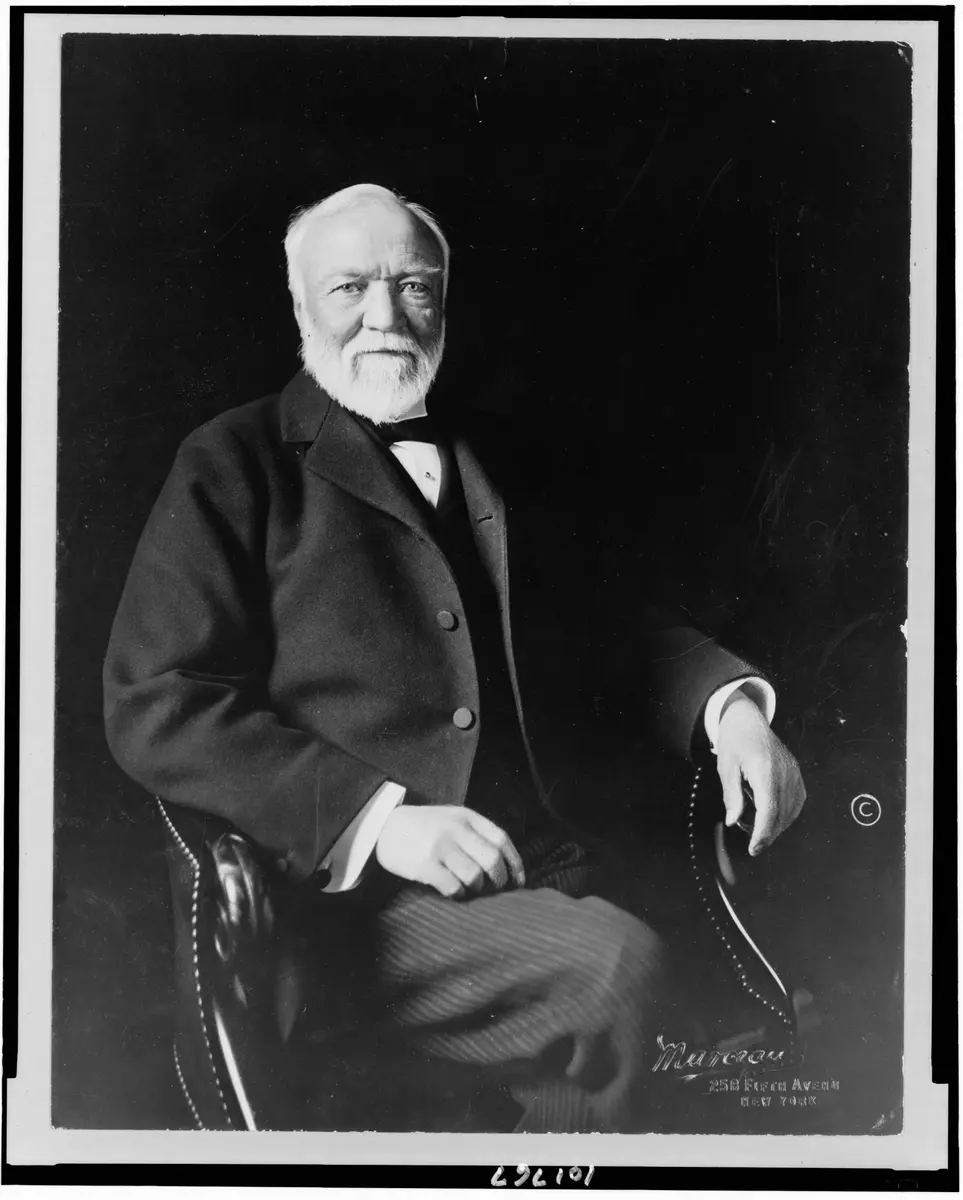
“The Scottish-born steel king who sold Carnegie Steel to J. P. Morgan for $480 million in 1901 and gave his fortune away, above all to libraries: 'the man who dies thus rich dies disgraced'.”
Andrew Carnegie was the Scottish-born American industrialist who built the largest steel business in the United States in the late nineteenth century and then gave most of his fortune away. A handloom weaver's son who reached Pittsburgh at twelve with almost nothing, he rose through the telegraph and the railroad into iron and steel, where his Edgar Thomson and Homestead works helped make America the world's leading steel producer. In 1901 he sold Carnegie Steel to J. P. Morgan for $480 million, the core of the new United States Steel Corporation, and was called the richest man in the world. He spent his last eighteen years giving it away: 2,509 public library buildings, 1,679 of them in the United States, Carnegie Hall, and trusts for science, teaching and peace, about $350 million in all, true to his own rule that 'the man who dies thus rich dies disgraced'.
He was born on 25 November 1835 in the attic of a weaver's cottage in Dunfermline, Fife. His father William wove damask linen on a handloom and, with Andrew's uncle Tom Morrison, led the town's Chartists, who demanded the vote for working men; when steam-powered looms came to Dunfermline in 1847, hundreds of handloom weavers lost their work and the family slid into poverty. In May 1848 they sold their belongings, borrowed twenty pounds for the passage and sailed from Glasgow on the Wiscasset to join relatives in Allegheny, across the river from Pittsburgh. Andrew started as a bobbin boy in a cotton mill at $1.20 a week. Early in 1850 he became a messenger in Pittsburgh's telegraph office, learned the instruments and was soon an operator, and on Saturdays he borrowed books from the four hundred volumes Colonel James Anderson opened to working boys, the debt he later gave as the reason for his libraries. In 1853 Thomas A. Scott of the Pennsylvania Railroad made him his clerk and telegrapher at $35 a month, and in December 1859 he succeeded Scott as superintendent of the railroad's Pittsburgh Division.
He learned to invest as fast as he learned to work. Scott let him buy ten shares of Adams Express, for which his mother mortgaged the house; he took a share in the Woodruff sleeping-car company, made money in Pennsylvania oil, and put his gains into iron mills, a locomotive works and the Keystone Bridge Company, which built iron bridges in place of wooden ones. In 1865 he left the railroad. In December 1868, aged thirty-three, he wrote himself a note to stop at an income of $50,000 a year and give the surplus away, and then made money for thirty more years. After seeing Henry Bessemer's steel process in Britain in 1872 he built the Edgar Thomson Steel Works at Braddock, named after the Pennsylvania Railroad's president, which made its first steel in August 1875. His methods became the model for American industry: strict cost accounting ('watch costs, and the profits take care of themselves'), any new machine that made a ton cheaper, and ownership of every step from the iron ore and Henry Clay Frick's coke to the ships and railways that carried them. He bought the rival Homestead Works in 1883, and on 1 July 1892 his firms were merged as the Carnegie Steel Company, with Frick as chairman.
Carnegie liked to be seen as a friend of working men, and in magazine essays he defended their right to form unions. In June 1889 the North American Review printed his essay 'Wealth', soon called The Gospel of Wealth: the rich are only trustees of their fortunes, should live modestly, and should give the surplus away in their lifetime to things that help people help themselves, such as libraries, universities and parks. Three years later his name was tied to the bloodiest labour battle of the age. With the union's contract at Homestead ending in June 1892 and Carnegie away in the Scottish Highlands, Frick locked the workers out, fenced the mill and hired three hundred Pinkerton guards. On 6 July the guards came up the Monongahela on barges and a day-long gun battle left three of them and seven townsmen dead; the state militia then occupied the town, strikebreakers ran the mill, and in November the strikers gave up. Carnegie had backed Frick by letter and stayed out of reach of the press and the men; he later wrote that no wound of his business life still hurt except Homestead.
In 1901, at sixty-five, he let J. P. Morgan buy him out, and Carnegie Steel became the heart of U.S. Steel. The rest of his life went into giving, mostly through trusts that still carry his name: the Carnegie Institute in Pittsburgh (1895), the Carnegie Institution of Washington for science (1902), the Hero Fund (1904), pensions for college teachers (1905), the Peace Palace at The Hague (opened in 1913), the Carnegie Endowment for International Peace (1910) and, for most of what was left, the Carnegie Corporation of New York (1911), renamed the Andrew Carnegie Foundation in 2026. He married Louise Whitfield in 1887, had one daughter, Margaret, in 1897, and divided his years between New York and Skibo Castle in the Highlands. The war of 1914 broke his hopes for peace. He died at Shadow Brook, his summer house at Lenox, Massachusetts, on 11 August 1919. He is remembered both as the hard-driving cost-cutter whose mill broke a union and as the man who made giving a public duty of the rich, the model modern philanthropy still follows.
What happened
- 1835
Andrew Carnegie is born in the attic of a weaver's cottage at Moodie Street and Priory Lane in Dunfermline, Fife, the first son of William Carnegie, a damask weaver, and Margaret Morrison.
The weaver's cottage on Moodie Street, Dunfermline, where he was born on 25 November 1835; now the Andrew Carnegie Birthplace Museum- 1848
With the handloom trade ruined by steam looms, the family leaves Dunfermline, sails from the Broomielaw in Glasgow on the Wiscasset and, after about seven weeks at sea and three more by canal, settles in Allegheny. Andrew starts work as a bobbin boy in a cotton mill at $1.20 a week.
- 1850
Early in the year he becomes a messenger boy at the Pittsburgh telegraph office at $2.50 a week, learns the instruments and is soon an operator; on Saturdays he borrows books from Colonel James Anderson's library for working boys.
- 1853
Thomas A. Scott, superintendent of the Pennsylvania Railroad's western division, engages him as his clerk and telegraph operator at $35 a month.
- 1859
Aged twenty-four, he succeeds Scott as superintendent of the Pennsylvania Railroad's Pittsburgh Division. His shares in Adams Express and the Woodruff sleeping-car company are beginning to pay him more than the railroad does.
- 1861
When the Civil War begins, Scott calls him to Washington, where he helps repair the cut lines through Maryland and organise the military railways and telegraphs of the North.
- 1865
He leaves the railroad to run his own businesses, above all the Keystone Bridge Company, which builds iron bridges in place of wooden ones.
- 1868
In a note to himself at the St. Nicholas Hotel in New York he resolves to stop at an income of $50,000 a year, spend the surplus on good causes and retire at thirty-five. He keeps making money for another thirty years.
- 1872
In England he sees Henry Bessemer's process for turning iron into steel in large batches, and comes home resolved to build a steel works.
- 1875
The Edgar Thomson Steel Works at Braddock, named after the Pennsylvania Railroad's president, make their first Bessemer blow; the first rail is rolled on 1 September, for a first order of 2,000 rails for the Pennsylvania.
The Edgar Thomson Steel Works at Braddock, Pennsylvania: his first steel mill, making steel from August 1875, still working as U.S. Steel's Edgar Thomson Plant- 1881
In Dunfermline his mother lays the foundation stone of the town's free library, the first library building he gives; thousands will follow.
- 1882
The Carnegies buy a large share of the H. C. Frick Coke Company, binding the coke of the Connellsville ovens, and Henry Clay Frick himself, to the steel business.
- 1883
He buys the rival Homestead Steel Works on the Monongahela, built by a group of Pittsburgh manufacturers, at a time of falling steel prices.
- 1886
His mother dies, weeks after his brother Tom, while he lies ill with typhoid. That year he also publishes Triumphant Democracy, a hymn to the American republic.
- 1887
He marries Louise Whitfield, the daughter of a New York merchant, at her family's home in New York; they honeymoon on the Isle of Wight.
- 1889
The North American Review prints his essay 'Wealth', later called The Gospel of Wealth: the rich should give their fortunes away in their lifetime, for 'the man who dies thus rich dies disgraced'.
- 1891
His Music Hall on 57th Street in New York opens with a concert at which Tchaikovsky makes his American debut; it soon becomes known as Carnegie Hall.
Carnegie Hall, Seventh Avenue and 57th Street, New York: the Music Hall he built, opened on 5 May 1891- 1892
At Homestead, with the union's contract running out and Carnegie in the Scottish Highlands, Frick shuts the mills and locks out 3,800 men; on 1 July his companies are merged as the Carnegie Steel Company, Limited.
The Pump House of the Homestead Works, Munhall, beside the landing where the Pinkertons' barges came ashore on 6 July 1892Before dawn about three hundred Pinkerton guards come up the Monongahela on barges to take over the mill. Strikers and townspeople meet them at the landing with rifles, a cannon and burning oil, and the fighting lasts all day.
The Pump House of the Homestead Works, Munhall, beside the landing where the Pinkertons' barges came ashore on 6 July 1892- 5:00 p.m.
The Pinkertons surrender and are beaten as they are marched through the crowd. Three guards and seven workmen are dead; days later the state militia occupies the town and strikebreakers start the mill.
The Pump House of the Homestead Works, Munhall, beside the landing where the Pinkertons' barges came ashore on 6 July 1892 Alexander Berkman, an anarchist with no tie to the union, shoots and stabs Frick in his Pittsburgh office. Frick survives, and public sympathy turns against the strikers.
The last strikers vote, 101 to 91, to give up and declare the mill open; the union is broken at Homestead.
The Pump House of the Homestead Works, Munhall, beside the landing where the Pinkertons' barges came ashore on 6 July 1892- 1895
The Carnegie Institute opens in Pittsburgh's Oakland district, with a library, a music hall and, soon, an art gallery and a natural history museum.
- 1897
His only child, Margaret, is born, named after his mother; Louise asks for a summer home of their own in the Highlands.
- 1898
He buys the Skibo estate on the Dornoch Firth and rebuilds the castle as the family's summer home. The same year he dedicates a library, hall, pool and gymnasium at Homestead.
- 1901
He agrees to sell Carnegie Steel to J. P. Morgan for $480 million, and it becomes the core of the United States Steel Corporation; Morgan is said to have told him he was now the richest man in the world.
Retiring from business, he makes the 'first use of surplus wealth': $4 million in bonds for a fund to help injured workmen and pension old ones of his mills.
- 1902
He founds the Carnegie Institution of Washington to pay gifted people to do scientific research.
- 1907
Three days after rededicating the enlarged Carnegie Institute in Pittsburgh, he opens the National Arbitration and Peace Congress in New York as its president; its meetings fill Carnegie Hall.
Carnegie Hall, Seventh Avenue and 57th Street, New York: the Music Hall he built, opened on 5 May 1891- 1910
He gives $10 million to found the Carnegie Endowment for International Peace, to hasten the end of war.
- 1911
He sets up the Carnegie Corporation of New York and transfers most of what is left of his fortune to it, $125 million by 1912, the largest charitable trust yet made.
- 1913
The Peace Palace he paid for at The Hague, home of the Permanent Court of Arbitration, is opened in the presence of the Dutch royal family and of Carnegie.
- 1914
News of the war reaches the Carnegies in the Highlands and they go back to Skibo; he stops writing his memoirs that day, and that year he leaves Scotland for the last time.
- 1919
Weakened by influenza and pneumonia, Andrew Carnegie dies at Shadow Brook, his summer house at Lenox, Massachusetts, aged 83. He is buried at Sleepy Hollow, New York, under a Celtic cross.
Sleepy Hollow Cemetery, Sleepy Hollow, New York: his grave