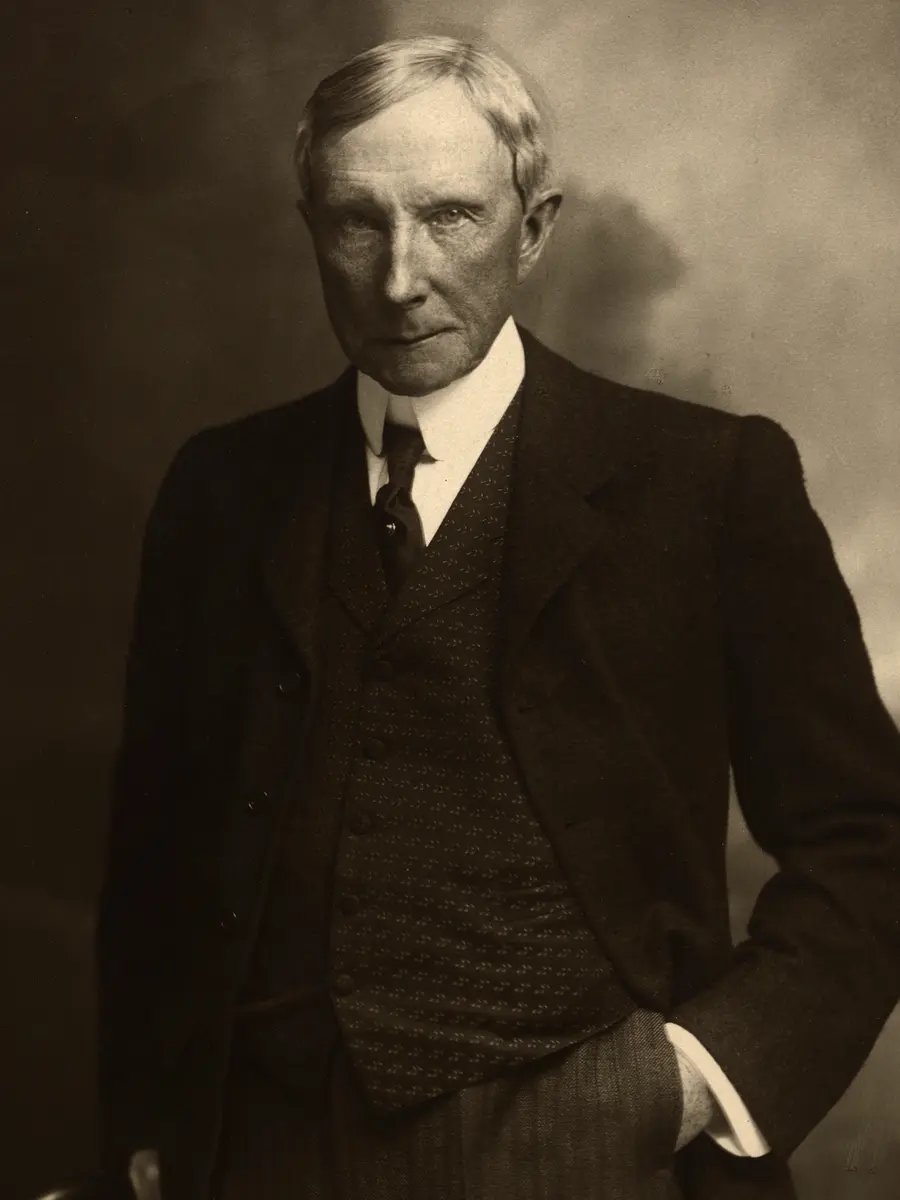
John D. Rockefeller
“The Cleveland bookkeeper who built Standard Oil into America's first great trust, refining about nine-tenths of the nation's oil, until the Supreme Court broke it up in 1911; then the greatest philanthropist of his age.”
John Davison Rockefeller was the American businessman who built Standard Oil, the company that by about 1880 refined some nine-tenths of the oil in the United States and became the model for the giant modern corporation, and who then gave away more money than anyone before him. He started as a sixteen-year-old bookkeeper in Cleveland, went into the new trade of refining oil in 1863, cut costs without mercy, won secret rebates from the railways and bought up his rivals until the industry was largely his. To admirers he brought order to a wasteful boom and made lamp oil cheap for millions; to critics, led by the journalist Ida Tarbell, he was the most ruthless of the 'robber barons', and anger at his trust helped give the United States its antitrust law. In 1911 the Supreme Court ordered Standard Oil broken up. By then he had turned to philanthropy, founding the University of Chicago, the Rockefeller Institute for Medical Research and the Rockefeller Foundation.
He was born on 8 July 1839 on a farm near Richford, in southern New York, the second of six children of William Avery Rockefeller, a travelling seller of cures who was often away for months, and Eliza Davison, a strict and religious mother who taught him to work, to save and to give. The family moved several times and in 1853 settled near Cleveland, Ohio, where he went to Central High School. After a short course in bookkeeping at a commercial college he tramped the streets for weeks looking for work, until on 26 September 1855 the commission merchants Hewitt & Tuttle took him on as an assistant bookkeeper. In March 1859, with his savings and $1,000 borrowed from his father at ten per cent, he became the junior partner of Maurice B. Clark in Clark & Rockefeller, dealers in grain, hay and meat, a business that prospered in the Civil War. That August Edwin Drake struck oil near Titusville in western Pennsylvania, and Cleveland, joined to the new oil regions by rail and to the East by lake and railway, became a refining centre.
In 1863 Rockefeller and Clark went into refining with Samuel Andrews, who knew how to clean crude oil with sulphuric acid. In 1865 the partners fell out and auctioned the refinery among themselves; Rockefeller bought it for $72,500 and from then on worked only in oil. With Henry Flagler as a partner, on 10 January 1870 he, his brother William, Andrews, Flagler and Stephen Harkness founded the Standard Oil Company of Ohio with $1 million of capital. Rockefeller wanted size and efficiency: Standard made its own barrels, ran its own tank cars and storage tanks, sold every by-product, and used its huge, steady freight to win rebates from the railways that smaller refiners could not get. In the winter of 1871 to 1872, amid the uproar over the South Improvement Company, a secret railway pool that would have charged rivals extra, he bought out almost all of Cleveland's refiners, often paying in Standard shares, and then moved on to Pittsburgh, Philadelphia, New York, the oil regions and the pipelines. On 2 January 1882 the owners placed the shares of some forty companies in the hands of nine trustees with Rockefeller at their head: the Standard Oil Trust, the first great American 'trust', which gave its name to every monopoly that copied it. In 1885 it moved its headquarters to 26 Broadway in New York.
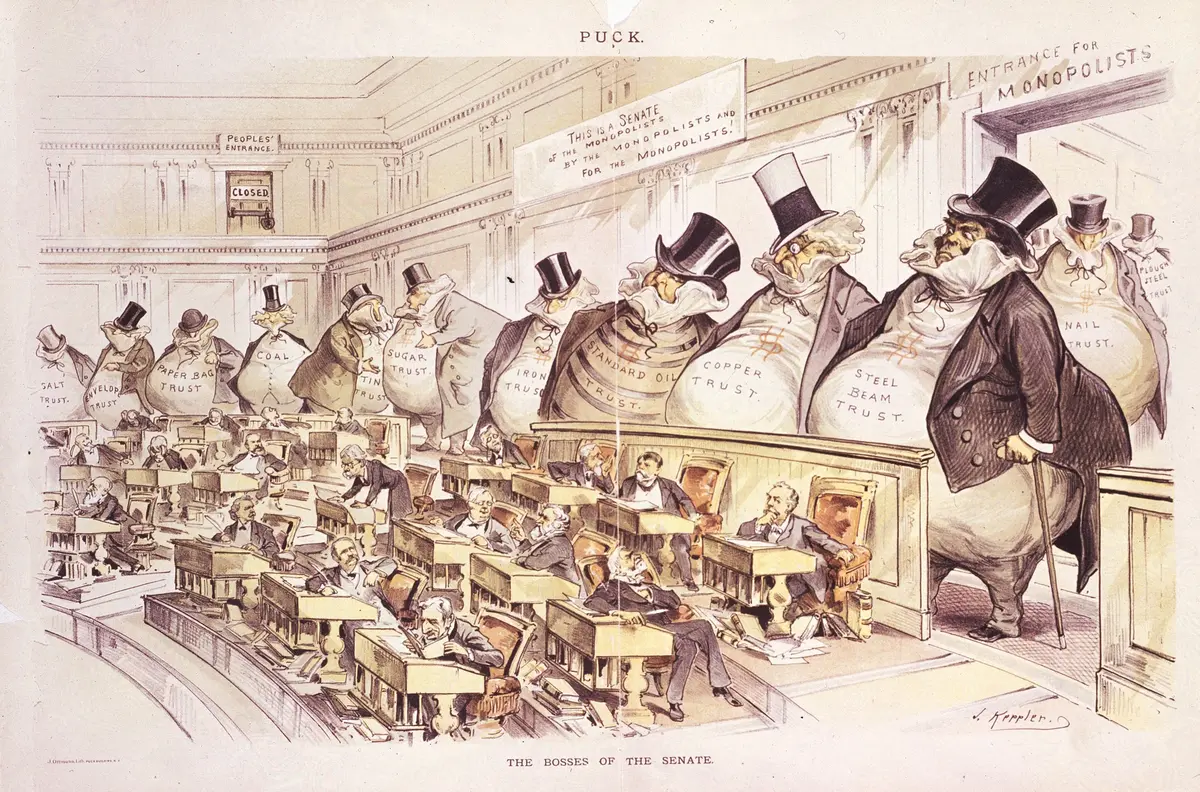
Public anger at the trusts led Congress to pass the Sherman Antitrust Act in 1890. In 1892 an Ohio court ruled against the trust, and in 1899 its companies were gathered again under a holding company, Standard Oil of New Jersey. Rockefeller stepped back from the daily work in 1896, though he kept the title of president, and his silence made him the target. Ida Tarbell's History of the Standard Oil Company, a series in McClure's Magazine from 1902 to 1904 and a book in November 1904, set out the rebates and the pressure on competitors in detail, and cartoonists drew Standard as an octopus around the Capitol. In November 1906, under President Theodore Roosevelt, the federal government sued, and on 15 May 1911 the Supreme Court upheld the order that the New Jersey company give up the thirty-seven companies it controlled. The separate companies kept the same owners, and Rockefeller's own fortune reached almost $900 million in 1912.
A lifelong Baptist who had given part of his pay to his church and to charity since his first job, Rockefeller made giving a system, advised by the Baptist minister Frederick T. Gates and by his son, John D. Rockefeller Jr. In 1889 he pledged $600,000 toward a Baptist college in Chicago; the University of Chicago opened in 1892 and received $35 million from him in all. He founded the Rockefeller Institute for Medical Research (1901), the General Education Board (1902), the Sanitary Commission that fought hookworm in the American South (1909) and the Rockefeller Foundation (1913), 'to promote the well-being of mankind throughout the world'; his gifts came to some $540 million. In 1914 the killing of strikers' families at Ludlow, Colorado, at a coal company the family controlled, damaged the name again. He spent his last years at Kykuit, his stone house above the Hudson at Pocantico Hills, and his winters at The Casements in Ormond Beach, Florida, playing golf and handing out dimes, and he died there on 23 May 1937, aged 97. He is buried in Lake View Cemetery in Cleveland.
What happened
- 1839
John Davison Rockefeller is born on a farm near Richford, New York, the second of six children of William Avery Rockefeller and Eliza Davison.
Richford, Tioga County, New York: born on a farm near the village on 8 July 1839- 1853
After several moves in New York State the family settles near Cleveland, Ohio, at Strongsville; he goes to Central High School in the city until 1855.
- 1855
After a short course at a commercial college and weeks of asking for work, he is taken on as assistant bookkeeper by Hewitt & Tuttle, commission merchants on the Cleveland docks.
The Flats, Cleveland: the Cuyahoga valley where he started as a bookkeeper on the docks in 1855 and where Standard Oil's refineries stood- 1859
With his savings and $1,000 borrowed from his father at ten per cent, he goes into business with Maurice B. Clark as Clark & Rockefeller, commission merchants in grain, hay and meat.
The Flats, Cleveland: the Cuyahoga valley where he started as a bookkeeper on the docks in 1855 and where Standard Oil's refineries stoodEdwin Drake strikes oil near Titusville in western Pennsylvania, and a rush of drillers and refiners begins in the 'oil regions'.
- 1863
With Clark's brothers and Samuel Andrews, who knows how to clean crude oil, he goes into refining in Cleveland: Andrews, Clark & Co.
The Flats, Cleveland: the Cuyahoga valley where he started as a bookkeeper on the docks in 1855 and where Standard Oil's refineries stood - 1864
He marries Laura Celestia Spelman, a teacher, in Cleveland. They will have five children; their only son, John D. Rockefeller Jr., will run the family's giving.
- 1865
The partners fall out and auction the refinery among themselves. Rockefeller bids $72,500, wins, and with Andrews forms Rockefeller & Andrews; from now on he works only in oil.
The Flats, Cleveland: the Cuyahoga valley where he started as a bookkeeper on the docks in 1855 and where Standard Oil's refineries stood- 1870
He, his brother William, Samuel Andrews, Henry Flagler and Stephen Harkness found the Standard Oil Company of Ohio, with $1 million of capital and about a tenth of the country's refining.
The Flats, Cleveland: the Cuyahoga valley where he started as a bookkeeper on the docks in 1855 and where Standard Oil's refineries stood- 1872
In the uproar over the South Improvement Company, a secret pact of railways and refiners that would have charged rivals extra, he buys out almost all of Cleveland's refiners within a few months, paying many in Standard shares.
The Flats, Cleveland: the Cuyahoga valley where he started as a bookkeeper on the docks in 1855 and where Standard Oil's refineries stood - 1882
The owners sign the Standard Oil Trust agreement: the shares of some forty companies go to nine trustees headed by Rockefeller, who issue trust certificates in return. It is the first great American 'trust'.
- 1885
Standard Oil moves its headquarters to its new building at 26 Broadway in New York; Rockefeller has bought a house at 4 West 54th Street the year before.
26 Broadway, New York: Standard Oil's headquarters from 1885; the present building of 1921 to 1928 takes in the first one - 1889
Persuaded by Frederick T. Gates, he pledges $600,000 toward a $1 million endowment for a new Baptist college in Chicago, if the American Baptist Education Society raises the rest.
- 1890
The Sherman Antitrust Act becomes law, born of public anger at trusts like his; it is the law under which Standard Oil will be broken up.
- 1892
After a suit by Ohio's attorney general, the Ohio Supreme Court rules against the trust, and it is formally dissolved; the same men keep control through the separate companies.
The University of Chicago, incorporated in 1890 with his money, opens its doors; students enter the unfinished Cobb Hall under scaffolding. His gifts to it will reach $35 million.
- 1896
Aged about 57, he gives up the daily direction of Standard Oil to John D. Archbold and others, though he keeps the title of president until 1911.
- 1899
The companies of the old trust are gathered again under a holding company, the Standard Oil Company of New Jersey.
- 1901
He founds the Rockefeller Institute for Medical Research in New York (today Rockefeller University).
- 1902
He creates the General Education Board 'without distinction of race, sex or creed'; by 1965 it will spend $325 million, much of it on schools in the South.
Ida Tarbell's History of the Standard Oil Company begins in McClure's Magazine; in nineteen parts over two years it sets out the rebates and the pressure on rivals.
- 1904
Puck prints Udo Keppler's 'Next!', Standard Oil as an octopus gripping the Capitol and reaching for the White House.
Tarbell's series comes out as a book in two volumes; the second opens with George Varian's sketch of Rockefeller drawn in Cleveland the year before.
- 1906
The federal government files its antitrust suit against Standard Oil of New Jersey, some seventy other companies, Rockefeller, his brother William, Flagler and others.
- 1909
He gives $1 million to found the Rockefeller Sanitary Commission, which treats and teaches against hookworm in eleven Southern states.
His new stone house at Kykuit, on the hilltop of his Pocantico Hills estate above the Hudson, is finished; it is enlarged from 1911 to 1913.
Kykuit, Pocantico Hills: his house above the Hudson from 1909 until his death- 1911
The Supreme Court upholds the order to break up Standard Oil: the New Jersey company must give up the thirty-seven companies it controls. The pieces keep the same owners, and in 1912 his fortune reaches almost $900 million.
- 1913
He founds the Rockefeller Foundation 'to promote the well-being of mankind throughout the world'; it takes the hookworm work worldwide.
- 1914
At Ludlow, Colorado, the National Guard and company guards attack the tent colony of striking miners of the Colorado Fuel and Iron Company, a Rockefeller company; 25 people die, 11 of them children, and the family is blamed.
- 1933
Aged 93, he is still photographed playing golf in Florida, where he spends his winters at The Casements in Ormond Beach.
- 1937
John D. Rockefeller dies in his sleep at The Casements, Ormond Beach, aged 97. He is buried in Lake View Cemetery, Cleveland.
Lake View Cemetery, Cleveland: his grave under the family obelisk