The Suez Canal opens
“In 1869 the Suez Canal, dug by a French company with Egyptian money and forced labour, joined the Mediterranean to the Red Sea, so ships to India and Java no longer had to sail round Africa.”
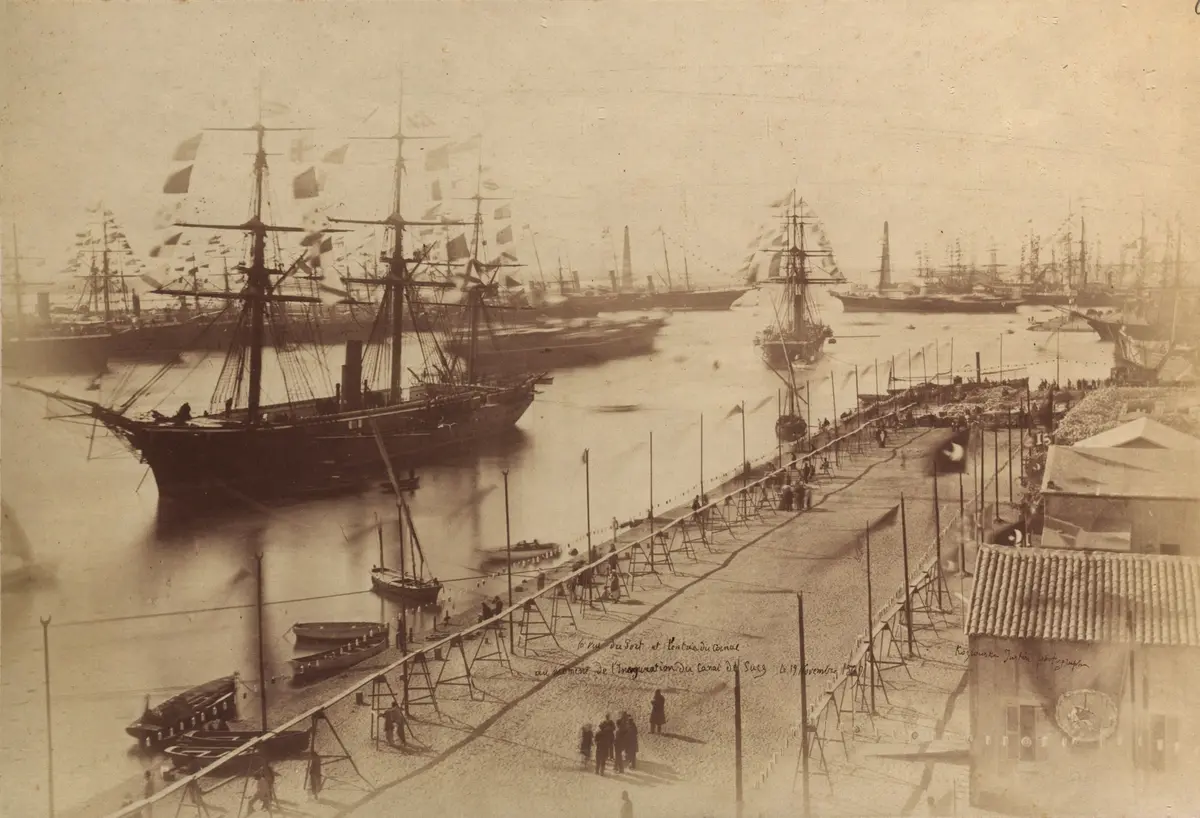
On 17 November 1869 the French imperial yacht L'Aigle, with Empress Eugénie and Ferdinand de Lesseps on board, led a procession of ships out of Port Said into a new waterway cut across the Isthmus of Suez. Three days later it reached Suez on the Red Sea. For the first time ships could sail from the Mediterranean to the Indian Ocean without going round Africa. The canal ran 164 kilometres through the desert and through the lakes of the isthmus, Lake Manzala, Lake Timsah and the Bitter Lakes. It needed no locks, because the two seas lie at almost the same level, and it was about eight metres deep. Digging it had moved some 74 million cubic metres of sand and mud.
It was a French enterprise built on Egyptian ground, and Egypt was then still part of the Ottoman Empire. De Lesseps, a former French diplomat who had known the viceroy Said Pasha since Said was a boy, obtained a concession from him on 30 November 1854, and a second one in January 1856. It allowed him to form a company that would dig the canal, keep it open to the ships of every nation and run it for 99 years. The Compagnie universelle du canal maritime de Suez was founded in December 1858 with 400,000 shares of 500 francs. Britain, whose prime minister Palmerston feared a French road to India, refused to take part. Some 21,000 French savers, many of them people of modest means, bought more than half the shares, and Said took the rest, 44 per cent, partly with borrowed money. The work took ten years instead of six and cost 433 million francs, twice the estimate.
Work began on 25 April 1859, on the beach where Port Said would rise. In the first years the canal was dug by hand: Egyptian peasants, called up by their government in rotating gangs as forced labour (the corvée), carried the earth away in baskets. Nobody knows how many died. The historian Caroline Piquet speaks of tens of thousands among the hundreds of thousands called up; Nasser, in 1956, spoke of 120,000; no reliable record survives. Britain denounced the forced labour, and Said's successor Ismail challenged the company's terms. Napoleon III's arbitration of 6 July 1864 ended the corvée on the canal, gave most of the company's land back to Egypt and made Egypt pay the company a heavy indemnity. Steam dredgers and excavators, worked mostly by European labourers, did the rest. The company built new towns along the line, Port Said and Ismailia, and in August 1869 the waters of the two seas met in the Bitter Lakes.
Ismail, by then khedive, turned the opening into a festival for the crowned heads of Europe: the Emperor of Austria, the Crown Prince of Prussia and Prince Hendrik of the Netherlands were among his guests. The canal changed the map of trade. Today's sea route from Rotterdam to Singapore is some 3,500 nautical miles shorter through Suez than round the Cape. Together with the steamship, the canal cut the passage from Britain to India from about three months to about three weeks. The Dutch, who had needed some four months to reach the Indies, founded the Stoomvaart Maatschappij Nederland in Amsterdam in 1870 to run steamers to Java. There, the canal and the end of the Cultivation System opened the way to a new export economy of private plantations.
For Egypt the canal was ruinous. Ismail's debts grew from 7 million pounds to almost 100 million, and in November 1875 he sold his 176,602 shares to the British government. Benjamin Disraeli paid for them with £4 million lent by the Rothschild bank, and Britain, which had fought the canal, became its largest single shareholder; in 1882 it occupied Egypt. The Convention of Constantinople of 1888 declared the canal open to the ships of all nations in peace and in war. In 1956, twelve years before the concession was due to end, President Nasser nationalised the company and set off the Suez Crisis. The canal is still one of the busiest shipping lanes in the world.
What happened
- 1859
De Lesseps strikes the first blow of the pickaxe on the beach where Port Said will rise, near ancient Pelusium. Work begins although neither Britain nor the Ottoman sultan has approved the project.
Port Said, the company town at the canal's Mediterranean entrance, where work began in 1859 and the opening was celebrated in 1869- 1862
The Mediterranean flows into Lake Timsah through the first channel dug from Port Said, much of it cut by hand by Egyptian peasants drafted as forced labour, the corvée.
Lake Timsah, reached by the Mediterranean on 18 November 1862, where the opening fleet anchored on 17 November 1869- 1863
Said Pasha dies. His nephew Ismail becomes viceroy and, with Britain and the Ottoman sultan pressing him, disputes the company's use of forced labour and the huge lands it was given.
- 1864
Napoleon III's arbitration award: the company returns most of its land and gives up the forced labour, and Egypt pays it a heavy indemnity of 84 million francs. Steam dredgers and excavators, worked mostly by European labourers, take over the digging.
- 1865
Cholera sweeps through the camps of the isthmus and slows the work.
- 1866
The Ottoman sultan Abdülaziz ratifies the concession by an imperial firman: the canal, begun without his consent, is now lawful in Constantinople as well as in Cairo.
- 1869
The last dams are cut and the waters of the Mediterranean and the Red Sea meet in the Bitter Lakes: the canal is finished.
The Great Bitter Lake, where the waters of the Mediterranean and the Red Sea met in August 1869Empress Eugénie arrives at Port Said, where Ismail has gathered the crowned heads of Europe. On the beach a religious ceremony blesses the canal before the guests.
Port Said, the company town at the canal's Mediterranean entrance, where work began in 1859 and the opening was celebrated in 1869To the sound of the guns, L'Aigle, with the Empress and de Lesseps on board, leads the procession of ships into the canal. By evening the fleet lies at anchor in Lake Timsah, off Ismailia.
Port Said, the company town at the canal's Mediterranean entrance, where work began in 1859 and the opening was celebrated in 1869At Ismailia the Khedive gives a dinner and a ball for the Empress, the Emperor of Austria, the Crown Prince of Prussia and Prince Hendrik of the Netherlands.
Ismailia, the company's town on Lake Timsah, halfway along the canal, where the Khedive held the opening ball- 11:30 a.m.
L'Aigle reaches Suez on the Red Sea, and the Empress's companions sign a sheet to mark the end of the first passage from sea to sea.
Suez, the old Red Sea port at the southern end, reached by L'Aigle on 20 November 1869