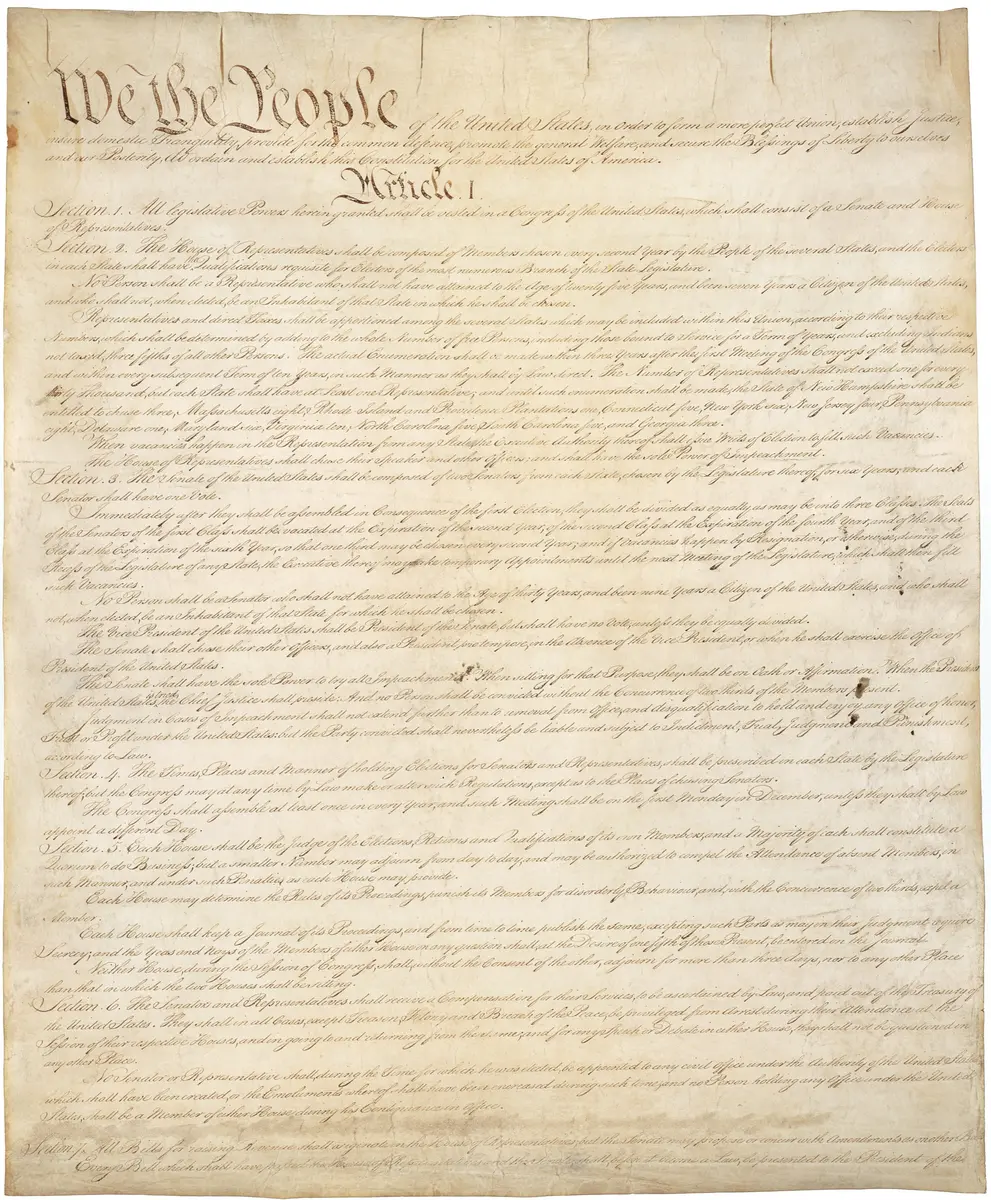
The US Constitution is written
“Philadelphia, summer 1787: meeting in secret, 55 delegates write a new frame of government, 'We the People'; ratified by nine states in 1788, it is still the US Constitution.”
Four years after the peace with Britain, the United States were in danger of coming apart. Since 1781 the thirteen states had been held together only by the Articles of Confederation, a 'league of friendship' whose Congress could not tax, could not regulate trade and could do little to settle quarrels between the states. Paper money lost its value, farmers were jailed for debt, and in 1786 armed men led by Daniel Shays, a former Continental Army captain, stopped the court from sitting at Northampton in Massachusetts. James Madison of Virginia, 36, who had long studied why confederacies fail, worked for a remedy: a meeting on trade at Annapolis in September 1786 asked Congress to summon all the states, and in February 1787 Congress called a convention in Philadelphia 'for the sole and express purpose of revising the Articles of Confederation'.
The delegates replaced the Articles instead. Twelve states sent men, Rhode Island refusing, and 55 of them met behind closed doors in the Assembly Room of the Pennsylvania State House, now Independence Hall, from May 25 to September 17, 1787, with George Washington in the chair and Madison writing down the debates day by day. On May 29 Edmund Randolph laid out the Virginia Plan, Madison's design for a national government of three branches with a two-house Congress elected by population. The small states answered with William Paterson's New Jersey Plan, one state one vote, and the quarrel nearly broke up the meeting until the Connecticut Compromise of July 16 gave the House of Representatives seats by population and every state an equal vote in the Senate. North and South bargained over slavery: three-fifths of the enslaved were counted for seats and taxes, Congress could not stop the slave trade before 1808, and people escaping 'service or labour' had to be handed back, without the word 'slave' appearing anywhere. Late in the summer the delegates settled on electors to choose a President for four years.
A Committee of Detail turned the resolutions into a first draft, reported on August 6; after five more weeks of debate a Committee of Style gave the text its final shape, in words largely Gouverneur Morris's, including the opening 'We the People of the United States'. On September 17, 1787, 39 delegates signed. George Mason, Edmund Randolph and Elbridge Gerry refused, chiefly because there was no bill of rights, while Benjamin Franklin, at 81 the oldest member, asked the others to 'doubt a little of his own infallibility' and sign. The document was still only a proposal: by its own Article VII it would take effect once conventions in nine states had ratified it. Printed in Philadelphia two days later and sent to the states by Congress in New York, it split the country into Federalists and Anti-Federalists, and Alexander Hamilton, Madison and John Jay defended it in 85 newspaper essays signed 'Publius', The Federalist. Delaware ratified first, unanimously, on December 7; Massachusetts agreed on February 6, 1788, by 187 votes to 168, only after proposing amendments; and on June 21, 1788 New Hampshire became the ninth state.
Virginia and New York followed that summer by narrow votes, and the new government began in New York, where Washington took the oath as the first President at Federal Hall on April 30, 1789. The promise of amendments was kept: Madison steered them through the First Congress, which adopted twelve in September 1789, and ten, the Bill of Rights, were ratified by December 15, 1791; North Carolina and Rhode Island joined only after the amendments had been proposed. The Constitution made the United States a federal republic, its government resting on the people rather than on the states, its power split among Congress, the President and the courts so that each could check the others, and most everyday power left with the states. Its bargains with slavery lasted until the Civil War and the Thirteenth Amendment of 1865. Amended 27 times, it is the oldest written national constitution still in use, and its four parchment pages are on display at the National Archives in Washington.
What happened
- 1787
With a seventh state present, the Convention called for May 14 at last has its quorum in the State House; nominated by Robert Morris, Washington is elected its president unanimously and takes the chair, William Jackson becomes secretary and a committee is named to write rules.
Independence Hall, then the Pennsylvania State House: the Convention met in its Assembly Room from May 25 to September 17, 1787, and the delegates signed the Constitution thereThe rules are adopted, secrecy among them. Edmund Randolph attacks the Articles of Confederation and lays out fifteen resolutions, the Virginia Plan drafted mainly by Madison: a national government of three branches with a two-house Congress chosen by population. Charles Pinckney offers a plan of his own.
Independence Hall, then the Pennsylvania State House: the Convention met in its Assembly Room from May 25 to September 17, 1787, and the delegates signed the Constitution thereWilliam Paterson answers for the small states with the New Jersey Plan: keep a one-house Congress in which every state has one vote, but give it powers to raise money and regulate trade.
Independence Hall, then the Pennsylvania State House: the Convention met in its Assembly Room from May 25 to September 17, 1787, and the delegates signed the Constitution thereAlexander Hamilton, silent until now, speaks for the rest of the day: he rejects both plans, calls the British government the best in the world and proposes a President and a Senate serving during good behaviour. The speech is, as a delegate put it, praised by everybody but supported by none.
Independence Hall, then the Pennsylvania State House: the Convention met in its Assembly Room from May 25 to September 17, 1787, and the delegates signed the Constitution thereWith the quarrel over representation turning bitter, Franklin, the oldest delegate, moves that a clergyman open each day's sitting with prayers; the delegates let it drop, noting among other things that they have no money to pay a chaplain.
Independence Hall, then the Pennsylvania State House: the Convention met in its Assembly Room from May 25 to September 17, 1787, and the delegates signed the Constitution thereBy five states to four, with Massachusetts divided, the Convention adopts the Connecticut, or Great, Compromise: the first house by population, with direct taxes in the same proportion and money bills starting there, and an equal vote for every state in the second.
Independence Hall, then the Pennsylvania State House: the Convention met in its Assembly Room from May 25 to September 17, 1787, and the delegates signed the Constitution thereA Committee of Detail of five, John Rutledge, Edmund Randolph, Nathaniel Gorham, Oliver Ellsworth and James Wilson, is chosen to turn the resolutions into a constitution; two days later the Convention adjourns until August 6 to give it time.
Independence Hall, then the Pennsylvania State House: the Convention met in its Assembly Room from May 25 to September 17, 1787, and the delegates signed the Constitution thereRutledge delivers the committee's report, printed for every member: the first draft, a preamble beginning 'We the people of the States of New Hampshire, Massachusetts...' and twenty-three articles. For five weeks the delegates go through it clause by clause.
Independence Hall, then the Pennsylvania State House: the Convention met in its Assembly Room from May 25 to September 17, 1787, and the delegates signed the Constitution thereOn a committee's compromise, the Convention agrees by seven states to four that Congress may not ban the importation of slaves before 1808; Madison objects that twenty years will produce all the mischief that can be feared from it.
Independence Hall, then the Pennsylvania State House: the Convention met in its Assembly Room from May 25 to September 17, 1787, and the delegates signed the Constitution thereWithout dissent the delegates add a clause that a person 'bound to service or labor' who escapes into another state shall be 'delivered up'; the same day a motion to require two-thirds of Congress for laws on trade, the South's price, is voted down, the other half of the bargain.
Independence Hall, then the Pennsylvania State House: the Convention met in its Assembly Room from May 25 to September 17, 1787, and the delegates signed the Constitution thereThe delegates settle how to choose a President: electors in every state, as many as its senators and representatives, appointed as its legislature directs; if no one wins a majority, the House of Representatives chooses, each state casting one vote.
Independence Hall, then the Pennsylvania State House: the Convention met in its Assembly Room from May 25 to September 17, 1787, and the delegates signed the Constitution thereTheir debate on the draft finished, the delegates name a Committee of Style to put the text in order: William Samuel Johnson, Alexander Hamilton, Gouverneur Morris, James Madison and Rufus King.
Independence Hall, then the Pennsylvania State House: the Convention met in its Assembly Room from May 25 to September 17, 1787, and the delegates signed the Constitution thereJohnson reports the committee's draft, printed for the members, with Morris's new opening, 'We, the People of the United States'. George Mason wishes it had a bill of rights; Elbridge Gerry's motion for a committee to write one fails, every state present voting no.
Independence Hall, then the Pennsylvania State House: the Convention met in its Assembly Room from May 25 to September 17, 1787, and the delegates signed the Constitution thereRandolph, Mason and Gerry ask in vain for a second convention to weigh amendments from the states; late in the afternoon the roll is called and every state present votes for the Constitution as amended.
Independence Hall, then the Pennsylvania State House: the Convention met in its Assembly Room from May 25 to September 17, 1787, and the delegates signed the Constitution thereWashington, silent on every question all summer, speaks to back one last change, allowing up to one representative for every 30,000 people instead of 40,000; Wilson reads Franklin's appeal to sign; 39 delegates sign and Mason, Randolph and Gerry refuse. As the last names go on, Franklin says the sun on the back of Washington's chair is rising, not setting. The members dine together at the City Tavern.
Independence Hall, then the Pennsylvania State House: the Convention met in its Assembly Room from May 25 to September 17, 1787, and the delegates signed the Constitution thereThe Pennsylvania Packet, and Daily Advertiser gives a whole issue to the Constitution, its first authorised printing; after a summer of secrecy the public reads it for the first time.
In New York the Confederation Congress, meeting in City Hall, resolves unanimously to send the Constitution to the state legislatures, to be put before conventions chosen by the people.
Federal Hall, Wall Street, New York: on this site stood the City Hall where the Confederation Congress sent the Constitution to the states on September 28, 1787; remodelled as Federal Hall, it saw Washington sworn in as the first President on April 30, 1789Hamilton publishes the first essay of The Federalist under the name 'Publius'; with Madison and John Jay he writes 85 in all for New York newspapers into 1788, and J. and A. McLean collect them in two volumes.
Delaware's convention ratifies first, unanimously, by 30 votes to none.
Led by James Wilson, the Federalists carry Pennsylvania's convention by 46 votes to 23, after weeks of fierce argument in the press.
- 1788
Massachusetts, the first real test, ratifies by 187 votes to 168, but only with a list of recommended amendments amounting to a bill of rights; six of the states still to vote will add recommendations of their own.
New Hampshire's convention, meeting again after an adjournment, ratifies as the ninth state, and under Article VII the Constitution is established between the states that have ratified it. Congress in New York hears the news on July 2.