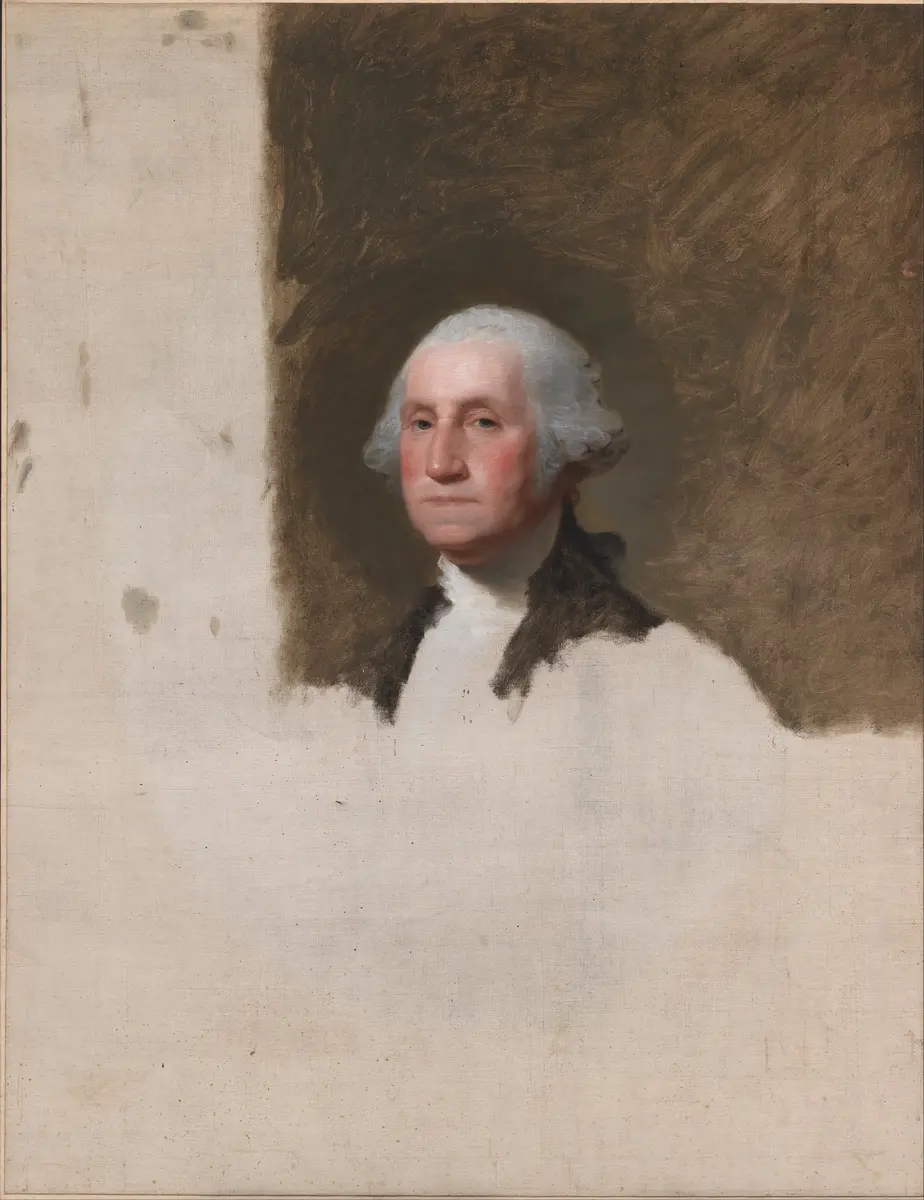
George Washington
“The Virginian who led America's army to victory over Britain, became its first President, and gave up power twice, in 1783 and 1797.”
George Washington was born on February 22, 1732, at Popes Creek in Westmoreland County, Virginia, the son of the tobacco planter Augustine Washington and his second wife, Mary Ball (by the calendar Virginia used at the time, the date was February 11, 1731). The family left Popes Creek when he was three, and he grew up mostly at Ferry Farm on the Rappahannock River. His father died when he was eleven, and unlike his two older half-brothers he was never sent to school in England; he learned practical mathematics and surveying instead, and at seventeen he was the official surveyor of Culpeper County. When his half-brother Lawrence died in 1752, he took over Mount Vernon, the estate on the Potomac that he enlarged for the rest of his life.
His first fame came from the frontier. In 1753, aged twenty-one, he carried the governor of Virginia's warning to the French forts in the Ohio country. The next year his attack on a French party at Jumonville Glen and his surrender at Fort Necessity helped start the war that became the Seven Years' War; in 1755 he survived General Braddock's disaster on the Monongahela, and he then commanded Virginia's regiment until the French gave up Fort Duquesne in 1758. In January 1759 he married Martha Dandridge Custis, a rich young widow with two children. For the next fifteen years he lived as a Virginia planter and member of the House of Burgesses, and as a slaveholder: Mount Vernon ran on the work of enslaved people, more than 300 of them by 1799.
When the quarrel with Britain turned to war, the Continental Congress chose him on June 15, 1775, to command its army. He forced the British out of Boston in March 1776, lost New York that summer, and saved the cause at Christmas with the crossing of the Delaware and the victories at Trenton and Princeton. He held the army together through the hungry winter at Valley Forge, and in October 1781, with the French army and fleet, he trapped Cornwallis at Yorktown and effectively won the war. Then, on December 23, 1783, he handed his commission back to Congress at Annapolis and rode home, a public lesson that soldiers obey the elected government.
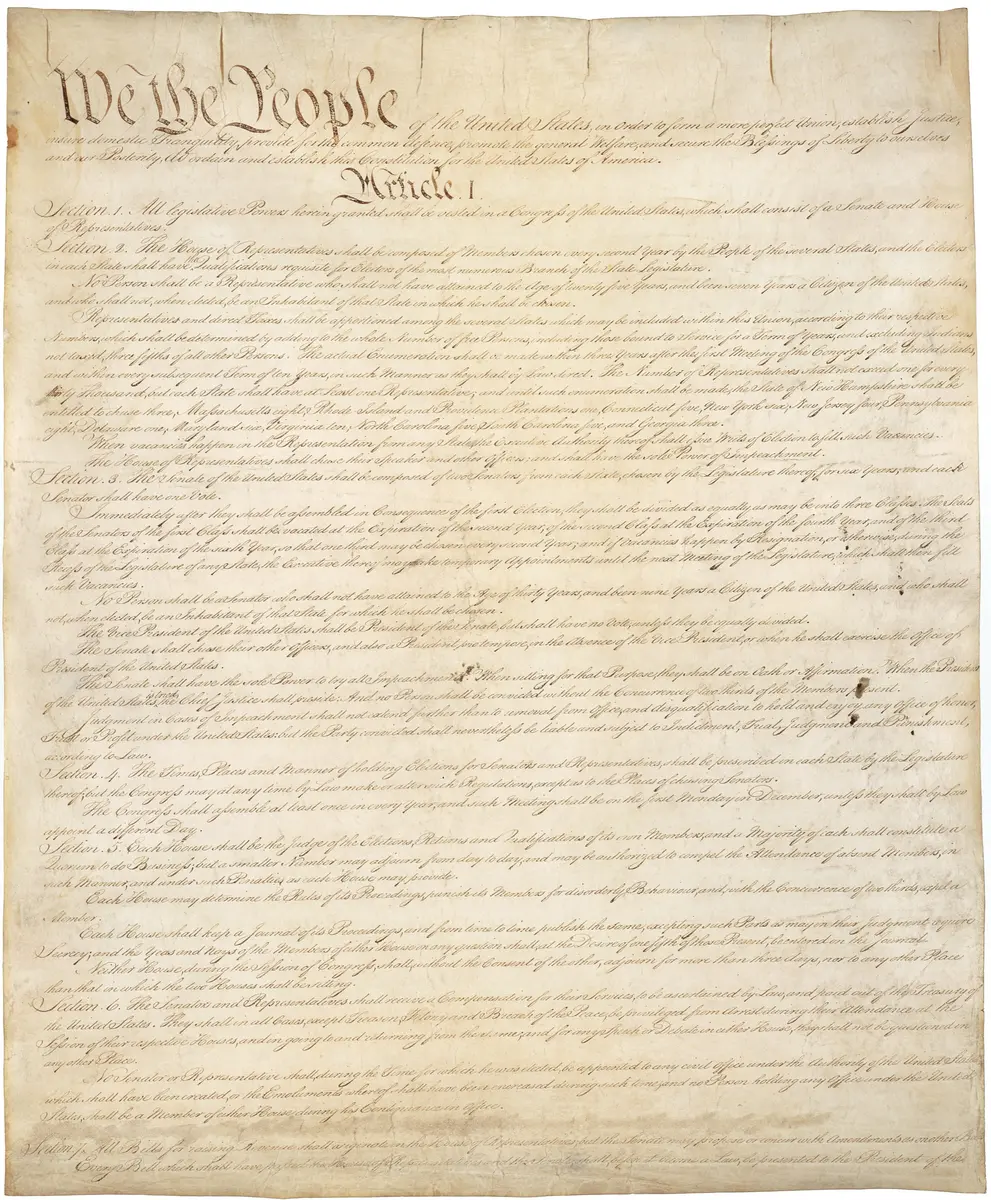
He came back to preside over the convention that wrote the Constitution in 1787, and in 1789 the electors chose him unanimously as the first President; he took the oath on the balcony of Federal Hall in New York on April 30. In two terms he built the new government around a cabinet with Thomas Jefferson at State and Alexander Hamilton at the Treasury, kept the country out of the war between Britain and France, put down the Whiskey Rebellion and signed the unpopular Jay Treaty. He refused a third term, and his Farewell Address of September 1796 warned Americans against sectional rivalry, party spirit and the influence of foreign powers.
He retired to Mount Vernon in March 1797 and died there on December 14, 1799, two days after riding round his farms in snow and rain, of a throat infection that his doctors treated by bleeding him again and again. His will freed the people he owned after Martha's death; she freed them early, on January 1, 1801, while those who belonged to the Custis estate stayed enslaved. The new capital already carried his name, and Congress mourned him in Henry Lee's words, 'first in war, first in peace, and first in the hearts of his countrymen'. Historians such as Yale's Joanne Freeman see his real importance in trust: Americans who feared tyranny were willing to hand him power because he kept giving it back.
What happened
- 1732
Born at Popes Creek in Westmoreland County, Virginia (February 11, 1731, by the calendar then used there), the son of the planter Augustine Washington and his second wife, Mary Ball.
Popes Creek, Westmoreland County, Virginia: his birthplace, February 22, 1732- 1743
His father dies; the eleven-year-old becomes the ward of his half-brother Lawrence, who lives at Mount Vernon.
- 1749
At seventeen, with Lord Fairfax's help, he becomes the official surveyor of Culpeper County and spends two years surveying the western wilderness.
- 1751
Sails with the sick Lawrence to Barbados, his only journey outside today's United States, and catches smallpox, which leaves him immune.
- 1752
Lawrence dies of tuberculosis; within months the twenty-year-old is heir to Mount Vernon.
Mount Vernon, Fairfax County, Virginia: his home on the Potomac from the 1750s, where he died on December 14, 1799; his tomb is on the estate nearby- 1753
Sets out from Williamsburg with Governor Dinwiddie's letter ordering the French to leave the Ohio country; on the way he maps the upper Ohio and keeps a journal of the winter trip.
- 1754
With the Mingo leader Tanacharison and about forty men he attacks a French party at Jumonville Glen, killing ten and taking twenty-one prisoners: the first shots of the French and Indian War.
Surrenders Fort Necessity at the Great Meadows to a larger French force, the only surrender of his life; the capitulation, in French, makes him admit the 'assassination' of Jumonville, which he blames on his translator.
- 1755
As General Braddock's volunteer aide he survives the rout on the Monongahela and organises the retreat after Braddock is mortally wounded; 977 of 1,459 men are killed or wounded.
- 1758
Colonel of the Virginia Regiment on the Forbes expedition, he reaches the smoking ruins of Fort Duquesne, burned by the French the day before; he resigns his command soon after.
- 1759
Marries Martha Dandridge Custis, a wealthy widow with two small children, and settles down as a planter at Mount Vernon.
- 1774
Takes his seat, in uniform, as a Virginia delegate at the First Continental Congress in Philadelphia.
- 1775
The Second Continental Congress votes unanimously to make him commander-in-chief of the army besieging Boston; he refuses any pay beyond his expenses.
Takes command of the army on Cambridge common, outside Boston.
- 1776
With Knox's cannon from Ticonderoga hauled onto Dorchester Heights in a single night, he forces the British to sail out of Boston.
After a summer and autumn of defeats around New York, he crosses the icy Delaware at night with about 2,400 men in a snowstorm.
Surprises the Hessian garrison at Trenton at dawn: in under two hours their commander is killed and nearly 1,000 men are taken.
- 1777
Slips away from Cornwallis by night, leaving campfires burning, and defeats the British at Princeton; New Jersey is largely freed.
After losing Philadelphia, he leads the army into winter quarters at Valley Forge; a third of the men have no shoes.
Washington's Headquarters (the Isaac Potts House), Valley Forge, Pennsylvania: his headquarters in the winter of 1777–78- 1778
The army, drilled over the winter by Baron von Steuben, marches out of Valley Forge; nine days later it fights the British at Monmouth.
Washington's Headquarters (the Isaac Potts House), Valley Forge, Pennsylvania: his headquarters in the winter of 1777–78- 1781
Cornwallis surrenders his army at Yorktown to Washington's American and French troops after a siege by land and a French fleet at sea; the war is effectively won.
Yorktown, Virginia: the siege that ended with Cornwallis's surrender on October 19, 1781- 1783
At Newburgh, New York, he talks his unpaid and angry officers out of defying Congress.
Takes leave of his officers at Fraunces Tavern in New York, nine days after the British have left the city.
Resigns his commission to Congress in the Maryland State House at Annapolis and is home at Mount Vernon by Christmas Eve.
- 1785
The French sculptor Jean-Antoine Houdon arrives at Mount Vernon to make Virginia's statue of him; he models a bust and takes a plaster life mask before leaving on October 17.
Mount Vernon, Fairfax County, Virginia: his home on the Potomac from the 1750s, where he died on December 14, 1799; his tomb is on the estate nearby- 1787
Elected by unanimous vote to preside over the Constitutional Convention in Philadelphia, as he notes in his diary that evening.
- 1789
Chosen unanimously by the electors, he takes the oath as the first President on the balcony of Federal Hall in New York and gives his inaugural address to Congress inside.
Federal Hall, Wall Street, New York: where he took the oath as the first President on April 30, 1789- 1793
Starting a second term (the electors chose him unanimously again in 1792), he keeps the United States neutral when war breaks out between France and Britain; Jefferson leaves his cabinet at the end of the year.
- 1794
Reviews at Fort Cumberland, Maryland, the militia army of nearly 13,000 men called out against the Whiskey Rebellion in western Pennsylvania; the rising collapses.
- 1795
Signs the Jay Treaty with Britain, which sets off the bitterest attacks of his presidency.
- 1796
His Farewell Address, refusing a third term and warning against sectional quarrels, parties and foreign influence, appears in Claypoole's American Daily Advertiser in Philadelphia.
- 1797
Hands the presidency to John Adams and retires to Mount Vernon.
Mount Vernon, Fairfax County, Virginia: his home on the Potomac from the 1750s, where he died on December 14, 1799; his tomb is on the estate nearby- 1798
With war with France feared, he is appointed commander-in-chief of a new provisional army; the danger passes.
- 1799
Signs his will at Mount Vernon: the enslaved people he owns are to be freed after Martha's death, the old and sick supported for life, the children taught to read and write.
Mount Vernon, Fairfax County, Virginia: his home on the Potomac from the 1750s, where he died on December 14, 1799; his tomb is on the estate nearbyRides round his farms for hours in snow, hail and rain and sits down to dinner in his wet clothes; the next day his throat is sore.
Mount Vernon, Fairfax County, Virginia: his home on the Potomac from the 1750s, where he died on December 14, 1799; his tomb is on the estate nearbyAfter a day of bleeding and remedies he dies at Mount Vernon late in the evening, with Martha, his doctor, his secretary and the enslaved servants who nursed him in the room.
Mount Vernon, Fairfax County, Virginia: his home on the Potomac from the 1750s, where he died on December 14, 1799; his tomb is on the estate nearby