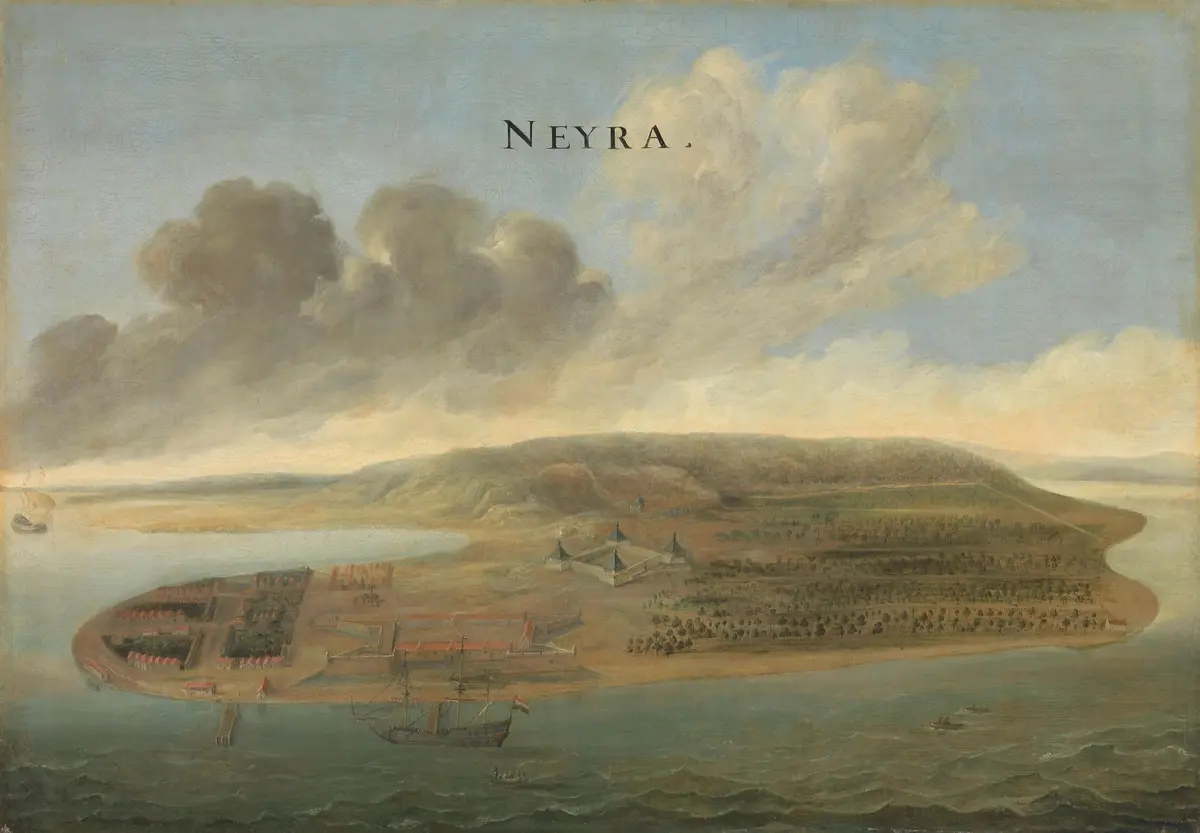
The VOC conquers the Banda Islands
“In 1621 the Dutch East India Company under Coen conquered the Banda Islands, the world's only source of nutmeg, killing, enslaving or driving out most of the Bandanese to win a monopoly.”
In 1621 the Dutch East India Company, the VOC, conquered the Banda Islands, a cluster of small volcanic islands in the Banda Sea of eastern Indonesia that were then the only place in the world where nutmeg and mace came from. Its governor-general, Jan Pieterszoon Coen, led the campaign himself, with 19 ships and about 1,650 European and 290 Asian soldiers, Japanese mercenaries among them. The troops soon took the coast of Lonthor, the main nutmeg island. When its orangkaya, the leading men of the villages, came to Coen to bargain, they were seized, accused of plotting against him and tortured, and on 8 May 1621 they were put to death at Fort Nassau on Banda Neira by Japanese executioners. Their families, 789 old men, women and children, were shipped to Batavia, some of them to be put to work as slaves. The people who had fled into the mountains were besieged for months; many starved or threw themselves from the cliffs rather than surrender, and only a few escaped by boat to the Kei Islands, Seram Laut and other islands nearby. Of an estimated 15,000 Bandanese, about 1,000 were left.
The Dutch had first reached Banda in 1599 and were welcomed as allies against the Portuguese. But the company wanted the Bandanese to sell their spices to it alone, at its price, and the orangkaya, who depended on outside traders, Javanese, Makassarese and English, for their food, signed contract after contract and kept trading with everyone. In 1609, as the company began building Fort Nassau on Banda Neira, the Bandanese ambushed its admiral, Pieter Verhoeff, during talks and killed him and some 46 of his men; a young merchant named Coen was with the fleet. A second fort, Belgica, rose on the hill behind Nassau from 1611. By 1614 the directors in the Netherlands were ready to conquer the islands even at the cost of destroying their people. In 1616 the company took the island of Ai, where some 400 people drowned trying to flee to Run, the neighbouring island the English East India Company had made its own. In January 1621, after inviting the English to join him, Coen sailed from Batavia with an all-Dutch fleet, on the pretext of punishing the Bandanese for breaking their contracts.
The conquest emptied the islands, and the company rebuilt them as the first plantation colony of its empire. The nutmeg gardens were divided into lots called perken and leased to settlers, the perkeniers, most of them former company servants and soldiers, who had to sell the whole harvest to the company at fixed prices. The work was done by enslaved people, brought from India, the Malay peninsula, Java, Borneo, China and the eastern islands, and by the surviving Bandanese, who knew how to tend the trees; so many died or fled that new shiploads were always needed. Run, which the English held, was spared the fighting, but the Dutch later emptied it and cut down its nutmeg trees. England gave up its claim only at the Peace of Breda in 1667, when the Dutch kept Run and Suriname and gave up New Amsterdam, which became New York. The perkenier system lasted until 1873.
Coen's slaughter shocked even his contemporaries and earned him a reprimand from the company's directors, but it gave the company what it wanted: for most of two centuries the world's nutmeg and mace came from the company's Banda. Many scholars now call the conquest a genocide, some the first colonial genocide in Asia. Most people on the islands today descend from those brought in to work the plantations. On 8 May 2021, four hundred years on, the killings were commemorated on Banda, in Indonesia and in the Netherlands, and the statue of Coen in his home town of Hoorn, put up in 1893, was once again the target of protest.
What happened
- 1621
After inviting the English to take part, Coen sails from Batavia with an all-Dutch fleet of 19 ships, 1,655 European and 286 Asian soldiers, Japanese mercenaries among them, on the pretext of punishing the Bandanese for breaking their contracts.
The fleet anchors in the roads of Banda Neira under Fort Nassau, where a local contingent of troops and 36 local vessels join it.
Fort Nassau, begun by the company in 1609, where the orangkaya were executed on 8 May 1621The troops land on Lonthor, the main nutmeg island, and soon hold its coast. The orangkaya, the leading men of its villages, come to Coen to bargain for a new contract that would give the company everything it asks.
Lonthor, the main village of Great Banda (Banda Besar), the largest nutmeg island, stormed in 1621Instead their leaders are seized and tried. Accused of plotting to kill Coen, the orangkaya are interrogated on the rack and sentenced to death.
Lonthor, the main village of Great Banda (Banda Besar), the largest nutmeg island, stormed in 1621Coen reports to the company's directors that some 2,000 Bandanese, 600 of them fighting men, still hold the mountains of Lonthor. The orangkaya's families, 789 old men, women and children, are shipped off to Batavia, where some are put to work as slaves.
At Fort Nassau on Banda Neira the orangkaya are put to death, beheaded by Japanese mercenaries in the company's service: 44 of them by the usual count.
Fort Nassau, begun by the company in 1609, where the orangkaya were executed on 8 May 1621By the end of the year the company holds the islands. Those who fled into the hills of Lonthor have been besieged for months; many have starved or leapt from the cliffs near Selamon rather than surrender, and a few have escaped by boat to the Kei Islands and Seram Laut. Of some 15,000 Bandanese about 1,000 remain, and the nutmeg gardens are being divided into perken for Dutch planters and their slaves.
Lonthor, the main village of Great Banda (Banda Besar), the largest nutmeg island, stormed in 1621