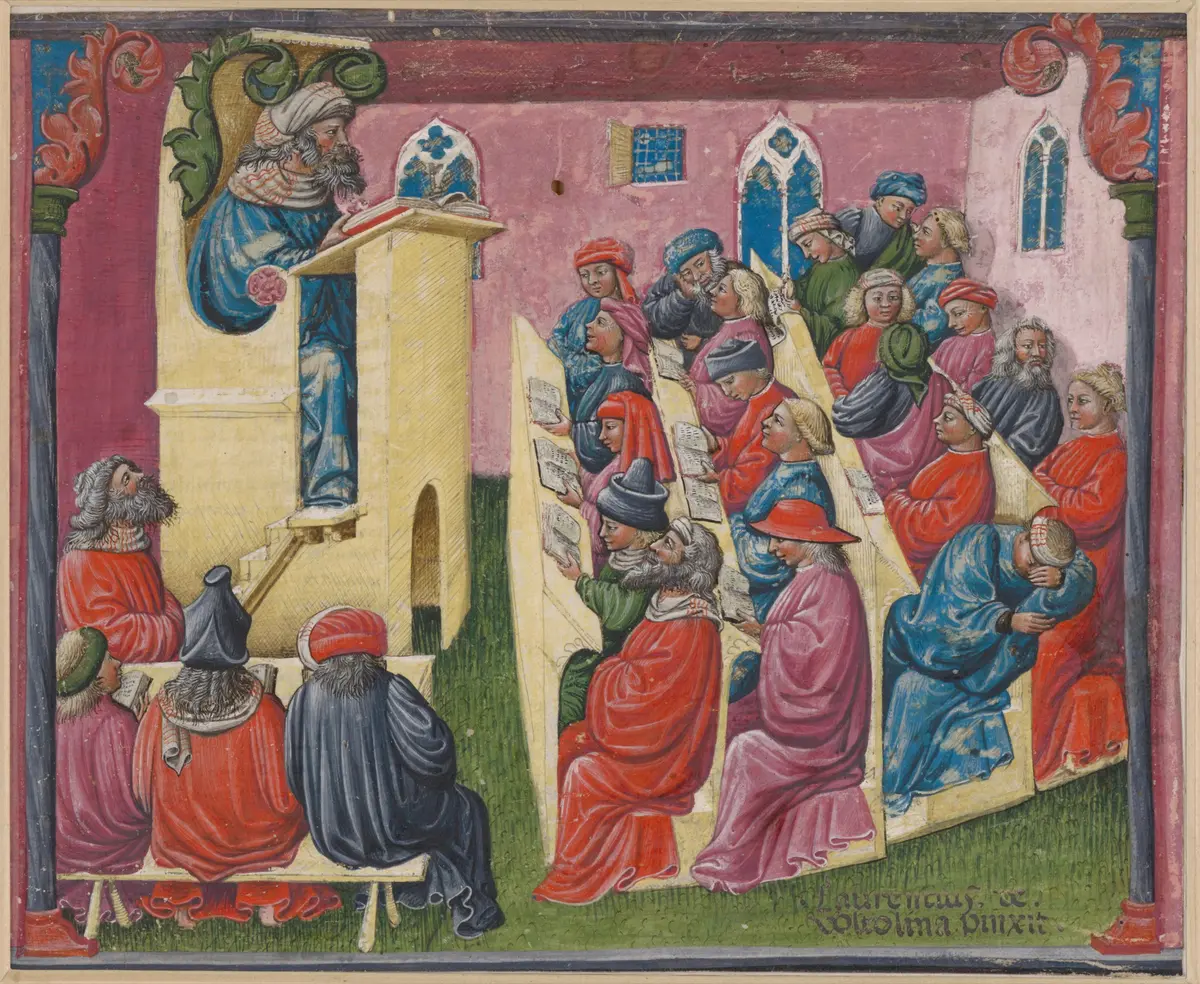
University of Bologna is founded
“Europe's oldest university grew from lectures on Roman law in Bologna from about 1088 (a date fixed in 1888); its students formed the first 'universities', and an emperor (1158) and a pope (1219) made it an institution.”
The University of Bologna was never founded in the way a king founds a college. In the last decades of the eleventh century, in a town of a few thousand people where the roads from Lombardy, Tuscany, Romagna and the Veneto meet, teachers began to lecture on the law books of the Roman emperor Justinian, above all the Digest, his sixth-century collection of the opinions of Roman jurists, which had hardly been read in the West for five hundred years. A lawyer called Pepo was already citing the Digest in a court case of 1076; the teacher who made the school famous was Irnerius, a master of the liberal arts who, the story goes, took up the law at the wish of Countess Matilda of Tuscany and is believed to have given his first law lectures between 1084 and 1088. He explained the text in short notes, glosses, written between the lines and in the margins, and the teachers who followed him were called the glossators. The year 1088 is a convention: it was fixed for the eight-hundredth birthday celebrated in 1888, and the poet Giosuè Carducci, who led the celebrations, admitted that no real founding date can be known.
Bologna rose because Europe needed lawyers. Emperors and popes were fighting over who should appoint bishops, and the towns of northern Italy were turning themselves into self-governing communes; every side looked for arguments in ancient law. Irnerius served Matilda and then her rival, Emperor Henry V, who recognised the commune of Bologna in 1116, and soon a poet could speak of 'learned Bologna' and its laws. Around 1140 Gratian, a monk of the city, put the laws of the Church in order in his Decretum, and Bologna taught both laws, the civil law of Rome and the canon law of the Church. Its students were mostly grown men, many of them already clergy or officials, and they came from all over Europe.
The school became an institution step by step. The teachers taught privately, for fees paid by their students, in their own houses. In 1155 masters and students met Emperor Frederick Barbarossa near the city, and in 1158, at the Diet of Roncaglia, where four of Irnerius's pupils advised him on the emperor's rights, he issued the privilege later called the Authentica Habita: scholars travelling for study were under the emperor's protection, and when sued could choose to be judged by their own master or by the bishop. Foreign students, who had no rights as citizens, banded together by origin into 'nations' and, by about 1200, into guilds, universitates, under rectors they elected themselves: the first 'universities' were these associations of students, who set the course of teaching and saw that it was given. In 1219 Pope Honorius III, once archdeacon of Bologna, ruled that no one could become a doctor without the archdeacon's licence, and at the end of the century Nicholas IV made a Bologna degree a licence to teach anywhere.
What Bologna built was copied across Europe. Students and teachers who left the city in protest set up new schools, at Vicenza in 1204 and at Padua in 1222, and Bologna's student guilds became the model for many later universities in Italy and beyond, while Paris, which grew up at the same time, was run by its masters. The Great Gloss that Accursius compiled between 1220 and 1250 accompanied the texts of Roman law for five hundred years, and the Roman law taught at Bologna became common ground for the legal systems of continental Europe. Faculties of medicine and of arts formed around 1200, and Bologna's doctors revived the dissection of human bodies in the thirteenth century. The school had no building of its own until 1563, when the pope's legate gathered it into the Archiginnasio, under the Church's control; since the Napoleonic years its seat has been Palazzo Poggi.
The university calls itself the Alma Mater Studiorum, the nourishing mother of studies, a name that grew out of the medieval city's motto, 'Bologna, mother of laws'. The idea it pioneered, a self-governing community of teachers and students that grants degrees and claims the freedom to teach and to learn, spread from medieval Europe to the whole world. On 12 June 1888 Carducci opened the eight-hundredth-anniversary celebrations in the courtyard of the Archiginnasio, and for the ninth centenary in 1988, 430 European rectors signed the Magna Charta Universitatum in the city's main square, a declaration of academic freedom that more than eight hundred universities have signed since.
What happened
- 1088
The year from which, by a convention fixed for the 1888 jubilee, the Studium of Bologna is counted. Irnerius, a teacher of the liberal arts in the city, is believed to have given his first lectures on Justinian's Roman law between 1084 and 1088, explaining the text in glosses between the lines and in the margins.
The Two Towers, Bologna: the heart of the town where Irnerius taught, whose noble families raised the Asinelli and Garisenda towers in 1109-1119 - 1113
Irnerius's name first appears in a document: he sits among the lawyers in a court held by Countess Matilda of Tuscany over property at Ferrara. A later chronicle says that he renewed the long-neglected books of the laws at her request.
- 1116
Emperor Henry V pardons Bologna for destroying his castle above the city the year before and recognises its commune; Irnerius, now in the emperor's service, signs the act with the chancellor Burchard, and serves as a judge in Henry's documents until 1125.
The Two Towers, Bologna: the heart of the town where Irnerius taught, whose noble families raised the Asinelli and Garisenda towers in 1109-1119 - 1140
Around this year Gratian, a monk of San Felice in Bologna, completes his Decretum, nearly four thousand texts of Church law set side by side and reconciled. It becomes the textbook of canon law, the second law taught at Bologna.
- 1155
On his way to be crowned in Rome, Frederick Barbarossa meets the masters and students of Bologna, who ask him for protection, as a Latin poem of the time tells; Pope Adrian IV crowns him emperor on 18 June.
- 1158
At the Diet of Roncaglia, near Piacenza, the Four Doctors, Irnerius's pupils Bulgarus, Martinus, Jacobus and Hugo, advise Frederick on the emperor's rights over the Lombard towns. He issues the privilege later called the Authentica Habita: scholars who travel for study are under his protection and, when sued, may choose to be judged by their master or by the bishop.
Roncaglia, near Piacenza: the plain of the Diet of 1158, where the Four Doctors advised Frederick Barbarossa and the Authentica Habita was issued - 1189
A bull of Pope Clement III confirms that masters and scholars may not offer a landlord more rent for a house already let to students. In these last years of the century the students from abroad, who have no rights as citizens, form the first universities: guilds of students under rectors they elect.
- 1204
Students and teachers leave Bologna for Vicenza and set up a school there, organised, like their mother school, in four universities of students: the first of the migrations that carried Bologna's model to Arezzo (1215) and Padua (1222).
- 1215
In San Giovanni in Monte, the master of rhetoric Boncompagno has his new book, the Rhetorica antiqua, read before 'the university of professors of canon and civil law' and a crowd of doctors and students; it is approved and crowned with laurel. It is the first explicit mention of Bologna's teachers as one body.
San Giovanni in Monte, Bologna: where Boncompagno's book was read and crowned before 'the university of professors' on 26 March 1215- 1219
Pope Honorius III, himself once archdeacon of Bologna, rules that no one may be made a doctor without the consent of the archdeacon of Bologna. The degree becomes a licence given by public authority, examined by the doctors and conferred in the cathedral, the model for universities across Europe.
The cathedral of San Pietro, Bologna: seat of the archdeacon who licensed every doctor from 1219, where the degrees were conferred