Indus Valley civilization
“South Asia's first cities, Harappa and Mohenjo-daro, with planned brick streets, drains, standard weights and an undeciphered script, flourished from about 2600 to 1900 BCE and traded with Mesopotamia as Meluhha.”
The Indus Valley civilization, also called Harappan after the first site to be dug, was the earliest urban culture of South Asia and, in area, the largest of the three great Bronze Age civilizations, bigger than Egypt and Mesopotamia put together. Its towns and villages, more than a thousand of them, spread over what is now Pakistan and north-western India: from the Arabian Sea coast of Baluchistan to the foothills of the Himalaya, and from the Indus and the now dry Ghaggar-Hakra river east to the Yamuna and south to Gujarat. Farming villages had grown here since about 7000 BCE, and walled towns since about 3300; around 2600 BCE, within a few generations, the towns were rebuilt as planned cities, and the mature phase that this entry covers began.
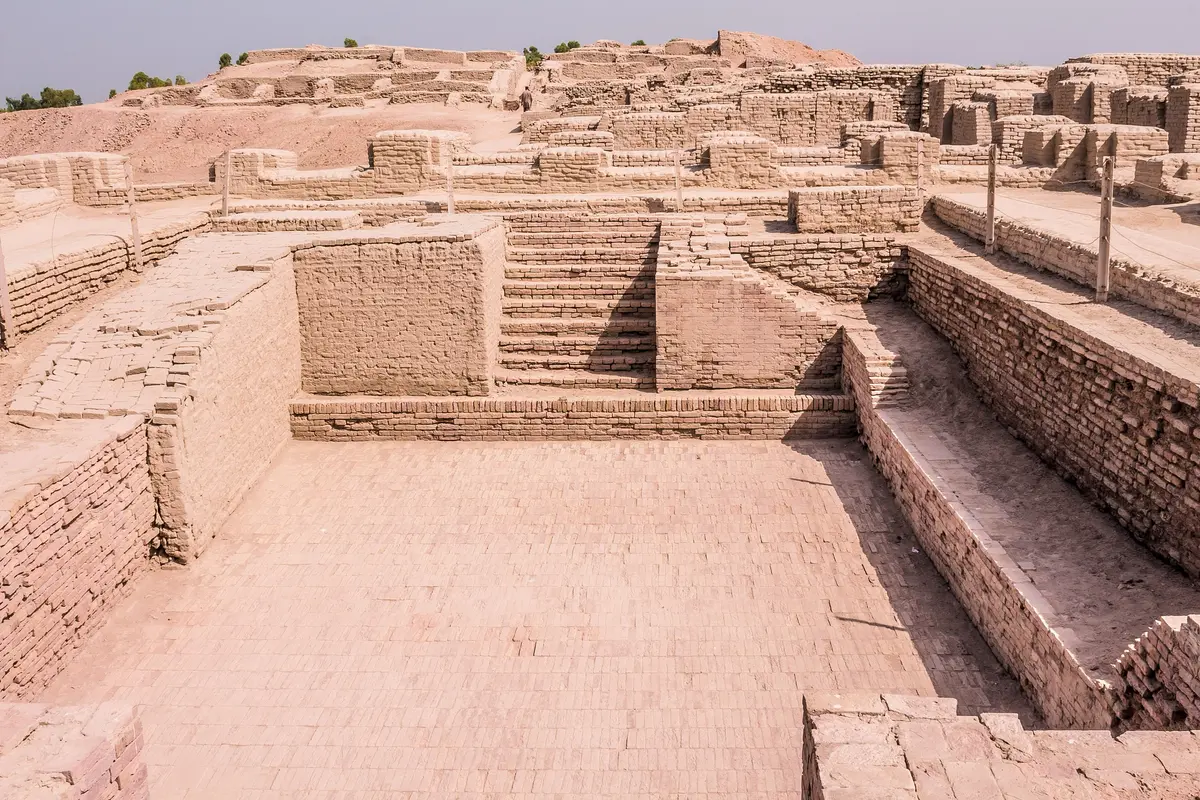
Mohenjo-daro on the Indus and Harappa on the Ravi were the two largest cities, each home to perhaps 30,000 to 40,000 people, with Dholavira, Rakhigarhi and Ganweriwala as regional centres. They were built of baked brick to a common plan: a raised citadel in the west, with the Great Bath, granaries and halls at Mohenjo-daro, and a lower town of straight streets crossing at right angles, where most houses had a well, a bathroom and a drain to a covered sewer in the street. The same cubical stone weights, the same brick sizes and the same seals were used from one end of the country to the other, which suggests a strong common administration; yet no palace, no royal tomb and no named king have ever been found, and nobody knows how the cities were ruled. The art is small: the steatite "Priest-King" and the bronze "Dancing Girl" from Mohenjo-daro, terracotta figurines and toy carts, painted pottery, and thousands of little stamp seals carved with a unicorn-like bull, an elephant, a tiger or a horned figure, above a line of signs. That script, some 400 signs in very short texts, is still undeciphered.
The Harappans traded far. Their carnelian beads, made in workshops at Chanhudaro and Lothal, lie in the royal graves of Ur; their seals and weights turn up at Susa, Kish and Umma; and they kept an outpost at Shortugai on the Oxus, near the lapis lazuli mines of Afghanistan. Mesopotamian texts call their land Meluhha: Sargon of Akkad boasted that ships of Meluhha docked at his capital, Gudea of Lagash had its wood and carnelian brought for his temple, and an Akkadian official, Shu-ilishu, called himself "interpreter of the Meluhhan language" on his seal. Lothal, on the Gulf of Khambhat, had a brick basin that its excavator read as a tidal dock.
After about 1900 BCE the cities declined. Mohenjo-daro had been flooded and rebuilt more than once; the summer monsoon weakened, the rivers of the Ghaggar-Hakra system shrank to seasonal streams, and settlements along them were abandoned while smaller villages multiplied to the east, toward the Ganges. Writing, seals and the standard weights went out of use; the late Harappan cultures that followed were rural. The cities were then forgotten for more than three thousand years, until Daya Ram Sahni's digging at Harappa in 1921 and Rakhal Das Banerji's at Mohenjo-daro in 1922 let Sir John Marshall announce, in the Illustrated London News of 20 September 1924, a civilization as old as Sumer. Its legacy is debated: the planned towns, the brick wells and the bathing culture, perhaps the horned figure on the seals and the cult of the pipal tree, may have passed into later India; what is certain is that it is the root of South Asia's urban history.
What happened
- 2600 BCE
The mature phase begins: within a few generations the towns of the Indus and the Ghaggar-Hakra are rebuilt as planned cities of baked brick, with straight streets, drains, a common script and common weights.
The Indus Valley civilization at its greatest extent, from Baluchistan to the Yamuna and south to Gujarat, as the historical-basemaps dataset draws itHarappa, on the Ravi, grows into a walled city on several mounds, with a citadel behind a mud-brick rampart and rows of brick 'granaries' on the plain below it.
Harappa: the first site dug, on a dry bed of the Ravi in the PunjabMohenjo-daro is laid out on the Indus: a citadel raised 6 to 12 metres on mud brick, crowned by the Great Bath, a granary and halls, and a lower town of a dozen blocks whose houses have wells, bathrooms and covered drains.
Mohenjo-daro: the largest Indus city, on the right bank of the Indus in SindhStamp seals of steatite come into use across the country, most carved with a one-horned bull before a standard and a line of signs in a script of some 400 signs that nobody has read since.
Mohenjo-daro: the largest Indus city, on the right bank of the Indus in SindhCubical weights of chert cut to one standard are used from Baluchistan to Gujarat, a uniformity that points to a single administration of trade.
The Indus Valley civilization at its greatest extent, from Baluchistan to the Yamuna and south to Gujarat, as the historical-basemaps dataset draws itDholavira, on an island in the Rann of Kutch, becomes a walled city of stone and brick with a castle, a bailey, a middle and a lower town, and a chain of reservoirs that store the monsoon rain.
Dholavira: the walled city of the reservoirs on an island in the Rann of KutchRakhigarhi, far to the east on the dry Drishadvati in Haryana, is the largest of all the Harappan settlements, some 550 hectares of mounds with its own cemetery.
Rakhigarhi: the largest known Harappan site, in Haryana on the dry Drishadvati- 2500 BCE
Ganweriwala on the Hakra in Cholistan stands with Harappa, Mohenjo-daro, Dholavira and Rakhigarhi as one of the five great centres; it has never been excavated.
Ganweriwala: the fifth big centre, on the dry Hakra in Cholistan, never excavatedTerracotta figurines of women in fan-shaped headdresses and heavy jewellery, clay bulls with nodding heads, toy carts and whistles are made in every town: the people's art.
Harappa: the first site dug, on a dry bed of the Ravi in the PunjabCarnelian beads drilled in Indus workshops reach Sumer: Queen Puabi's cloak of beads in the Royal Cemetery of Ur is largely Indian carnelian, and Indus seals turn up at Ur, Kish and Umma.
Ur: where Indus carnelian beads lie in the royal graves and Indus seals were foundThe Dancing Girl is cast in bronze at Mohenjo-daro by the lost-wax method, 10.5 centimetres tall, one arm sheathed in bangles, the finest surviving piece of Indus art.
Mohenjo-daro: the largest Indus city, on the right bank of the Indus in Sindh- 2400 BCE
Lothal is founded on the Gulf of Khambhat: a small walled town with a warehouse, a bead factory and a brick basin 217 metres long, read by its excavator as a tidal dock for the sea trade.
Lothal: the port town on the Gulf of Khambhat with the brick basin read as a dockSutkagen Dor, 480 kilometres west of Karachi near the Arabian Sea, marks the westernmost reach of the Harappan world, a fort on the route to the Persian Gulf.
Sutkagen Dor: the westernmost outpost, near the Arabian Sea coast of Baluchistan- 2350 BCE
Chanhudaro, south of Mohenjo-daro, works as a town of bead-makers and seal-cutters; its clay model of cattle pulling a cart is one of the oldest pictures of a wheeled vehicle in South Asia.
Chanhudaro: a bead-making town south of Mohenjo-daro, dug by Mackay in 1935–36 - 2300 BCE
Kalibangan on the Ghaggar in Rajasthan has a fortified citadel, a lower town on a grid and a cemetery, built over an older pre-Harappan village that had no writing and no baked brick.
Kalibangan: the Ghaggar town with a citadel, a lower town and a cemeterySargon of Akkad boasts that ships from Meluhha, Magan and Dilmun dock in the harbour of his capital: the first mention of the Indus country in writing that can be read.
Ur: where Indus carnelian beads lie in the royal graves and Indus seals were foundA seal-cutter at Mohenjo-daro carves a horned figure seated among a tiger, an elephant, a rhinoceros and a buffalo, the seal later called Pashupati and read by some as an early Shiva.
Mohenjo-daro: the largest Indus city, on the right bank of the Indus in Sindh- 2200 BCE
Harappans hold Shortugai on the Oxus in Badakhshan, 1,000 kilometres from the Indus, next to the only lapis lazuli mines of the ancient world; Indus seals reach Altyn Depe in Turkmenistan.
Shortugai: the Harappan colony on the Oxus, near the lapis lazuli mines of BadakhshanIn Akkad an official named Shu-ilishu has a cylinder seal cut that calls him 'interpreter of the Meluhhan language'; Meluhhan villages with their own granaries are recorded in Mesopotamia.
- 2140 BCE
Gudea, ruler of Lagash, has wood from Magan and Meluhha and 'translucent carnelian from Meluhha' brought for the temple of Ningirsu at Girsu.
Ur: where Indus carnelian beads lie in the royal graves and Indus seals were found - 2100 BCE
The Priest-King is carved at Mohenjo-daro: a bearded man in a trefoil cloak, eyes half closed, 17.5 centimetres of steatite, found in 1927 and still the only face the civilization has.
Mohenjo-daro: the largest Indus city, on the right bank of the Indus in Sindh - 2000 BCE
Mohenjo-daro is flooded by the Indus to abnormal depth, not for the first time; the city is rebuilt on higher platforms, each time poorer than before.
Mohenjo-daro: the largest Indus city, on the right bank of the Indus in Sindh - 1950 BCE
The summer monsoon weakens; the Ghaggar-Hakra, fed by rain alone, dries to a seasonal stream and the towns along it, Kalibangan among them, are abandoned.
The Ghaggar-Hakra: the monsoon river between the Indus and the Ganges whose drying emptied the eastern towns - 1900 BCE
The mature phase ends: the cities shrink, seals, script and standard weights fall out of use, and smaller villages multiply to the east toward the Yamuna and the Ganges.
The Indus Valley civilization at its greatest extent, from Baluchistan to the Yamuna and south to Gujarat, as the historical-basemaps dataset draws it