Shang dynasty (China)
“China's first historical dynasty: the kings of Anyang whose oracle bones carry the earliest Chinese writing and whose bronze vessels are the finest of the Bronze Age, overthrown by the Zhou in 1046 BCE.”
The Shang were the kings who ruled the plain of the Yellow River in the second half of the second millennium BCE, and theirs is the first Chinese dynasty that can be seen in its own records as well as in the histories written long afterwards. Chinese tradition made them the second of three ancient dynasties: a virtuous founder, Tang, overthrew the last king of the Xia around 1600 BCE, and some thirty Shang kings followed him over about five and a half centuries, moving their capital several times. Archaeology has found the kind of cities the stories describe: a palace city at Erlitou near Luoyang that many scholars take for the Xia, a walled city of the fifteenth century at Zhengzhou with ramparts twenty metres thick, and outposts as far as Panlongcheng on the Yangtze, built to secure copper and tin.
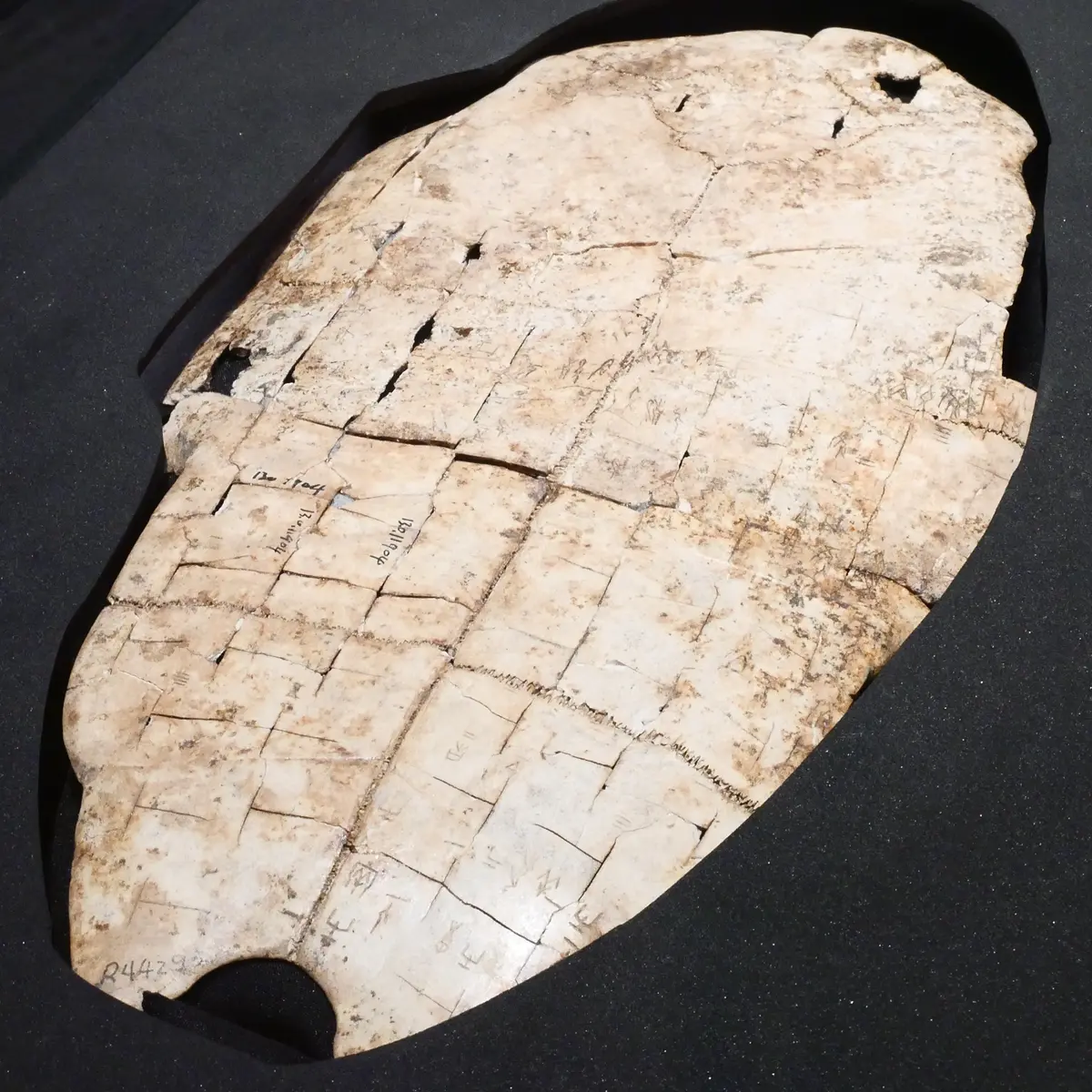
The Shang are known above all from Yin, their last capital, whose ruins (Yinxu) lie by the Huan river at Anyang in Henan. The court settled there around 1300 BCE, and from the reign of Wu Ding, about 1250, the kings had their questions to the ancestors and the high god Di cut into turtle shells and ox shoulder blades: will it rain, will the harvest come, will the queen's child be a boy, will the army beat the Qiang. These oracle bones, tens of thousands of them, carry the earliest Chinese writing, already a full system whose characters are the ancestors of those in use today. They name the kings in the order the later histories give, which is why the Shang, unlike the Xia, count as history. Wu Ding's consort Fu Hao, who led armies and presided over sacrifices, was buried in the only royal tomb at Anyang that robbers never reached; it held 468 bronzes and 755 jades when it was opened in 1976.
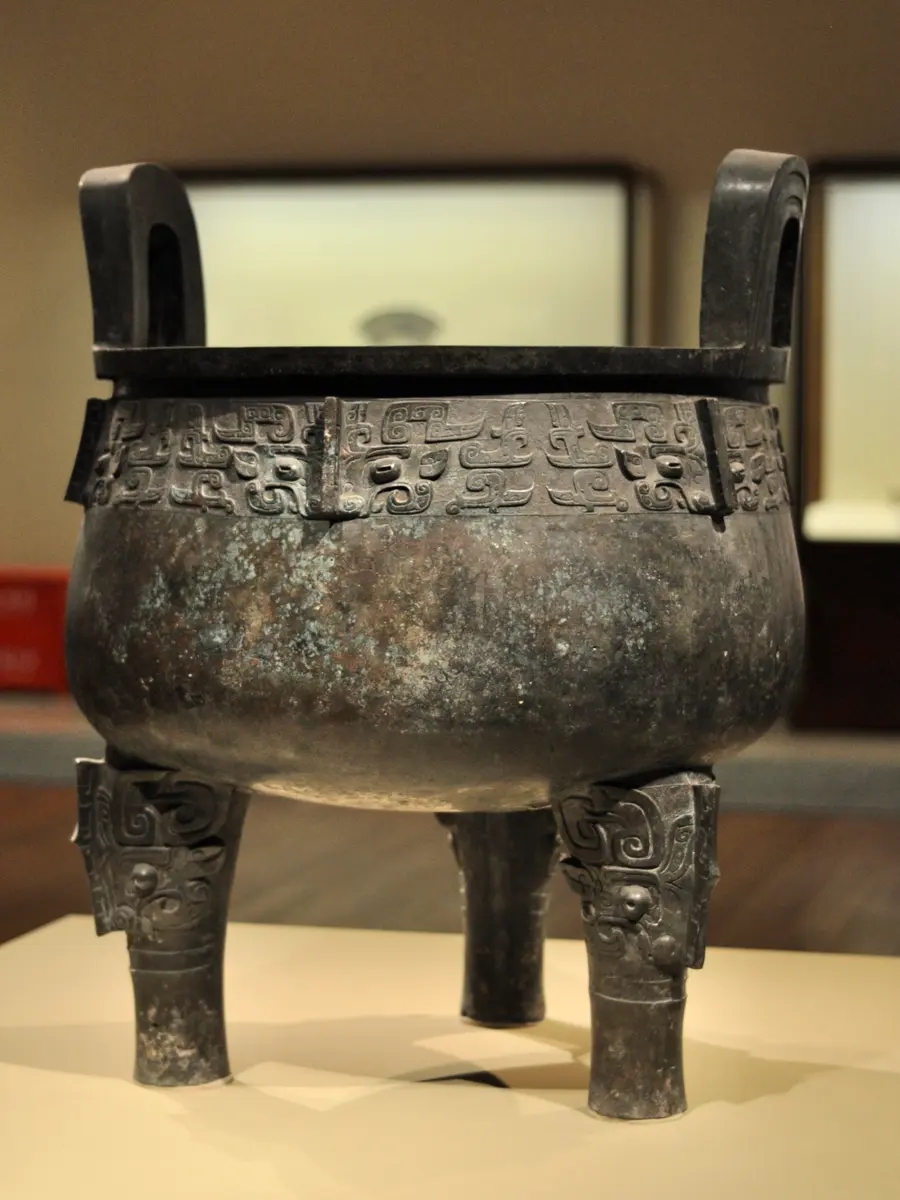
The Shang state ran on ritual and war. Its craftsmen cast bronze vessels for offerings of food and wine in clay piece-moulds, a technique found nowhere else, and reached a scale no other Bronze Age culture matched: the Houmuwu ding, cast for a queen mother about 1190 BCE, weighs 833 kilograms. Kings were buried in the great cross-shaped tombs of Xibeigang with chariots, horses and hundreds of sacrificed people, most of them war captives. Beyond the Shang's reach other bronze cultures flourished, above all at Sanxingdui in Sichuan, where masks and heads of a wholly different style were buried in pits in the twelfth and eleventh centuries. The last king, Di Xin, whom the victors remembered as a tyrant, fought costly wars in the east while the Zhou, a people of the Wei valley to the west, grew strong. In 1046 BCE, by the chronology most used today, King Wu of Zhou beat the Shang army at Muye and Di Xin burned himself in his palace.
The Zhou kept Shang writing, bronze casting and the cult of ancestors, and explained their victory as a Mandate of Heaven withdrawn from an unworthy king, an idea that justified every change of dynasty for the next three thousand years. The Shang themselves faded into legend until 1899, when the scholar Wang Yirong recognised the 'dragon bones' sold by Beijing pharmacists as inscribed; Luo Zhenyu traced them to Anyang, and from 1928 to 1937 Li Ji and Dong Zuobin of the Academia Sinica dug there in fifteen seasons, finding the palaces, the royal tombs and more than 25,000 oracle bones. Excavation has continued since 1950, Yinxu has been a World Heritage site since 2006, and the Shang bronzes in Beijing, Taipei, Paris, Washington and New York are among the most admired objects of the ancient world.
What happened
- 1600 BCE
By tradition Tang of Shang defeats Jie, the cruel last king of the Xia, at Mingtiao and founds the dynasty; the Chronology Project ties the founding to the walled city built about now at Yanshi, six kilometres from Erlitou.
Yanshi (Shixianggou): the walled city of about 1600 BCE that the Chronology Project takes as the start of the dynasty - 1500 BCE
Zhengzhou: a rammed-earth wall about 7 km round, 20 metres thick at the base and 8 high, encloses a new Shang city on the Yellow River, probably one of the early capitals the histories name.
Zhengzhou Shang City: the walled Erligang city of the fifteenth century BCE, probably an early Shang capital - 1480 BCE
The foundries of the Erligang period cast ritual vessels for wine and food in clay piece-moulds, a method used nowhere else in the Bronze Age, and their style spreads over the whole plain.
- 1450 BCE
Panlongcheng on the Yangtze near today's Wuhan grows into a walled Shang outpost with elite burials like Zhengzhou's, placed to secure the copper and tin the plain lacks.
Panlongcheng: the Erligang outpost on the Yangtze near Wuhan, built to secure copper and tin - 1400 BCE
Erlitou, the old palace city on the Luo plain, has lost its bronze workshops to the Shang centres and dwindles to a village; Zhengzhou's own power fades in the same century.
Erlitou: the palace city of the early second millennium that many Chinese scholars identify with the Xia capital - 1350 BCE
A walled city of 470 hectares with a palace and temple compound rises at Huanbei, north of the Huan river by today's Anyang; it burns to the ground after about fifty years.
Huanbei: the walled city north of the Huan river that burned about 1300 BCE, just before Yin was built - 1300 BCE
King Pan Geng moves the court to Yin on the south bank of the Huan, tradition says; the Shang stay there until the end, and the later histories call the dynasty 'Yin' from this move.
Yinxu, Anyang: Yin, the last Shang capital from about 1300 BCE, with the palaces, the royal cemetery and the oracle-bone pits - 1250 BCE
Wu Ding comes to the throne. From his reign the kings' diviners crack turtle shells and ox bones and cut the questions and answers into them: the earliest Chinese writing, and the first contemporary record of a Chinese king.
Yinxu, Anyang: Yin, the last Shang capital from about 1300 BCE, with the palaces, the royal cemetery and the oracle-bone pits - 1230 BCE
Fu Hao, one of Wu Ding's three queens, commands armies against the Shang's enemies, offers sacrifices to the ancestors in the king's place and holds her own estate, as the oracle bones record.
The tomb of Fu Hao, Wu Ding's consort: the one royal tomb at Yinxu found intact, opened in 1976 - 1200 BCE
Fu Hao dies and is buried in a single shaft outside the royal cemetery with 468 bronzes, 755 jades, sixteen sacrificed people and six dogs; robbers never find the tomb, and it is opened intact in 1976.
The tomb of Fu Hao, Wu Ding's consort: the one royal tomb at Yinxu found intact, opened in 1976Horse-drawn chariots appear at Anyang, the first in China, and are buried with their horses and drivers in pits beside the tombs.
Yinxu, Anyang: Yin, the last Shang capital from about 1300 BCE, with the palaces, the royal cemetery and the oracle-bone pits- 1192 BCE
A diviner records a lunar eclipse on an ox shoulder blade, the firmest date in Shang history; Wu Ding's long reign ends about now and his son Zu Geng succeeds him.
Yinxu, Anyang: Yin, the last Shang capital from about 1300 BCE, with the palaces, the royal cemetery and the oracle-bone pits- 1190 BCE
The Houmuwu ding is cast, probably by Zu Geng for his dead mother Fu Jing, Wu Ding's principal queen: 833 kilograms of bronze poured in one go into a mould that needed more than a tonne of metal.
Yinxu, Anyang: Yin, the last Shang capital from about 1300 BCE, with the palaces, the royal cemetery and the oracle-bone pits - 1150 BCE
The kings are buried at Xibeigang, north of the river, in great tombs with four ramps, with chariots and hundreds of sacrificed people, most of them Qiang captives taken in the west.
Yinxu, Anyang: Yin, the last Shang capital from about 1300 BCE, with the palaces, the royal cemetery and the oracle-bone pitsAt Sanxingdui in Sichuan, a walled city of a different culture breaks, burns and buries its bronze masks, heads and trees in pits; it has no writing and no known contact with the Shang court.
Sanxingdui, Sichuan: a different bronze culture of the same centuries, whose masks were buried in pits about 1150 BCE- 1120 BCE
Anyang's bronze art reaches its height: vessels covered in taotie masks, dragons and birds in relief, some inlaid with turquoise, made for offerings of wine and food to the ancestors.
- 1100 BCE
Workshops on the middle Yangtze in Hunan take up Shang forms and make them their own, among them a wine vessel shaped as a tiger holding a man.
- 1080 BCE
The last great bronzes of the Shang world are cast, such as the Freer's lidded ewer crowded with tigers, elephants, fish and snakes, probably in the middle Yangzi valley.
- 1075 BCE
Di Xin, remembered by the Zhou as the tyrant King Zhou of Shang, becomes the last king; he holds court at Zhaoge and fights long wars against the Renfang in the east while the Zhou of the Wei valley gather allies.
Zhaoge (Qi County, Hebi): Di Xin's court in the last years of the dynasty - 1070 BCE
On a hunt during the eastern campaign the king's men take a deer, a whale's shoulder blade and an elephant's jaw; the deer's skull is inscribed as a trophy and buried at Xiaotun, where the Academia Sinica digs it up on 8 April 1931.
Yinxu, Anyang: Yin, the last Shang capital from about 1300 BCE, with the palaces, the royal cemetery and the oracle-bone pits - 1050 BCE
King Wen of Zhou dies after taking several Shang allies; his son Wu marches to the Mengjin ford on the Yellow River, turns back for want of a sign from Heaven, and prepares to strike again.
- 1046 BCE
King Wu's army, 45,000 men and 300 chariots with allied contingents, defeats the Shang host at Muye; Di Xin flees to Yin and burns himself in his palace on the Deer Terrace. The Zhou officer Li has a bronze gui cast that names the morning of the jiazi day.
Muye, near Xinxiang: where King Wu of Zhou defeated the Shang army in 1046 BCE