Charlemagne
“The Frankish king who conquered most of western Europe, revived learning, and was crowned emperor by the pope in Rome on Christmas Day 800: the 'father of Europe'.”
Charlemagne, Charles the Great, was king of the Franks from 768, king of the Lombards from 774 and, from Christmas Day 800, the first emperor in the West since the fifth century. He was born on 2 April, probably in 748 or 747; the old date, 742, is now doubted, and nobody knows where. He was the elder son of Pippin III, the mayor of the palace who in 751 pushed aside the last Merovingian king and took the crown with the pope's approval, and in 754 Pope Stephen II anointed Pippin and both his sons at Saint-Denis. When Pippin died in 768 the kingdom was shared between Charles and his younger brother Carloman. The brothers were close to war when Carloman died in December 771; Charles took the whole kingdom and ignored his nephews' rights.
For thirty years he went to war almost every summer, and he usually won. Called in by Pope Hadrian I, he besieged the Lombard capital, Pavia, from September 773 until it fell in June 774, and made himself king of the Lombards. The war against the pagan Saxons between the Rhine and the Elbe lasted from 772 to 804 and was the cruellest: forced baptism, hostages, deportations, and at Verden in 782, by his own annals' count, 4,500 Saxons beheaded in a single day after a revolt. In 778 he crossed the Pyrenees, invited by Muslim governors who had broken with Córdoba; on the way home Basque fighters wiped out his rear guard in the mountains, and the death there of Roland, warden of the Breton march, became the Song of Roland three centuries later. He annexed Bavaria in 787–788 and broke the Avar khaganate on the Danube in 791–796, carrying off a treasure that paid for years of his rule.
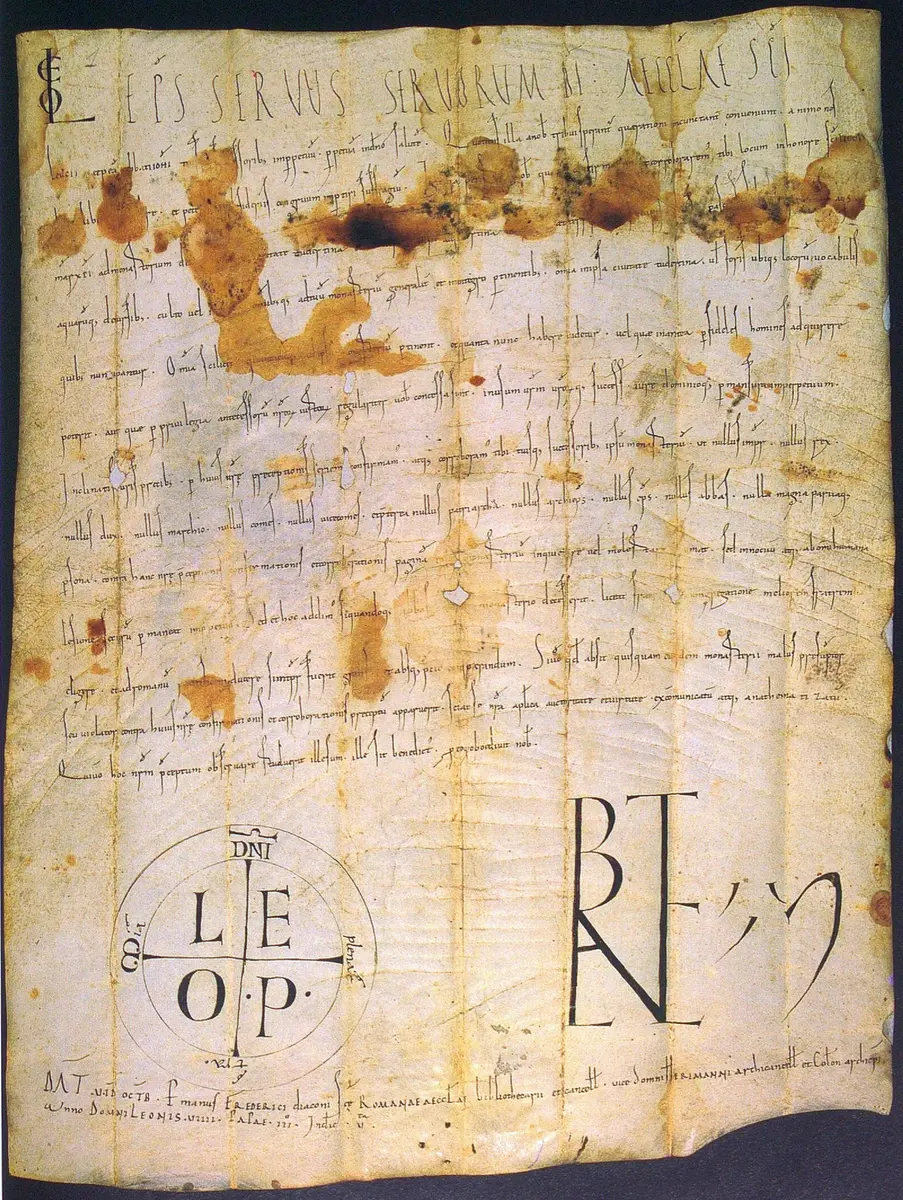
He ruled this huge, mixed realm largely from the saddle, through counts and bishops, a yearly assembly of the great men, travelling inspectors called missi dominici and written orders called capitularies. He also believed it was his duty to make his people better Christians, and that needed a clergy who could read. From the 780s he gathered scholars from Italy, Spain, Ireland and England at his court, Alcuin of York above all, and schools and monastic copying workshops multiplied. A clear new script, Carolingian minuscule, spread from his circle and is the ancestor of the letters printed today; some classical Latin texts survive only because they were copied for libraries in these years. Charles himself, Einhard says, spoke Latin well but started too late to learn to write, and kept writing tablets under his pillow. From about 794 his favourite home was Aachen, for its hot springs; there he built a palace and an eight-sided chapel with columns brought from Rome and Ravenna.
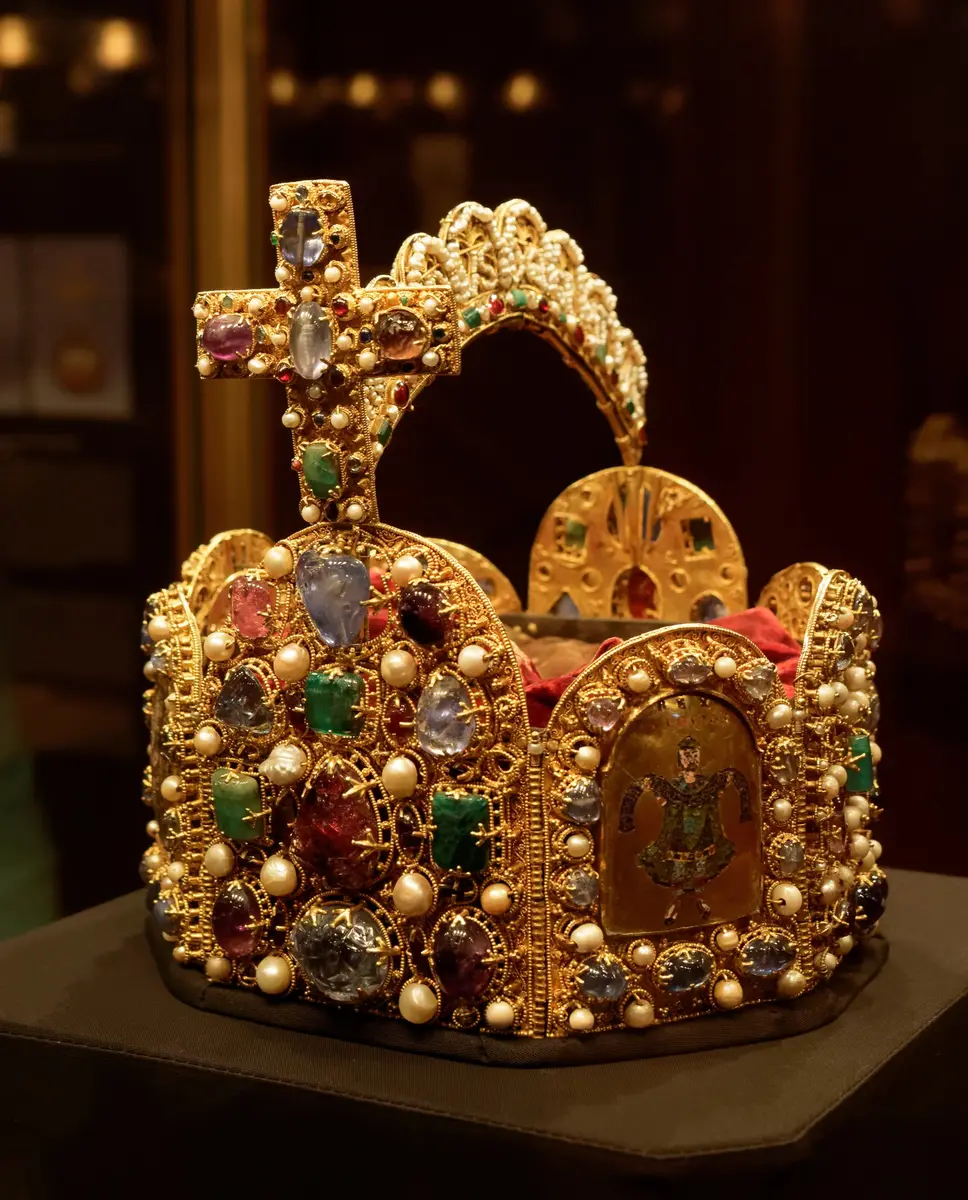
In April 799 a faction in Rome attacked Pope Leo III, who escaped to Charles at Paderborn. Charles had him escorted home and came to Rome himself late in 800. Two days after Leo had cleared himself on oath, at the Christmas mass in St Peter's, the pope set a crown on Charles's head and the Romans hailed him as emperor and Augustus. Einhard claims he would not have entered the church had he known, but historians think king and pope planned it together; in Western eyes the empress Irene, a woman ruling in Constantinople since 797, was no true emperor. Byzantium recognised his title only in 812. In 806 he planned to divide his lands among three sons, but two died before him, so in 813 he crowned the survivor, Louis, at Aachen with his own hands. He died there on 28 January 814 after a week of fever, at about sixty-five, and was buried the same day in his chapel.
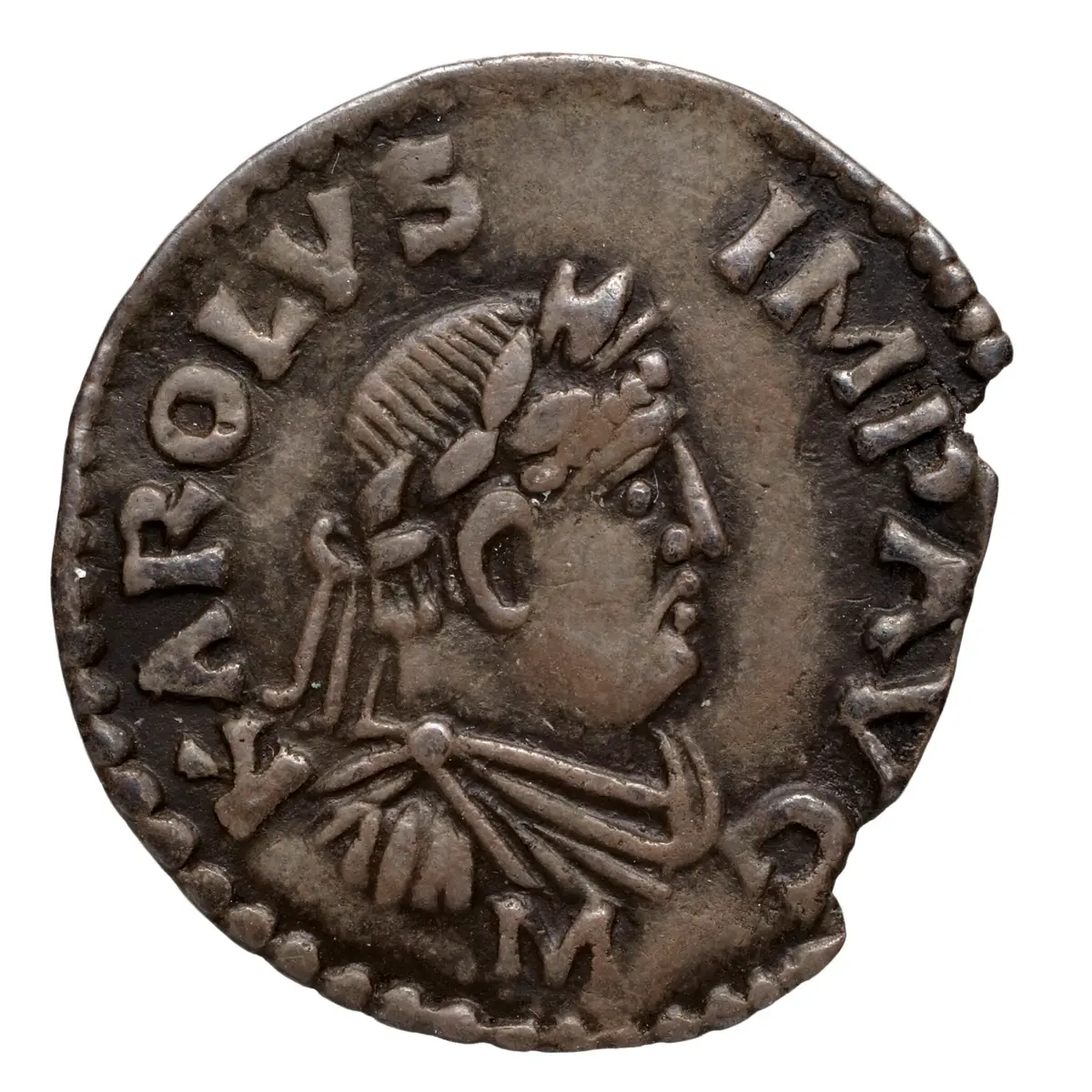
His grandsons split the empire by the Treaty of Verdun in 843; the imperial title he revived passed in 962 to the German king Otto I and lived on in the Holy Roman Empire until 1806. His own age called him the father of Europe, Frederick Barbarossa had an antipope declare him a saint in 1165, and French and German kings alike claimed him as their forefather. Historians weigh the conquests and the massacres against the schools and the books: he made the Frankish kingdom the core of a Latin Christian Europe. The only likeness made in his lifetime is a small silver coin of his last years that shows him as a laurelled Roman emperor; the long-bearded Charlemagne of Dürer and of legend was invented centuries later.
What happened
- 748
Charles is born, the elder son of Pippin, mayor of the palace of the Franks, and his wife Bertrada. The day is known; the year is not (748 or 747 is now preferred to the traditional 742), and nor is the place.
- 754
Pope Stephen II, in Francia to seek help against the Lombards, anoints Pippin, king since 751, and his two sons Charles and Carloman at the abbey of Saint-Denis.
- 768
Pippin dies at Saint-Denis. By Frankish custom the kingdom is divided between Charles and Carloman, and the rivalry between the brothers begins at once.
- 771
Carloman dies with war between the brothers in the air. Charles takes the whole kingdom, ignoring his nephews, and sends back his Lombard wife, the daughter of King Desiderius whom he had married in 770.
- 772
His first campaign against the pagan Saxons: he storms their stronghold of Eresburg and destroys the Irminsul, their sacred pillar. The war will last more than thirty years.
- 773
Called in by Pope Hadrian I against the Lombards, he crosses the Alps and lays siege to King Desiderius in his capital, Pavia.
Pavia: the Lombard capital he besieged from September 773 and took in June 774- 774
Leaving the siege, he spends Easter in Rome with Hadrian I and confirms the lands his father had promised to the papacy: the start of an alliance between Frankish kings and popes.
St Peter's, Rome: where Pope Leo III crowned him emperor at the Christmas mass of 800Pavia surrenders after a long siege. Desiderius is banished for life, his son flees to Constantinople, and Charles takes the title king of the Lombards.
Pavia: the Lombard capital he besieged from September 773 and took in June 774- 777
He holds the Frankish assembly at Paderborn, deep in Saxony; many Saxons are baptised there. Envoys of Muslim governors in Spain, at odds with the emir of Córdoba, invite him across the Pyrenees.
Paderborn: his palace in Saxony, scene of the assembly of 777 and of his meeting with Pope Leo III in 799 - 778
He leads an army into Spain; Pamplona is razed but Saragossa holds out. On the march home through the Pyrenees Basque fighters ambush the baggage train and the rear guard and kill them to a man; Roland, warden of the Breton march, is among the dead.
Roncevaux (Ibañeta pass), Pyrenees: where tradition puts the ambush of his rear guard in 778 - 781
At Easter in Rome Pope Hadrian baptises his son Pippin and anoints Pippin and Louis as kings of Italy and of Aquitaine. On this journey he meets Alcuin of York in Italy and invites him to his court. The Godescalc gospels, made for him in the next two years, record the baptism in gold.
St Peter's, Rome: where Pope Leo III crowned him emperor at the Christmas mass of 800- 782
After the Saxons under Widukind destroy a Frankish army at the Süntel hills, he returns in fury. The Saxon leaders hand over the rebels, and at Verden on the Aller, at his command, 4,500 of them are beheaded in a single day.
- 783
Queen Hildegard, mother of his heirs, dies at Thionville. That summer he crushes the Saxons at Detmold and on the Hase, the only two pitched battles he fights in person in the war; he marries Fastrada, and his mother Bertrada dies on 12 July.
- 785
Widukind, the Saxon leader, submits and is baptised at the palace of Attigny, with Charles as his godfather.
- 788
He deposes Duke Tassilo and annexes Bavaria, bringing the Franks face to face with the Avars on the Danube. The chalice Tassilo and his wife Liutpirc had given probably passes after his fall to Kremsmünster, which keeps it still.
- 794
A great church council meets under him at Frankfurt. From about this year Aachen, with its hot springs, becomes his favourite home, where his palace and chapel are rising.
Aachen Cathedral, around his palace chapel: his favourite residence from about 794, where he died and was buried in 814 - 795
Pope Hadrian I has died, and Leo III is elected. Charles, who mourns Hadrian, has a Latin verse epitaph made for his tomb in St Peter's.
St Peter's, Rome: where Pope Leo III crowned him emperor at the Christmas mass of 800- 796
His armies take the Ring, the great fortified centre of the Avars, and carry off two centuries of plunder; the treasure pays for his rule for years.
Alcuin leaves the court to become abbot of St Martin at Tours, where his monks work on Carolingian minuscule, the script that leads to our printed letters.
- 799
In Rome a faction that includes officials of the papal court attacks Pope Leo III and leaves him unconscious. Leo escapes and travels to Charles at Paderborn, who has him escorted back to Rome.
Paderborn: his palace in Saxony, scene of the assembly of 777 and of his meeting with Pope Leo III in 799- 800
Two days after Leo has cleared himself of the charges on oath, at the Christmas mass in St Peter's, the pope sets a crown on Charles's head and the Romans hail him as emperor of the Romans. Einhard says he would not have gone into the church had he known.
St Peter's, Rome: where Pope Leo III crowned him emperor at the Christmas mass of 800- 801
After a long siege, Barcelona surrenders to the army of his son Louis: the start of the Spanish March, the Frankish frontier between the Pyrenees and the Ebro.
- 802
He first uses the title 'emperor governing the Roman Empire', while keeping 'king of the Franks and the Lombards', and has every free man swear an oath of loyalty to him.
- 804
The Saxon war ends: he takes ten thousand Saxons from the banks of the Elbe and settles them across Gaul and Germany. Alcuin dies at Tours on 19 May.
- 806
At Thionville he decrees how the empire will be divided at his death among his three sons, Charles, Pippin and Louis.
- 810
His son Pippin, king of Italy, dies. It is a year of blows: at Aachen he hears that a Danish fleet of 200 ships has ravaged Frisia, and the elephant sent to him by the caliph Harun al-Rashid dies on the march north.
Aachen Cathedral, around his palace chapel: his favourite residence from about 794, where he died and was buried in 814- 812
Envoys of the Byzantine emperor at Aachen address him as emperor: Constantinople at last accepts his title. The portrait coins of his last years show him as a laurelled Roman emperor.
Aachen Cathedral, around his palace chapel: his favourite residence from about 794, where he died and was buried in 814 - 813
Old and ill, he summons the great men of the empire to Aachen and, with their consent, places the crown on the head of Louis, his only surviving son by Hildegard, making him co-emperor without any part for the pope.
Aachen Cathedral, around his palace chapel: his favourite residence from about 794, where he died and was buried in 814 - 814
A week after a fever struck him at Aachen, he dies in the morning, after taking communion, and is buried the same day in his chapel, by the treasury's account in an ancient Roman sarcophagus.
Aachen Cathedral, around his palace chapel: his favourite residence from about 794, where he died and was buried in 814