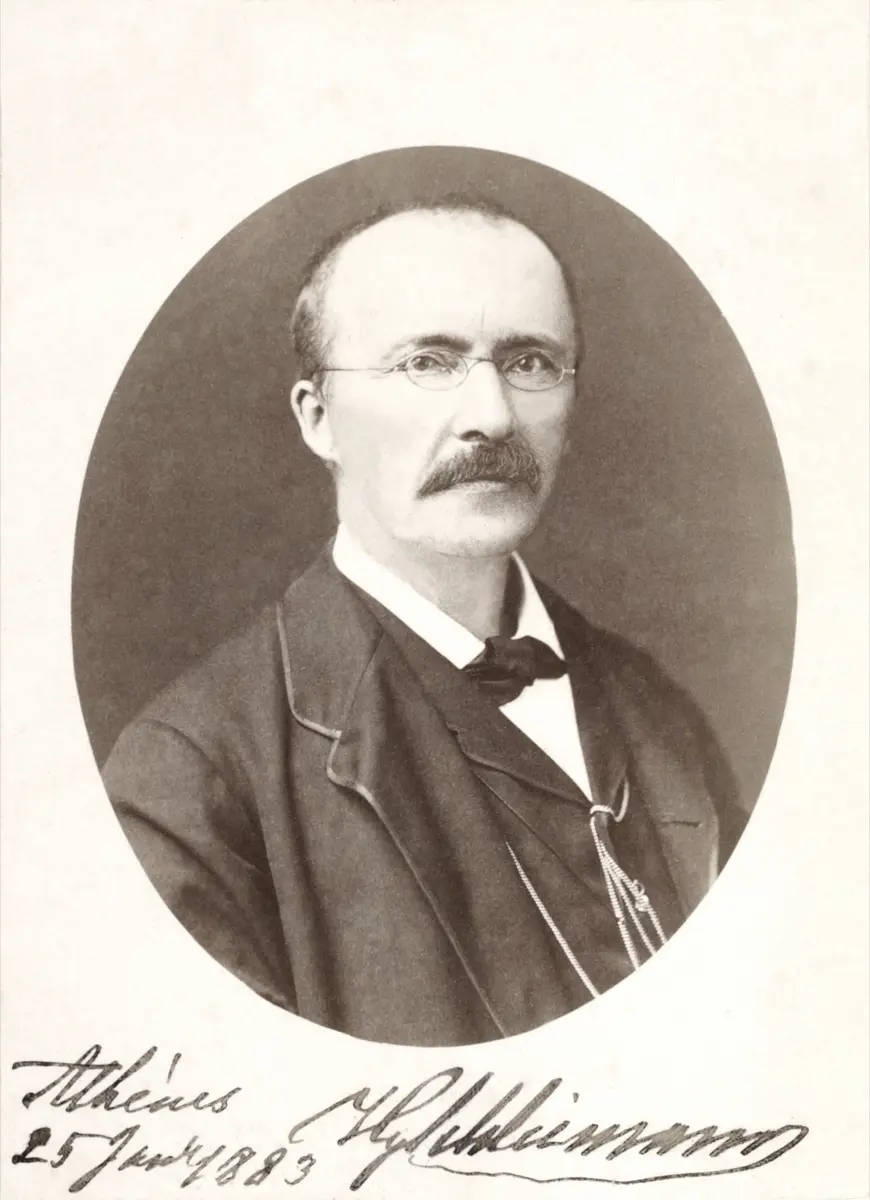
Heinrich Schliemann
“The German merchant who dug Troy and Mycenae, found 'Priam's Treasure' (1873) and the 'Mask of Agamemnon' (1876), revealed Bronze Age Greece, but wrecked layers, smuggled gold and embroidered his own life.”
Heinrich Schliemann was a German merchant who made two fortunes, in Russia and in gold-rush California, and then spent them trying to prove that Homer's stories were history. From 1870 he dug into the mound of Hisarlik in north-west Turkey, which he declared to be Troy. There, on 31 May 1873, he found a hoard of gold and silver that he called 'Priam's Treasure', and in 1876 at Mycenae in Greece he opened royal shaft graves full of gold, among them the face mask he linked with King Agamemnon. His digs uncovered the Bronze Age world of Greece and Anatolia, and his quick books and newspaper reports made archaeology exciting to the public. He was also a gifted self-promoter who reshaped his own life story, so historians now judge him with mixed feelings.
He was born on 6 January 1822 in Neubukow, in the north German duchy of Mecklenburg-Schwerin, the son of a poor Protestant pastor, and grew up in the village of Ankershagen. His mother died when he was nine, and at fourteen he left school to work in a grocer's shop. In 1841 he sailed as a cabin boy for South America, was shipwrecked off the Dutch coast and ended up in Amsterdam, where the trading house B. H. Schröder & Co. took him on in 1844. He had a gift for languages, learned Russian, and in 1846 the firm sent him to St Petersburg, where he set up on his own, traded in indigo and grew rich as a supplier during the Crimean War. In 1851 and 1852 he ran a bank in Sacramento, California, buying gold dust from miners. He married a Russian, Ekaterina Lyschin, in 1852 and had three children with her, but the marriage failed.
In his forties he left trade, travelled round the world and studied in Paris. In 1868 he toured Ithaca, the Peloponnese and the Troad looking for Homer's places. Frank Calvert, an Englishman of the Dardanelles who owned part of Hisarlik and had already dug there, convinced him that Troy lay under that mound. Schliemann divorced his wife in Indiana in 1869 and married Sophia Engastromenos, a seventeen-year-old Athenian. At Hisarlik he cut a trench 17 metres deep through the middle of the hill, destroying much of the later city, including the Late Bronze Age levels now thought to fit Homer's Troy. His 'Priam's Treasure' came from a layer more than a thousand years older than any Trojan War, and he smuggled it out of the Ottoman Empire to Athens. In Mycenae the graves he opened date from the sixteenth century BCE, centuries before Agamemnon could have lived. With the architect Wilhelm Dörpfeld, from 1882, his digs at Troy and Tiryns became far more careful.
Schliemann polished his own legend. He wrote that he had vowed as a boy to find Troy, that he had become an American when California joined the Union in 1850, that he had escaped a great fire in San Francisco and that Sophia had carried the treasure away in her shawl; research since the 1970s has shown these and other stories to be false or embroidered. He also played down Calvert's part, and Calvert criticised him in print. Rich and famous, he built a palace in Athens, the Iliou Melathron, now the Numismatic Museum, and gave his Trojan collection to Berlin in 1881.
Suffering from a chronic ear disease, he had an operation in Halle in November 1890, travelled on in great pain, collapsed in Naples on Christmas Day and died there on 26 December 1890. He is buried in Athens in a temple-shaped tomb. His gold from Troy, taken from Berlin by the Red Army in 1945, is in the Pushkin Museum in Moscow. He is remembered as the man who showed that the Greek Bronze Age, the Mycenaean civilisation, was real, and as a warning of what an impatient digger can destroy.
What happened
- 1822
Johann Ludwig Heinrich Julius Schliemann is born in Neubukow, a small town in the duchy of Mecklenburg-Schwerin, son of the poor Protestant pastor Ernst Schliemann.
Neubukow, Mecklenburg: born here on 6 January 1822, where his father was pastor- 1823
His father becomes pastor of Ankershagen, a village between Waren and Penzlin, and the family moves there; Schliemann later calls it his home village, and the parsonage is now the Heinrich Schliemann Museum.
- 1829
By his own later account, his father gives him Jerrer's Universal History for Christmas, with a picture of Troy in flames, and the boy decides that walls so huge cannot have vanished. Britannica calls this one of his 'autobiographical accounts'; historians treat the childhood vow as part of the legend he built.
- 1831
His mother dies when he is 'hardly nine'; soon afterwards a scandal over his father ends the family's standing in the village, and the boy is sent to an uncle, a pastor at Kalkhorst.
- 1836
At fourteen, too poor for further school, he becomes an apprentice in Ernst Ludwig Holtz's small grocer's shop in Fürstenberg, Mecklenburg-Strelitz, selling herrings, butter and potato spirits for five and a half years.
- 1841
After leaving the shop, he sails from Hamburg as cabin boy on the brig Dorothea, bound for La Guaira in Venezuela.
In a storm in the night of 11 to 12 December the Dorothea is wrecked on a sandbank off the Dutch island of Texel; the nine men of the crew survive nine hours in an open boat. Schliemann makes his way to Amsterdam and works as an office boy.
- 1844
He joins the Amsterdam trading house B. H. Schröder & Co. as correspondent and bookkeeper. He teaches himself languages fast, by reading aloud and learning texts by heart, and adds Russian.
- 1846
Schröder & Co. send him to St Petersburg as their agent. He soon trades on his own account as well, above all in indigo, and becomes rich.
- 1850
His younger brother Ludwig, who had gone to the California gold fields and opened a hotel in Sacramento, dies there of typhoid at 25.
Schliemann leaves St Petersburg for America; his journal gives a desire to travel as the reason, though most biographers link the trip to his brother's estate.
- 1851
In Washington he listens to a debate on the Fugitive Slave Act and that evening calls on President Millard Fillmore, by his journal talking with the family for an hour and a half before a reception. The scholar William Calder called the scene invented; Thanos and Arentzen think a visit was possible but its importance inflated.
After crossing the Isthmus of Panama, he lands in San Francisco from the steamer Oregon.
The date Schliemann later gave to a great fire of San Francisco that he said he had escaped from his hotel. There was no fire that day (the city burned on 4 May and 22 June), the hotel he named was already in ruins, and David Traill showed in 1978 that the account was written afterwards and glued into his journal.
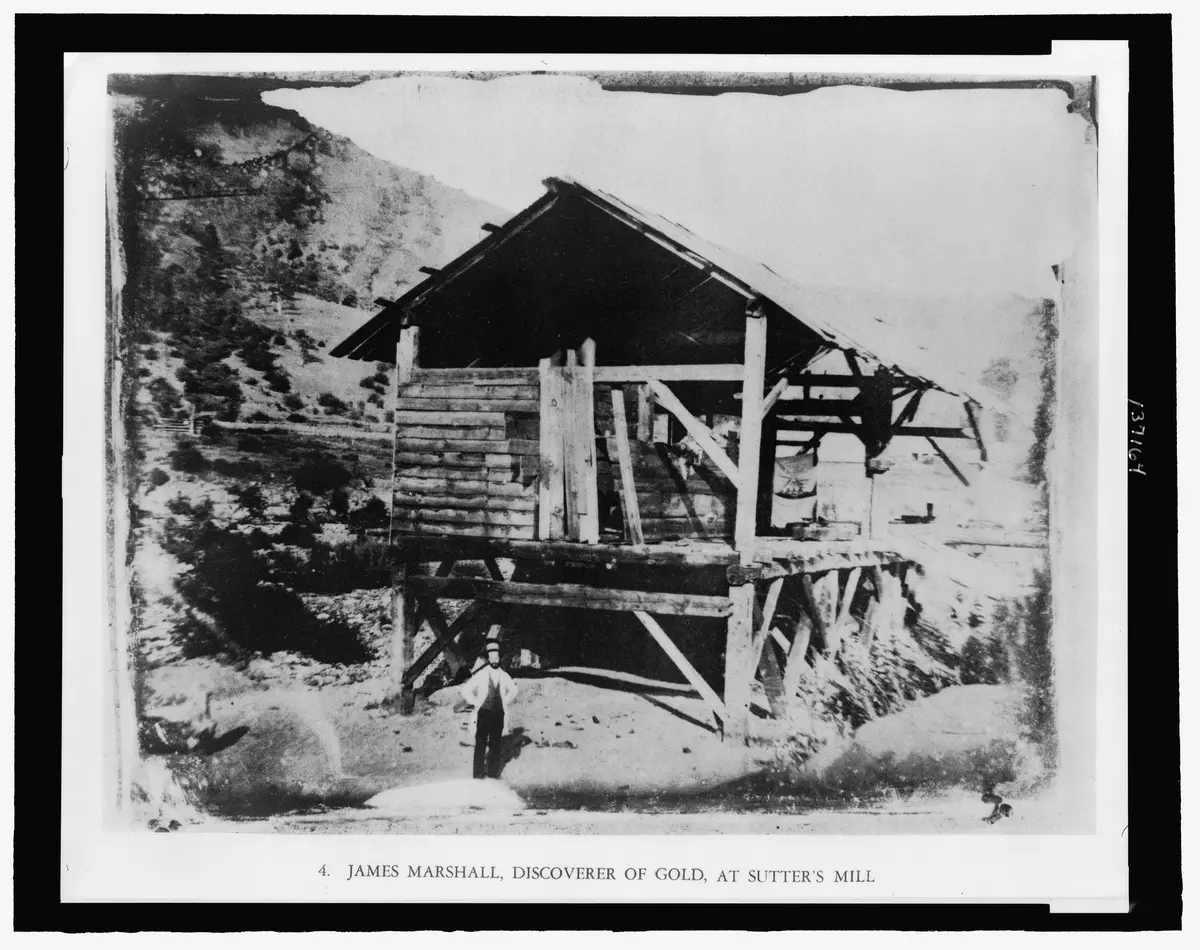
The 'Banking House of Henry Schliemann', in the brick building at the corner of Front and J streets in Sacramento, advertises for 3,000 ounces of gold dust; he buys from miners and sells on as agent of B. Davidson, the Rothschilds' man in San Francisco, and makes his second fortune.
- 1852
His bank is handed over to Davidson and he sails from San Francisco on the steamer Golden Gate for Panama. His journal blames fever; David Traill found that Davidson suspected him of short-weighting gold consignments and forced the sale.
Back in St Petersburg, he marries Ekaterina Petrovna Lyschin, the niece of a rich friend; they have three children, but she will not follow him out of Russia and the marriage fails.
- 1854
During the Crimean War, with Russia's ports blockaded, he makes a fortune as a merchant and military contractor, shipping indigo and supplies overland through Prussian ports.
- 1858
Rich enough at 36, he steps back from business and travels to Sweden, Denmark, Germany, Italy and Egypt, where he learns Arabic; he soon returns to trade.
- 1864
He sets out round the world: Tunis and Carthage, Egypt, India, Java, China, where he walks on the Great Wall, Japan, and across the Pacific to San Francisco; on the crossing he writes his first book, La Chine et le Japon au temps présent.
- 1866
He settles in Paris, invests in property and attends lectures at the Sorbonne, turning to archaeology and ancient Greek.
- 1868
He leaves by way of Rome and Naples to look for Homer's places on the ground: Corfu, Cephalonia and Ithaca, where he digs on Mount Aetos for the palace of Odysseus, then the Peloponnese, including Mycenae.
In the Troad he digs at Bunarbashi, the hill most scholars then took for Troy, and finds nothing old. Frank Calvert, whose family owns part of the mound of Hisarlik and who has already dug there, convinces him that Troy lies under Hisarlik.
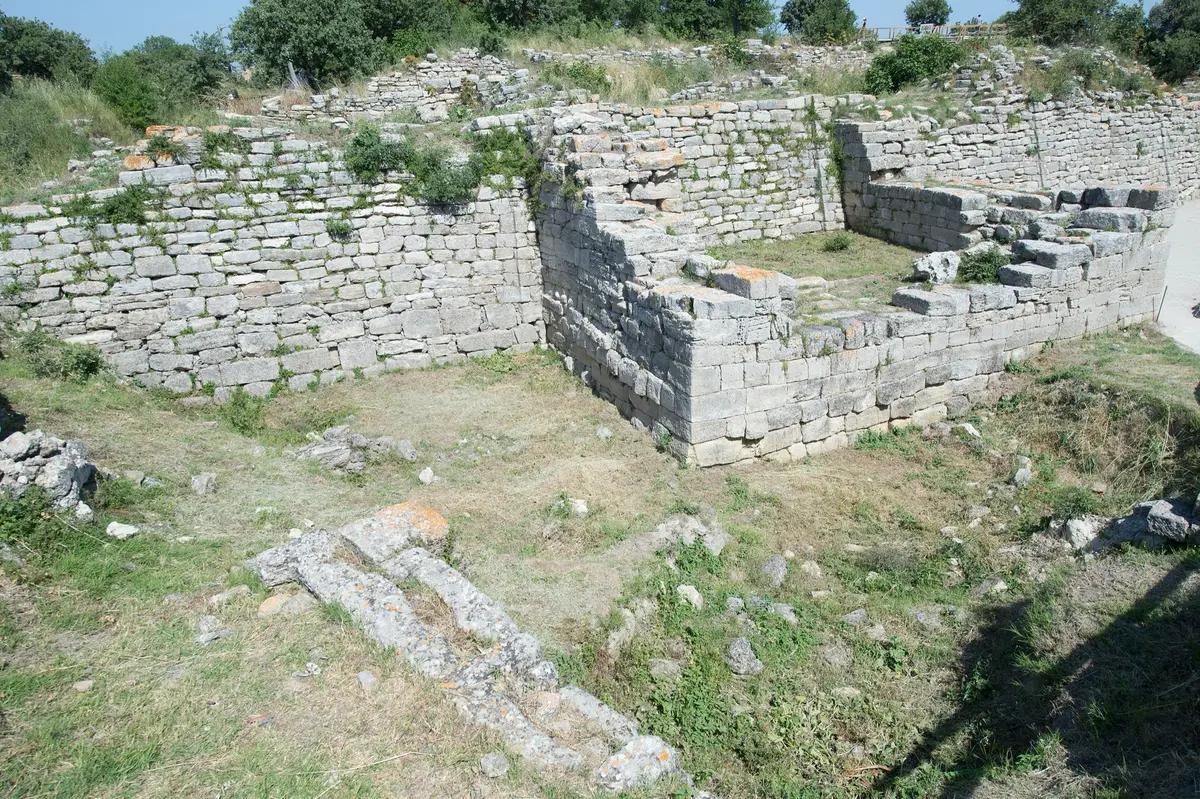
Hisarlik (Troy), north-west Turkey: the mound he dug in 1870-73, 1878-79, 1882-83 and 1889-90, where he found 'Priam's Treasure'- 1869
He publishes Ithaka, der Peloponnes und Troja, arguing for Hisarlik while leaving out Calvert's name, and on the strength of it the University of Rostock makes him a Doctor of Philosophy.
In Indianapolis, where he has bought a house and a business share to show he means to stay, the Marion County court grants his divorce from Ekaterina; earlier that year he has become a United States citizen in New York. He leaves Indiana within weeks.
In Athens he marries the seventeen-year-old Sophia Engastromenos, picked from photographs sent by his old Greek teacher, Archbishop Theokletos Vimpos; they will have two children, Andromache and Agamemnon.
- 1870
Without a permit from the Ottoman government, he cuts a first trial trench at the north-west corner of Hisarlik.
Hisarlik (Troy), north-west Turkey: the mound he dug in 1870-73, 1878-79, 1882-83 and 1889-90, where he found 'Priam's Treasure'- 1871
With a firman from the Sublime Porte at last, he and Sophia begin the first real season at Hisarlik with about 80 labourers, working until 24 November.
Hisarlik (Troy), north-west Turkey: the mound he dug in 1870-73, 1878-79, 1882-83 and 1889-90, where he found 'Priam's Treasure'- 1872
- 6:00 a.m.
At six in the morning he opens his second season with 100 workmen and starts the great trench through the middle of the hill, which reaches 17 metres deep; believing Homer's Troy is the lowest city, he cuts through the later layers, including those of the Late Bronze Age.
Hisarlik (Troy), north-west Turkey: the mound he dug in 1870-73, 1878-79, 1882-83 and 1889-90, where he found 'Priam's Treasure' - 1873
He returns to Hisarlik with Sophia for a third season, slowed by cold, storms and church festivals.
Hisarlik (Troy), north-west Turkey: the mound he dug in 1870-73, 1878-79, 1882-83 and 1889-90, where he found 'Priam's Treasure'Beside a wall near what he calls Priam's palace he finds a great hoard: gold diadems, earrings and thousands of beads packed in a silver vase, gold and silver vessels, copper weapons, a cauldron and a shield. He names it 'Priam's Treasure'. He wrote that Sophia stood by and carried it off in her shawl, but she had gone home to Athens after her father's death, and he later admitted the story. The hoard comes from a city of the third millennium BCE, more than a thousand years before any Trojan War.
Hisarlik (Troy), north-west Turkey: the mound he dug in 1870-73, 1878-79, 1882-83 and 1889-90, where he found 'Priam's Treasure'He ends the season and, to avoid giving the Ottoman government its share under his permit, smuggles the treasure out of the empire to Athens.
- 1874
He publishes Trojanische Alterthümer with an Atlas of 217 photographic plates; Sophia's photograph in the 'Jewels of Helen' goes round the world. Many scholars are sceptical, but the public and William Gladstone are won over.
When he asks to dig again at Hisarlik, the Ottoman government sues him in Athens for its share of the finds, and his work at Troy stops.
Frank Calvert publishes a letter in The Athenaeum that strongly criticises some of Schliemann's statements about Troy.
- 1875
The lawsuit ends in a settlement: he pays 10,000 gold francs for the treasure and gives several times that sum to the Imperial Museum in Constantinople to be allowed back.
- 1876
A new firman allows him to dig at Troy again, but he turns first to Mycenae.
He begins at Mycenae with 63 workmen, twelve of them clearing the Lion Gate and the rest digging just inside the walls, watched by the Greek government's representative, Panagiotis Stamatakis.
Mycenae, Argolis: the citadel where in 1876 he opened the shaft graves of Grave Circle AInside a double ring of upright slabs, Grave Circle A, his men open five shaft graves with sixteen bodies, gold masks, weapons, cups and jewellery; he believes he has found Agamemnon and his companions.
Mycenae, Argolis: the citadel where in 1876 he opened the shaft graves of Grave Circle AHe telegraphs King George I of Greece (16 November in the Greek calendar) that he has found the tombs Pausanias gave to Agamemnon and Cassandra, and that he gives all the treasure to Greece.
Mycenae, Argolis: the citadel where in 1876 he opened the shaft graves of Grave Circle A- 1878
His book Mycenae appears, with a preface by Gladstone. The gold mask he linked with Agamemnon is now dated to the sixteenth century BCE, about three centuries before the legend's king. He digs on Ithaca again and goes back to Troy.
- 1879
At Hisarlik he works with the French scholar Emile Burnouf, who draws a new plan of the site, and the German doctor Rudolf Virchow.
Hisarlik (Troy), north-west Turkey: the mound he dug in 1870-73, 1878-79, 1882-83 and 1889-90, where he found 'Priam's Treasure' - 1880
He publishes Ilios, the city and country of the Trojans, with his autobiography, and digs at Orchomenos in Boeotia, where the 'Treasury of Minyas' yields little but a beautiful carved ceiling.
- 1881
He gives his Trojan collection, with the gold, to the Royal Museums in Berlin to be kept together. In 1945 the Red Army takes the gold to Moscow, where it is shown in the Pushkin Museum.
A grand reception opens the Iliou Melathron, the 'Palace of Troy' that Ernst Ziller built for him in the centre of Athens, with Pompeian-style paintings and Homeric verses on its walls.
The Iliou Melathron, Athens: the 'Palace of Troy' he built in 1878-81 as his home, now the Numismatic Museum- 1882
He takes on Wilhelm Dörpfeld, an architect trained at the German dig at Olympia, who brings careful method and the study of layers to Troy.
- 1884
With Dörpfeld he digs Tiryns, near Mycenae, and uncovers a Mycenaean palace with painted walls inside its huge Cyclopean ramparts.
- 1889
He returns to Troy with Dörpfeld for his last campaigns, defending his Troy against critics.
Hisarlik (Troy), north-west Turkey: the mound he dug in 1870-73, 1878-79, 1882-83 and 1889-90, where he found 'Priam's Treasure' - 1890
Long troubled by an ear disease, he has an operation in Halle, then travels on through Europe in growing pain, visiting doctors.
Alone and in great pain, he collapses while crossing a square in Naples.
Naples: he collapsed here on Christmas Day 1890 and died the next dayHeinrich Schliemann dies in Naples, from an infection that followed the ear operation. Dörpfeld takes his body to Athens, where he is buried in the First Cemetery in a temple-tomb designed by Ernst Ziller.
Naples: he collapsed here on Christmas Day 1890 and died the next day