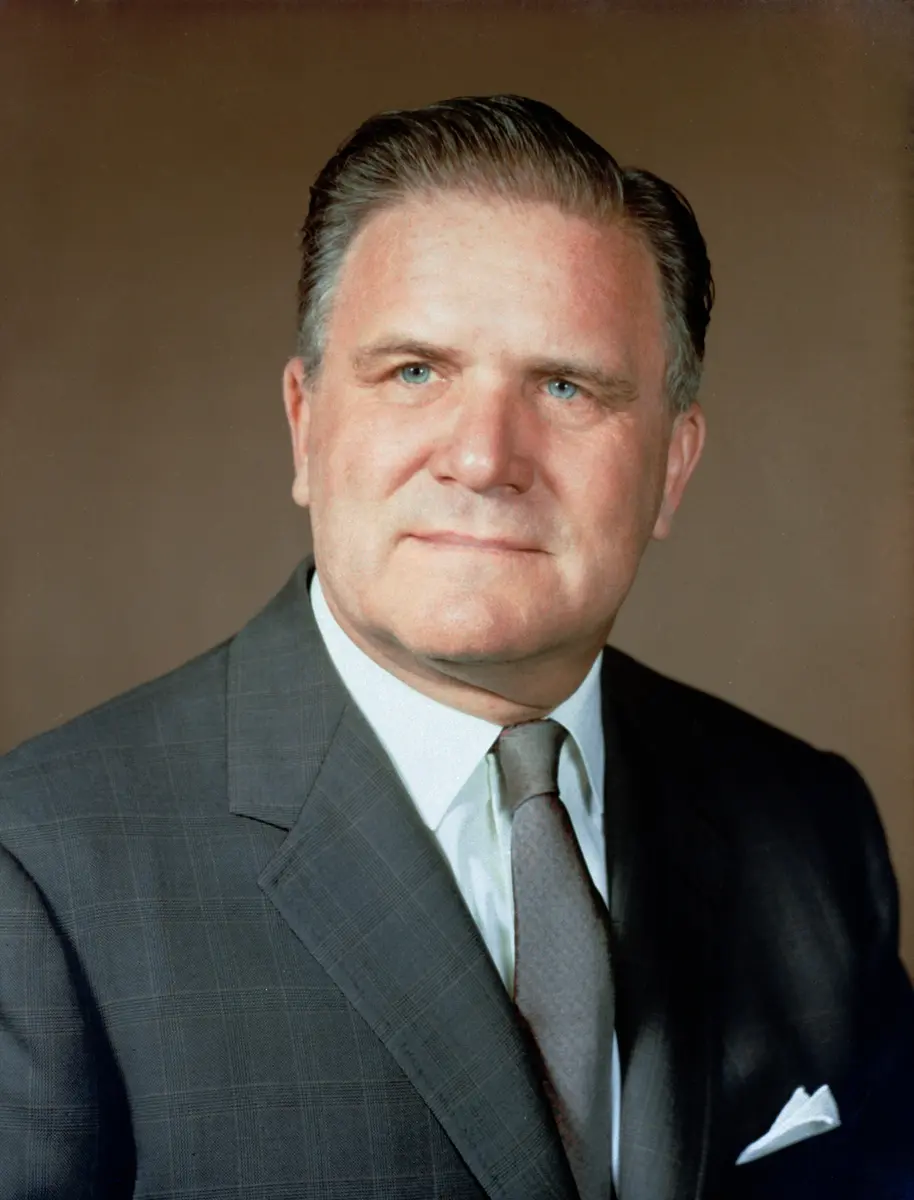
James E Webb
“NASA's administrator through the Apollo years (1961–68): a lawyer and manager, not a scientist, who won the money and political cover for the Moon race. The telescope named for him is disputed over the Lavender Scare.”
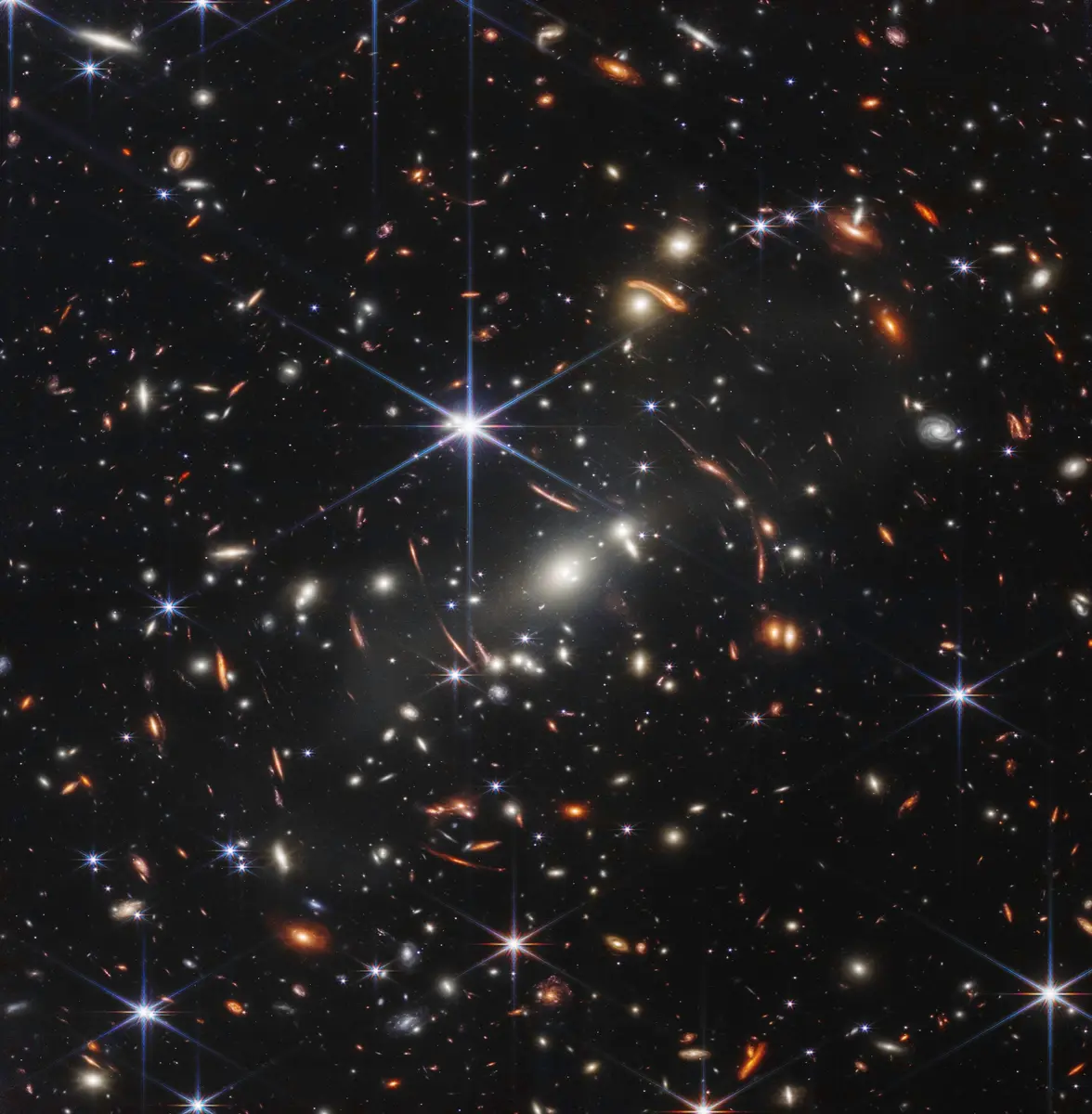
James E. Webb was the lawyer and manager who ran NASA through almost the whole race to the Moon. The agency's second administrator, he held the job from 14 February 1961 to 7 October 1968: from the first weeks of President Kennedy's term to four days before the first crewed Apollo flight. He was not a scientist or an engineer, and he never flew. His skill was Washington. He knew how to win money from Congress, how to hold together a huge web of NASA centres and private contractors, and how to keep two presidents behind the project. In 2002, ten years after his death, a telescope was named for him, and in 2021 that name became the subject of a bitter argument.
He was born on 7 October 1906 at Tally Ho, a farming community in Granville County, North Carolina, where his father ran the county's schools. After the University of North Carolina (a degree in education, 1928) he learned to fly as a Marine Corps reserve pilot, went to Washington in 1932 as secretary to a congressman, and studied law at night. In 1936 he joined the Sperry Gyroscope Company in Brooklyn and rose to vice president while it made instruments and radar for the war; in 1944 he went back into the Marines. President Truman made him Director of the Bureau of the Budget in 1946 and Under Secretary of State in 1949, the second man in Dean Acheson's department. After he left State in 1952 he worked for the Oklahoma oil company of Senator Robert Kerr, and in 1961 it was Kerr, the new chairman of the Senate space committee, who recommended him to Kennedy.
Webb reportedly took the job with reluctance, and within weeks he faced the first test: Yuri Gagarin's flight on 12 April 1961. On 8 May he and Defense Secretary Robert McNamara sent Vice President Johnson a memo urging a manned Moon landing, and on 25 May Kennedy made it the nation's goal. Webb spent the next seven years turning that sentence into an organisation. In 1961 he sent a team to choose the site of the Manned Spacecraft Center, announced for Houston on 19 September, and made the deal with the Pentagon under which NASA bought the Merritt Island land for the Apollo launch complex. In July 1962 he backed lunar-orbit rendezvous as the way to land. He did not want the Moon to swallow everything, and in a taped meeting on 21 November 1962 he told Kennedy it was one of NASA's top aims, not the only one. He also enforced the presidents' equal-employment orders at NASA, and in June 1965 he and Wernher von Braun lectured Alabama's governor, George Wallace, on integration.
On 27 January 1967 a fire in the pure-oxygen cabin of the first Apollo spacecraft killed Gus Grissom, Ed White and Roger Chaffee on the launch pad. Webb asked President Johnson to let NASA investigate itself and promised to name the blame, his own included; in the hearings that followed he was often defensive, and the New York Times said NASA now stood for 'Never a Straight Answer'. Yet Congress and the public stayed behind Apollo. He stepped down on 7 October 1968, his 62nd birthday, so that the next president could choose his own man; Apollo 7 flew four days later and Apollo 11 landed in July 1969. He then sat on the boards of the National Geographic Society and the Smithsonian, and died of a heart attack in Washington on 27 March 1992, aged 85. In September 2002 NASA's administrator, Sean O'Keefe, named the Next Generation Space Telescope after him, without asking astronomers.
The argument is about the Lavender Scare, the post-war purge in which thousands of gay and lesbian federal workers were fired as supposed security risks. In March 2021 four astronomers asked NASA, in Scientific American, to drop Webb's name, and over 1,200 people signed a petition. They pointed to two things. In June 1950, as Under Secretary, Webb met Truman and then Senator Hoey, who was investigating homosexuals in government, and handed Hoey a State Department paper on the subject. And in 1963 a NASA budget analyst, Clifford Norton, was arrested, questioned by NASA's security chief and fired; he won in court in 1969. NASA first said in September 2021, after searching its own records, that it saw no reason to rename; after protests it widened the search, and on 18 November 2022 it published a review of over 50,000 pages by its chief historian, Brian Odom. He found no evidence that Webb led or promoted firings and no sign that he knew of Norton's case, and he concluded that Webb's main aim in 1950 was to limit Congress's access to State's files. The review is thorough, and the Royal Astronomical Society, which had asked authors to use only the initials, welcomed it. But NASA commissioned it, it looks for leadership rather than for what Webb should have known, and Odom himself says Webb's own views are unknown. The astronomers call it selective reading and say the bar is too low. NASA kept the name; the telescope had already launched under it, on 25 December 2021.
What happened
- 1906
James Edwin Webb is born at Tally Ho, near Stem in Granville County, North Carolina, the second of five children of John Frederick Webb, a teacher who became the county's school superintendent, and Sarah Gorham Webb.
Tally Ho, near Stem, Granville County, North Carolina: where Webb was born on 7 October 1906; his father ran the county's schools- 1928
He graduates from the University of North Carolina at Chapel Hill with a degree in education, after a year out in 1924–25 to earn money.
- 1930
He joins the Marine Corps Reserve and learns to fly at Pensacola, serving on active duty as a pilot until 1932.
- 1932
He moves to Washington as secretary to Congressman Edward W. Pou, chairman of the House Rules Committee, and studies law at night at George Washington University.
- 1936
Admitted to the D.C. bar, he moves to New York to be personnel director at the Sperry Gyroscope Company, and becomes a vice president in the next few years.
- 1938
He marries Patsy Aiken Douglas of Washington; the marriage lasts until his death and they have two children.
- 1944
He goes back into the Marine Corps for the war and commands a Marine air warning group working on radar.
- 1946
President Truman names him Director of the Bureau of the Budget, on the advice of his old patron O. Max Gardner; he holds the post until January 1949.
- 1949
He takes up his post as Under Secretary of State, the second man in Dean Acheson's department, and is charged with reorganising it.
Harry S Truman Building, Washington: the State Department's headquarters from April 1947, where Webb was Under Secretary from January 1949 to February 1952- 1950
With Acheson out of town, Webb attends the weekly Thursday meeting with President Truman, who wants to find a basis for cooperating with Senator Hoey's investigation of homosexuals in the federal government.
Webb meets Senator Hoey and the White House aides Charles Murphy and Stephen Spingarn, and passes on a State Department paper on homosexuality prepared by Carlisle Humelsine. NASA's historian finds that his main aim was to limit Congress's access to the department's personnel files and that no later action or follow-up by him is on record.
- 1952
His appointment as Under Secretary ends. He soon moves to Oklahoma City and the oil business, working for Senator Robert Kerr's Kerr-McGee company (by about 1953).
- 1961
Webb becomes NASA's second administrator, taking over from the acting head, Hugh Dryden. Senator Kerr, the new chairman of the Senate space committee, had recommended him to President Kennedy.
Federal Office Building 6, 400 Maryland Avenue SW, Washington: NASA's headquarters from the autumn of 1961, where Webb worked until 1968 (now the Department of Education)The day Yuri Gagarin becomes the first man in space, Webb, Dryden, Robert Seamans and Abe Silverstein face the press at NASA headquarters to answer questions on the American programme.
Federal Office Building 6, 400 Maryland Avenue SW, Washington: NASA's headquarters from the autumn of 1961, where Webb worked until 1968 (now the Department of Education)Webb and Defense Secretary Robert McNamara send Vice President Johnson a memo recommending that the national space programme aim at manned lunar exploration before the end of the decade. The same day Webb stands behind Kennedy in the Rose Garden as astronaut Alan Shepard receives NASA's Distinguished Service Medal.
President Kennedy asks Congress to commit the nation to landing a man on the Moon and returning him safely before the decade is out. Webb's work for the next seven years is to make it happen.
NASA announces that it will buy about 324 square kilometres, mostly on Merritt Island, beside the Air Force's Cape Canaveral, for the Apollo launch complex. On the same day Webb and Deputy Defense Secretary Roswell Gilpatric sign an agreement on how the two organisations will share the work.
NASA announces that its new Manned Spacecraft Center will be built near Houston, after a team that Webb appointed in July had weighed the twenty-three sites that met NASA's tests.
Johnson Space Center, Houston: the Manned Spacecraft Center whose site Webb's team chose in 1961 and which Kennedy and Webb visited on 12 September 1962Former President Truman visits the newly opened NASA headquarters, where Webb shows him a collection of rocket models for his presidential library.
Federal Office Building 6, 400 Maryland Avenue SW, Washington: NASA's headquarters from the autumn of 1961, where Webb worked until 1968 (now the Department of Education)- 1962
After hearing the briefing on 28 June and approving the staff memorandum of 10 July, Webb announces with Seamans and two colleagues that Apollo will land on the Moon by lunar-orbit rendezvous: a small lander separates from the main spacecraft in orbit.
President Kennedy visits the Manned Spacecraft Center in Houston with Johnson and Webb, and the same day gives his 'We choose to go to the Moon' speech at Rice University.
Johnson Space Center, Houston: the Manned Spacecraft Center whose site Webb's team chose in 1961 and which Kennedy and Webb visited on 12 September 1962In the Cabinet Room, Kennedy presses Webb on whether the Moon landing is NASA's first priority. Webb answers that it is one of the top priorities, not the top one; nine days later he sends the president a letter arguing for a broad space programme.
- 1963
In the early hours Clifford Norton, a NASA budget analyst, is arrested in Washington by police morals-squad officers who say he made a 'homosexual advance' to another man; NASA's security chief questions him and the agency later fires him under Civil Service rules. NASA's historian finds no evidence that Webb knew.
Six days before his death, Kennedy visits Cape Canaveral with Webb and NASA's leaders and is briefed on the Saturn V rocket.
- 1965
During the Gemini 4 flight, Webb tours the Manned Spacecraft Center in Houston and sits in a Gemini trainer.
Johnson Space Center, Houston: the Manned Spacecraft Center whose site Webb's team chose in 1961 and which Kennedy and Webb visited on 12 September 1962At the Marshall Space Flight Center in Huntsville, Webb and Wernher von Braun meet Alabama's segregationist governor, George Wallace, with a show of rocket firing, and then lecture him and his party on integration.
- 1967
A fire in the pure-oxygen cabin of the first Apollo spacecraft on Pad 34 kills Gus Grissom, Ed White and Roger Chaffee. That night Webb and Seamans ask Floyd Thompson to lead a review board; Webb asks Johnson to let NASA run the inquiry and promises to name the blame, his own included.
Webb, Seamans, Mueller and Phillips testify to the Senate space committee on the fire; Webb had at first denied the existence of the 'Phillips report' on North American Aviation's work, and is now pressed on it.
- 1968
While Webb and George Mueller are at a conference in Vienna, NASA headquarters discusses sending Apollo 8 round the Moon in December; Webb agrees later that week to plan for a December launch.
Webb announces that he will resign as NASA's administrator.
On his 62nd birthday Webb leaves NASA so that the next president can choose his own administrator; Thomas Paine takes over as acting administrator. Four days later Apollo 7 launches.
At the White House President Johnson presents NASA's Distinguished Service Medal to Webb, calling him NASA's most distinguished alumnus.
Johnson awards Webb the Presidential Medal of Freedom.
- 1992
Webb dies of a heart attack at Georgetown University Hospital in Washington, aged 85; he is buried at Arlington National Cemetery.
Arlington National Cemetery, Virginia: where Webb is buried