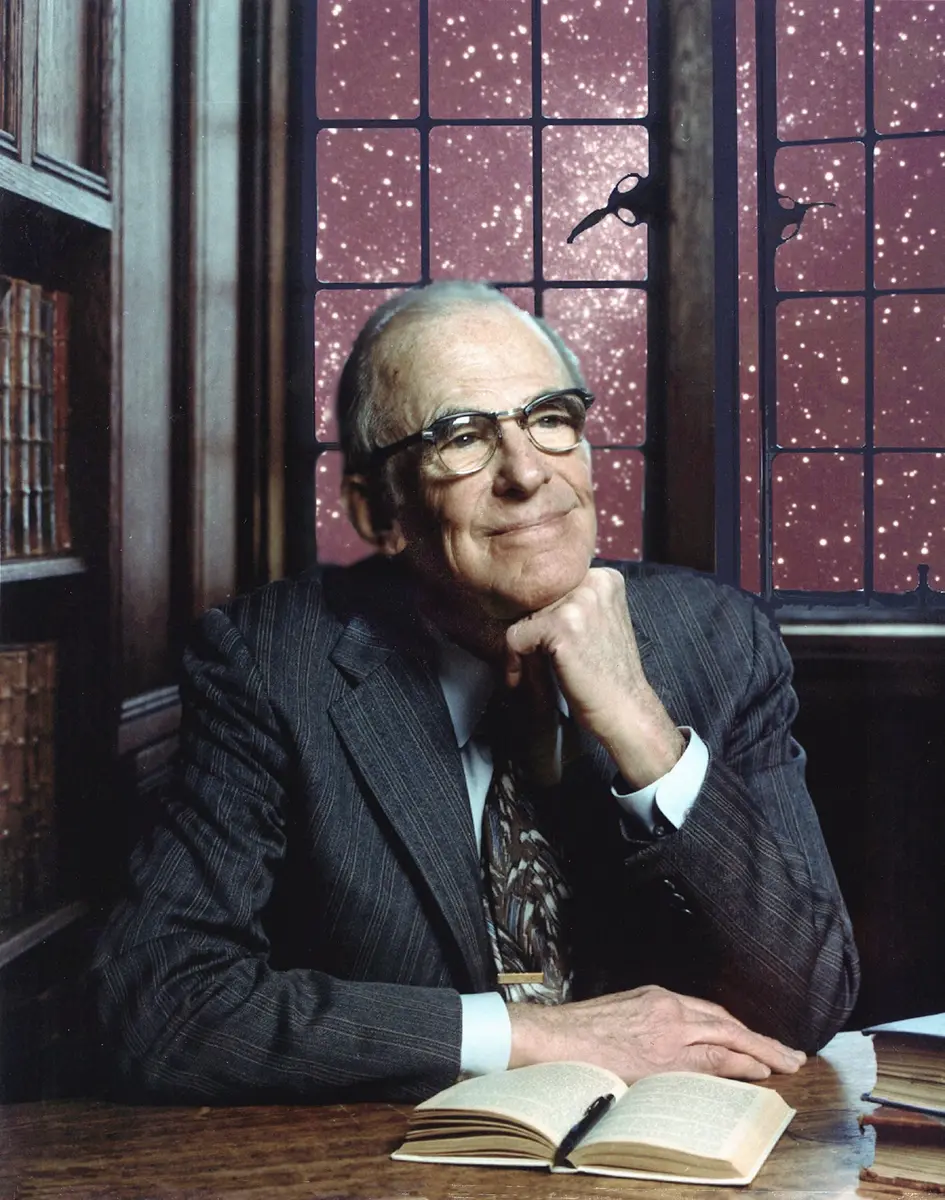
Lyman Spitzer
“The Princeton astrophysicist who argued in 1946 for a telescope in orbit, built the Copernicus satellite, pressed for Hubble for fifty years, and invented the stellarator fusion machine.”
Lyman Spitzer Jr. was an American astrophysicist who chose very large problems and then stayed with them for decades. In 1946, eleven years before the first satellite, he wrote a report arguing that a big telescope in orbit would see more sharply, and in kinds of light that the air blocks. In 1951 he proposed the stellarator, a twisted magnetic bottle for holding hydrogen hot enough to fuse, and set up the Princeton laboratory that still works on fusion. In between he built the physics of the gas and dust between the stars, and showed that stars are still being born today.
He was born on 26 June 1914 in Toledo, Ohio, into a well-off business family, and went to Phillips Academy and then Yale, where he took a physics degree in 1935. A year at Cambridge put him in front of Arthur Eddington and Subrahmanyan Chandrasekhar. He took his doctorate at Princeton in 1938 under Henry Norris Russell, spent a year at Harvard and joined the Yale faculty in 1939. In the war he worked on underwater sound for the U.S. Navy at Columbia University and, at 30, ran its Sonar Analysis Group.
In 1946 a friend at the RAND think tank asked him how a large satellite might serve astronomy. His answer, dated 1 September, said an orbiting mirror would escape the blur of the atmosphere and see ultraviolet light that never reaches the ground, and that it could 'revolutionize' astronomy. Almost nobody read it: he later admitted it never appeared in the astronomical journals, and its chief effect was on himself. In 1947 he went to Princeton as chair of astronomy and director of its observatory, a post he held until 1979, and with Martin Schwarzschild made it the leading centre of theoretical astrophysics. His books Diffuse Matter in Space (1968) and Physical Processes in the Interstellar Medium (1978) became the standard texts.
In 1951 he went to the Atomic Energy Commission with the stellarator. The money came on 1 July 1951 and the work grew into Project Matterhorn, first housed in a former rabbit hutch; its first machine, Model A, ran in 1953. In 1961 the project became the Princeton Plasma Physics Laboratory and in 1962 its largest stellarator, Model C, switched on. The tokamak later overtook the stellarator, but today stellarators are being built again. Sources disagree on when Spitzer stopped leading the laboratory, 1961 or 1967 (see the research notes).
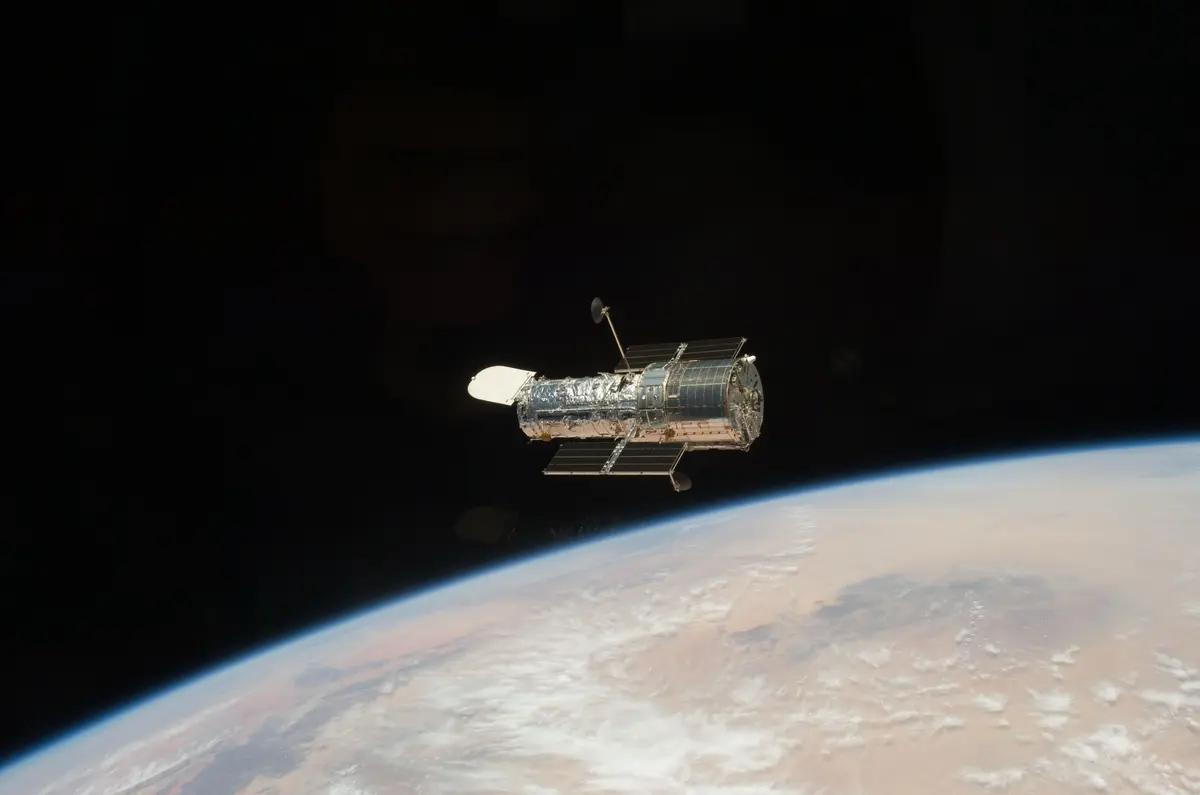
For space he worked in two ways. His Princeton group built the telescope on Copernicus, the third Orbiting Astronomical Observatory, launched on 21 August 1972; just before launch he found a flaw in its focus drive and telephoned a fix that saved it. From 1965 he chaired the National Academy committee whose 1969 report laid out what a Large Space Telescope should do, and in the 1970s he and John Bahcall lobbied Congress to keep it alive. Congress approved it in 1977 and it flew as the Hubble Space Telescope in 1990, a launch that has its own entry. Spitzer died suddenly on 31 March 1997, at home in Princeton, after a full day's work at the observatory. In 2003 NASA named its infrared space observatory after him.
What happened
- 1914
Lyman Spitzer Jr. is born in Toledo, Ohio, the son of a real-estate and paper-box businessman and of Blanche Brumback.
Toledo, Ohio: Spitzer was born here on 26 June 1914, into a prosperous commercial family, and went to Scott High School before Phillips Academy- 1935
He graduates in physics from Yale, then spends a year at St John's College, Cambridge, where Arthur Eddington teaches him and the slightly older Subrahmanyan Chandrasekhar influences him.
- 1938
He takes his doctorate at Princeton under Henry Norris Russell, then spends a year at Harvard as a postdoctoral fellow before becoming an instructor at Yale in 1939.
- 1944
Working for the war effort, he becomes, at the age of 30, director of the Sonar Analysis Group, a wartime research group on underwater sound that grew out of his work in Columbia University's Special Studies Group; he keeps the post until 1946.
- 1946
Now an associate professor at Yale, he finishes 'Astronomical Advantages of an Extra-Terrestrial Observatory', a report for Project RAND (Douglas Aircraft) that sets out what a satellite telescope could do: see through no air, in ultraviolet light the ground never receives, with resolution limited only by the mirror. It would, he writes, open completely new vistas of research.
- 1947
In the spring he moves to Princeton at 33 as professor of astronomy and director of the University Observatory, succeeding Henry Norris Russell. He accepts only on condition that Martin Schwarzschild is made a professor too; together they make Princeton the world's leading place for theoretical astrophysics.
- 1951
He proposes to the U.S. Atomic Energy Commission a machine to hold hydrogen gas hot enough to fuse in a twisted magnetic bottle, which he calls a stellarator. Official Princeton accounts say he was moved by exaggerated claims of fusion success in Argentina.
Princeton Plasma Physics Laboratory, Forrestal Campus, Plainsboro: the fusion laboratory that began as Spitzer's Project Matterhorn in 1951The AEC approves the money. The work becomes part of the secret Project Matterhorn, with Spitzer heading the controlled-fusion section (Matterhorn S); a former rabbit hutch on the Forrestal site is its first home. He and Schwarzschild spend weekends there winding copper wire round glass tubes.
Princeton Plasma Physics Laboratory, Forrestal Campus, Plainsboro: the fusion laboratory that began as Spitzer's Project Matterhorn in 1951- 1953
The Model A stellarator, the 'table-top' first machine, is running at Princeton and compares a figure-eight tube with a simple racetrack.
Princeton Plasma Physics Laboratory, Forrestal Campus, Plainsboro: the fusion laboratory that began as Spitzer's Project Matterhorn in 1951 - 1956
His book Physics of Fully Ionized Gases is published and becomes a standard text for plasma physicists.
- 1958
Fusion research is declassified. Princeton shows a working stellarator at the United Nations' second Atoms for Peace conference in Geneva, and Spitzer's paper 'The Stellarator Concept' appears in Physics of Fluids.
- 1961
Project Matterhorn is renamed the Princeton Plasma Physics Laboratory. By PPPL's account Melvin Gottlieb takes over from Spitzer as head that year; NASA, JPL and Ostriker keep Spitzer's name on the laboratory until 1967.
Princeton Plasma Physics Laboratory, Forrestal Campus, Plainsboro: the fusion laboratory that began as Spitzer's Project Matterhorn in 1951- 1962
The Model C stellarator, the largest the laboratory builds, starts running after four and a half years of design and construction.
Princeton Plasma Physics Laboratory, Forrestal Campus, Plainsboro: the fusion laboratory that began as Spitzer's Project Matterhorn in 1951- 1965
After the NASA and National Academy summer study at Woods Hole he becomes chairman of an ad hoc committee of the Academy to define what a large space telescope should study.
On the Alpine Club of Canada's second Baffin Island expedition (5 to 30 July), Spitzer and Donald Morton carry a camp down the Weasel valley and make the first ascent of Mount Thor by its north-east face. Afterwards he walks 38 miles alone to the settlement of Pangnirtung to catch an early plane home.
- 1968
His book Diffuse Matter in Space, on the gas and dust between the stars, is published and becomes the standard text on the interstellar medium.
- 1969
The committee's report, Scientific Uses of the Large Space Telescope, a greatly expanded version of his 1946 paper, urges NASA to build a large orbiting telescope.
- 1972
Technicians at NASA's Goddard Space Flight Center test the 32-inch mirror of the Princeton Experiment Package, the telescope Spitzer's group has designed for Copernicus.
Studying the specifications at the Cape just before launch, Spitzer finds that the instrument's focus drive might lock and the telescope become unusable. He works out where to set the focus and telephones it to the launch site. The motor does fail in orbit, and his fix saves the mission.
- 6:28 a.m.
Copernicus, the third Orbiting Astronomical Observatory, is launched on an Atlas-Centaur from Cape Canaveral. Its 82 cm ultraviolet telescope works until 1981.
Cape Canaveral Launch Complex 36, Florida: Copernicus, the satellite telescope built by his Princeton group, was launched from pad 36B on 21 August 1972 - 1973
The first scientific papers from Copernicus appear in the Astrophysical Journal Letters, with Spitzer among the authors, among them one on molecular hydrogen in interstellar space. The satellite also yields an accurate value for the ratio of deuterium to hydrogen between the stars.
- 1974
The House appropriations committee proposes to cut all $6.2 million of planning money for the space telescope. Spitzer and John Bahcall go door to door in Congress, and the Senate and the final bill restore part of the money.
- 1977
Congress approves the Large Space Telescope, later called Hubble.
- 1981
NASA chooses Johns Hopkins University in Baltimore, not Princeton, as the home of the Space Telescope Science Institute. Spitzer, who had hoped it would crown his career at Princeton, is disappointed; that year he becomes chairman of the Institute's council, and stays so until 1990.
Space Telescope Science Institute, Baltimore: the institute NASA placed at Johns Hopkins in January 1981 rather than at Princeton; Spitzer chaired its council from 1981 to 1990- 1985
The Royal Swedish Academy of Sciences gives him the Crafoord Prize for 'fundamental pioneering studies of practically every aspect of the interstellar medium, culminating in the results obtained using the Copernicus satellite'.
- 1990
The Royal Society of London elects him a Foreign Member.
Hubble is launched on the shuttle Discovery, 44 years after his paper; it is set free on 25 April.
- 1997
After a full day in Peyton Hall working on a scientific paper, Spitzer collapses at home that evening and dies suddenly, aged 82.
Peyton Hall, Princeton: the home of the Department of Astrophysical Sciences since 1966, where he worked on his last day, 31 March 1997 (he led the observatory from 1947)