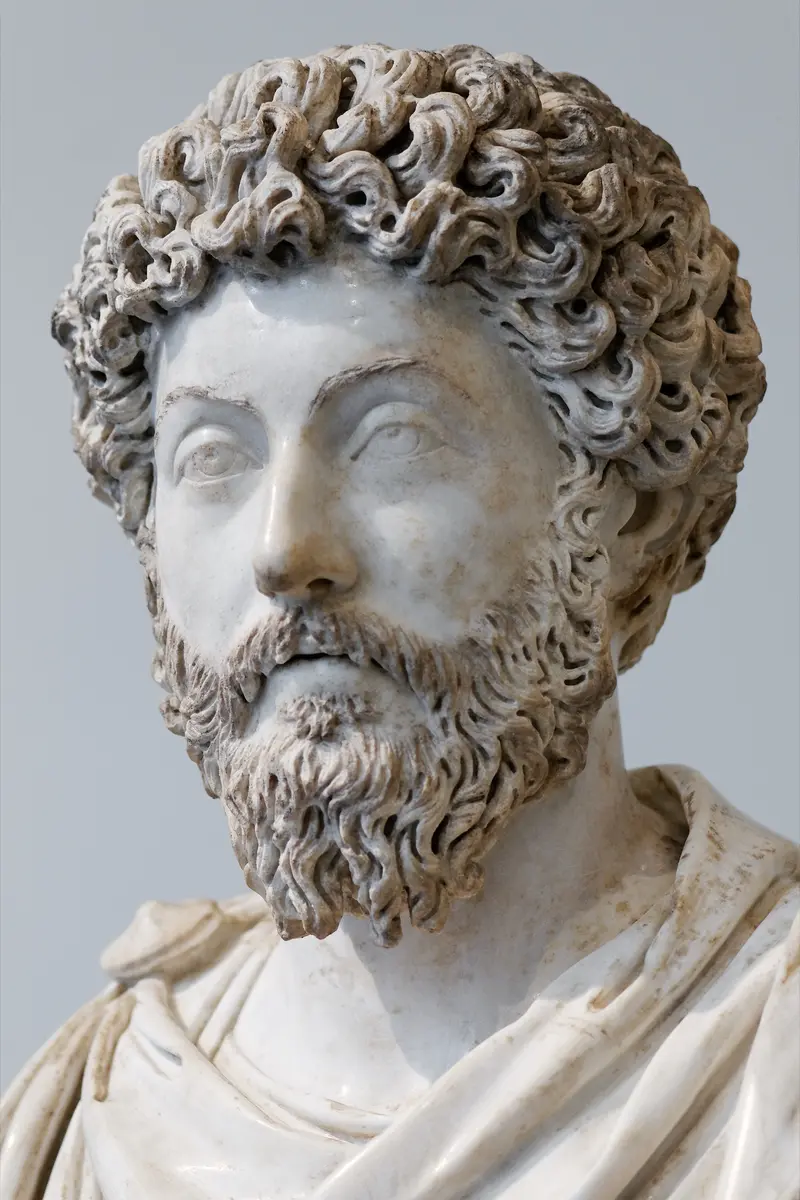
Marcus Aurelius
“Rome's philosopher-emperor (161–180), who spent most of his reign at war on the Danube and wrote the Meditations, a private Stoic notebook on duty, reason and calm.”
Marcus Aurelius was emperor of Rome from 161 to 180, and the only Roman ruler remembered first of all as a philosopher. He was born in Rome on 26 April 121 into a rich family of Spanish origin with close ties to the court; his father died when he was small, and his grandfather, who held the consulship three times, brought him up. The emperor Hadrian noticed the serious boy and, playing on the family name Verus, called him Verissimus, 'the most truthful'. In February 138, after his first choice of heir had died, Hadrian adopted Antoninus, the husband of Marcus's aunt, on condition that Antoninus in turn adopt Marcus, not yet seventeen, and the seven-year-old Lucius Verus.
For twenty-three years Marcus learned the work of an emperor at Antoninus's side. He was consul in 140 and 145, married the emperor's daughter Faustina in 145, and in 147 received the main formal powers of an emperor. His teacher of Latin oratory, Fronto, wrote to him for decades, but in his twenties Marcus turned away from rhetoric to philosophy, above all to the Stoic teaching of Epictetus, a former slave whose recorded lectures his teacher Junius Rusticus lent him. When Antoninus died on 7 March 161, Marcus insisted that Lucius share the throne with equal powers: for the first time Rome had two emperors.
His reign was one long emergency. A war with Parthia over Armenia (161–166) was won by Lucius's generals, but the returning army brought back a plague, probably smallpox, that spread through the empire for years. Then Germanic and Sarmatian peoples broke across the Danube, and some reached Italy and laid siege to Aquileia. After Lucius died in 169, Marcus, who had never commanded an army, spent most of his last eleven years in camps on the Danube, at Carnuntum and elsewhere, and sold the palace treasures to pay for the war; a sudden storm that saved a thirsty army in the land of the Quadi was remembered as a miracle. In 175 he put down the revolt of his general Avidius Cassius without taking revenge, toured the East, lost Faustina, and was initiated into the Mysteries at Eleusis; in 177 he made his son Commodus his co-emperor. He died on campaign on 17 March 180, at Vindobona (Vienna) or Sirmium, with victory in reach; Commodus made peace and went back to Rome.
In the camps he kept a notebook in Greek, written only for himself. Its twelve books remind him again and again that the universe is one ordered whole guided by reason, that only virtue is good, that anger, fame and comfort are worth nothing, that death is natural, that all people are related, and that he must get up each morning and do the work he was born for. One book ends 'Among the Quadi at the Granua', the next 'This in Carnuntum'. No one is known to have mentioned the notebook for nearly two centuries after his death; it survived in Byzantine copies, was first printed in Greek and Latin at Zurich in 1558 from a manuscript since lost, and has been called the Meditations since Meric Casaubon's English translation of 1634.
To later centuries he became the model of the good ruler, the last of the 'Five Good Emperors'. The historian Cassius Dio wrote that with his son's accession Rome's history went 'from a kingdom of gold to one of iron and rust', and Edward Gibbon called him 'that philosophic monarch'. Modern historians are cooler: Christians were put to death at Lyon in 177 while he ruled, his wars drained the treasury, and he left the empire to Commodus, one of Rome's worst emperors. His gilded bronze statue on horseback is the only one of its kind to survive from antiquity, because in the Middle Ages the rider was taken for Constantine, the first Christian emperor, and his column still stands in Piazza Colonna in Rome. The Meditations, one of the most quoted books of ancient philosophy, are read today as a practical guide to keeping calm, duty and perspective under pressure.
What happened
- 121
Born in Rome, in a villa on the Caelian Hill, into a rich family of Spanish origin; first called Catilius Severus after his mother's grandfather, he grows up as Marcus Annius Verus. His father dies when he is small, and his grandfather, consul for the second time this year, raises him.
The Caelian Hill, Rome: born here on 26 April 121- 133
At twelve, the story goes, he takes up the rough Greek cloak of a philosopher and sleeps on the ground, until his mother persuades him to use a couch spread with skins. Hadrian, who has taken an interest in him, plays on his name and calls him Verissimus, 'the most truthful'.
- 136
Hadrian names Lucius Ceionius Commodus as his heir, and the young Marcus is engaged to Ceionia Fabia, the heir's daughter.
- 138
Lucius Aelius having died, Hadrian adopts Antoninus, the husband of Marcus's aunt, who in turn adopts Marcus, not yet seventeen, and Lucius's seven-year-old son Lucius Verus. Marcus becomes Marcus Aelius Aurelius Verus.
Hadrian dies and Antoninus, now called Pius, becomes emperor. Marcus's engagement is broken off and he is promised to Antoninus's daughter Faustina instead.
- 139
Made quaestor and named Caesar, the heir to the throne; he moves into the imperial residence on the Palatine, the House of Tiberius, where he will live beside his adoptive father for twenty-three years.
- 140
Consul for the first time, at eighteen, with Antoninus as his colleague.
- 145
Consul for the second time; he marries Faustina, his cousin and the emperor's daughter. Their marriage lasts thirty years and produces at least twelve children.
- 146
About now he writes to his teacher Fronto that reading the Stoic Aristo of Chios has filled him with joy and with shame at his own faults: he turns from rhetoric to philosophy, and above all to the teaching of Epictetus, whose recorded lectures his teacher Junius Rusticus lends him.
- 147
After the birth of his first daughter, Antoninus gives him the tribunician power and the imperium, the main formal powers of an emperor: from now on he is a kind of junior co-emperor.
- 161
Antoninus Pius dies, giving the watchword 'Equanimity'. Marcus becomes emperor as Marcus Aurelius Antoninus and insists that Lucius Verus be made emperor with him with equal powers: for the first time Rome has two emperors.
Faustina gives birth at Lanuvium to twin sons, Titus Aurelius Fulvus Antoninus, who dies at four, and Commodus, the future emperor.
- 162
The Parthian king Vologases has invaded Armenia and beaten the Roman armies; Lucius leaves for the East to lead the war, while Marcus governs from Rome. The fighting is done by generals such as Avidius Cassius, who take Seleucia and Ctesiphon.
- 165
A plague, probably smallpox, breaks out among the army in the East; the returning soldiers spread it across the empire, and it reaches Rome in 167.
- 166
Parthia defeated, the two emperors celebrate a triumph in Rome and add the titles Parthicus and Medicus to the Armeniacus taken in 164; Marcus's young sons Commodus and Annius Verus are named Caesars.
- 168
With Germanic peoples pressing across the Danube, Marcus and Lucius set out together for the northern frontier and stay at Aquileia, at the head of the Adriatic.
- 169
On the way back to Rome, Lucius dies of a stroke at Altinum, in the carriage beside Marcus, who brings the body to Rome. Marcus now rules alone.
Short of money and soldiers, he auctions the palace treasures in the Forum of Trajan, gold and crystal goblets and even his wife's silk robes among them, raises two new legions and arms slaves and gladiators for the war.
- 171
From 171 to 173 he directs the war from Carnuntum, the legionary base on the Danube east of Vienna. In his camps he keeps a notebook in Greek, written for himself alone; one of its books ends 'This in Carnuntum', the one before it 'Among the Quadi at the Granua'.
Carnuntum, on the Danube: his headquarters from 171 to 173, where he wrote part of the Meditations - 172
He takes the title Germanicus. In the land of the Quadi, a Roman army surrounded and dying of thirst is saved by a sudden storm: the rain miracle, later carved on his column.
- 175
He forces the Iazyges to terms and takes the title Sarmaticus. Then news comes that Avidius Cassius, commander of the East, has proclaimed himself emperor on a rumour of Marcus's death; Cassius is soon killed by his own soldiers, and Marcus sets out for the East with Faustina and the young Commodus.
In the winter, at Halala in the Taurus mountains of Cappadocia, Faustina dies; he renames the town Faustinopolis and gives it a temple in her honour. He asks the Senate to put none of Cassius's supporters to death and has the rebels' letters burned unread.
- 176
After Syria and Egypt he comes to Athens, is initiated into the Mysteries of Eleusis, as Hadrian had been, and endows chairs of philosophy at Athens for the four schools: Platonist, Aristotelian, Stoic and Epicurean.
The sanctuary of Demeter at Eleusis: initiated into the Mysteries here in 176Back in Rome, he celebrates a triumph over the Germans and Sarmatians with Commodus, who had been acclaimed imperator with him on 27 November; the emperor runs on foot beside his son's chariot.
- 177
He makes the teenage Commodus co-emperor with the title Augustus, and consul. In the same year Christians are put to death at Lyon after a local outcry, under the existing law, which he leaves to run its course.
- 178
With war flaring again on the Danube, he leaves Rome with Commodus for his second northern campaign, after hurling the blood-stained spear from the temple of Bellona towards enemy country.
- 180
Dies in camp after an illness, probably at Vindobona (Vienna), perhaps at Sirmium, aged fifty-eight, having commended Commodus to his friends and the army. To the officer who asked for the watchword he said, 'Go to the rising sun; I am already setting.' His ashes are laid in Hadrian's mausoleum in Rome; Commodus makes peace and goes home.
Vindobona (Vienna): his headquarters in the last war, and probably where he died on 17 March 180