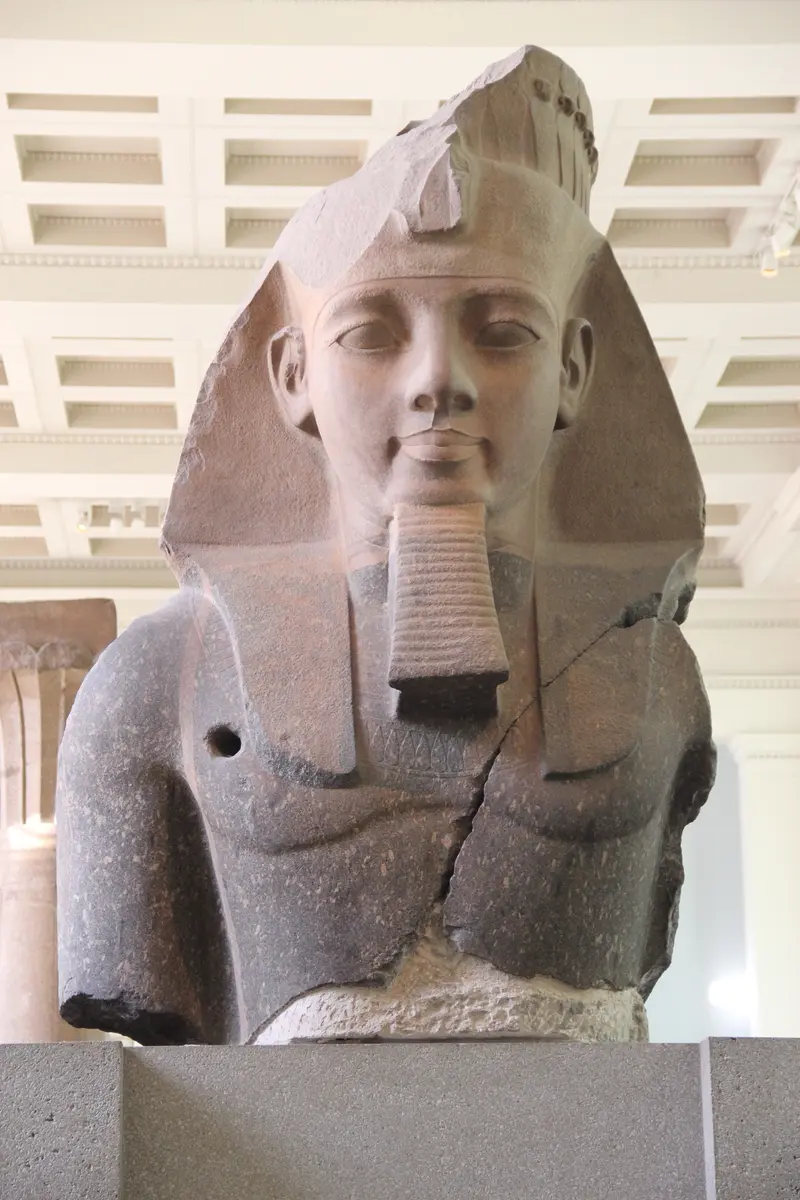
Ramses II
“Egypt's longest-reigning great pharaoh: he fought the Hittites to a draw at Kadesh, signed the oldest surviving peace treaty, carved his colossi at Abu Simbel and ruled sixty-six years, dying in 1213 BCE at about ninety.”
Ramses II, whom later Egyptians called the Great Ancestor and the Greeks Ozymandias, was born about 1303 BCE into a family of soldiers from the eastern Nile Delta, not into a royal house. His grandfather, a vizier and army officer, was made king by Horemheb, who named him his successor, as Ramses I; his father Seti I then ruled for about a decade and groomed the boy from the start, giving him the rank of captain at ten, a household and harem of his own as prince regent in his teens, and a place beside him on campaign. When Seti died in 1279 BCE, by the usual chronology, Ramses came to the throne at about twenty-five already knowing both kingship and war. He kept it for sixty-six years, the longest reign of the New Kingdom and one of the longest in Egyptian history.
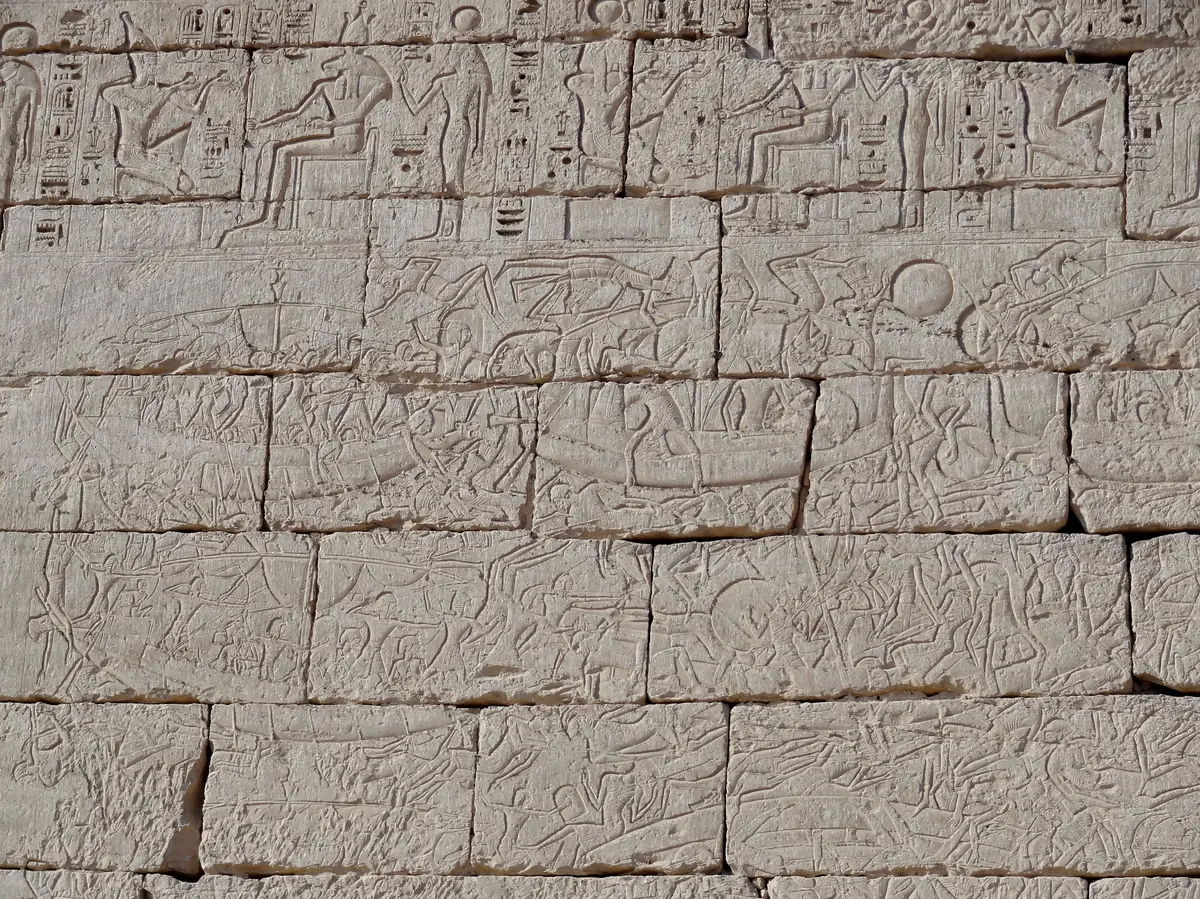
The first half of the reign was spent trying to win back Egypt's empire in Syria from the Hittites of Anatolia. In his fifth year, about 1274 BCE, he marched four divisions to Kadesh on the Orontes, was fooled by two Hittite spies into believing the enemy was far away at Aleppo, and was caught in camp by 2,500 Hittite chariots. He fought his way out with his household troops until a second Egyptian force arrived, held the field, and could not take the city. He called it a great victory and had the story carved and painted on temple walls from the Delta to Nubia, which is why Kadesh is the best-recorded battle of the ancient world. Sixteen more years of campaigning changed little. In his twenty-first year, about 1259 BCE, he and the new Hittite king Hattusili III agreed a treaty of peace and mutual defence between equal great powers, written in Egyptian at Karnak and in Akkadian on clay at Hattusa: the oldest peace treaty whose text survives on both sides, and a copy hangs at the United Nations. Thirteen years later he married a Hittite princess.
No pharaoh built more. He finished his father's temples at Abydos and the great hypostyle hall at Karnak, raised a new capital, Pi-Ramesses, among the gardens and orchards of the eastern Delta, and gave Thebes his own temple of a million years, the Ramesseum, with a seated statue of himself a thousand tonnes in weight. At Abu Simbel in Nubia his workmen cut two temples into the sandstone cliff: the greater fronted by four seated colossi of the king twenty metres high, the smaller dedicated to the goddess Hathor and to his favourite wife Nefertari, 'the one for whom the sun shines', who died about the thirtieth year of the reign and was buried in the finest tomb of the Valley of the Queens. He also put his name on the monuments of earlier kings, and colossal statues of him stand or lie from Memphis to the far south. Over the years he celebrated thirteen or fourteen jubilee festivals, more than any other pharaoh, and in his lifetime he was worshipped as a god.
He had some two hundred wives and concubines and over a hundred children, and he outlived most of them, including his fourth son Khaemwaset, the high priest of Ptah at Memphis who restored the pyramids of Saqqara and is sometimes called the first Egyptologist. When he died in his sixty-seventh regnal year, 1213 BCE, aged about ninety, with worn teeth, hardened arteries and a stooped, arthritic back, his son Merneptah succeeded him. He was buried in tomb KV7 in the Valley of the Kings; when the valley's tombs were robbed in the next century, priests moved his body from hiding place to hiding place until it came to rest in a cliff shaft at Deir el-Bahari with some fifty other royal mummies. A local family found that cache about 1871 and sold from it quietly until the Antiquities Service emptied it in July 1881. His mummy, red-haired and hook-nosed, was unwrapped in Cairo in 1886, flown to Paris with military honours for treatment against fungus in 1976, and carried through Cairo again in the Pharaohs' Golden Parade of 2021 to the National Museum of Egyptian Civilization.
Within a few decades of his death the Bronze Age world he had dominated began to fall apart, the Hittite empire with it, and nine kings of the next dynasty took his name in the hope of sharing his luck. Modern Europe met him through a fallen colossus: the head and shoulders of one of the Ramesseum statues, hauled to the Nile by Giovanni Belzoni in 1816 for the British Museum, where the news of its coming inspired Shelley's 'Ozymandias'. Belzoni dug the sand from the door of Abu Simbel the next year, and in the 1960s UNESCO's campaign cut both temples into 16,000 blocks and rebuilt them sixty metres up the cliff, above the waters of the Aswan High Dam. The book of Exodus names a city called Raamses, and films have long cast him as the pharaoh of Moses; Egyptologists find no evidence for it, but the association has made him the one pharaoh almost everyone can name.
What happened
- 1303 BCE
Born, by the usual reckoning about 1303 BCE, to the army officer Seti and his wife Tuya, in a family of soldiers from the eastern Delta; his grandfather Ramesses is vizier to the childless king Horemheb.
- 1292 BCE
Horemheb dies and the old vizier, whom he had named his successor, becomes king as Ramesses I, the first of the 19th dynasty; the boy is about eleven.
- 1290 BCE
His father Seti I becomes king and makes him prince regent at about fourteen, with a household and harem of his own; he had held the rank of captain since he was ten, and now rides with his father on campaign in Syria and Nubia.
- 1279 BCE
Seti I dies and Ramses II comes to the throne, on the 27th day of the third month of summer in the Egyptian calendar, usually put at 31 May 1279 BCE; he is about twenty-five. His first act as king is to sail to Thebes for the Opet festival, when Amun travels in his barge from Karnak to Luxor; on the way home he stops at Abydos to restart work on his father's great temple and names Nebwenenef high priest of Amun.
- 1278 BCE
Early in the reign he turns his father's summer palace in the eastern Delta into a new capital, Pi-Ramesses, 'House of Ramses, Great in Victory', with temples to Amun, Seth, Wadjet and the Syrian Astarte in its four quarters, a palace, barracks, docks and workshops for chariots and weapons, close to the road into Asia.
Pi-Ramesses (Qantir), the eastern Delta: the capital he built early in his reign, where he probably died in 1213 BCE - 1276 BCE
Year 4: his first Syrian campaign, to bring the vassal princes of the coast back into line; he takes Amurru from the Hittites and cuts a stela into the rock at the Nahr al-Kalb near Beirut, of which only his name and the date survive.
- 1274 BCE
Year 5: Kadesh. Marching north in four divisions of about 5,000 men each, he is told by two captured spies that the Hittite army is far away at Aleppo, pitches camp before the city, and learns too late that King Muwatalli is hidden behind it with 2,500 chariots. The Hittites break the division of Re and storm the camp; Ramses fights on with his household chariotry until a second Egyptian force arrives from the coast and the Hittites are driven into the Orontes. He holds the field, cannot take Kadesh, agrees a truce and goes home to call it a victory on every temple wall.
Kadesh (Tell Nebi Mend) on the Orontes, Syria: the chariot battle against the Hittites in his fifth year, about 1274 BCE- 1272 BCE
The lost prestige of Kadesh brings revolts in Canaan; from year 7 he campaigns again every year or two, through Edom and Moab, into Galilee and Amurru, and in about year 8 storms the hill town of Dapur in Hittite territory with his sons on the ladders, a scene he has carved in the Ramesseum.
- 1269 BCE
About year 10 he breaks through to Katna and Tunip in central Syria, going into battle without his armour when the Hittites surprise him, and sets up a statue of himself as overlord in Tunip; like his father he cannot hold land so far from Egypt, and the war settles into a stalemate.
- 1264 BCE
Work begins on the two rock temples at Abu Simbel in Nubia, the Great Temple for Amun-Re, Re-Horakhty, Ptah and the deified king himself, the Small Temple for Hathor and Nefertari; the cutting and carving take about twenty years.
Abu Simbel, Nubia: the two rock temples, the great one fronted by four colossi of the king, dedicated about 1255 BCE and moved uphill in 1964-68 - 1259 BCE
Year 21: peace with the Hittites. After the usurper Hattusili III has demanded the return of his exiled nephew and Egypt has refused, the two kings agree a treaty of peace, alliance and mutual defence, each promising to send back the other's fugitives; the Egyptians receive it on a silver tablet on the 21st day of the first month of winter, usually put at 10 November 1259 BCE, and carve it on the wall at Karnak.
- 1255 BCE
The Great Temple of Abu Simbel is dedicated, its four colossi of the king twenty metres high at the door and the sun reaching its innermost shrine twice a year; Ramses and Nefertari travel to Nubia for the inauguration.
Abu Simbel, Nubia: the two rock temples, the great one fronted by four colossi of the king, dedicated about 1255 BCE and moved uphill in 1964-68 - 1250 BCE
Nefertari, his great royal wife since before the accession, dies about the thirtieth year of the reign and is buried in the Valley of the Queens, in the painted tomb now numbered QV66 that Schiaparelli will find in 1904.
- 1249 BCE
Year 30: his first Sed festival, the jubilee that renews a king's strength after thirty years, is proclaimed at Memphis by his son Khaemwaset; he will hold thirteen or fourteen, every two or three years, more than any other pharaoh.
- 1245 BCE
Year 34: Hattusili III's eldest daughter is brought to Egypt to become his wife under the name Maathorneferure, and the marriage is carved on a stela at Abu Simbel; a second Hittite princess may have followed years later.
- 1225 BCE
His fourth son Khaemwaset, high priest of Ptah at Memphis, restorer of the Old Kingdom pyramids at Saqqara and crown prince since about year 50, dies in about year 55; his full brother Merneptah becomes heir to a king now in his late seventies.
- 1213 BCE
Year 67: Ramses II dies at about ninety, probably at Pi-Ramesses, on a day the tomb builders of Thebes later kept as his 'day of sailing', the 6th of the second month of the flood season, in late July or August 1213 BCE; his body, worn by arthritis and an abscessed jaw, is embalmed over seventy days and buried in tomb KV7 in the Valley of the Kings, and Merneptah is king.
KV7, the Valley of the Kings: his tomb, from which the priests later moved his body to the cache at Deir el-Bahari, found in 1881