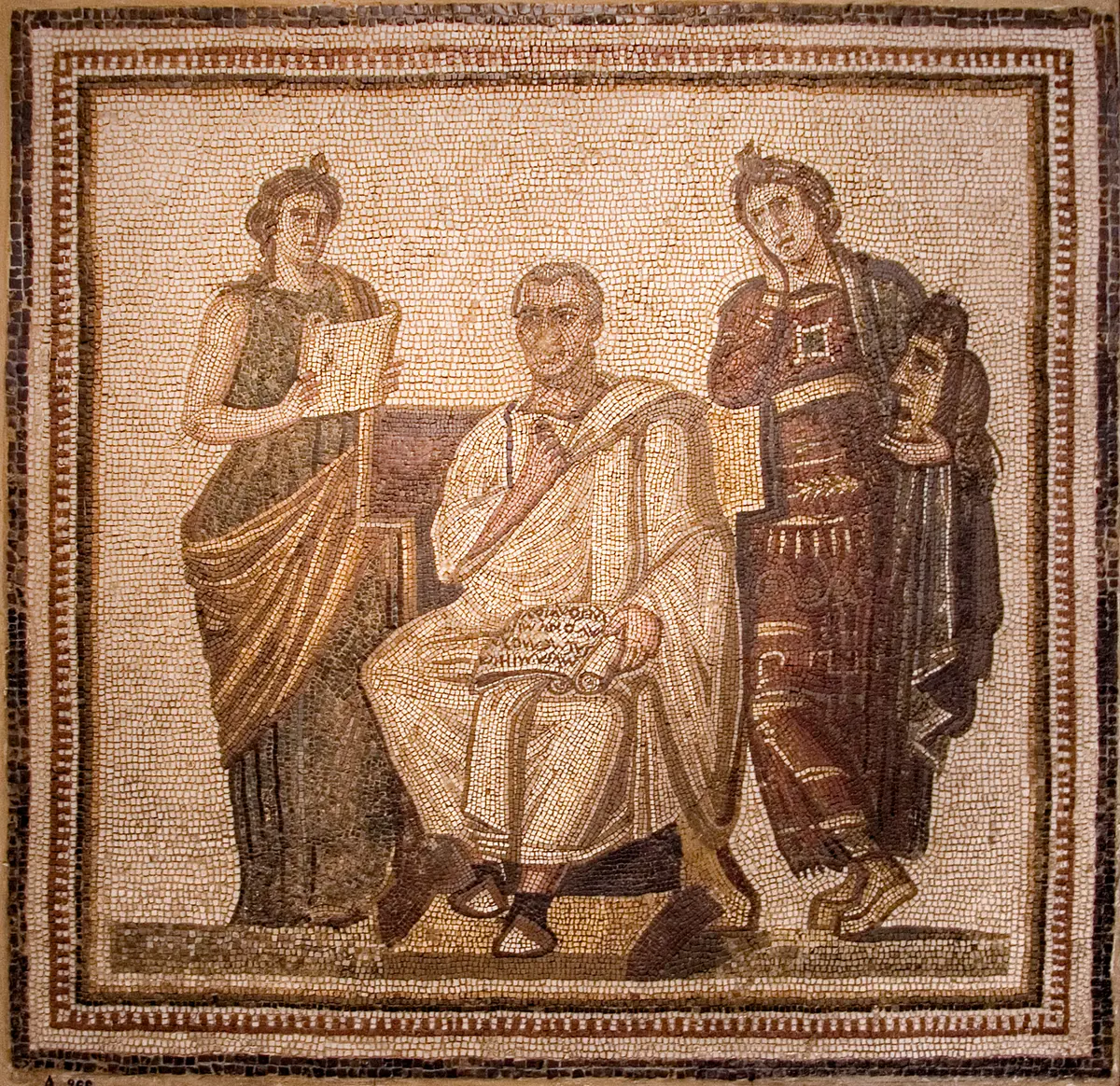
Virgil
“Rome's greatest poet: the Eclogues, the Georgics and the Aeneid, the epic of Aeneas and the founding of Rome, written for the age of Augustus and left unfinished at his death.”
Virgil (Publius Vergilius Maro) was the poet the Romans themselves thought their greatest, and the author of the Aeneid, the epic of Rome's beginnings. He was born on 15 October 70 BCE at Andes, a village near Mantua in the plain of the Po, to a family of modest means; the ancient Life that goes back to Suetonius says his father was a potter, or a hired man who grew rich by buying woodland and keeping bees. The boy was sent to school at Cremona, then Milan, then Rome, and later studied in Naples with the Epicurean philosopher Siro. He was shy, often ill, never married and never held office; the one time he spoke in court he did badly, and in Naples people called him 'the Virgin'. His whole life went into poetry.
He grew up in the last years of the Republic. He was twenty when Caesar crossed the Rubicon, and after Caesar's murder the civil wars reached his own fields: in 41 BCE, after the battle of Philippi, the triumvirs settled their veterans on confiscated land around Cremona and Mantua, and the farm of Virgil's family seems to have been among the losses. The ten short pastoral poems of the Eclogues (about 42 to 37 BCE), written in the manner of the Greek poet Theocritus, turn that world into song: shepherds who sing of love and of farms taken from them, and in the fourth poem a child whose birth will bring back the golden age, a prophecy the Middle Ages read as a forecast of Christ. The poems made him famous, and they brought him into the circle of Maecenas, the rich Etruscan who found and supported poets for Octavian, the future Augustus. Horace, his contemporary and friend, belonged to the same circle.
The Georgics, four books on farming, took him seven years, written mostly in Naples, and were finished about 29 BCE; he read them to Octavian over four days at Atella, in the summer after the victory at Actium, with Maecenas taking over when his voice gave out. The poem teaches ploughing, vines, cattle and bees, but its real subject is Italy itself and the hope that a land emptied by war could be farmed and at peace again. Then he began the Aeneid, which was to occupy the rest of his life: the story of the Trojan prince Aeneas, who escapes the burning of Troy carrying his father on his back, loves and leaves Dido, queen of Carthage, visits the underworld, and fights his way to a new home in Italy, where his descendants will found Rome. Virgil set it against both of Homer's poems, an Odyssey of wandering in the first half and an Iliad of war in the second, and filled it with prophecies that run forward to Augustus's own time. Augustus pressed him for a draft from his camp in Spain; about 23 BCE Virgil read him books two, four and six, and when he reached the lines on the emperor's nephew Marcellus, who had just died, Marcellus's mother Octavia fainted.
In 19 BCE, at fifty, he sailed for Greece, meaning to spend three years revising the poem and then give the rest of his life to philosophy. At Athens he met Augustus on his way home from the East and decided to turn back with him; he fell ill in the heat at Megara, grew worse on the crossing, and died at Brundisium (Brindisi), the port at the end of the Appian Way, on 21 September. His bones were taken to Naples and buried outside the city on the road to Puteoli, where a Roman tomb is still shown as his. He had asked his friend Varius to burn the Aeneid if anything happened to him, and on his deathbed asked for the manuscript so that he could burn it himself; nobody would hand it over. Augustus ordered Varius and Plotius Tucca to publish it with only light correction, which is why about sixty of its lines are still unfinished half-lines.
The Aeneid became the Romans' national poem at once and a school text for as long as Latin was taught, and it has never gone out of reach: late antique illustrated copies of it survive in the Vatican, a Roman villa in Somerset had the story of Dido and Aeneas laid in its bath floor, Dante made Virgil his guide through Hell and Purgatory, Petrarch had Simone Martini paint the frontispiece of his own copy, and the first book printed in italic type, in Venice in 1501, was a Virgil. The lines on Rome's mission, to spare the conquered and war down the proud, and the 'tears in things' of the first book have been quoted for two thousand years.
What happened
- 70 BCE
Born at Andes, a village near Mantua in the plain of the Po, on the ides of October in the consulship of Pompey and Crassus, to parents of modest means; the ancient Life makes his father a potter, or a hired man who bought woodland and kept bees.
Andes (Pietole), near Mantua: born here on 15 October 70 BCE- 55 BCE
At fifteen he takes the toga of manhood at Cremona, where he has been at school, on the day, the Life says, the poet Lucretius died; he goes on to Milan, then to Rome, for rhetoric and philosophy, and later to Naples and the Epicurean teacher Siro.
- 49 BCE
He is twenty when Caesar crosses the Rubicon and the civil wars begin that will last until Actium; he takes no part in them, or in public life, and speaks only once in court, without success.
- 41 BCE
After the victory at Philippi the triumvirs settle their veterans on land taken from the towns north of the Po, Cremona and Mantua among them. Virgil's family farm seems to have been lost; his friends Pollio, Varus and Gallus intervene for him, and the first and ninth Eclogues sing the sorrow of the dispossessed.
Andes (Pietole), near Mantua: born here on 15 October 70 BCE - 40 BCE
The fourth Eclogue foretells the birth of a child who will bring back the golden age, most likely an expected child of Antony and Octavia in the year of their marriage; the Middle Ages will read it as a prophecy of Christ.
- 37 BCE
The ten Eclogues, begun about 42 in the manner of Theocritus, are complete and are a success: singers perform them on the stage. They bring him into the circle of Maecenas, Octavian's adviser and the patron of poets, in which Horace is enrolled early in 38.
- 29 BCE
The Georgics, four books on farming dedicated to Maecenas and written over seven years, mostly at Naples, are finished; in the summer after Actium he reads them to Octavian over four days at Atella in Campania, Maecenas reading on whenever his voice fails.
Naples: his home for most of his writing life, and his burial place on the road to PuteoliHe begins the Aeneid, planned as the equal of both Homeric poems, the wanderings of Aeneas from Troy and his war in Italy, and as the story of the origin of Rome and of Augustus; in August Octavian celebrates three triumphs and closes the gates of Janus for peace. Virgil drafts the poem in prose first, in twelve books, and works on whichever part takes him.
- 26 BCE
Augustus, away at the war in Cantabria in northern Spain, writes to him with threats and entreaties asking to be sent 'the first sketch of the Aeneid, or the first sentence, it does not matter which'. The poet Propertius has already announced that something greater than the Iliad is being born.
- 23 BCE
Marcellus, Augustus's nephew and son-in-law, dies at nineteen. About now Virgil reads three books of the Aeneid, the second, fourth and sixth, to Augustus and his sister Octavia; at the lines on her son in the sixth book, 'you shall be Marcellus', she faints.
Rome: schooled here, later a house on the Esquiline beside the gardens of Maecenas, where he read the Aeneid to Augustus - 19 BCE
In his fifty-second year, with the poem drafted, he sails for Greece and Asia meaning to spend three years on revision and the rest of his life on philosophy. At Athens he meets Augustus on his way home from the East and decides to return with him; sightseeing at Megara in the late-summer heat, he falls ill.
Athens: met Augustus here in 19 BCE, on the voyage meant for three years of revising the AeneidWorse after the crossing, he dies at Brundisium a few days after landing, on 21 September. His bones are carried to Naples and buried on the road to Puteoli; the epitaph says 'Mantua bore me, Calabria took me, now Naples holds me: I sang of pastures, fields and leaders'. He had asked Varius to burn the Aeneid and on his deathbed called for the manuscript to burn it himself; Augustus orders Varius and Tucca to publish it instead, its unfinished lines left as they stand.
Brundisium (Brindisi): died here on 21 September 19 BCE, back from Greece