Augustus
“Caesar's adopted heir, who won Rome's civil wars at Actium and, as Augustus, turned the Republic into a monarchy in republican dress: the first Roman emperor.”
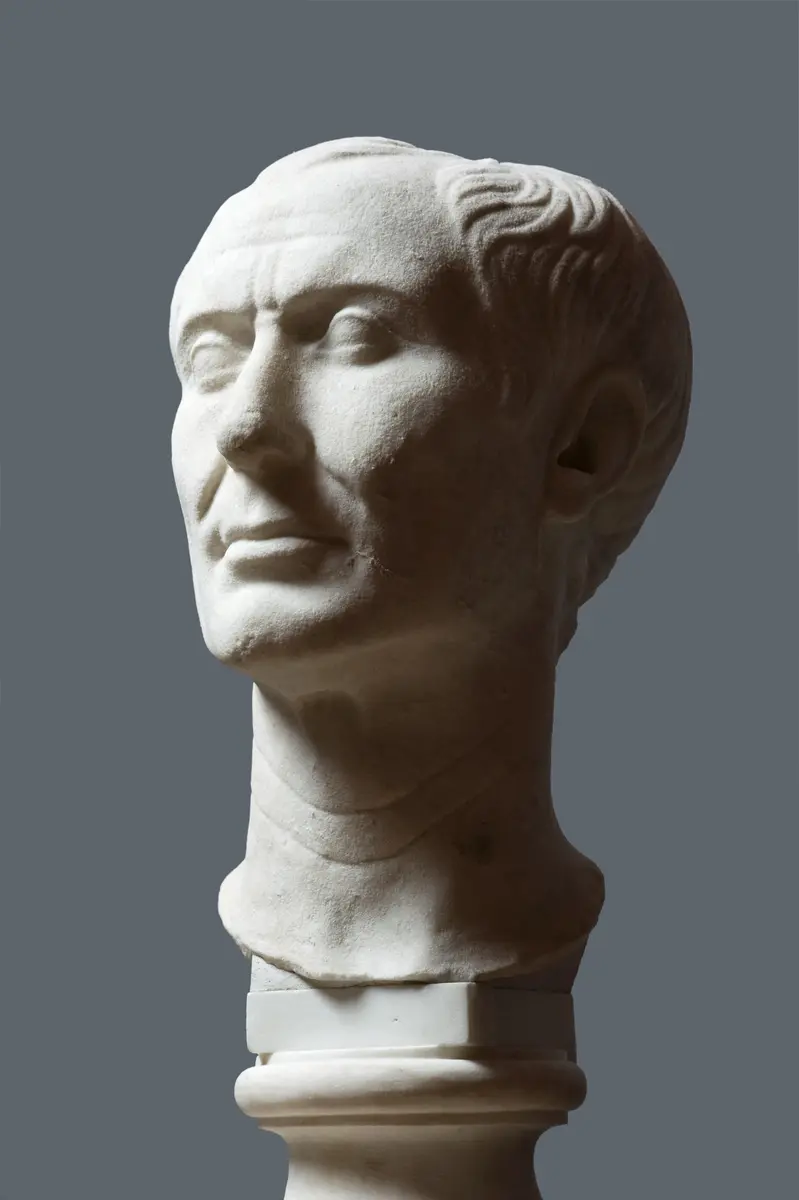
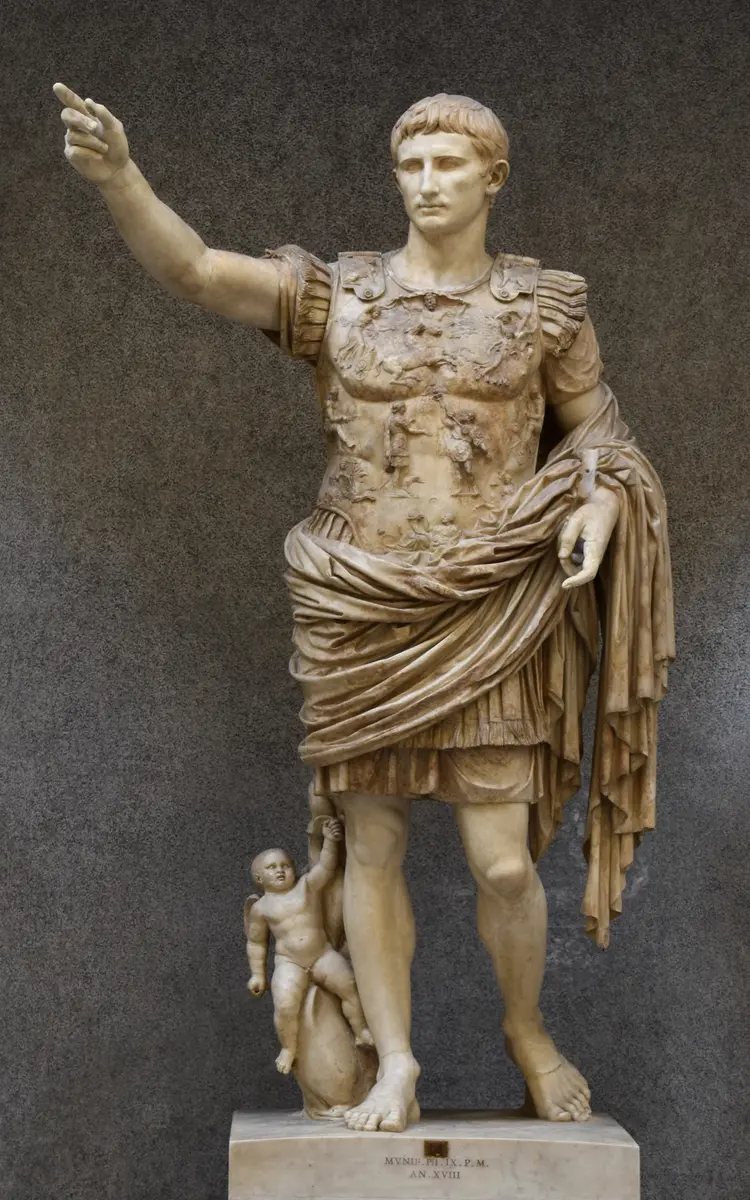
Augustus was the first Roman emperor. He was born Gaius Octavius in Rome on 23 September 63 BCE, the son of a senator from the small town of Velitrae and of Atia, a niece of Julius Caesar, and it was Caesar who launched him: the boy gave the funeral speech for his grandmother Julia at twelve, took part in Caesar's triumph in 46 and followed him to Spain in 45. In March 44 he was studying at Apollonia, across the Adriatic, when Caesar was murdered. Caesar's will made the eighteen-year-old his adopted son and chief heir. Against his family's advice he took up the inheritance and the name that came with it, and from then on called himself simply Caesar; historians call him Octavian until 27 BCE.
The next fourteen years were civil war. At nineteen he raised a private army from Caesar's veterans, which the Senate, led by Cicero, made legal so that he could fight Mark Antony; then he turned on the Senate, took the consulship by force, and in November 43 joined Antony and Lepidus as triumvirs, a junta that began by killing its enemies, Cicero among them. At Philippi in October 42 Antony and he destroyed Brutus and Cassius, Caesar's murderers. Antony took the East and Octavian the West. With his friend Agrippa as admiral he beat Sextus Pompey at Naulochus in 36 and pushed Lepidus aside. His rivalry with Antony, now Cleopatra's partner, ended in war: on 2 September 31 Agrippa's fleet won at Actium, and in August 30 Octavian took Alexandria, where Antony and Cleopatra killed themselves. Egypt became a Roman province, and he was the last man standing.
He spent the next forty-four years making one-man rule look like a restored republic. In January 27 BCE he handed his powers back to the Senate, was given command of the provinces where most of the legions stood, and received a new name, Augustus, 'the revered one'. Consuls, Senate and elections went on, but from 23 BCE he held a tribune's powers and a command that overrode every governor's, and the army, now 28 standing legions paid and pensioned by him alone, swore its oath to him. He called himself princeps, the first citizen. Inside the frontiers came the Pax Romana: the Parthians gave back the standards lost by Crassus in 20 BCE without a battle, and Spain, the Alps and the Danube lands were conquered, though three legions were lost in Germany under Varus in 9 CE. Suetonius says he found Rome a city of brick and left it a city of marble; Virgil, Horace and Livy wrote in his Rome.
What he could never settle was who came next. He had one child, his daughter Julia, and the heirs he chose died one after another: his nephew Marcellus, his friend Agrippa, his grandsons Gaius and Lucius. In 4 CE he adopted his stepson Tiberius, the son of his wife Livia. Augustus died at Nola on 19 August 14 CE, a month short of seventy-six, and Tiberius took over without a fight. His own account of his deeds, the Res Gestae, was set up in bronze outside his Mausoleum, and the Senate made him a god. Every later emperor took his name, the month of August still carries it, and the system he built held the Mediterranean world together for centuries. Jesus was born in his reign.
What happened
- 63 BCE
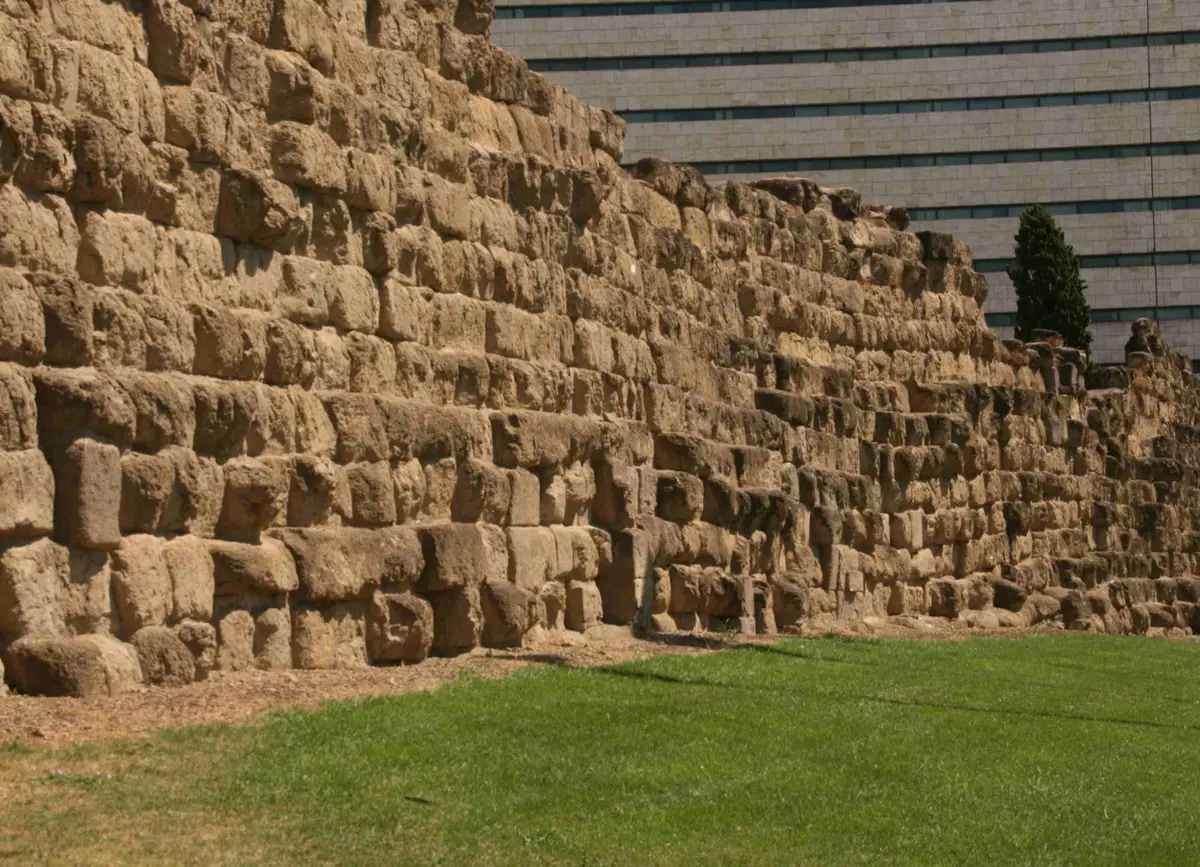
Born Gaius Octavius in Rome, in the Palatine quarter, to Gaius Octavius, a senator from Velitrae, and Atia, the daughter of Julius Caesar's sister Julia.
The Palatine, Rome: born in this quarter in 63 BCE, and his home for forty years- 59 BCE
His father dies; he grows up with his mother and his stepfather, Lucius Marcius Philippus.
- 51 BCE
At twelve he gives the funeral speech for his grandmother Julia, Caesar's sister: his first appearance in public.
- 46 BCE
He takes part in Caesar's triumphal procession and is given military honours; the next year he follows Caesar to the war in Spain.
- 44 BCE
Studying at Apollonia across the Adriatic when Caesar is murdered on 15 March, he learns that the will adopts him as son and chief heir. He sails for Italy, takes up the inheritance against his family's advice, and calls himself Caesar.
Apollonia, Illyria (Albania): studying here when Caesar was murdered, March 44 BCE- 43 BCE
The Senate, led by Cicero, makes legal the private army of Caesar's veterans he raised at nineteen, and sends him against Mark Antony; the Res Gestae opens with that army.
Antony is beaten in two battles around Mutina and flees over the Alps; both consuls are killed. That summer Octavian marches on Rome with his legions and is made consul at nineteen.
A law makes him, Antony and Lepidus triumvirs for five years. Their proscription lists follow: hundreds of senators and knights are killed, Cicero among the first.
- 42 BCE
Julius Caesar is declared a god of the Roman state, and Octavian becomes 'son of the god'; his coins of these years show him bearded in mourning beside the deified Caesar.
At Philippi in Macedonia, in two battles some weeks apart, Antony and Octavian destroy the armies of Brutus and Cassius, who kill themselves; Antony leads, Octavian is ill.
Philippi, Macedonia: the double battle against Brutus and Cassius, October 42 BCE- 40 BCE
After starving out Antony's brother in Perusia, he makes peace with Antony at Brundisium: Antony keeps the East, Octavian the West, and Antony marries Octavian's sister Octavia.
- 38 BCE
He marries Livia Drusilla, already the mother of Tiberius and pregnant with her second son, Drusus, born that April; she will be at his side for more than fifty years.
- 36 BCE
Agrippa destroys the fleet of Sextus Pompey at Naulochus off Sicily; the third triumvir, Lepidus, is pushed aside the same year.
- 32 BCE
He reads Antony's will to the Senate, Italy swears an oath to him, and Rome declares war on Cleopatra.
- 31 BCE
At Actium, off western Greece, Agrippa's fleet defeats Antony and Cleopatra, who break out and flee to Egypt; Antony's legions go over to Octavian.
Actium: his camp above the strait and its victory monument, after the battle of 2 September 31 BCE- 30 BCE
Antony's fleet and cavalry desert him before Alexandria; he and Cleopatra kill themselves, Caesarion is executed, and Egypt becomes a Roman province.
- 29 BCE
Back in Rome he celebrates three triumphs on three days, for Dalmatia, Actium and Egypt, and the doors of the temple of Janus are closed as a sign of peace.
- 27 BCE
Three days after handing his powers back to the Senate, he is given command of the main armed provinces and the name Augustus; laurels are set on the doorposts of his house.
- 23 BCE
Gravely ill, he hands his signet ring to Agrippa. He recovers, gives up the consulship and takes tribunician power and a command over every province; his nephew and son-in-law Marcellus dies at nineteen.
- 20 BCE
By treaty, without a battle, the Parthian king Phraates IV hands back the standards lost by Crassus at Carrhae in 53 BCE.
- 17 BCE
He holds the Secular Games to open a new age, and adopts his grandsons Gaius and Lucius, the sons of Agrippa and his daughter Julia.
- 12 BCE
After Lepidus's death he is elected pontifex maximus, Rome's chief priest; later that year Agrippa dies.
- 9 BCE
The Altar of Augustan Peace, voted four years before on his return from Spain and Gaul, is dedicated on the Field of Mars.
- 2 BCE
The Senate, the knights and the people name him Father of his Country. The same year he dedicates his forum and the temple of Mars the Avenger, and exiles his daughter Julia.
- 4
With Lucius dead in 2 CE and Gaius in 4, he adopts his stepson Tiberius as his heir and has him adopt his nephew Germanicus.
- 9
In the Teutoburg Forest the Germans under Arminius destroy three legions under Quinctilius Varus; Suetonius says Augustus beat his head against a door, crying 'Varus, give me back my legions!'
- 14
He dies at Nola in Campania, a month short of seventy-six; Tiberius succeeds. His body is carried to Rome and laid in the Mausoleum, the Res Gestae is set up beside it, and the Senate makes him a god.
Nola, Campania: where he died on 19 August 14 CE