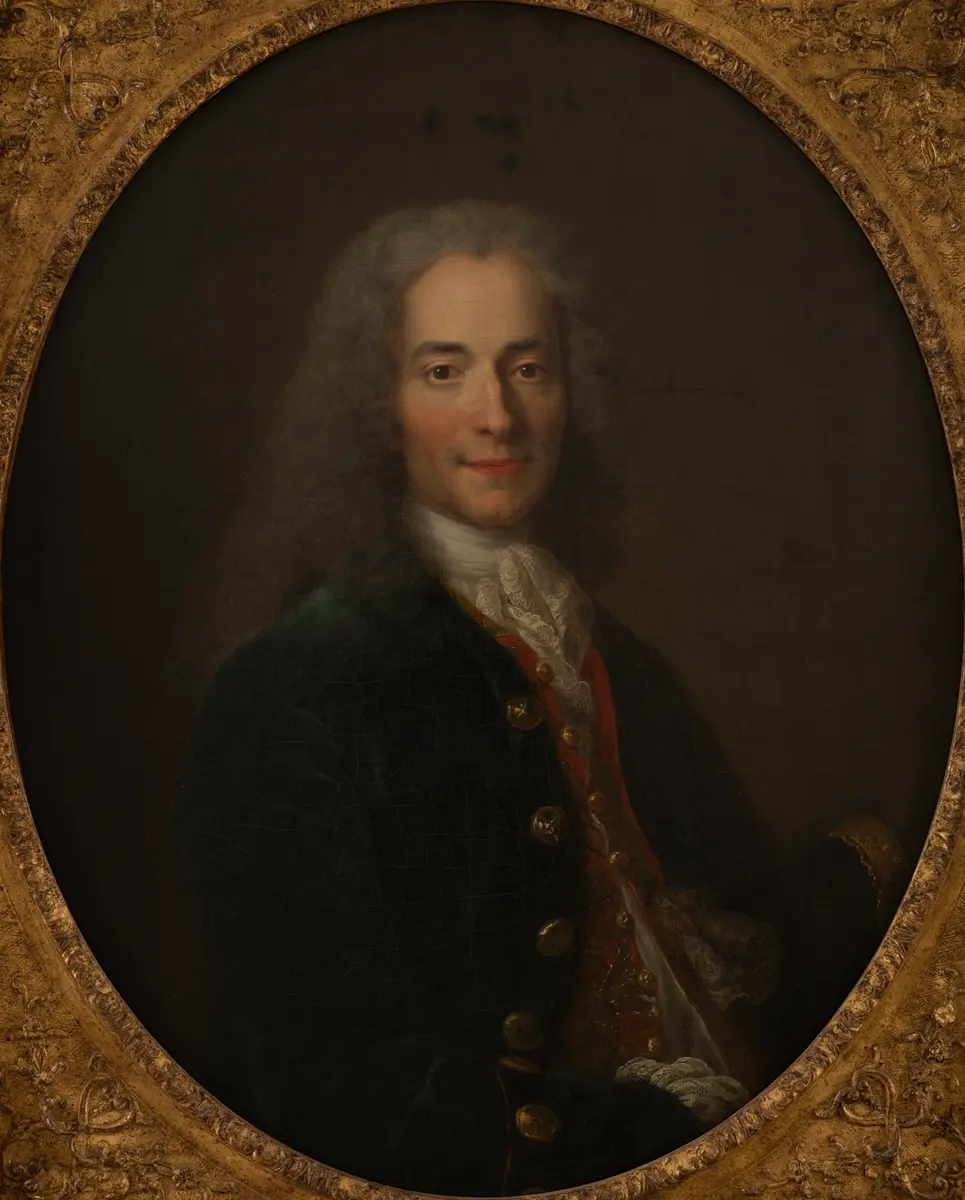
Voltaire
“The French writer of Candide and the Philosophical Letters who made the Enlightenment a public fight against intolerance: 'Écrasez l'infâme'.”
Voltaire was the pen name of François-Marie Arouet (1694–1778), the French poet, playwright, historian and pamphleteer who, more than anyone, turned the Enlightenment into a public fight. He wrote in almost every form, under some 175 false names, and sent about 20,000 letters, but he is remembered for a few books: the Philosophical Letters of 1734, which held up English tolerance, Locke and Newton as a lesson for France; Candide (1759), a short comic novel that laughs at the belief that all is for the best; and the Treatise on Tolerance (1763). His motto, 'Écrasez l'infâme', 'crush the infamous thing', meant the intolerance of the established Church.
He was born in Paris on 21 November 1694 (he liked to claim February), the son of a well-off notary who became an official of the royal audit office, and was taught by the Jesuits at the Collège Louis-le-Grand. Refusing the career in law his father wanted, he became the wit of Regency society, and verses against the regent cost him eleven months in the Bastille in 1717–18. He came out to a triumph: his tragedy Œdipe made him famous, and he took the name Voltaire, probably an anagram of 'Arouet l(e) j(eune)'. In 1726 a nobleman, the chevalier de Rohan, had his servants beat him with sticks for answering an insult; Voltaire wanted a duel and was sent back to the Bastille, then into exile in England. There he learned English, met Pope and Swift, saw Newton buried, and decided that English freedom explained why England led in science.
The book he made of it, published in London in 1733 and in France in 1734 as the Lettres philosophiques, was condemned and burned. To escape arrest he fled to Cirey in Champagne, the château of Émilie du Châtelet, a brilliant mathematician, and for fifteen years they studied together: he explained Newton's physics to French readers, she translated Newton's Principia. He won back the court's favour as royal historiographer in 1745 and entered the Académie française in 1746. After her death in 1749 he accepted the invitation of his long-time correspondent Frederick the Great and lived at Potsdam as his chamberlain, but he mocked the president of the king's academy, Maupertuis, in print and left Prussia in disgrace in 1753, held for over a month at Frankfurt on the way and forbidden by Louis XV to come near Paris.
So he settled at the edge of France: at Les Délices in Geneva from 1755, then from 1760 at Ferney, an estate just inside the French border, from which he could cross into Switzerland if the police came. 'The innkeeper of Europe' received Boswell, Casanova and Gibbon there, set up watchmaking and stocking workshops on his estate, and wrote to kings and to Catherine the Great. The Lisbon earthquake of 1755 had shaken his faith in a kindly Providence, and Candide, printed in January 1759 and in seventeen editions that year alone, turned the doubt into comedy. Then he took up real cases. When the Protestant merchant Jean Calas was broken on the wheel in Toulouse in 1762 for a murder he had not committed, Voltaire campaigned until the verdict was overturned in 1765; he fought too, in vain, for the young chevalier de La Barre, beheaded in 1766 for insulting a procession and damaging a crucifix.
In February 1778, aged 83, he came back to Paris for the first time in 28 years to stage his last tragedy, Irène. Hundreds called at the Marquis de Villette's house on the quai des Théatins, and on 30 March he was cheered at the Académie and the actors crowned his bust on stage. Worn out, he died there on 30 May. Church burial was to be refused him, but his nephew took the body to the abbey of Scellières, where it was buried before the ban arrived. On 11 July 1791 the Revolution carried him to the Panthéon, the first of its great men; he has remained the model of the writer who uses wit and publicity against injustice.
What happened
- 1694
François-Marie Arouet is born in Paris, the son of a well-off former notary, and is christened the next day at Saint-André-des-Arts. Later he would claim he was born on 20 February.
- 1701
His mother dies when he is seven; he will hardly ever speak of her.
- 1704
He begins brilliant studies at the Jesuit Collège Louis-le-Grand in Paris, where he learns to love literature and the theatre.
- 1713
As secretary to the French ambassador at The Hague he falls in love with a young Protestant, 'Pimpette' Du Noyer, and is sent home in disgrace.
- 1717
Arrested in May for verses against the regent, Philippe d'Orléans, he is questioned in the Bastille. He is held without trial for eleven months and plans an epic poem on Henri IV.
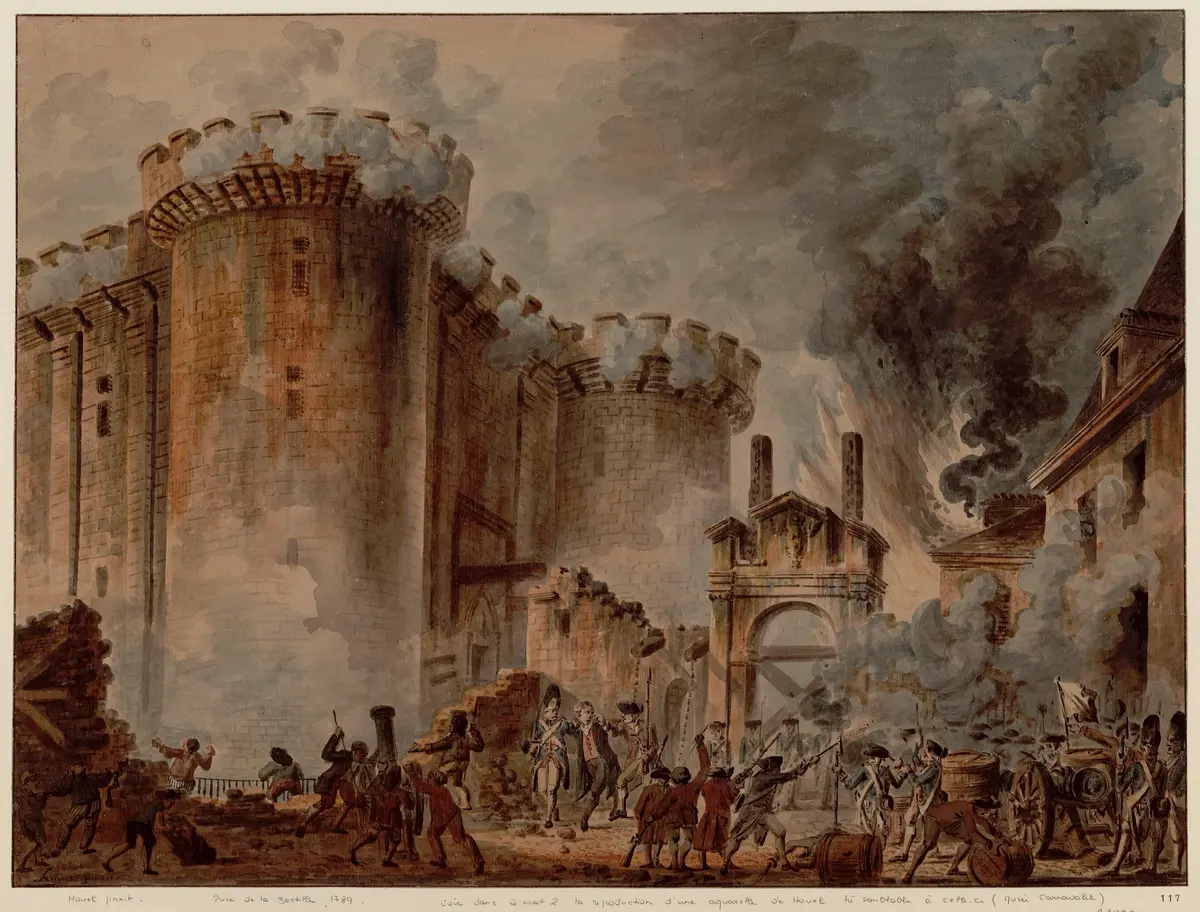
The Bastille, Paris: the royal fortress-prison where he was held for eleven months in 1717–18 and again in 1726 (pulled down after its capture in 1789; the site is the Place de la Bastille)- 1718
His tragedy Œdipe is a triumph at the Comédie-Française, and he takes the name Voltaire. At Châtenay, where he lives after the Bastille, he first signs a letter 'Arouet de Voltaire'.
- 1722
His father dies; the regent grants him a pension, and he becomes the wit of the great houses. Largillierre paints him in these years.
- 1726
Beaten by the chevalier de Rohan's servants for answering an insult, he seeks a duel, is put in the Bastille, and is escorted to Calais, from where he sails into exile in England.
The Bastille, Paris: the royal fortress-prison where he was held for eleven months in 1717–18 and again in 1726 (pulled down after its capture in 1789; the site is the Place de la Bastille)- 1727
In London he learns English, meets Pope and Swift, and attends Newton's funeral.
- 1728
His epic of Henri IV, the Henriade, appears in a lavish London edition sold by subscription and dedicated to Queen Caroline.
- 1733
Back in France, he publishes his account of England in London first, in English, as Letters concerning the English Nation.
He begins his relationship with Émilie du Châtelet, a married marquise of 26 with a gift for mathematics.
- 1734
The Lettres philosophiques come out in France without permission; the Parlement has them burned and a warrant is issued for his arrest. He flees to Cirey, her château in Champagne, and pays for a new wing.
Château de Cirey, Cirey-sur-Blaise: Émilie du Châtelet's house in Champagne, his refuge and workplace from 1734 to 1749- 1735
He is allowed back to Paris, where he sits for the pastellist Maurice Quentin de La Tour.
- 1736
Frederick, crown prince of Prussia, writes him an admiring letter; their correspondence will run to more than seven hundred letters.
- 1738
His Elements of Newton's Philosophy explains Newton's physics to French readers, against the followers of Descartes.
Château de Cirey, Cirey-sur-Blaise: Émilie du Châtelet's house in Champagne, his refuge and workplace from 1734 to 1749 - 1740
Frederick becomes king of Prussia. The two men meet for the first time, near Cleves, and Voltaire then visits him in Berlin.
- 1745
Back in favour at Versailles, he is made royal historiographer, then a gentleman of the king's chamber.
- 1746
After several failures he is elected to the Académie française, unanimously; he is received on 9 May.
- 1749
Émilie du Châtelet dies at Lunéville after giving birth; Voltaire, who was with her, is inconsolable.
- 1750
He sets out for Berlin at Frederick's invitation and becomes his chamberlain at Potsdam, with a pension of 20,000 livres.
Sanssouci, Potsdam: Frederick the Great's summer palace; Voltaire lived at the king's court in Potsdam and Berlin from 1750 to 1753- 1752
In the Diatribe of Doctor Akakia he ridicules Maupertuis, president of the king's academy; Frederick has the pamphlet burned.
Sanssouci, Potsdam: Frederick the Great's summer palace; Voltaire lived at the king's court in Potsdam and Berlin from 1750 to 1753 - 1753
He leaves Prussia. On the road the king's agents hold him at Frankfurt for over a month, and Louis XV forbids him to come near Paris.
- 1755
He buys a house at Geneva and names it Les Délices: at sixty-one, master of his own house for the first time.
- 1756
His Poem on the Lisbon Disaster, on the earthquake of 1 November 1755, asks how a good God can allow such suffering; his universal history, the Essai sur les mœurs, appears.
- 1758
At the end of the year he buys the estate of Ferney, on French soil a few miles from Geneva.
Château de Voltaire, Ferney: his estate just inside France near Geneva, bought at the end of 1758 and his home from 1760 to 1778 - 1759
Candide, or Optimism appears anonymously, printed in Geneva and sent to Paris and Amsterdam at once; seventeen editions follow that year.
- 1760
He moves into Ferney for good and begins to sign his letters with the cry 'Écrasons l'Infâme', 'let us crush the infamous thing'.
Château de Voltaire, Ferney: his estate just inside France near Geneva, bought at the end of 1758 and his home from 1760 to 1778 - 1762
In Toulouse the Protestant merchant Jean Calas, convicted of murdering his son, is broken on the wheel. Voltaire takes up the case.
- 1763
He publishes the Treatise on Tolerance, 'on the occasion of the death of Jean Calas'.
- 1764
The Pocket Philosophical Dictionary appears, 73 short articles of attack and irony.
Château de Voltaire, Ferney: his estate just inside France near Geneva, bought at the end of 1758 and his home from 1760 to 1778 - 1765
A panel of fifty judges overturns the Calas verdict, and the government pays the family compensation.
- 1766
The young chevalier de La Barre, found with a copy of the Philosophical Dictionary, is executed for insulting a procession and damaging a crucifix; Voltaire's protests fail.
- 1778
At 83 he returns to Paris for the first time in 28 years, to stage his tragedy Irène, and stays at the Marquis de Villette's house on the quai des Théatins; more than 300 people call the next day.
Hôtel de Villette, 27 quai Voltaire, Paris: the Marquis de Villette's house on the corner of the rue de Beaune, where he died on 30 May 1778He sits for the sculptor Jean-Antoine Houdon, whose bust is thought so true to life that crowds visit the studio to see it.
He is cheered at the Académie; that evening, after the sixth performance of Irène, the actors crown his bust on the stage of the Comédie-Française's hall in the Tuileries.
He dies at the Hôtel de Villette, twelve days after falling ill. His nephew has the body taken to the abbey of Scellières and buried before the Church's ban arrives; in 1791 the Revolution moves him to the Panthéon.
Hôtel de Villette, 27 quai Voltaire, Paris: the Marquis de Villette's house on the corner of the rue de Beaune, where he died on 30 May 1778