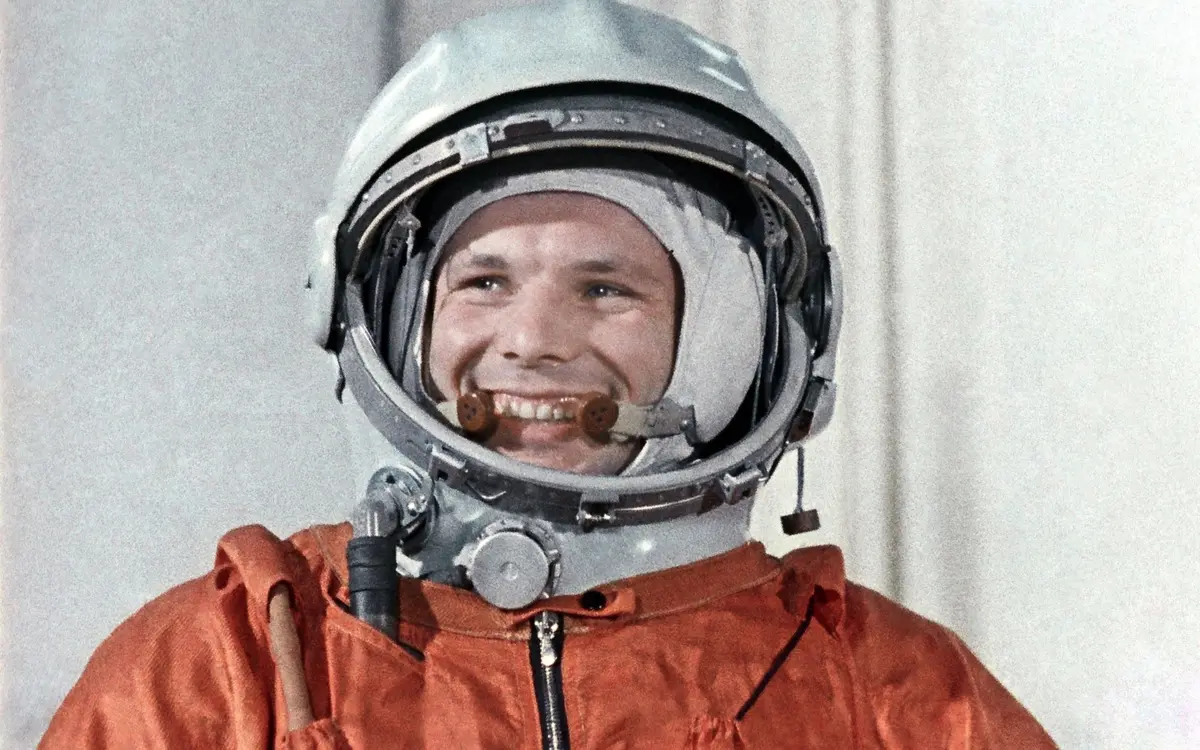
Yuri Gagarin
“The Soviet pilot who on 12 April 1961 became the first human in space, orbiting the Earth once in Vostok 1 in 108 minutes; he died in a jet crash in 1968, aged 34.”
Yuri Gagarin was the Soviet air force pilot who, on 12 April 1961, became the first human being to travel into space. In the spacecraft Vostok 1 he circled the Earth once and came back alive, 108 minutes after lift-off. The flight made the 27-year-old the most famous man in the world, and it gave the Soviet Union a victory in the Space Race that the United States could not match for almost a year. He never flew in space again. He died at 34, when the jet trainer he was flying with an instructor crashed in a forest east of Moscow.
He was born on 9 March 1934 in Klushino, a village near Gzhatsk, west of Moscow, the third of four children of a carpenter and a dairy worker on a collective farm. During the Second World War German troops occupied the village; the family was turned out of its house and lived in a dugout, and the two eldest children were taken away for forced labour. After the war the family moved to Gzhatsk. Yuri trained as a foundryman (a moulder of metal) at a trade school near Moscow, then studied at an industrial college in Saratov on the Volga, where he joined the local flying club and flew solo in 1955. From 1955 to 1957 he was a cadet at the air force pilots' school in Orenburg, where he met Valentina Goryacheva; they married in 1957 and had two daughters. He then flew MiG fighters in the Arctic north, in the Murmansk region.
In 1960 he was one of twenty young pilots chosen in secret as the first cosmonauts. Short, calm, quick to learn and well liked, he came first in the final exams of January 1961, and Sergei Korolev, the unnamed 'Chief Designer' of the Soviet rockets, took to him at once. On the morning of 12 April 1961 he was launched from Tyura-Tam (later called Baikonur) in Kazakhstan, shouting 'Poyekhali!' ('Let's go!'). The flight was automatic: Vostok had no way to land softly, so after the capsule came back through the atmosphere, Gagarin was ejected at about 7,000 metres and came down by his own parachute in a field near the Volga, close to Engels in the Saratov region. To win the world record, whose rules then said a pilot must land in his craft, the Soviet authorities hid the ejection for years. When the truth came out, the record body, the FAI, kept his records: what counted was going up, orbiting and coming back safely.
Moscow gave him a hero's welcome on Red Square on 14 April, and for two years he toured the world as the smiling face of Soviet success: Finland, Britain (where he was cheered in the rain in Manchester by the foundry workers' union), Poland and many other countries. He became commander of the cosmonaut team, a deputy of the Supreme Soviet and deputy head of the cosmonaut training centre, but his bosses were afraid to risk him. He fought his way back to training and was backup pilot for Soyuz 1 in April 1967, but after Vladimir Komarov died on that flight he was told he would probably never fly in space again. He returned to flying jets, and on 27 March 1968 his MiG-15UTI trainer, with the instructor Vladimir Seryogin, dived into the ground near Kirzhach. The cause is still argued about.
Hundreds of thousands of Muscovites watched his funeral; his ashes were placed in the Kremlin Wall, and his home town of Gzhatsk was renamed Gagarin. His flight is the human side of the Space Race that began with Sputnik in 1957 and ended with Americans walking on the Moon in 1969. The FAI, which keeps the world's air and space records, named its yearly Gagarin Gold Medal after him.
What happened
- 1934
Yuri Alekseyevich Gagarin is born in Klushino, a village near Gzhatsk in the Smolensk region, the third of four children of Alexei and Anna Gagarin, who work on a collective farm.
Klushino, Smolensk region: born here on 9 March 1934; the family lived through the German occupation in a dugout- 1941
German troops occupy Klushino. The Gagarins are turned out of their house and live in a dugout they dig behind it; the two eldest children are later taken away for forced labour. After the war the family moves to Gzhatsk.
Klushino, Smolensk region: born here on 9 March 1934; the family lived through the German occupation in a dugout - 1951
He finishes a trade school near Moscow (in Lyubertsy) as a foundryman, a moulder of metal, and goes on to the industrial technical college in Saratov on the Volga.
- 1955
In his last year at Saratov he flies with the local aero club and makes his first solo flight; that year he enters the air force pilots' school at Orenburg.
- 1957
Having earned his wings on the MiG-15, he graduates from Orenburg and is commissioned a lieutenant. The same year he marries Valentina Goryacheva, whom he met in Orenburg, and is posted to a fighter regiment of the Northern Fleet at Luostari, near Zapolyarny, north of the Arctic Circle.
- 1960
After a secret selection among air force pilots, he is one of the first twelve men formally enrolled as cosmonaut trainees; twenty are chosen in all. Classes begin on 14 March.
Parachute training begins: the trainees are flown to the Saratov region near Engels and each makes forty to fifty jumps in about six weeks, over the same fields where Gagarin will land a year later.
The cosmonaut training centre moves to a new site in the woods north-east of Moscow, later known as Zvyozdny Gorodok, 'Star City'.
- 1961
The six leading trainees sit their final exams. The commission ranks them Gagarin, Titov, Nelyubov, Nikolayev, Bykovsky, Popovich: Gagarin is the favourite. In an anonymous vote, all but three of the twenty name him as the one they want to fly first.
The State Commission at Tyura-Tam formally names Gagarin as the pilot of the first crewed Vostok and German Titov as his backup.
In Washington, NASA's leaders hold a press conference on the Soviet success; the first American, Alan Shepard, will only make a fifteen-minute suborbital hop on 5 May.
- 5:30 a.m.
Gagarin and Titov are woken (Moscow time), eat breakfast from tubes, are examined by doctors and dressed in their pressure suits, and ride the bus to the pad at Site 1, where Korolev and the generals see Gagarin off at the lift.
Gagarin's Start (Site 1), Baikonur, then called Tyura-Tam: Vostok 1 lifted off here at 09:07 Moscow time on 12 April 1961 - 9:07 a.m.
Vostok 1 lifts off at 09:06:59.7 Moscow time; Gagarin calls out 'Poyekhali!' ('Let's go!' or 'We're off!'). About 11 minutes later he is in orbit, 175 by 302 km high, the first human in space.
Gagarin's Start (Site 1), Baikonur, then called Tyura-Tam: Vostok 1 lifted off here at 09:07 Moscow time on 12 April 1961 - 10:02 a.m.
Radio Moscow's Yuri Levitan reads TASS's announcement that a Soviet citizen, Major Yuri Gagarin, has been launched into orbit; the news reaches the world while he is still in space. American listening posts had already heard his voice.
- 10:25 a.m.
Over Africa the braking rocket fires for 40 seconds. The equipment section fails to separate cleanly, and the joined craft tumbles until the cables burn through at about 10:35; then the ball-shaped capsule falls back through the atmosphere at up to about ten times the force of gravity.
- 10:55 a.m.
At about 7,000 metres he is ejected from the capsule and comes down by his own parachute in a field near Smelovka, 26 km south-west of Engels, 108 minutes after launch. A farm woman and a girl are the first to meet him; the capsule lands nearby.
The landing site near Smelovka, south-west of Engels, Saratov region: he came down here by parachute at 10:55 Moscow time He flies into Moscow's Vnukovo airport, reports to Khrushchev on the airfield, and rides through cheering crowds to a rally on Red Square, where he waves from the Lenin Mausoleum.
Red Square and the Kremlin Wall, Moscow: the welcome on 14 April 1961, and his grave since 30 March 1968At his first press conference in Moscow, and at many after it, he says nothing of his ejection: the Soviet record claim depended on the pilot landing in his craft. The Soviet Union first admitted the parachute landing in 1971.
Khrushchev thanks President Kennedy by telegram for his congratulations on the flight and hopes the two countries can work together to master the universe.
On a tour of Britain he visits Manchester at the invitation of the foundry workers' union, which honours him as a former foundryman: he walks through the rain to its offices and receives its medal from the union president, Fred Hollingworth. Later that July he is cheered in Warsaw.
His backup German Titov flies Vostok 2 for a full day in orbit. Gagarin, now commander of the cosmonaut group, had argued for the shorter flight the doctors wanted.
- 1963
After two years of tours and public duties, and a seat in the Supreme Soviet from 1962, he reluctantly becomes deputy director of the Cosmonaut Training Center for flight and space preparation.
- 1967
Vladimir Komarov, for whose flight Gagarin was the backup, is killed when Soyuz 1's parachutes fail. Five days later the cosmonaut chief Kamanin tells Gagarin there is almost no chance he will be allowed to fly in space again.
- 1968
He defends his dissertation at the Zhukovsky Air Force Engineering Academy, then throws himself back into flight training to regain the right to fly jets alone.
- 10:30 a.m.
Flying a two-seat MiG-15UTI from Chkalovsky airfield with the instructor Colonel Vladimir Seryogin, he reports the exercise done; the last radio contact is at 10:30:10 Moscow time. The jet crashes into a forest near Novosyolovo, Kirzhach district, killing both men.
Near Novosyolovo, Kirzhach district: where his MiG-15UTI crashed on 27 March 1968; a memorial stands here