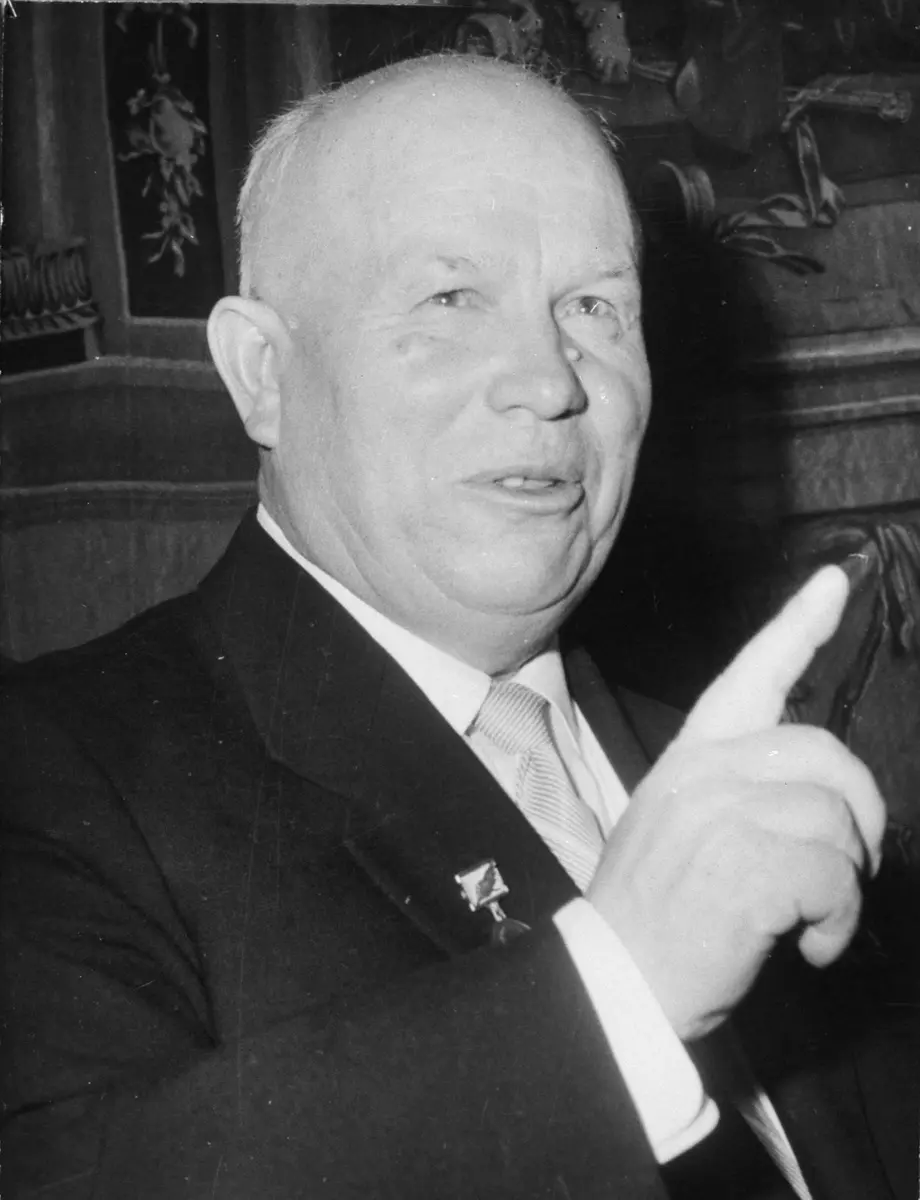
Nikita Khrushchev
“The Soviet leader after Stalin who denounced him in the 1956 'secret speech', crushed Hungary, and took the world to the brink over the missiles in Cuba in 1962.”
Nikita Sergeyevich Khrushchev was born in April 1894 in Kalinovka, a poor village in Kursk province close to the Ukrainian border. His grandfather had been a serf, and his father moved between the fields and the coal mines of the Donbas. Around 1908 the family settled in Yuzovka, the mining and steel town founded by a Welsh ironmaster, John Hughes, that is now Donetsk. Nikita had only about four years of school and went to work as a pipe fitter at fifteen. He joined the Bolsheviks in 1918, served as a junior political commissar in the Red Army during the civil war, lost his first wife Galina in the famine that followed, and then studied at a new workers' school in Yuzovka, where in 1924 he married Nina Petrovna, a teacher.
Party work made his career. Lazar Kaganovich, one of Stalin's closest men, took him up; in 1929 he went to Moscow to study at the Industrial Academy, and by 1935 he ran the party in Moscow and had finished the city's first metro line, which earned him the Order of Lenin. He was a zealous follower of Stalin and took part in the purges of the 1930s, one of the few regional party bosses to survive them. From 1938 he ruled Ukraine as its first secretary, joined the Politburo in 1939, served as a political officer at Stalingrad and Kursk during the Second World War, and rebuilt Ukraine after it, through the terrible famine of 1946. In 1949 Stalin called him back to Moscow.
When Stalin died in March 1953, Khrushchev outmanoeuvred his rivals: he arranged the arrest and execution of the secret-police chief Lavrenty Beria, became first secretary of the party that September and pushed Georgy Malenkov aside. On 25 February 1956, in a closed session of the 20th Party Congress, he gave his 'secret speech', which denounced Stalin's purges, torture and cult of personality. Millions of prisoners came home from the Gulag, and a cultural 'thaw' followed that later allowed Solzhenitsyn's One Day in the Life of Ivan Denisovich to be printed. But when Hungary tried to leave the Soviet bloc, his tanks crushed it on 4 November 1956. He survived a coup by the old Stalinists in June 1957, made himself premier as well in 1958, and promised that the Soviet Union would soon overtake America, ploughing up the 'virgin lands' of Kazakhstan and Siberia and launching Sputnik and Yuri Gagarin into space.
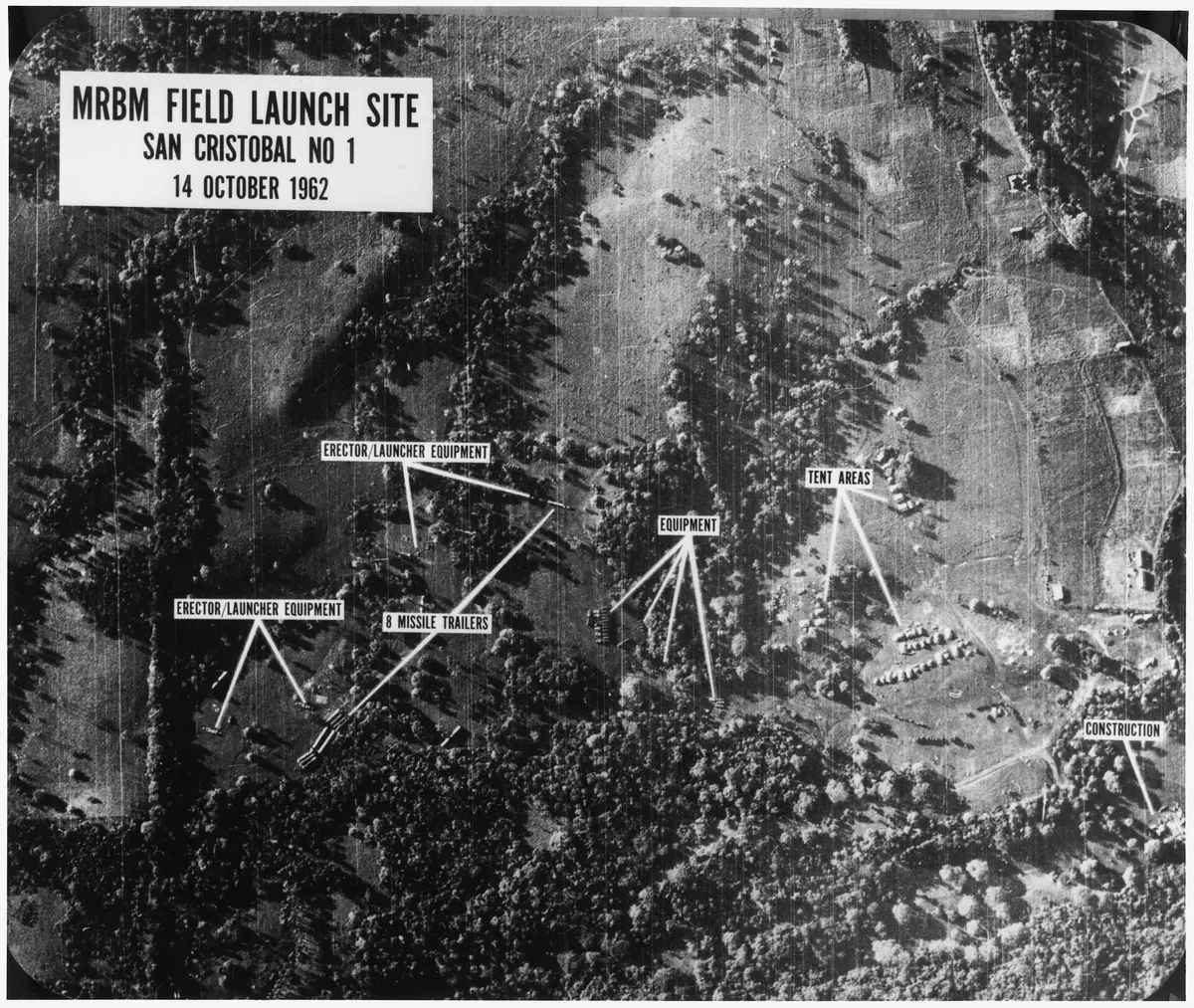
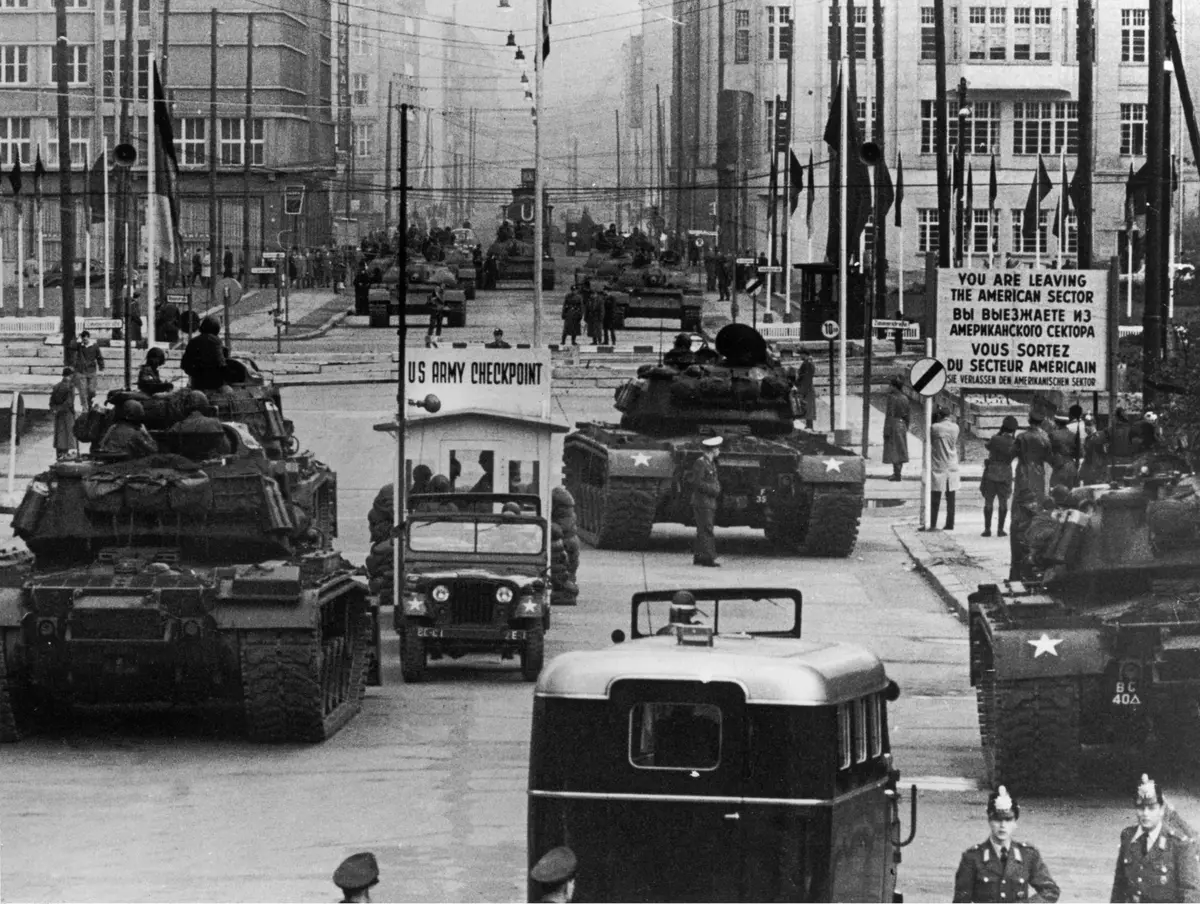
Abroad he preached 'peaceful coexistence' with the West and practised bluster. He argued with Vice President Nixon in a model American kitchen in Moscow in July 1959, toured the United States that September and talked with Eisenhower at Camp David. The U-2 spy plane shot down over the Urals in May 1960 wrecked the next summit, and at the United Nations that October he waved, or banged, a shoe. He bullied the young Kennedy at Vienna in June 1961, and in August East Germany walled off West Berlin. In 1962 he secretly sent nuclear missiles to Cuba, then took them out on 28 October in return for an American promise not to invade the island, the closest the world has come to nuclear war. The next year he signed the first treaty limiting nuclear tests, while his quarrel with Mao's China split the communist world.
On 14 October 1964 his colleagues, led by his protégé Leonid Brezhnev, removed him, blaming failed harvests, the break with China, the retreat over Cuba and his own erratic, high-handed rule. He became a 'special pensioner' and a non-person, and secretly dictated memoirs that were smuggled to the West and published as Khrushchev Remembers in 1970. He died in Moscow on 11 September 1971; he was denied a state funeral and a grave in the Kremlin wall and was buried at the Novodevichy Cemetery. Earthy, clever, ruthless and impulsive, he was the man who first told the Soviet people the truth about Stalin, and the generation that grew up with his thaw, Mikhail Gorbachev among them, later took the system apart.
What happened
- 1894
Born in the village of Kalinovka, in Kursk province near the Ukrainian border, into a poor family; his grandfather had been a serf, his father worked in the fields and the Donbas mines.
Kalinovka, Kursk Oblast: his birthplace- 1908
The family moves to the mining and steel town of Yuzovka in the Donbas, where he works as a pipe fitter from the age of fifteen.
Yuzovka (later Stalino, since 1961 Donetsk): where he grew up and worked as a fitter - 1918
Joins the Bolshevik party during the civil war in Ukraine.
- 1919
Joins the Red Army as a junior political commissar and fights the Whites and, in 1920, the Poles.
- 1922
After his first wife, Galina, dies in the famine, he enters the new workers' school at Yuzovka and becomes its party secretary; there he marries Nina Petrovna, a teacher, in 1924.
Yuzovka (later Stalino, since 1961 Donetsk): where he grew up and worked as a fitter - 1929
Goes to Moscow to study metallurgy at the Stalin Industrial Academy, where he runs the party committee.
- 1935
Wins the Order of Lenin for finishing the Moscow metro and becomes first secretary of the Moscow city and regional party, a loyal follower of Stalin in the years of the purges.
- 1938
Sent to Kiev as first secretary of the Ukrainian party, which he leads, with one short break, until 1949; a full member of the Politburo from 1939.
- 1942
After the failed Soviet offensive at Kharkov, serves as political adviser to the front commander during the defence of Stalingrad.
- 1949
Stalin calls him back to Moscow to run the city's party again and to sit as a secretary of the Central Committee.
- 1953
Stalin dies; Khrushchev shares power with Malenkov, Beria and Molotov, and soon arranges Beria's arrest and execution.
Becomes first secretary of the Communist Party, the post that makes him the Soviet Union's leader.
The Kremlin, Moscow: the seat of his power, 1953–1964- 1955
On his first trip abroad, to Belgrade, apologizes to Tito for Stalin's break with Yugoslavia.
- 1956
The 20th Congress of the Soviet Communist Party opens in Moscow, with some 1,500 delegates from fifty-six countries.
The Kremlin, Moscow: the seat of his power, 1953–1964In a closed session of the congress he gives his 'secret speech', condemning Stalin's purges, his brutality and the cult of his personality.
The Kremlin, Moscow: the seat of his power, 1953–1964Flies to Warsaw as Poland rebels, and accepts Władysław Gomułka's national communism.
After Imre Nagy declares Hungary neutral, Soviet troops invade and crush the Hungarian revolution.
- 1957
Outvoted in the Presidium by the old Stalinists, he appeals to the full Central Committee and wins; Malenkov and Molotov are disgraced as the 'anti-party group'.
The Soviet Union launches Sputnik 1, the first artificial satellite, and Khrushchev boasts of Soviet rockets.
- 1958
Becomes premier as well as party leader.
In a speech in Moscow he demands that the Western powers leave West Berlin within six months, opening a three-year crisis.
- 1959
The split with Mao's China begins, over Mao's call for war on the imperialists and Khrushchev's refusal to help China build the bomb.
Argues capitalism against communism with Vice President Richard Nixon in a model American kitchen at the US exhibition in Moscow: the 'kitchen debate'.
Lands in Washington, the first Soviet leader to visit the United States; he tours New York, Los Angeles, San Francisco and the farms of Iowa.
Talks with Eisenhower at Camp David until 27 September and visits his farm at Gettysburg: the 'spirit of Camp David'.
- 1960
A Soviet missile shoots down the American U-2 spy plane of Francis Gary Powers near Sverdlovsk in the Urals.
Reveals that the pilot is alive and has confessed; when Eisenhower refuses to apologize, Khrushchev walks out of the Paris summit later in the month.
Powers's trial opens in Moscow; he is sentenced to three years in prison and seven of hard labour.
At the UN General Assembly he raises a point of order against the Philippine delegate, who has compared Soviet rule in Eastern Europe to colonialism, and waves, or perhaps bangs, his shoe.
United Nations headquarters, New York: his speeches of 1959 and 1960 and the shoe- 1961
Welcomes Yuri Gagarin, the first man in space, home at Vnukovo airport and on Red Square.
Meets President Kennedy in Vienna; over two days he threatens to cut off the West's access to Berlin and renews his six-month deadline.
With his consent, East Germany closes the border through Berlin overnight with barbed wire, soon replaced by a wall.
- 1962
With American ships enforcing the quarantine of Cuba, he accepts U Thant's appeal to avoid a clash at sea.
Announces that the Soviet missiles in Cuba will be dismantled and taken home, in return for Kennedy's promise not to invade Cuba and a secret pledge to remove the American missiles from Turkey.
The Kremlin, Moscow: the seat of his power, 1953–1964- 1963
In Moscow, the United States, Britain and the Soviet Union sign the Limited Test Ban Treaty, ending nuclear tests in the air, in space and under water.
- 1964
Called back from a holiday by the Black Sea, he is removed by the Central Committee in a coup led by Leonid Brezhnev, officially for 'advanced age and poor health'.
The Kremlin, Moscow: the seat of his power, 1953–1964- 1970
The memoirs he has dictated in secret are published in the United States and Europe as Khrushchev Remembers, but not in the Soviet Union.
- 1971
Dies in Moscow at 77; the death is announced only after almost two days, and he is buried without a state funeral at the Novodevichy Cemetery.
Novodevichy Cemetery, Moscow: his grave