Dalton's atomic theory
“From 1803 to 1810 John Dalton in Manchester gave each element its own kind of atom with its own weight, showed that atoms join in simple whole numbers, and drew up the first table of atomic weights.”
Between 1803 and 1810 John Dalton, a Quaker teacher in Manchester, turned the old idea of atoms into a working tool of chemistry. Philosophers since the ancient Greeks had imagined that matter is made of tiny particles, but most thought all atoms were alike. Dalton said that every element has its own kind of atom, that all atoms of one element weigh the same, and that atoms of different elements join in simple whole numbers, one to one, one to two, two to one, to make compounds. Because atoms are far too small to weigh, he worked out their weights relative to the lightest, hydrogen, which he counted as 1. On 6 September 1803 he wrote his first symbols and his first table of such weights in his notebook, and on 21 October 1803 he read a paper to the Literary and Philosophical Society of Manchester which, when it was printed in 1805, ended with a table of 21 of them.
Dalton came to chemistry from the weather. He kept a daily weather diary for most of his life and wanted to know why the gases of the air, which have different weights, stay mixed instead of settling in layers. In 1801 he stated that each gas in a mixture presses as if the others were not there, and he came to believe that the particles of different gases differ in size and weight. How he went on from there is disputed. Thomas Thomson, who visited him in August 1804, wrote that the theory grew out of Dalton's analysis of two gases of carbon and hydrogen, marsh gas and olefiant gas: one held exactly twice as much hydrogen as the other. But Dalton's own notebooks, published by Henry Roscoe and Arthur Harden in 1896, show a table of atomic weights almost a year before those analyses, which points to a physical starting point. To fix the weights Dalton needed a rule, and he chose the simplest: if two elements make only one compound, it has one atom of each. So water was HO, and oxygen weighed 7, not the 16 we use today.
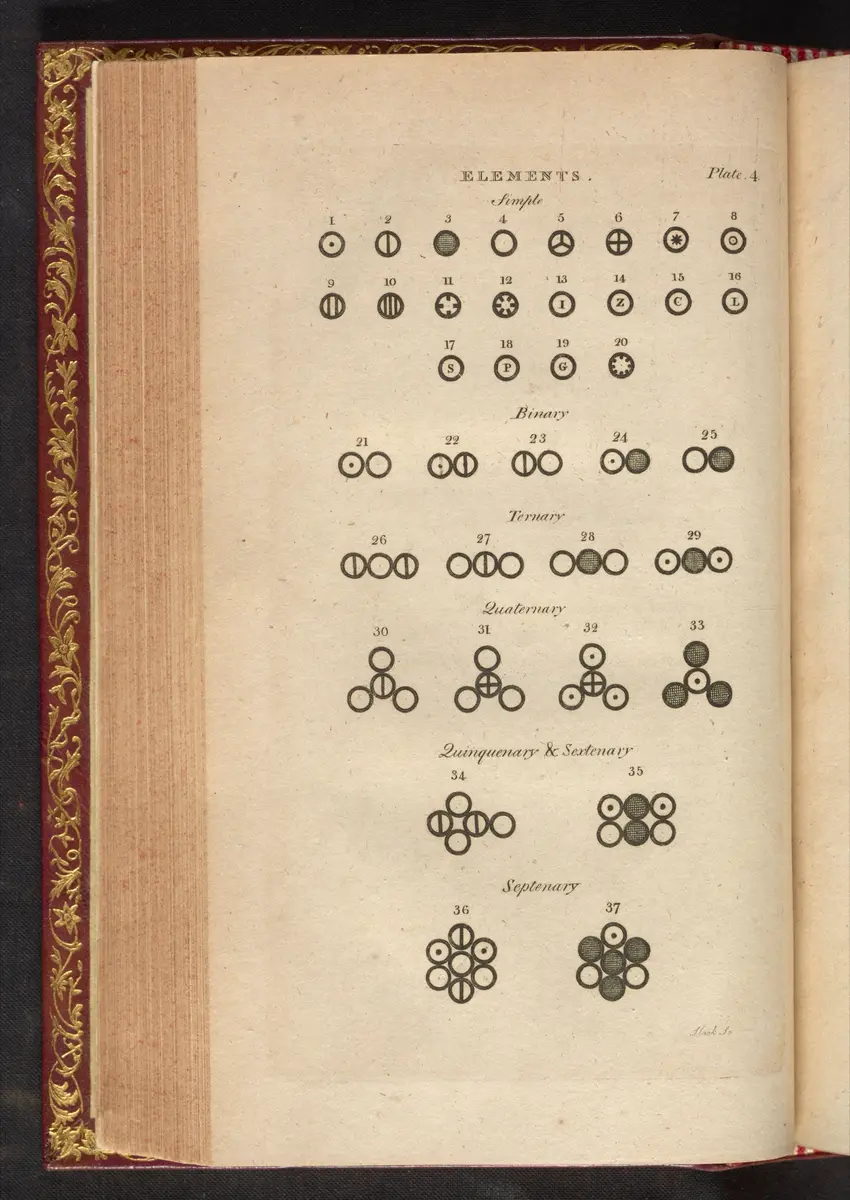
The theory spread through talk before print. Dalton outlined it in lectures at the Royal Institution in London in the winter of 1803 to 1804, and in Edinburgh and Glasgow in the spring of 1807. Thomson put a short account in the third edition of his System of Chemistry in 1807, the first time it was printed for a wide public. In January 1808 Thomson and William Hyde Wollaston showed the Royal Society salts in which one partner was exactly double in amount, which Wollaston called particular cases of Dalton's theory. Dalton's own book, A New System of Chemical Philosophy, came out in two parts, the first in 1808 with its famous plate of round atom symbols, the second in 1810 with a longer table of weights. On the last day of 1808 the French chemist Joseph-Louis Gay-Lussac showed that gases combine in simple ratios by volume. That fitted atoms well, but Dalton rejected it, because it did not fit his picture of gas particles of different sizes.
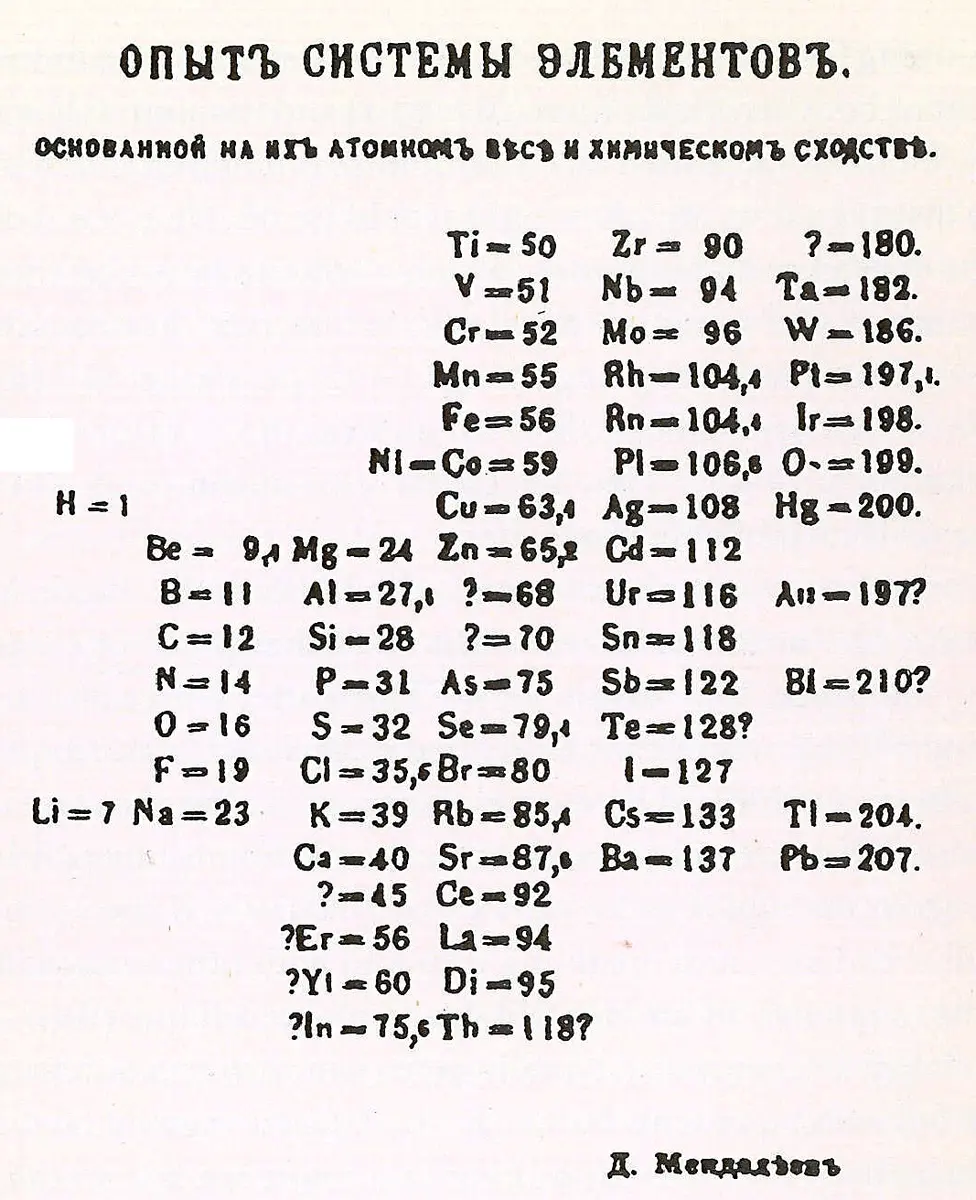
Much of the detail was wrong, and correcting it took half a century: chemists argued over whether water was HO or H2O until the 1850s, when the Italian Stanislao Cannizzaro showed how Avogadro's idea about gas volumes settled the weights. The Swedish chemist Jöns Jacob Berzelius kept Dalton's atoms but replaced his circles with letters, H, O, C, the symbols still used. Yet the core idea held. Berzelius wrote to Dalton that the law of multiple proportions was a mystery without the atomic theory. Dalton's weights became the backbone of chemistry: Mendeleev ordered the elements by them in 1869, and every chemical formula and equation since rests on them.
Dalton stayed in Manchester all his life. He became a Fellow of the Royal Society in 1822 and the first winner of its Royal Medal, and when he died in 1844 some 40,000 people came to his lying-in-state and funeral. The house of the Literary and Philosophical Society at 36 George Street, where he had his laboratory, was destroyed in the German air raids on Manchester in December 1940, and much of his paperwork burned with it. What survived is now at the John Rylands Library, and some of his apparatus and his wooden atom models are at the Science and Industry Museum in Manchester.
What happened
- 1803
In his laboratory notebook Dalton heads a page 'Observations on the ultimate particles of bodies and their combinations', draws his first circle symbols for hydrogen, oxygen, azote, carbon and sulphur, and writes out his first table of relative weights, with hydrogen as 1.
36 George Street, Manchester: the house of the Literary and Philosophical Society, where Dalton had his laboratory and read his paper of 21 October 1803; the building was destroyed in the air raids of December 1940Dalton reads 'On the Absorption of Gases by Water and other Liquids' to nine members and friends in the rooms of the Literary and Philosophical Society. He calls an inquiry into the relative weights of the ultimate particles 'entirely new', and the paper ends with a table of such weights.
36 George Street, Manchester: the house of the Literary and Philosophical Society, where Dalton had his laboratory and read his paper of 21 October 1803; the building was destroyed in the air raids of December 1940Dalton gives the first lecture of his course on natural philosophy at the Royal Institution in London, which runs into January 1804; he includes a brief outline of the new laws of chemical combination.
The Royal Institution, 21 Albemarle Street, London: Dalton outlined his theory here in lectures from 22 December 1803 and again in 1810- 1804
In the summer Dalton collects the inflammable gas that bubbles up from ponds, marsh gas, at various times and places, and compares it with olefiant gas. Both hold only carbon and hydrogen, but for the same carbon marsh gas has exactly twice the hydrogen: he gives olefiant gas one atom of each and marsh gas one carbon and two hydrogen.
Thomas Thomson of Edinburgh spends a day or two with Dalton in Manchester. Dalton explains his ideas on the composition of bodies, and Thomson writes them down in his journal: the ultimate particles of simple bodies are atoms that cannot be divided, each kind with its own weight.
36 George Street, Manchester: the house of the Literary and Philosophical Society, where Dalton had his laboratory and read his paper of 21 October 1803; the building was destroyed in the air raids of December 1940- 1805
The Society's Memoirs print the paper of 21 October 1803 with its 'Table of the relative weights of the ultimate particles of gaseous and other bodies', 21 substances from hydrogen 1 to sulphuric acid 25.4: the first table of atomic weights in print.
36 George Street, Manchester: the house of the Literary and Philosophical Society, where Dalton had his laboratory and read his paper of 21 October 1803; the building was destroyed in the air raids of December 1940- 1807
Thomson's System of Chemistry, third edition, prints a short account of Dalton's theory (vol. III, pp. 424 to 451), which makes it known to chemists everywhere before Dalton's own book.
Edinburgh, where Dalton gave his lectures on heat and chemical elements twice in March and April 1807, and where Thomas Thomson workedFrom Manchester Dalton writes that he has been urged to explain his recent enquiries on heat, gases and 'chemical elements or atoms' at Edinburgh, and offers a short course of four or five lectures for a subscription of half a guinea.
By 28 March Dalton is in Edinburgh, where in March and April he gives his course on heat and chemical elements twice, and then once in Glasgow. Most of his hearers ask him to publish soon; he dedicates Part I of his book to the professors and residents of the two cities and to the Lit & Phil.
Edinburgh, where Dalton gave his lectures on heat and chemical elements twice in March and April 1807, and where Thomas Thomson worked- 1808
Thomson's paper 'On Oxalic Acid' is read to the Royal Society: oxalic acid joins strontian and potash in two proportions, and the acid in one salt is exactly double that in the other.
Somerset House, London, then the Royal Society's home: Thomson's and Wollaston's papers supporting the theory were read here in January 1808William Hyde Wollaston reads 'On Super-acid and Sub-acid Salts' to the Royal Society. He had found the same doubling in other salts, but since Thomson's account of Dalton's theory he sees his results as particular cases of Dalton's rule that elements join atom to atom or in simple multiples.
Somerset House, London, then the Royal Society's home: Thomson's and Wollaston's papers supporting the theory were read here in January 1808Part I of A New System of Chemical Philosophy appears in Manchester, printed by S. Russell of Deansgate; its preface is dated May 1808. The chapter 'On Chemical Synthesis' sets out the theory, and Plate 4 shows the atom symbols with their weights: hydrogen 1, azote 5, carbon 5, oxygen 7.
36 George Street, Manchester: the house of the Literary and Philosophical Society, where Dalton had his laboratory and read his paper of 21 October 1803; the building was destroyed in the air raids of December 1940Dalton sends four copies of his book to Dr John Bostock in Liverpool, 'the only ones that have yet found their way to Liverpool', and predicts that the atomic system will win his assent.
In Paris Joseph-Louis Gay-Lussac reads to the Société philomatique his memoir on how gases combine: always in simple ratios by volume, such as one to one or two to one. It suits atoms, but Dalton, who believed the particles of different gases differ in size, refuses it.
Paris, where Gay-Lussac read his memoir on the combining volumes of gases to the Société philomatique on 31 December 1808- 1810
Humphry Davy invites Dalton to stand for election to the Royal Society; Dalton declines, and becomes a Fellow only in 1822.
Somerset House, London, then the Royal Society's home: Thomson's and Wollaston's papers supporting the theory were read here in January 1808At the Royal Institution, in the seventeenth of a course of twenty lectures, Dalton tells his London audience how he came to the atomic theory: from his study of mixed gases and the physics of their particles, not first from chemistry.
The Royal Institution, 21 Albemarle Street, London: Dalton outlined his theory here in lectures from 22 December 1803 and again in 1810Part II of the New System is published, its preface dated November 1810 and dedicated to Humphry Davy and William Henry. It applies the theory to the elements and their two-element compounds, with corrected weights, and in an appendix Dalton remarks that printing had taken nearly two years.
36 George Street, Manchester: the house of the Literary and Philosophical Society, where Dalton had his laboratory and read his paper of 21 October 1803; the building was destroyed in the air raids of December 1940