Mendeleev's periodic table
“In 1869 Dmitri Mendeleev arranged the 63 known elements by atomic weight, saw that their properties repeat, left gaps and predicted the missing elements; gallium, scandium and germanium proved him right.”
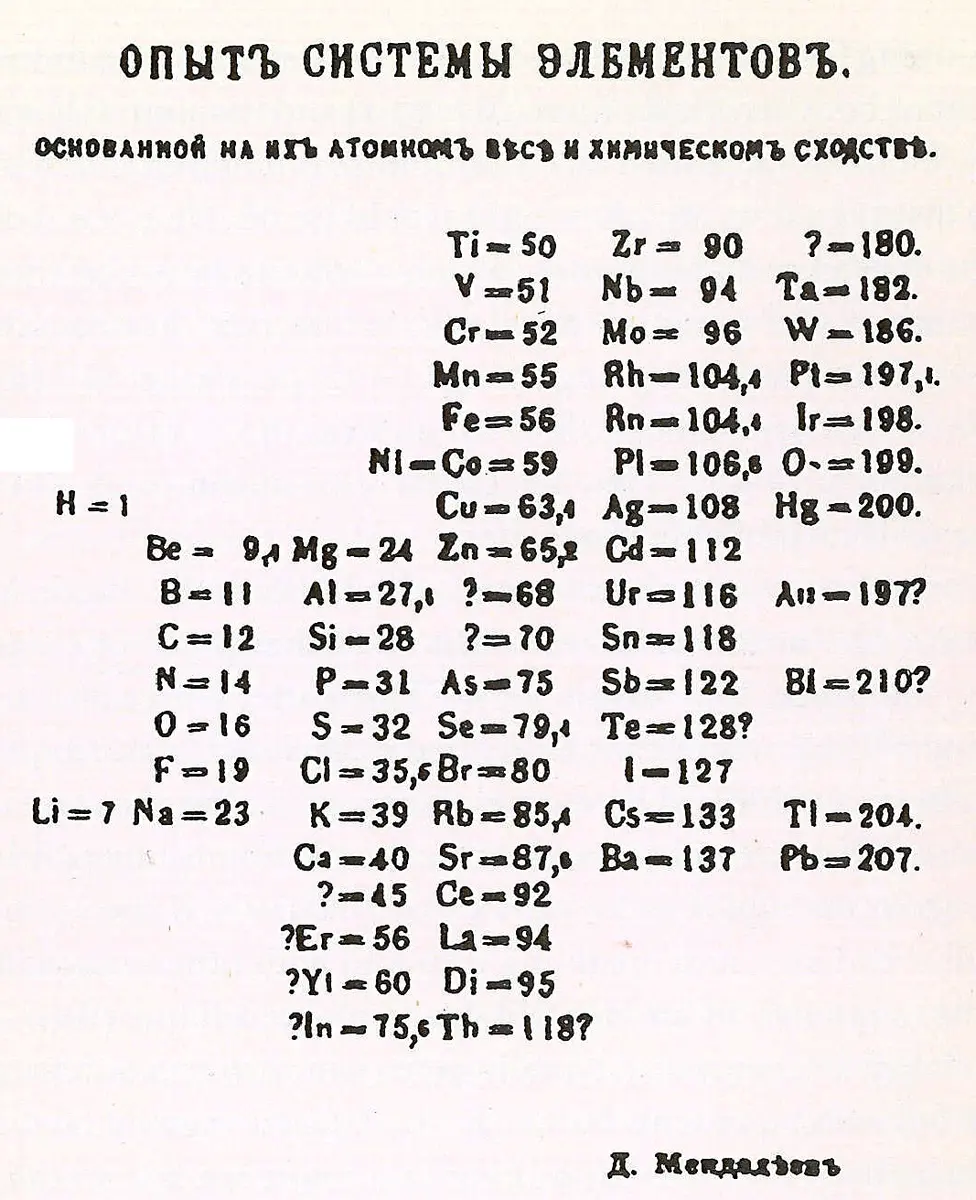
On 1 March 1869 (17 February in the Russian calendar of the time), Dmitri Mendeleev, professor of general chemistry at St Petersburg University, put all 63 chemical elements then known into one table. He was writing a textbook, The Principles of Chemistry, and needed an order in which to teach them. He wrote each element and its properties on a card and laid the cards out by atomic weight, and saw that similar elements come back at regular intervals: the properties of the elements repeat, they are 'periodic'. The same day he sent the table to the printer as 'An Attempt at a System of Elements, Based on Their Atomic Weight and Chemical Similarity', and the printed sheet went out to chemists in Russia and abroad.
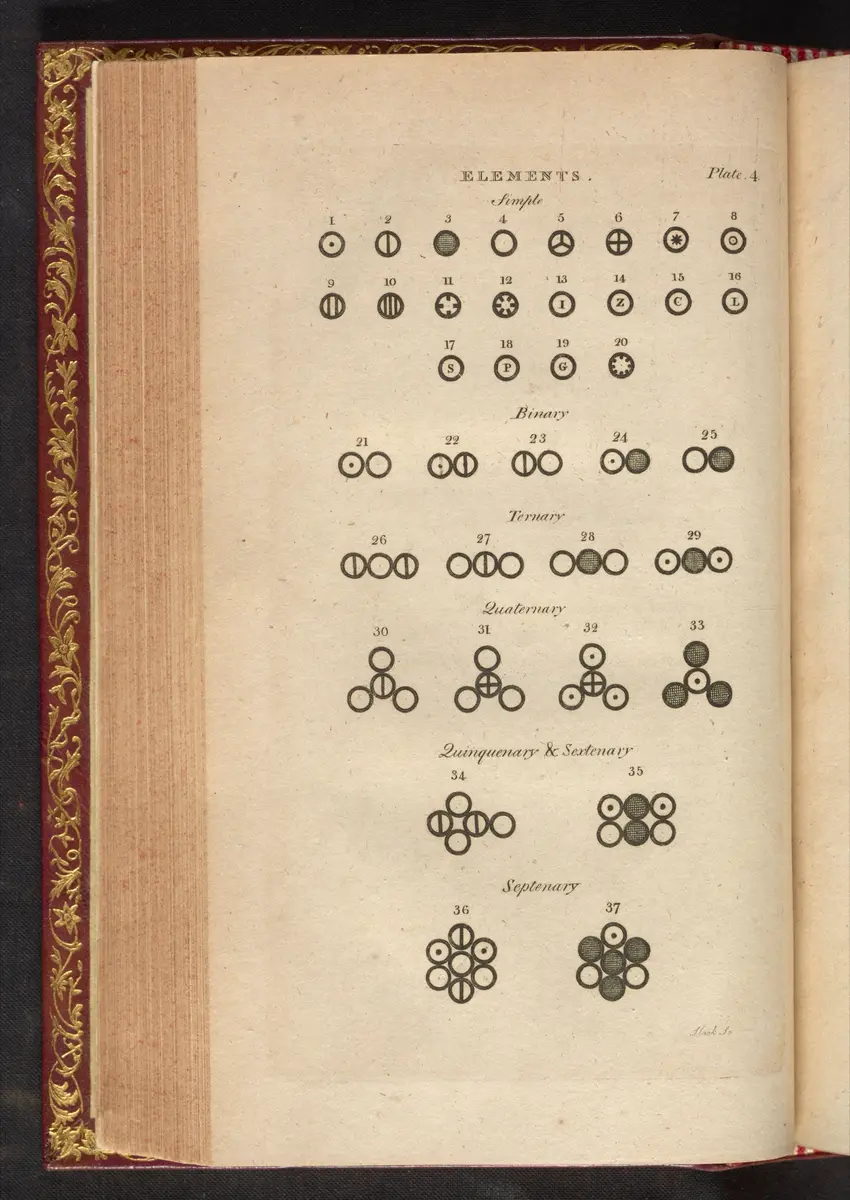
Chemists had looked for such an order for half a century. Döbereiner found groups of three similar elements in 1817, de Chancourtois wound the elements round a cylinder in 1862, the Englishman Newlands spoke of a 'law of octaves' in 1864, and the German Lothar Meyer printed a partial table of 28 elements the same year. What made the 1860s ripe was the chemists' congress at Karlsruhe in 1860, attended by both Mendeleev and Meyer, after which chemists at last agreed on reliable atomic weights. On 18 March 1869 Mendeleev's paper was read to the new Russian Chemical Society by its secretary, Nikolai Menshutkin, because Mendeleev was away inspecting cheese dairies (or ill, as other accounts say). A German summary that year translated 'periodic' as 'stepwise', and Meyer, who published his own fuller system in 1870, claimed that Mendeleev had missed the point; the two disputed the credit for years, and in 1882 the Royal Society gave them its Davy Medal together.
Mendeleev's boldness made the difference. Where an element did not fit, he moved it or declared its atomic weight wrong; where no known element fitted, he left a gap. In 1871 he described three missing elements in detail and called them eka-aluminium, eka-boron and eka-silicon ('eka' is Sanskrit for one: the element one place below aluminium, boron or silicon). In 1875 the French chemist Paul-Émile Lecoq de Boisbaudran found gallium in a zinc ore with his spectroscope; Mendeleev saw at once that it was his eka-aluminium and said its density must be about 5.9, higher than the first measurement, and the purified metal proved him right. Scandium, found by Lars Fredrik Nilson in Uppsala in 1879, was eka-boron, and germanium, found by Clemens Winkler in Freiberg in 1886, matched eka-silicon almost exactly: an atomic weight of 72.3 against the 72 predicted, a density of 5.47 against 5.5. From then on chemists took the table seriously, and lecture rooms hung it on the wall.
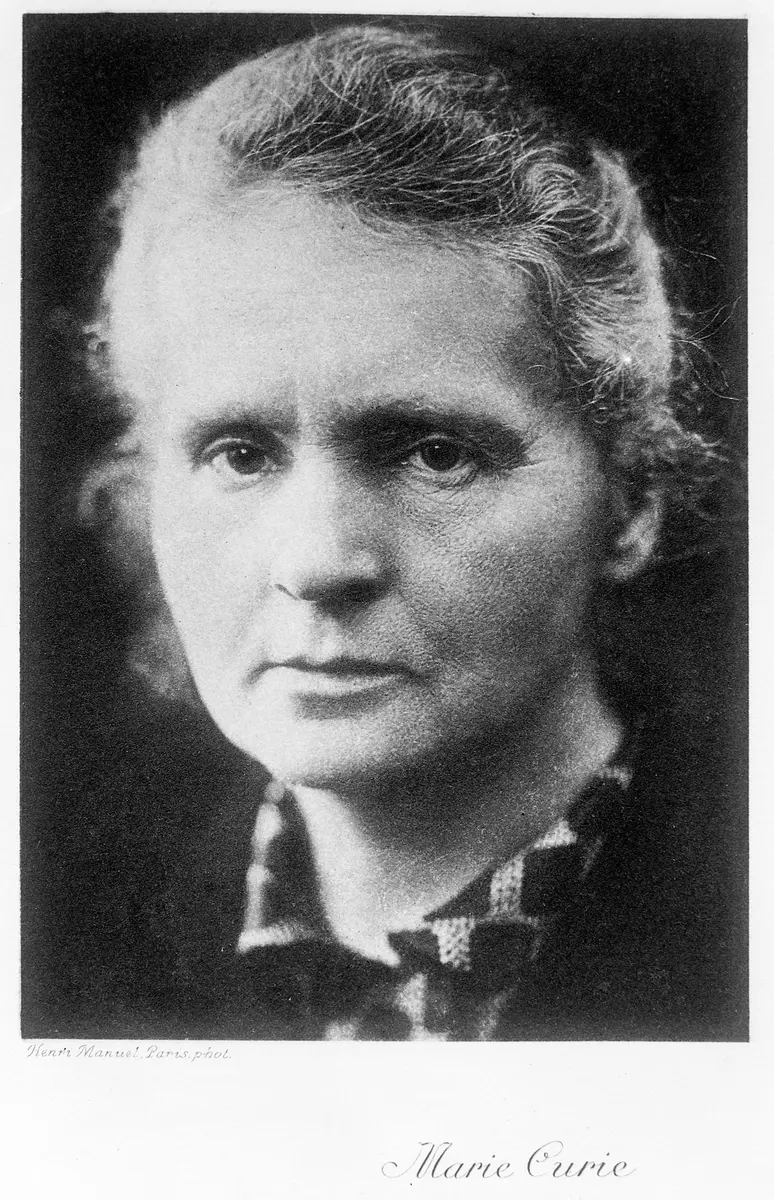
The table also survived what Mendeleev did not expect. When Rayleigh and Ramsay found argon in 1894 and then the other noble gases, there was no place for them, and Mendeleev at first doubted argon; they became a new group of their own. He could not say why the pattern exists, and a few pairs, such as tellurium and iodine, stood out of order by weight. In 1913 Henry Moseley, using X-rays, showed that the true order is the atomic number, the electric charge of the nucleus, and in the 1920s quantum theory explained the periods as shells of electrons. New elements found their places in it, like Marie and Pierre Curie's polonium of 1898, the element after bismuth that Mendeleev had foreseen, and the search for elements beyond uranium, the last in his table, led in 1938 to nuclear fission.
Mendeleev left the university in 1890 after carrying a student petition to the ministry, ran Russia's bureau of weights and measures from 1893 and died in St Petersburg in 1907; students carried a periodic table at his funeral. Element 101, made at Berkeley in 1955, is called mendelevium. Every chemistry classroom still has his table on the wall, now with 118 elements, and the United Nations declared 2019, its 150th year, the International Year of the Periodic Table.
What happened
- 1869
Working on his textbook, Mendeleev lays out the 63 known elements by atomic weight and chemical similarity and sees their properties repeat. On the day he is due to leave for the Free Economic Society's tour of cheese dairies, he sends the table to the printer, dated 17 February by the Russian calendar; the printed sheet, with a Russian and a French title, goes to chemists in Russia and abroad.
The Dmitri Mendeleev Museum-Archive, Mendeleevskaya Liniya 2: his former apartment, where his manuscripts of the table are keptAt the Russian Chemical Society's meeting (6 March in the Russian calendar), its secretary Nikolai Menshutkin reads Mendeleev's paper on the relation between the properties of the elements and their atomic weights; Mendeleev himself is away. The paper appears in the first volume of the Society's new journal, and a German summary follows in the Zeitschrift für Chemie.
The Twelve Collegia, the old main building of St Petersburg University: Mendeleev's university, where he lived in a university apartment from 1866 to 1890 and where the Russian Chemical Society, formed at the university, heard his paper- 1870
Lothar Meyer, professor at the Karlsruhe Polytechnic, publishes his own periodic system in Liebigs Annalen, with a curve of atomic volumes. He cites Mendeleev but, having read only the German summary that says 'stepwise', says Mendeleev missed the periodicity; a priority dispute begins that runs through the 1870s.
Karlsruhe, the Polytechnic on Kaiserstraße (today KIT): Lothar Meyer was professor here when he published his periodic system in 1870; the city had hosted the chemists' congress of 1860 - 1871
Mendeleev publishes the full version of his system in German in Liebigs Annalen. He moves 17 elements to new places and describes in detail three missing elements, eka-boron, eka-aluminium and eka-silicon, with their atomic weights and properties; his textbook carries the eight-group 'Natural System of Elements'.
The Twelve Collegia, the old main building of St Petersburg University: Mendeleev's university, where he lived in a university apartment from 1866 to 1890 and where the Russian Chemical Society, formed at the university, heard his paper - 1875
Between 3 and 4 in the afternoon, in his private laboratory at Cognac, Paul-Émile Lecoq de Boisbaudran sees a new violet line in the spark spectrum of zinc from a blende of the Pierrefitte mine in the Pyrenees: a new element.
Cognac, rue de Lusignan: the Lecoq de Boisbaudran family home, where Paul-Émile saw gallium's violet line in his private laboratory on 27 August 1875Adolphe Wurtz presents Lecoq's note to the Académie des sciences in Paris, and the sealed envelope he had deposited on 30 August is opened; Lecoq proposes to call the new element gallium.
The Institut de France, Paris, seat of the Académie des sciences: gallium was announced here on 20 September 1875, and Mendeleev's claim that it was his eka-aluminium was read here on 22 NovemberA note from Mendeleev is read to the Académie: gallium is his eka-aluminium, and its density should be about 5.9, higher than Lecoq's first figure. Lecoq insists his own methods found it, but the purified metal proves Mendeleev right about the density.
The Institut de France, Paris, seat of the Académie des sciences: gallium was announced here on 20 September 1875, and Mendeleev's claim that it was his eka-aluminium was read here on 22 NovemberHaving made metallic gallium by electrolysis in Wurtz's laboratory in Paris in November, Lecoq presents 3.4 milligrams of it to the Académie des sciences.
The Institut de France, Paris, seat of the Académie des sciences: gallium was announced here on 20 September 1875, and Mendeleev's claim that it was his eka-aluminium was read here on 22 November- 1879
At Uppsala, Lars Fredrik Nilson finds the oxide of a new metal, scandia, in the minerals euxenite and gadolinite; later that year his countryman Per Teodor Cleve shows that scandium is Mendeleev's eka-boron.
Uppsala University: Lars Fredrik Nilson found scandium here in 1879, and Per Teodor Cleve showed it was Mendeleev's eka-boron - 1882
The Royal Society in London awards its Davy Medal jointly to Mendeleev and Lothar Meyer for their work on the periodicity of the elements.
- 1885
In Vienna, Lenoir & Forster publish 'The periodic law of the elements after Mendeleev' as a wall chart for lecture rooms; a copy bought for St Andrews in 1888 is the oldest classroom periodic table known.
A miner in the Himmelsfürst silver mine near Freiberg comes across an unusual ore. Albin Weisbach of the Mining Academy certifies it as a new mineral, argyrodite, and asks his colleague Clemens Winkler to analyse it: 75% silver and 18% sulphur, but 7% that he cannot explain.
The Himmelsfürst mine near Brand-Erbisdorf, south of Freiberg: the silver mine where argyrodite, the mineral that held germanium, was found in 1885- 1886
Winkler isolates the missing element and names it germanium. Mendeleev first guesses it belongs between antimony and bismuth, but its properties prove it to be his eka-silicon: atomic weight 72.3 against the 72 he predicted, density 5.47 against 5.5. The last of his three predictions is fulfilled.
Brennhausgasse 5, Freiberg: the Mining Academy building where Clemens Winkler lived and worked and isolated germanium in February 1886