Harvey: the heart pumps blood around the body
“In 1628 the English physician William Harvey showed that the heart pumps the same blood round the body in a circle, out through the arteries and back by the veins, overturning fifteen centuries of Galen.”
In 1628 William Harvey, physician to King Charles I and to St Bartholomew's Hospital in London, published a short Latin book at Frankfurt: De motu cordis, 'On the motion of the heart and blood in animals'. In seventy-two pages it showed that the heart is a muscular pump that drives the same blood round the body in a closed circle: out from the left side of the heart through the arteries, back through the veins to the right side, and from there through the lungs to the left side again. Since Galen in the second century, physicians had taught something quite different: that blood was made all the time in the liver from digested food and carried out through the veins to feed the body, which used it up, while the arteries carried a separate, brighter blood with a life-giving principle from the lungs.
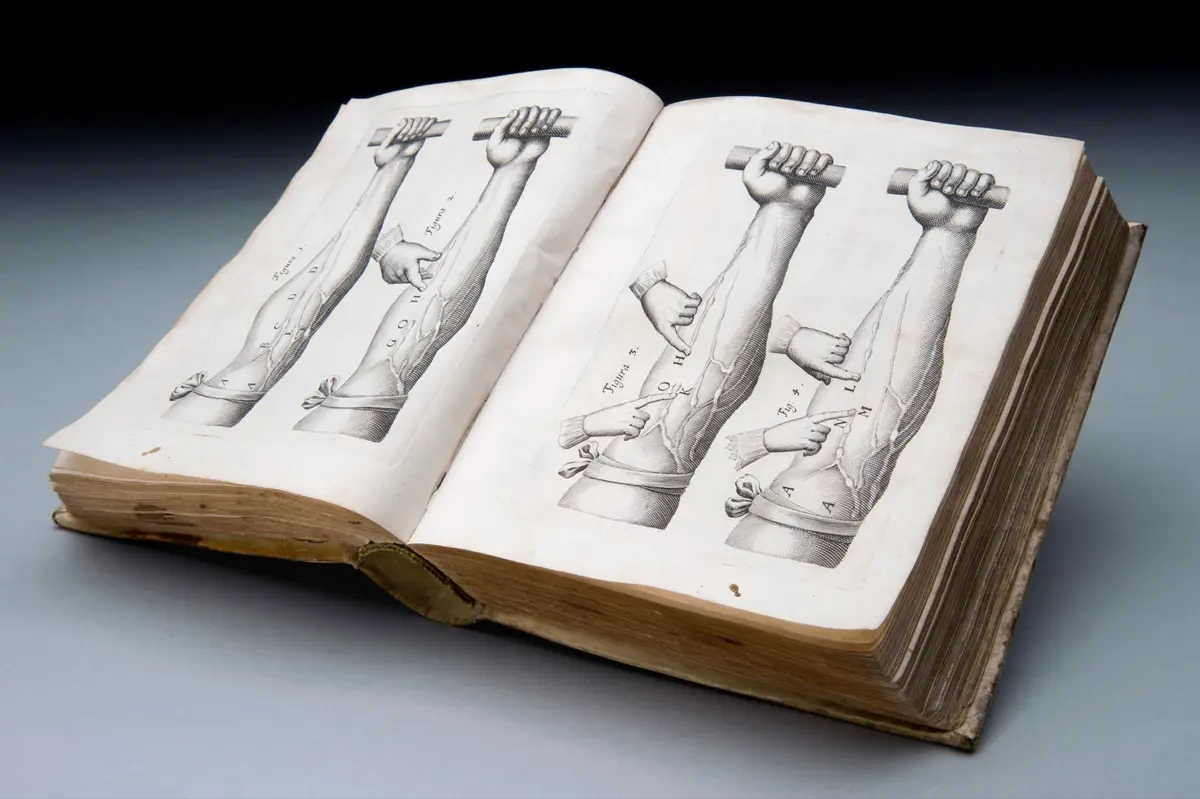
Harvey was born at Folkestone in Kent on 1 April 1578, studied at Gonville and Caius College, Cambridge, and then at Padua, the leading medical school of the day, where his teacher Hieronymus Fabricius described the small valves inside the veins in a book of 1603. Back in London he became a fellow of the College of Physicians, physician to St Bartholomew's in 1609 and, from 1615, the College's lecturer in anatomy and surgery. He seems to have reached the idea of a circulation about 1618–19, and he showed it to his colleagues for 'nine years and more' before he printed it. His case had three strands. Watching the slow hearts of cold-blooded and dying animals, he saw that the heart works when it contracts and squeezes blood out. A simple sum showed that even on the lowest guesses the heart sends more blood into the arteries in half an hour than the whole body holds, so blood cannot be made and used up as fast as that: it must come back. And a band tied round a living arm showed that the valves let the blood in the veins flow only towards the heart.
Conservative physicians attacked the book, among them the French anatomist Jean Riolan, to whom Harvey replied in print in 1649; but in 1637 Descartes praised 'a physician of England' for having broken the ice, and by Harvey's death the circulation was widely accepted. One link was missing: Harvey could never see how blood passes from the smallest arteries to the smallest veins. In 1661, four years after his death, Marcello Malpighi found that network, the capillaries, under the microscope in the lungs of frogs. Thomas Hobbes wrote that Harvey was the only man he knew of who lived to see his new doctrine established.
Harvey's later life was tied to the Stuart court. He was with Charles I at the Battle of Edgehill in 1642, the year parliamentary soldiers ransacked his house in Whitehall and his notes on the generation of insects were lost; at Oxford the king made him warden of Merton College; and in 1651 he published a long book on how animals grow from the egg. In 1654 he gave the College of Physicians a library and museum at Amen Corner, which burned in the Great Fire of 1666. He died at his brother Eliab's house in Roehampton on 3 June 1657, aged 79, and was buried in the family vault at Hempstead in Essex. He had no children.
The Royal College of Physicians says that our understanding of the body has never been the same since, and that the medicine we rely on today would not exist without this book. Yet Harvey was not a modern mechanist. His sums were rough and deliberately cautious, he saw the heart as a living pump rather than a machine, he called it the sun of the body's little world, and he strongly opposed Descartes's picture of the body as a mechanism.
What happened
- 1602
After his years at Padua, the leading medical school of the age, where he heard the anatomist Hieronymus Fabricius, Harvey takes his doctorate. His diploma says he did so well in the examination that he far surpassed what everyone expected of him.
The anatomical theatre in the Palazzo del Bo, University of Padua: where Fabricius taught anatomy and Harvey took his doctorate in 1602- 1603
Fabricius publishes De venarum ostiolis, 'On the little doors of the veins', at Padua: the veins have small valves, which, it was then thought, kept the blood from pooling in the limbs. Harvey later said it was thinking about these valves that led him to the circulation.
The anatomical theatre in the Palazzo del Bo, University of Padua: where Fabricius taught anatomy and Harvey took his doctorate in 1602 - 1604
Settled in London, Harvey is admitted a candidate of the College of Physicians. In November he marries Elizabeth Browne, daughter of the royal physician Launcelot Browne; they will have no children.
- 1607
He becomes a fellow of the College of Physicians, which he will serve for the rest of his life.
- 1609
Elected in February on James I's recommendation, Harvey takes up his post as physician to St Bartholomew's Hospital in Smithfield, which he will hold until 1643.
St Bartholomew's Hospital, Smithfield, London: Harvey was its physician from 1609 to 1643- 1614
The College of Physicians leases a large house at Amen Corner, close to St Paul's Cathedral; Harvey will lecture there.
Amen Corner, by St Paul's, London: the College of Physicians' house from 1614 to the Great Fire, where Harvey lectured and built its library in 1654 - 1615
In late summer the College appoints him Lumleian lecturer in anatomy and surgery, a post held for life; he keeps it until 1656.
- 1616
Harvey gives his first Lumleian lectures, dissecting a body before the fellows of the College. His notes, headed with the year 1616, survive in his own hand, and so does his whalebone pointer.
Amen Corner, by St Paul's, London: the College of Physicians' house from 1614 to the Great Fire, where Harvey lectured and built its library in 1654- 1618
Harvey is now physician extraordinary to James I. About this time, by Britannica's estimate in 1618–19, he arrives at the circulation: a passage of his lecture notes marked 'WH' says that the blood passes from arteries to veins and moves 'in a circle', driven by the heart like the clacks of a water bellows.
Amen Corner, by St Paul's, London: the College of Physicians' house from 1614 to the Great Fire, where Harvey lectured and built its library in 1654 - 1625
Harvey leads the doctors at James I's last illness and stays on as physician to the new king, Charles I, who will let him study the royal deer.
- 1627
The College names him one of its Elects. A portrait of about this year, attributed to Daniel Mytens, shows him as he looked when his book appeared.
- 1628
William Fitzer prints De motu cordis at Frankfurt, seventy-two pages with two plates, dedicated to Charles I and to the College. Harvey writes that he has shown its 'new view' in his lectures for nine years and more.
The book's arguments: the heart drives blood out when it contracts; even on the lowest guesses it pumps more blood in half an hour than the body holds, so the blood must return; and, as a bound arm shows, the valves let blood in the veins run only towards the heart.
- 1636
Travelling as doctor with the Earl of Arundel's embassy to the Emperor Ferdinand II, Harvey tries at Nuremberg to show the circulation to the German professor of medicine Caspar Hofmann.
- 1637
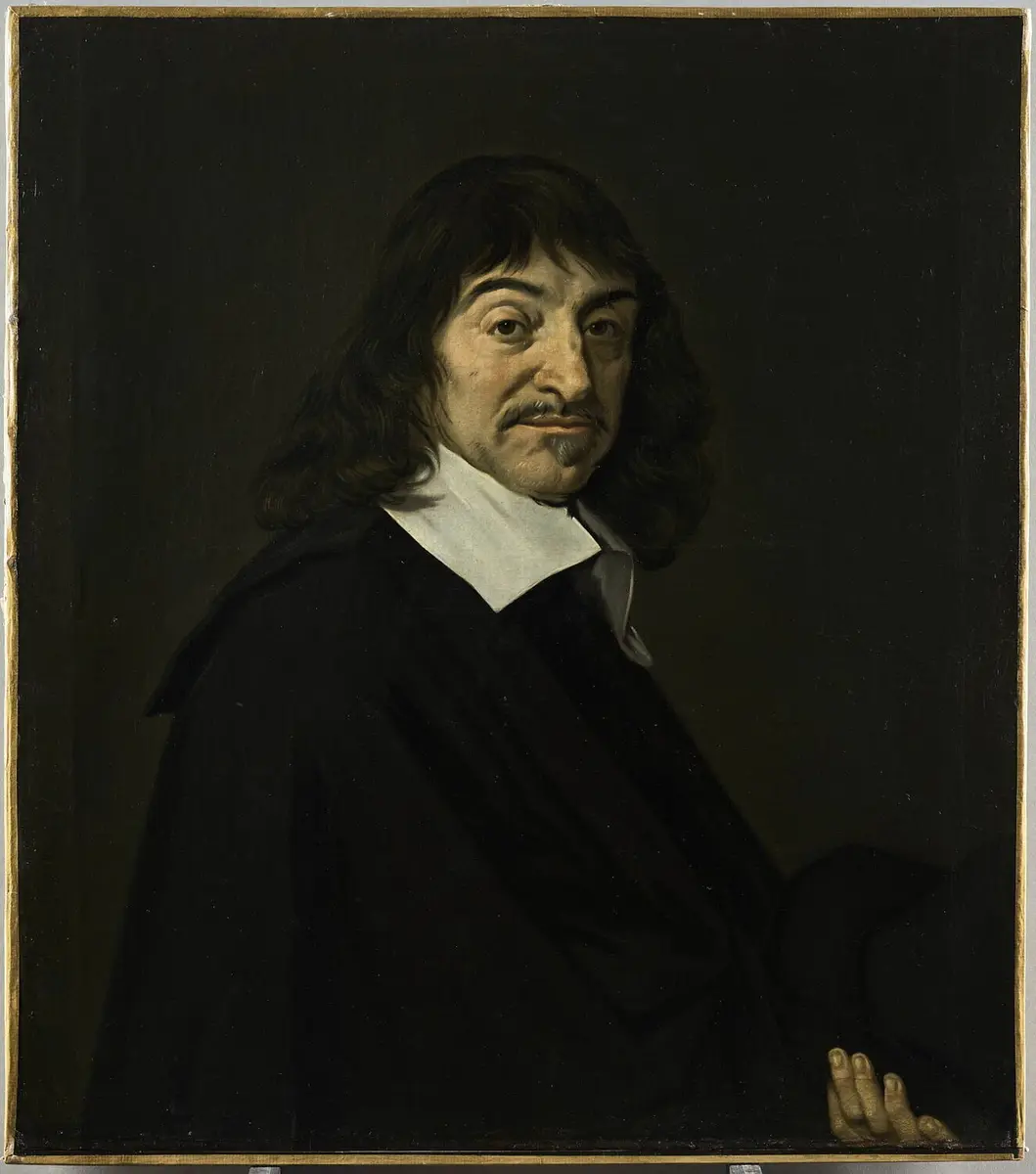
At Leiden, Descartes's Discourse on the Method is printed. In it he credits 'a physician of England' with having broken the ice and taught that the blood passes from the arteries into the veins and back to the heart in a perpetual circulation.
- 1642
At the Battle of Edgehill, Harvey minds the king's sons Charles and James and sits reading under a hedge until a cannon ball grazes the ground near him. The same year parliamentary soldiers ransack his house in Whitehall and his notes on the generation of insects are lost.
- 1645
In royalist Oxford the king has him elected warden of Merton College; he loses the post when Oxford surrenders in 1646 and returns to London in 1647.
- 1649
Harvey answers his chief critic, the Paris anatomist Jean Riolan, in Two Anatomical Exercises on the Circulation of the Blood.
- 1650
At Christmas his friend George Ent finds him at a brother's house near London and persuades him to hand over his papers on generation; Ent leaves 'like another Jason' with the golden fleece.
- 1651
Ent publishes Harvey's Exercitationes de generatione animalium, on how chickens, deer and other animals grow from the egg.
- 1653
The first English translation of De motu cordis is published in London.
- 1654
In a speech to the assembled fellows, Harvey hands over the library and museum he has built for the College at Amen Corner, a classical building with a great parlour below and the library above.
Amen Corner, by St Paul's, London: the College of Physicians' house from 1614 to the Great Fire, where Harvey lectured and built its library in 1654The College elects him President in his absence. The next day he thanks the fellows and declines because of his age and infirmities.
Amen Corner, by St Paul's, London: the College of Physicians' house from 1614 to the Great Fire, where Harvey lectured and built its library in 1654- 1656
Harvey gives the College his family estate at Burmarsh in Kent and hands the Lumleian lectures to Charles Scarburgh, after forty years.
- 1657
Harvey dies of a stroke at his brother Eliab's house in Roehampton, aged 79.
A three-day funeral procession of family and fellows of the College sets out from London for Hempstead in Essex, where he is laid 'lapt in lead' in the family vault that Eliab built in 1655.
St Andrew's Church, Hempstead, Essex: buried in the Harvey family vault in June 1657- 1661
At Bologna, Marcello Malpighi publishes De pulmonibus: under the microscope, in the lungs of frogs, he sees the fine network of capillaries that carries blood from the smallest arteries to the smallest veins, the link Harvey could never see.