Pacioli publishes double-entry bookkeeping
“In 1494 the friar Luca Pacioli printed in Venice the first published guide to double-entry bookkeeping, the merchants' 'method of Venice' of journal, ledger, debits and credits.”
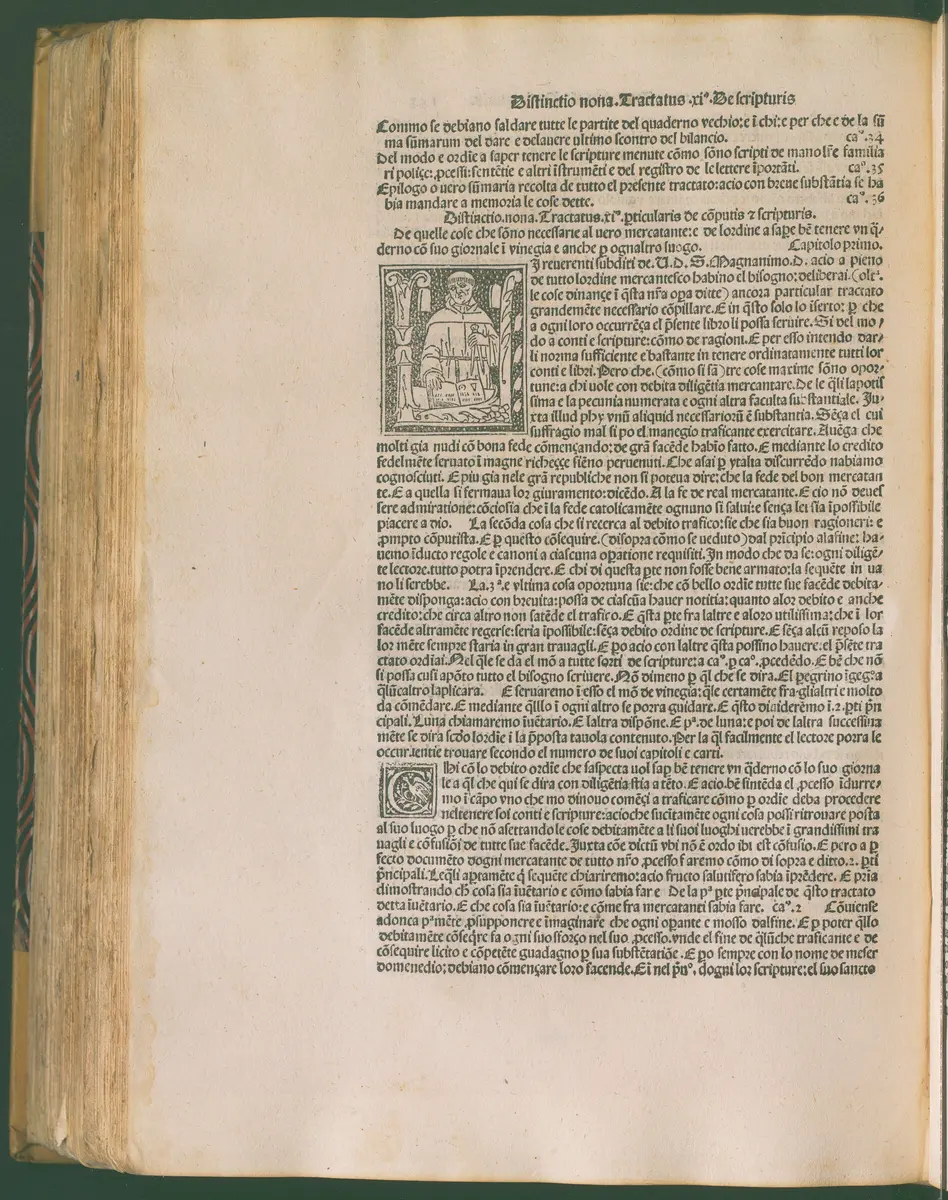
In November 1494 the Venetian printer Paganino de Paganini finished a huge book in Italian by Luca Pacioli, a Franciscan friar and mathematics teacher from the Tuscan town of Sansepolcro: the Summa de arithmetica, geometria, proportioni et proportionalita, more than 600 folio pages that gathered the mathematics of the day, from arithmetic and algebra to coins, weights and measures and Euclid's geometry. Pacioli dedicated it to the young Duke of Urbino, Guidobaldo da Montefeltro, and came to Venice to see it through the press; on the last page he says that he stood by the printers day and night. Inside the business part of the book, a treatise in 36 short chapters, 'Particularis de computis et scripturis' (on accounts and records), explained how a merchant should keep his books in what Pacioli called the method of Venice. It was the first printed description of double-entry bookkeeping.
Pacioli begins with what a merchant needs: money, a good accountant who is quick at figures, and good order in his books. He first takes an inventory of everything he owns, all on one day. Then he keeps three books: the memorandum, where each deal is noted as it happens; the journal, where it is written up in order, the account to be debited after the word 'Per' and the account credited after 'A'; and the ledger, where every entry is posted twice, as a debit in one account on the left-hand page and a credit in another on the right. Because each amount appears on both sides, the two sides must agree; at the closing of the books the totals of debits and credits are checked against each other in a trial balance, and profit and loss are worked out. His examples are dated November 1493, in Venice, and he advises closing the ledger every year.
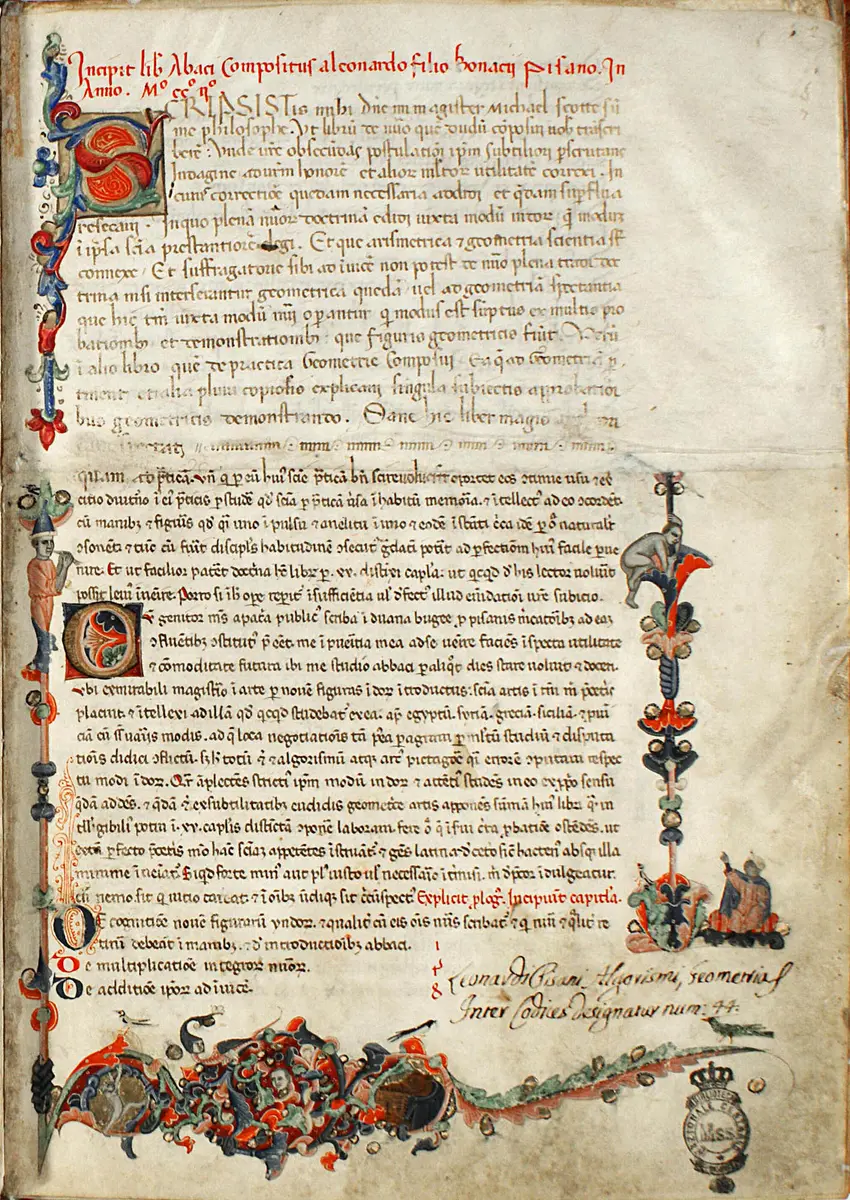
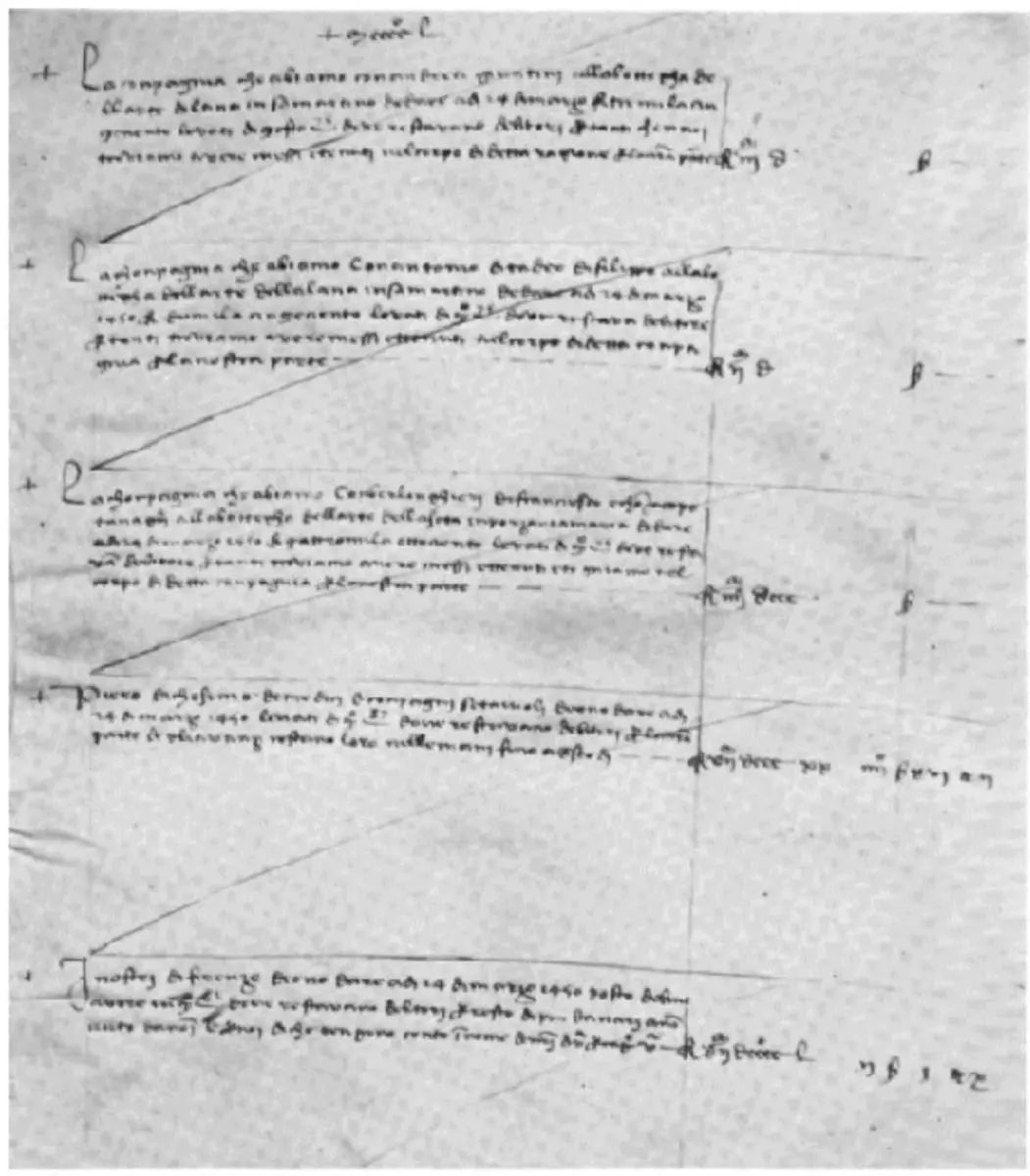
Pacioli did not invent any of this, and never claimed to: he wrote that he followed the Venetian practice because it was the best. Italian merchants and bankers had been working the method out for two centuries. A Florentine company's ledger of 1299–1300 already records each sum twice; the city of Genoa kept its accounts 'after the manner of banks' from about 1327, and its treasurers' ledger of 1340 is the most famous early double-entry book; the merchant Francesco di Marco Datini of Prato (about 1335–1410) had the companies he owned around the western Mediterranean send their ledgers home to him, where most of them survive, and his company at Avignon kept double entry in 1409–1410. Benedetto Cotrugli of Ragusa described the method in a manuscript of 1458, and Marino de Raphaeli wrote a manual for learners in 1475. What Pacioli added was print and plain Italian: a complete guide that any merchant or teacher could buy.
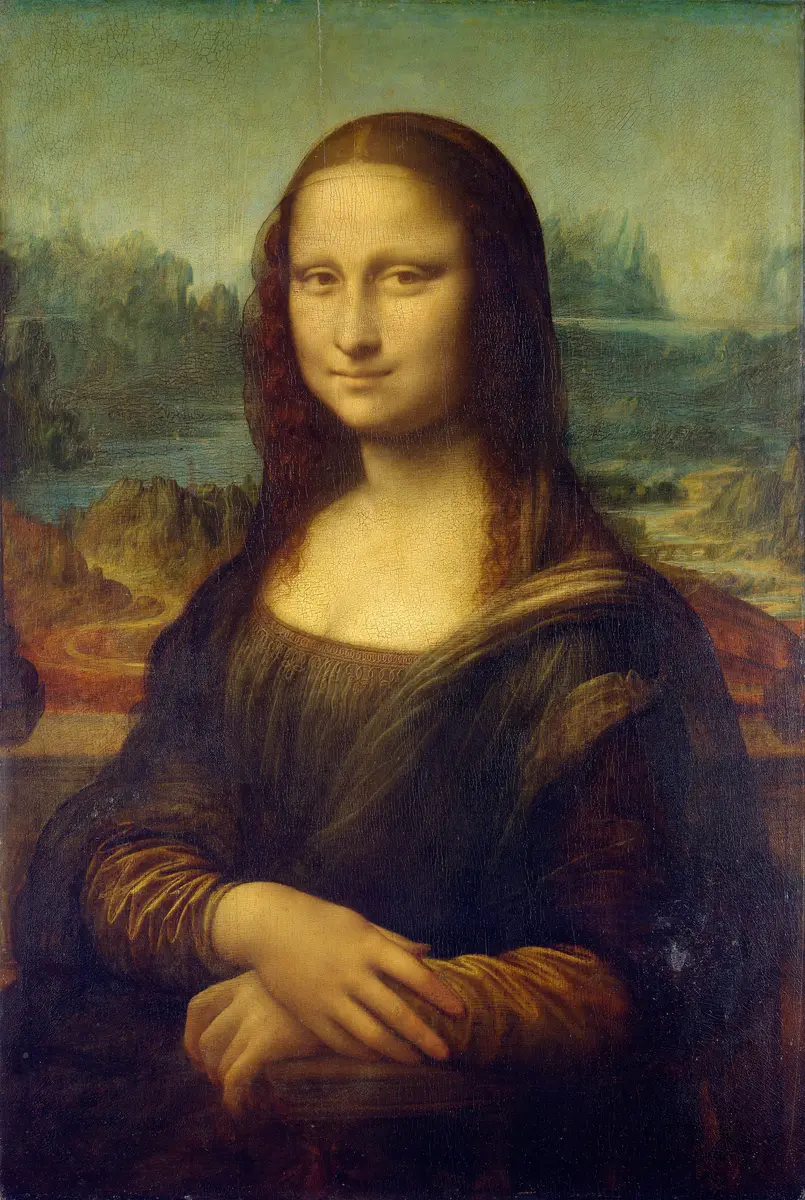
The Summa made Pacioli the best-known mathematics teacher in Italy. In 1495 he was painted demonstrating Euclid beside a young nobleman, and by about 1496 he was teaching at the court of Ludovico Sforza in Milan, where he became the friend of Leonardo da Vinci, who drew the solids for his next book, De divina proportione. When the French took Milan in 1499 the two men left together for Florence. In 1508 Pacioli lectured in the church of San Bartolomeo by the Rialto, and in 1509 Paganini printed De divina proportione and his Latin Euclid. He died in Sansepolcro in 1517. The treatise outlived him: the Summa was reprinted in 1523, Domenico Manzoni rewrote its bookkeeping in Venice in 1540, Jan Ympyn adapted it in Antwerp in 1543 in Dutch and French, and the first English books followed, Hugh Oldcastle's of 1543, now lost, Ympyn's English version of 1547 and James Peele's of 1553.
For two centuries almost every bookkeeping manual in Europe came down from Pacioli's chapters, and the method has hardly changed since. Every company, bank and government still records each transaction twice, as a debit and a credit, so that the books balance and mistakes show, and the system he set out already held most of the accounting cycle used today. Accountants call him the father of accounting. In 1994 they gathered in Sansepolcro for the Summa's 500th anniversary, and his statue there, inscribed 'Summa 1494 1994', was raised by his fellow citizens and the accounting schools of Japan.
What happened
- 1494
Pacioli brings the finished Summa from Sansepolcro to Venice to see it through the press of Paganino de Paganini, with a dedication to the young Duke of Urbino, Guidobaldo da Montefeltro.
The Rialto, Venice: the merchants' quarter of the city whose 'method' Pacioli printed in 1494, and where he had studied mathematics as a young manThe last part, the geometry, comes off the press. The colophon names the printer, Paganino de Paganini of Brescia, the Doge, Agostino Barbarigo, and a privilege that bars anyone else from reprinting the book for ten years; Pacioli says he stood by the printers day and night.
The Rialto, Venice: the merchants' quarter of the city whose 'method' Pacioli printed in 1494, and where he had studied mathematics as a young manThe first part, the arithmetic, is finished too, and with it the treatise 'Particularis de computis et scripturis': the first printed account of double entry, the method of Venice of inventory, memorandum, journal and ledger, debits and credits.
The Rialto, Venice: the merchants' quarter of the city whose 'method' Pacioli printed in 1494, and where he had studied mathematics as a young man- 1495
Pacioli is painted in his friar's habit, teaching Euclid beside a young nobleman, in the portrait dated 1495 and attributed to Jacopo de' Barbari.
- 1496
Invited by Ludovico Sforza, Pacioli moves to Milan to teach mathematics at his court and becomes the friend of Leonardo da Vinci, in the duke's service since 1482.
Castello Sforzesco, Milan: Ludovico Sforza's court, where Pacioli taught from about 1496 and met Leonardo - 1498
A learned debate is held before the duke in the castle of Milan, as Pacioli's dedication tells; out of it grows De divina proportione, finished that year in a presentation copy for Ludovico with drawings of sixty solids after Leonardo's designs.
Castello Sforzesco, Milan: Ludovico Sforza's court, where Pacioli taught from about 1496 and met Leonardo- 1499
Three months after the French take Milan, Pacioli and Leonardo leave the city together, by way of Mantua and Venice, for Florence.
- 1500
In Florence Pacioli is appointed to teach Euclid at the University of Pisa, which has moved there, and shares lodgings with Leonardo; he teaches there until 1506.
Florence: Pacioli taught Euclid here from 1500 to 1506 and shared lodgings with Leonardo - 1508
Back in Venice, Pacioli lectures on the fifth book of Euclid to a large audience in the church of San Bartolomeo by the Rialto; a few months later the Republic grants him the sole right to print his works for fifteen years, the Summa among them.
Church of San Bartolomeo by the Rialto, Venice: Pacioli's lecture on Euclid of 11 August 1508- 1509
Paganini prints De divina proportione in Venice, with woodcuts of the solids and Pacioli's Roman alphabet; his Latin Euclid appears the same year.
The Rialto, Venice: the merchants' quarter of the city whose 'method' Pacioli printed in 1494, and where he had studied mathematics as a young man