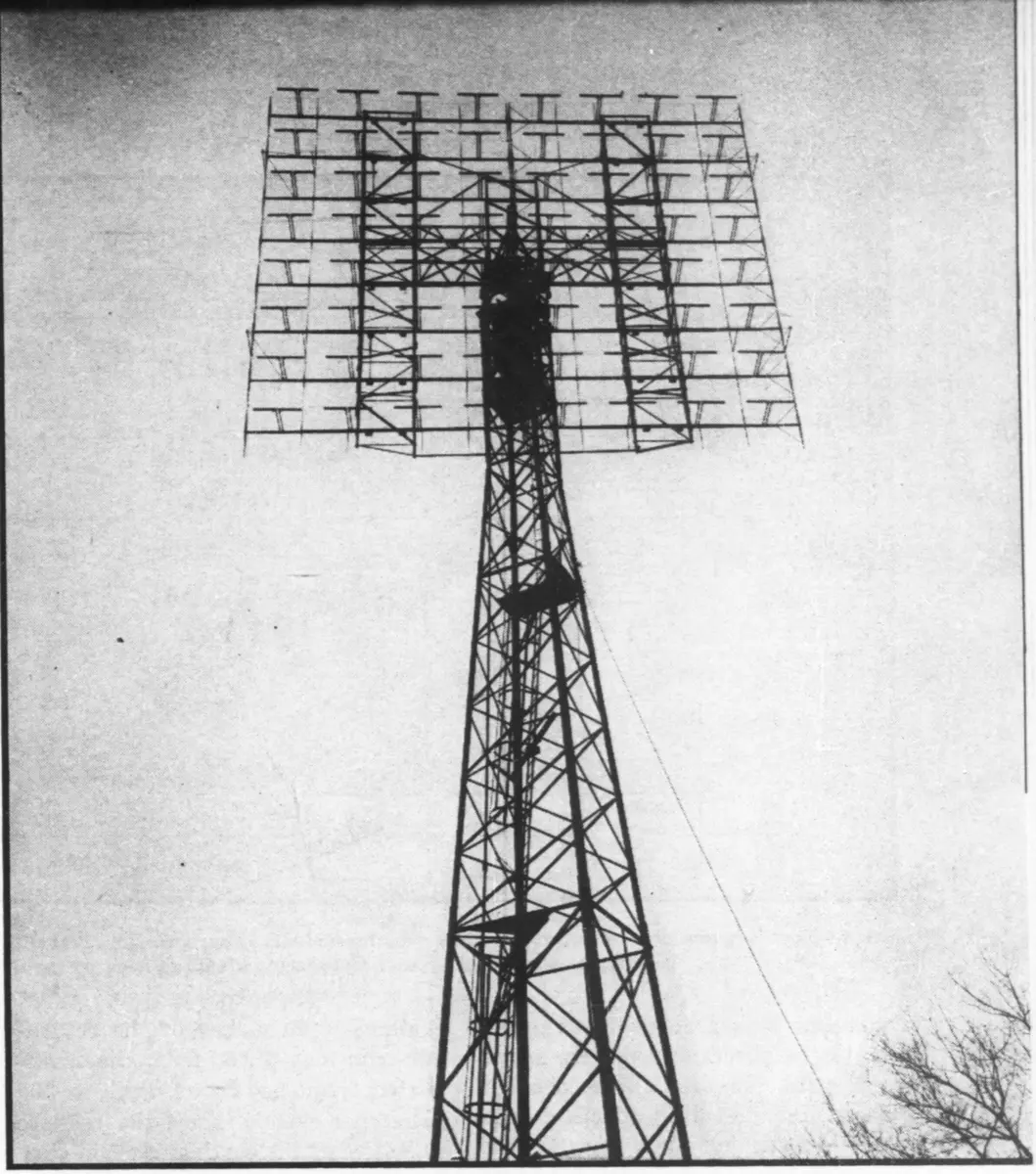
Project Diana bounces radar off the Moon
“On 10 January 1946 a US Army team at Camp Evans, New Jersey, bounced radar pulses off the Moon and caught the echoes 2.5 seconds later: the first signal sent to another world and back, and the start of radar astronomy.”
Project Diana was the first time people sent a radio signal to another world and heard it come back. At 11:58 in the morning of 10 January 1946, at the US Army Signal Corps' Evans Signal Laboratory at Camp Evans near Belmar, New Jersey, a small team watched a faint pip rise out of the noise on a nine-inch cathode-ray tube and heard it as a short beep from a loudspeaker. It came about 2.5 seconds after each pulse went out: the time a radio wave needs to travel to the Moon, some 384,000 kilometres away, and back. The Moon had risen at 11:48; at 12:09 it drifted out of the beam, and the first session was over. The project's leader, Lieutenant Colonel John H. DeWitt Jr., missed it: he had gone into Belmar for lunch and cigarettes.
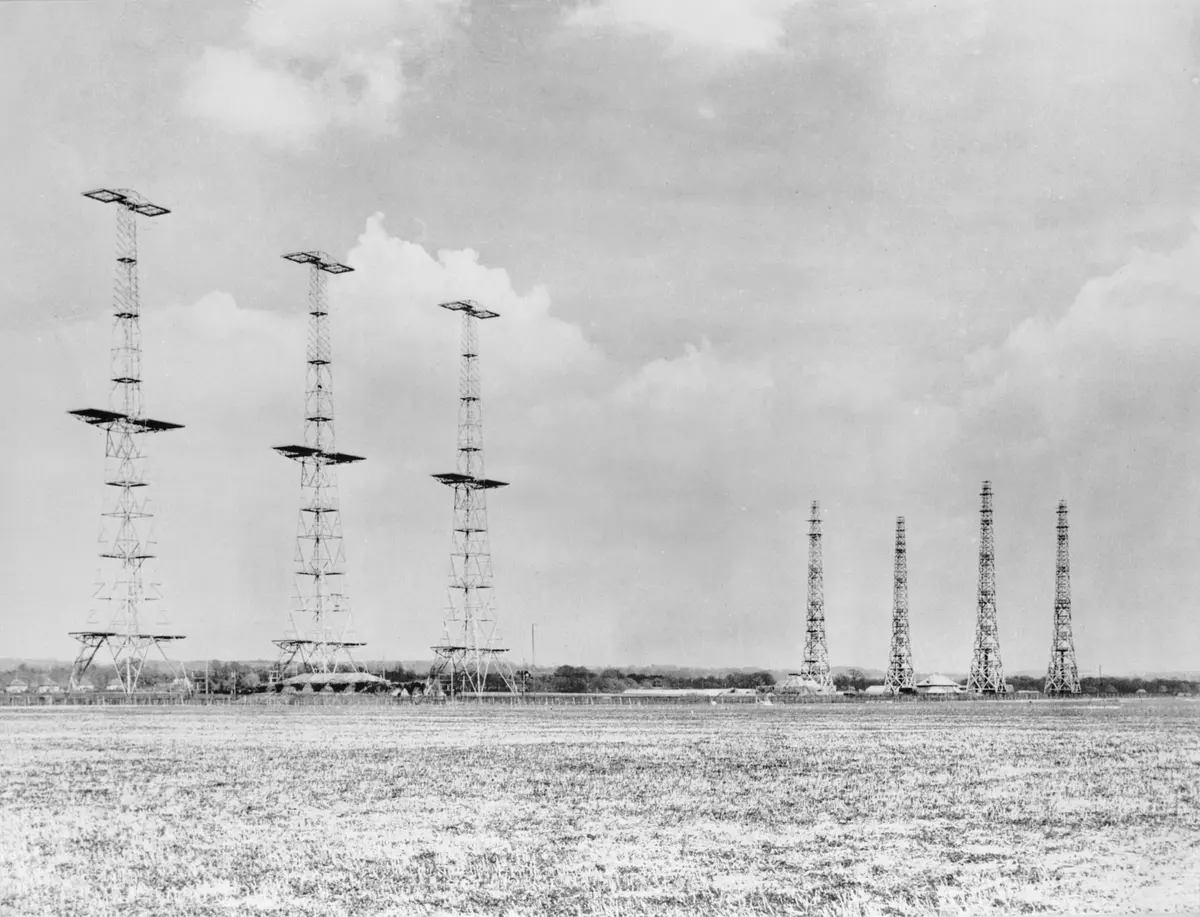
DeWitt, a radio engineer from Nashville, had tried the same thing in May 1940 with the transmitter of his radio station, WSM, and failed for lack of a sensitive enough receiver. As director of the laboratory at the end of the war he took it up again in September 1945, named it after Diana, the Roman goddess of the Moon, and gathered four civilian radar engineers: E. King Stodola, Dr Harold D. Webb, Herbert P. Kauffman and Jacob Mofenson; the mathematician Walter S. McAfee calculated how much of the signal the Moon would reflect. Nothing was built new. The aerial was two 'bedspring' antennas from a wartime SCR-271 early-warning radar, mounted side by side on a 100-foot tower: 64 dipoles that could turn left and right but not tilt, so they could only catch the Moon as it rose or set. Into it went quarter-second pulses at 111.5 megacycles, every four seconds, from a crystal-controlled transmitter that the FM pioneer Edwin H. Armstrong had designed for the Signal Corps; the same crystal kept the very narrow receiver in tune, and each session the team retuned it for the Doppler shift caused by the Earth's turning and the Moon's motion. The first tests in December 1945 failed, with burnt-out valves and oscillators that would not oscillate.
The Army had its own reason to pay for an astronomer's dream. The German V-2 had shown that rockets could climb far above the atmosphere, and the Chief Signal Officer wanted radars able to see missiles coming from the Soviet Union. Nobody knew whether radio waves could get through the charged layers of the upper atmosphere, the ionosphere, and there were no missiles to test on, so the Moon stood in for one. The War Department waited two weeks to be sure. When two outside scientists from MIT's Radiation Laboratory, George Valley and Donald Fink, came with General Van Deusen to watch, nothing happened, until a heavy truck rumbled past and the echoes popped up, probably because a crystal had been shaken into life. The news broke on the night of 24 January and ran on front pages the next morning; Life, Time and Newsweek followed, the War Department talking of mapping the planets and steering rockets from Earth.
Diana proved that radio could pass through the ionosphere and come back from space. It is counted as the birth of radar astronomy, which later measured the distance to Venus and the size of the solar system, mapped planets and asteroids, and of Earth–Moon–Earth or 'moonbounce' communication: the US Navy relayed messages by the Moon from the 1950s until satellites took over, and radio amateurs still do it. Less than a month after DeWitt, on 6 February 1946, the Hungarian physicist Zoltán Bay detected Moon echoes in Budapest with home-built equipment; his radar was too weak to show them directly, so he added up many faint returns in a chemical counter, the idea of 'integration' that made later planetary radar possible. The site of the Diana antenna is now part of the Camp Evans Historic District and the InfoAge Science History Center, where an IEEE Milestone plaque was dedicated in 2019.
What happened
- 1946
- 11:48 a.m.
The Moon rises over the New Jersey coast. The team at Camp Evans has turned the antenna, which cannot tilt, to the point on the horizon where it will appear, and starts sending quarter-second pulses at 111.5 megacycles every four seconds.
Site Diana, Camp Evans, Wall Township, New Jersey: where the antenna tower stood and the first Moon echoes were received - 11:58 a.m.
The first echoes come back: a pip on the nine-inch screen and a 180-cycle beep in the loudspeaker, about 2.5 seconds after each pulse, the round trip to the Moon. John DeWitt is not there; he is having lunch and buying cigarettes in Belmar.
Site Diana, Camp Evans, Wall Township, New Jersey: where the antenna tower stood and the first Moon echoes were received - 12:09 p.m.
The Moon moves out of the antenna's beam and the first session ends.
Site Diana, Camp Evans, Wall Township, New Jersey: where the antenna tower stood and the first Moon echoes were received The team repeats the experiment the next day, and again on each of the two days after; by the end of the month it has listened on eight more days, at moonrise and moonset. Not every pulse brings an echo back.
Site Diana, Camp Evans, Wall Township, New Jersey: where the antenna tower stood and the first Moon echoes were receivedAt moonrise the echo is photographed on the screen, about three times as strong as the noise. With a Doppler shift of 227 cycles to allow for, this is the trace the magazines will print around the world.
Site Diana, Camp Evans, Wall Township, New Jersey: where the antenna tower stood and the first Moon echoes were receivedSure at last, after outside scientists from MIT's Radiation Laboratory have seen the echoes for themselves, the War Department releases the news in the evening: 'the Signal Corps was certain beyond doubt that the experiment was successful'.
The story leads the front page of The New York Times and fills newspapers across the country; Sky and Telescope writes that the papers 'were ablaze' with it.
Cinema audiences see it in Universal's newsreel 'Radar makes round trip to Moon': the screen with the signal, and DeWitt explaining what it means.
Life ('Man Reaches Moon with Radar'), Time and Newsweek all carry the story; Newsweek calls the War Department's talk of mapping planets and steering rockets from Earth worthy of Jules Verne.
In Budapest, Zoltán Bay's team at the Tungsram research laboratory detects Moon echoes at night with a 120-megacycle radar built anew in the laboratory's workshops, after the Soviets had carried off the first set. Too weak to see directly, the echoes are added up in ten hydrogen coulometers, the first use of integration in radar astronomy.
The Tungsram works in Újpest, Budapest: where Zoltán Bay's laboratory detected Moon echoes on 6 February 1946The team publishes: Jack Mofenson's technical account 'Radar Echoes from the Moon' appears in Electronics, and Radio News calls it the most outstanding scientific achievement since the atomic bomb.
Bay's team repeats its Moon experiment in Budapest, again at night, when the factory's electrical noise is lowest.
The Tungsram works in Újpest, Budapest: where Zoltán Bay's laboratory detected Moon echoes on 6 February 1946