Sumerians count in 60s
“From about 3300 BCE scribes in southern Iraq counted in sixties; by 2000 BCE this was a place-value system, which Babylonian and Greek astronomers passed on to our minutes, seconds and degrees.”
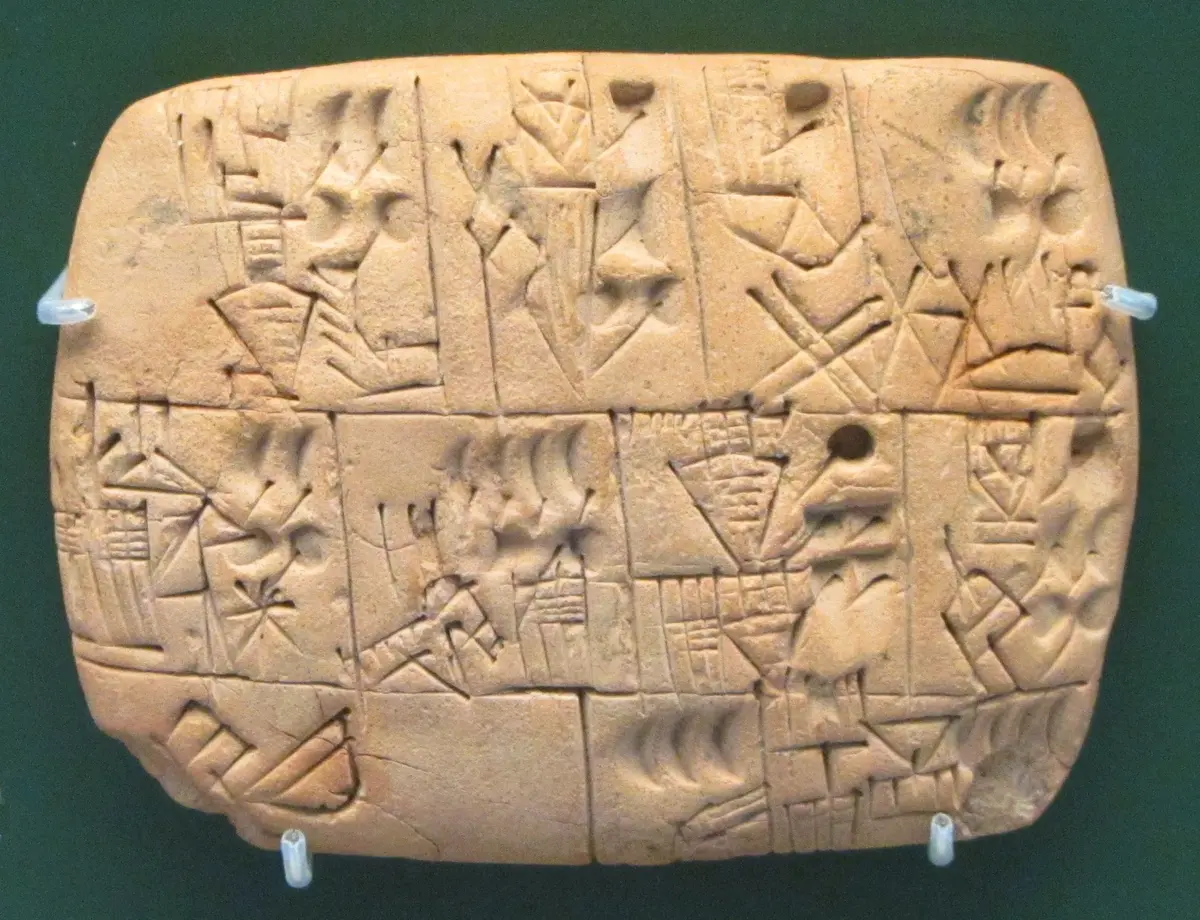
More than five thousand years ago, the accountants of Uruk in southern Iraq counted people, sheep, fish, tools and pots in sixties. On the oldest clay tablets, from about 3300 BCE, a small wedge-shaped dent meant one, a small circle ten, a large dent sixty, a large dent with a circle inside six hundred and a large circle 3,600: the steps went by ten and by six in turn. This was only one of about a dozen ways of counting. Barley, for example, had signs of its own, and the same small circle could mean six, ten or eighteen units, depending on what was being counted. The sixties system was the one that lasted. Nobody knows why sixty was chosen. It divides evenly by 2, 3, 4, 5, 6, 10, 12, 15, 20 and 30, which makes fractions easy, but that may be a result rather than the reason; others link it to the way weights and measures were split into thirds.
The great step came about four thousand years ago. Around 2050 BCE, in the tightly run kingdom of the Third Dynasty of Ur, whose king Shulgi had reformed weights and measures, scribes began to write numbers for calculation with just two signs: an upright wedge for one and a corner wedge for ten. Where a sign stood gave its value, as in our decimal numbers, so the same wedge could mean 1, 60, 3,600 or one sixtieth. There was no zero and no mark for where the whole number ended, so the reader had to know from the problem how big a number was. Scribes did their sums in this notation on rough tablets and then turned the answers back into ordinary measures of grain, silver or land.
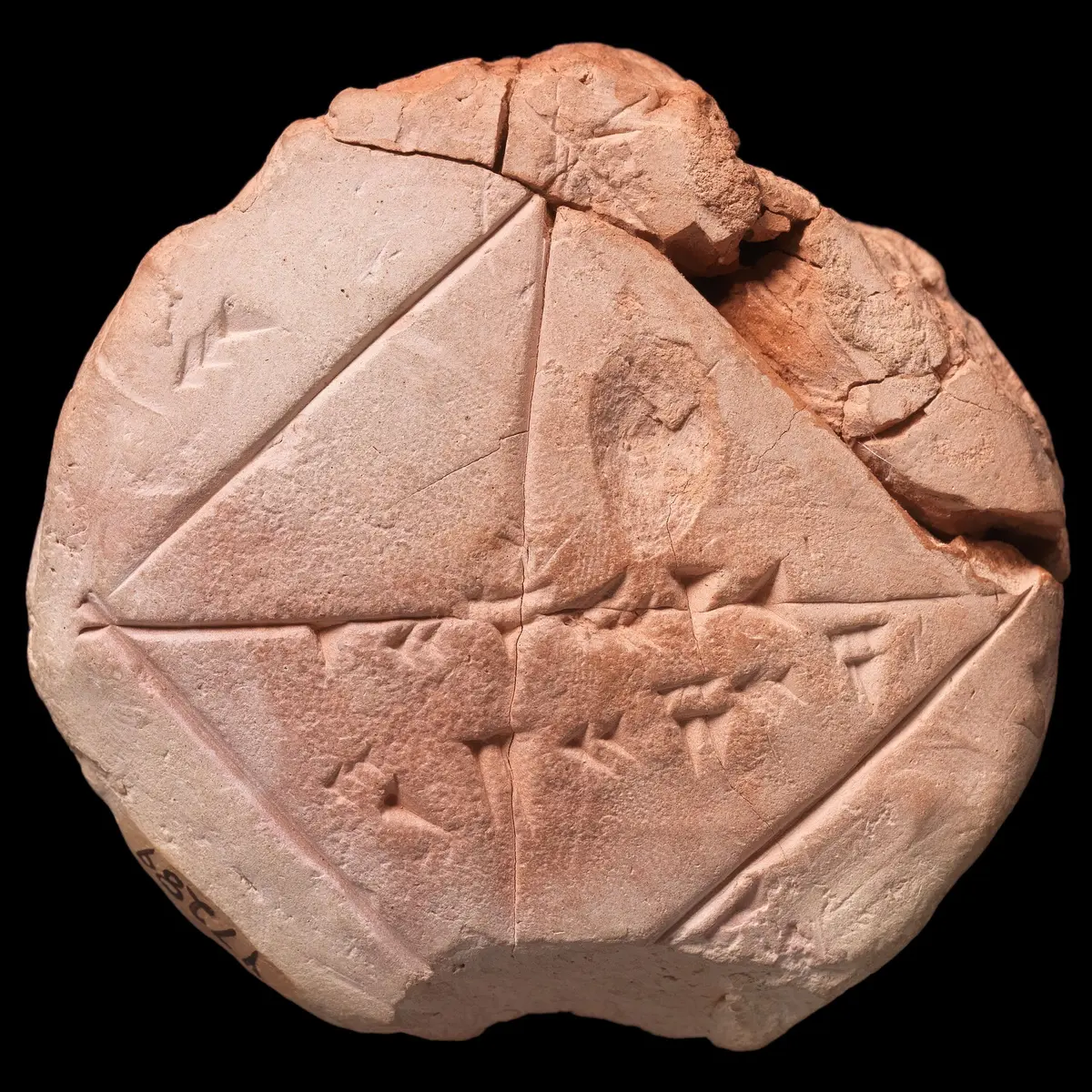
In the schools of the Old Babylonian period, about 1900 to 1600 BCE, pupils at Nippur, Ur and Larsa learned multiplication tables and tables of reciprocals by heart. To divide, they multiplied by a reciprocal: dividing by 4 meant multiplying by 15, because 4 times 15 makes 60. Numbers such as 7, which do not go evenly into sixty, have no exact reciprocal, so the tables leave them out. The best students went much further. A round school tablet now at Yale, YBC 7289, gives the square root of 2 as 1;24,51,10, wrong by less than a millionth, and a tablet from Larsa, Plimpton 322, lists fifteen right-angled triangles whose sides are whole numbers, more than a thousand years before Pythagoras.
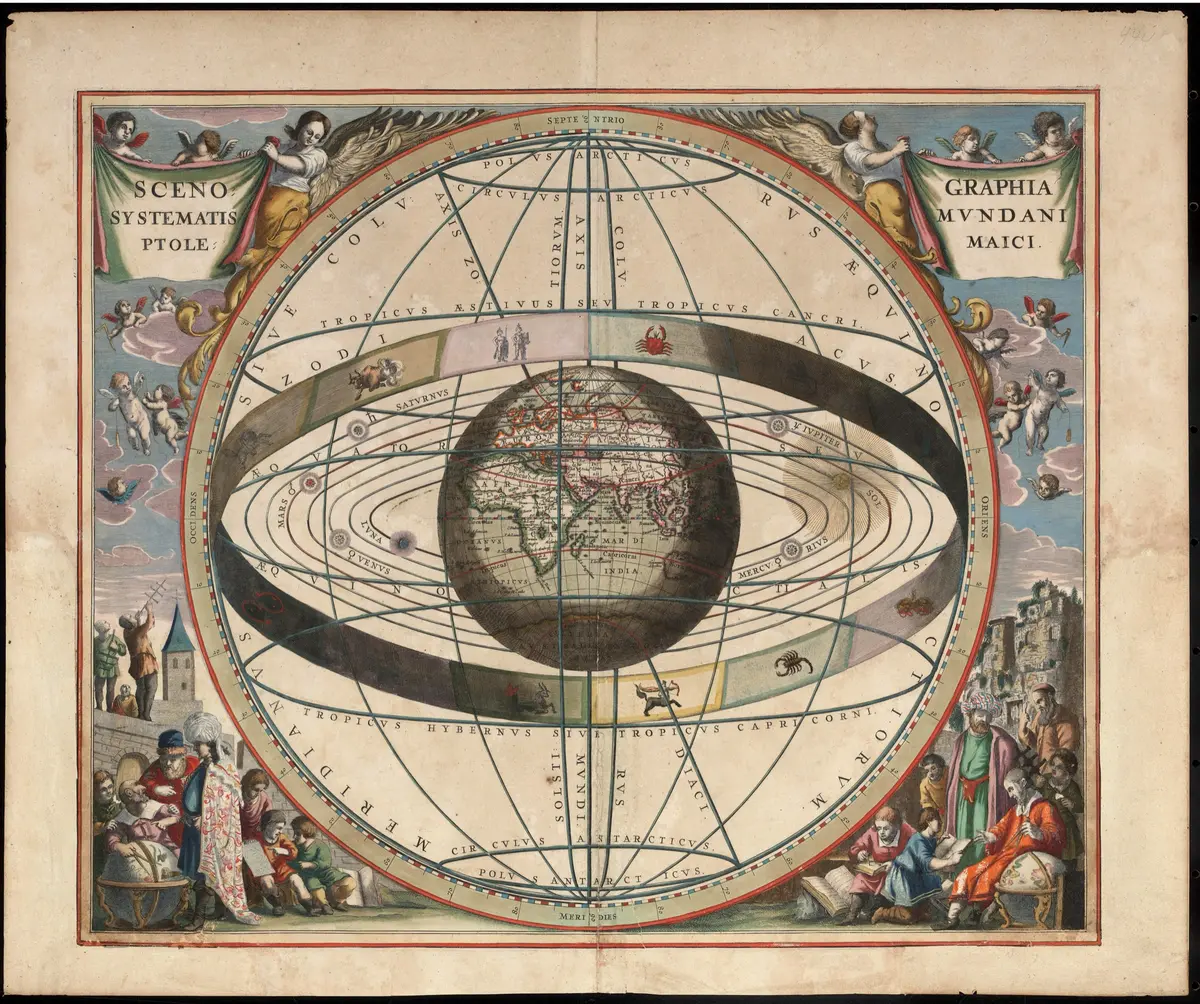
Our 60 minutes and 360 degrees came later, by a longer road than the popular story tells. The Old Babylonian scribes had no hour of sixty minutes and no idea of measuring angles. A thousand years later, Babylonian astronomers, who kept regular records of the sky from the 8th century BCE, still calculated in sixties, and in the 5th century BCE they divided the zodiac into twelve signs of 30 degrees each, 360 in all, the number of days in the ideal year of their older star lists. Greek astronomers took over both the degrees and the fractions in sixtieths: Hipparchus in the 2nd century BCE, then Ptolemy around 150 CE, who split every degree into 60 parts and each part into 60 again. Latin translators called these the 'first small parts' and the 'second small parts': minutes and seconds. The 24 hours of the day came from Egypt, and clocks began to show minutes only in the late 16th century.
Base sixty is still in daily use, in every clock, compass bearing and map coordinate. Its other gift was place value itself. Babylonian scribes added a sign for an empty place by about 400 BCE, Ptolemy used a small circle for it, and Indian mathematicians later joined place value to ten digits and a true zero, the way the world writes numbers now. The tablets themselves were understood again only in the 20th century: Otto Neugebauer and Abraham Sachs published YBC 7289 and Plimpton 322 in 1945, and scholars such as Eleanor Robson have since shown that they belonged to ordinary school mathematics.
What happened
- 3300 BCE
At Uruk, the largest city of its time, temple accountants press numbers into clay with a round stylus. People, animals, dried fish, tools and pots are counted in a system of steps of ten and six: 1, 10, 60, 600, 3,600 and 36,000.
Uruk (Warka): the oldest tablets with numbers counted in sixties, about 3300 BCE - 3200 BCE
The archaic tablets use about sixty number signs in about a dozen systems, each for its own kind of thing. In one grain account, eleven wedges add up to one circle and five wedges, so for barley a circle is six wedges, while for sheep or people it is ten.
- 3000 BCE
Tablets of the same kind are written at Jemdet Nasr in central Iraq. One list of goods records, among other things, thirty sheep as three small circles.
Jemdet Nasr: archaic accounts of about 3000 BCE in central Iraq - 2600 BCE
At Shuruppak scribes write the oldest known multiplication table, the areas of square fields, and set pupils an invented problem: how many men can be fed from a granary at seven measures each? The answer, 164,571 men with three measures left over, is written in the sixties system; one pupil gets it wrong.
Shuruppak (Fara): the oldest known multiplication table and school problems, about 2600 BCE - 2300 BCE
Under the kings of Akkad, a dozen school problems about square and rectangular fields survive. Some scholars, Marvin Powell and Robert Whiting among them, think they were worked out in an early place-value notation; others are not convinced.
- 2070 BCE
Around the middle of his reign, King Shulgi of Ur reforms the state: weights and measures, the calendar, writing and accounting. Official weights such as a half-mina stone dedicated to the moon god Nanna are 'verified' in the temple at Ur, and his hymns boast of his skill at reckoning.
Ur: King Shulgi's capital, where place-value numbers appear about 2050 BCE, and a house with school tablets of about 1750 BCE - 2050 BCE
Place-value numbers appear: one upright wedge for 1 and one corner wedge for 10, each worth sixty times more one column to the left. Scribes of the Ur state do their sums this way on rough tablets that are then wiped, and copy only the results into the accounts.
Ur: King Shulgi's capital, where place-value numbers appear about 2050 BCE, and a house with school tablets of about 1750 BCE - 1900 BCE
In the Old Babylonian schools of Nippur, Ur and Larsa, pupils learn by heart the thirty standard pairs of reciprocals from 2 to 81 and long series of multiplication tables, because every division is done by multiplying by a reciprocal.
Nippur: the city of the god Enlil, whose schools left the most mathematical exercises - 1800 BCE
At Larsa, a scribe who knows the format of the temple's administrative tables writes Plimpton 322: fifteen right-angled triangles with whole-number sides, worked out in base sixty, probably from pairs of reciprocals.
Larsa (Tell Senkereh): where Plimpton 322 was probably written, about 1800 BCE - 1763 BCE
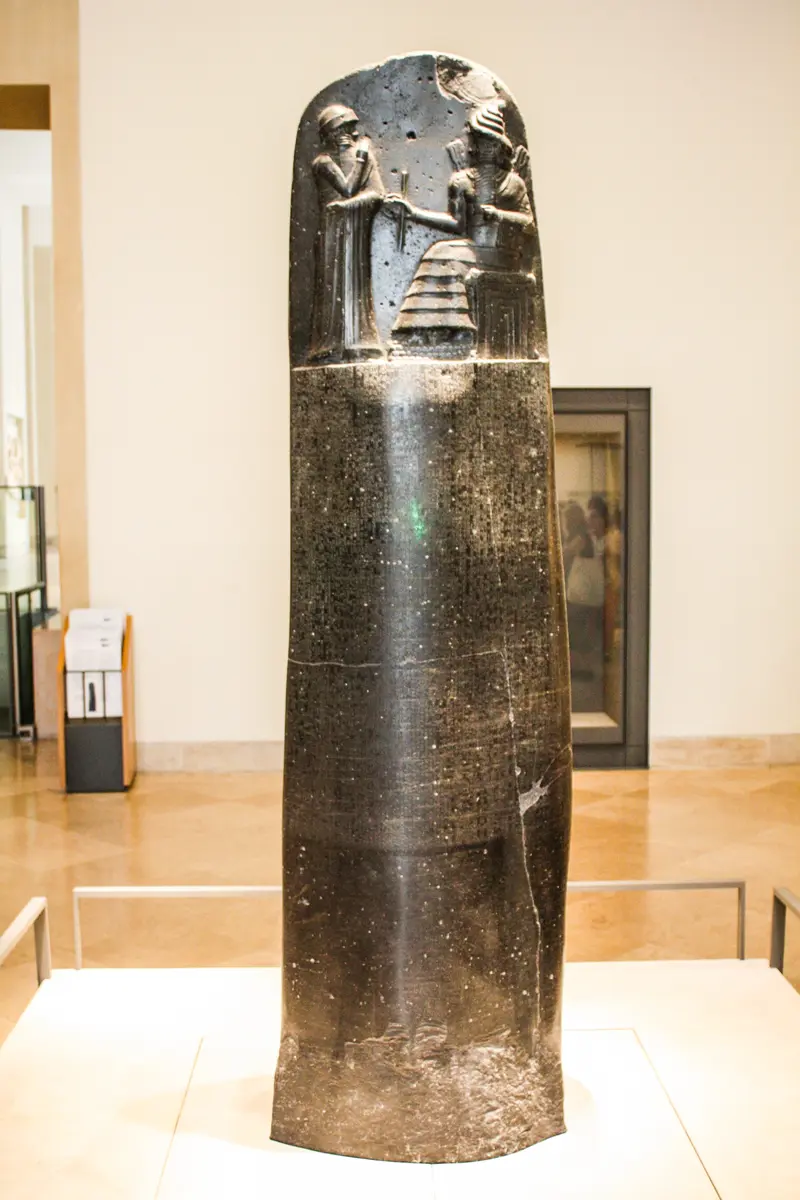
Hammurabi of Babylon takes Nippur and, a few weeks later, Larsa, in the thirtieth year of his reign. The south's schools now lie in his kingdom, and its mathematics is later called Babylonian after his city.
Larsa (Tell Senkereh): where Plimpton 322 was probably written, about 1800 BCE - 1740 BCE
In House F, a small house at Nippur used as a school in the early years of Hammurabi's son Samsu-iluna, pupils leave about 120 mathematical tablets. One squares 16 40 and checks the square root, slipping by a sexagesimal place on the way.
Nippur: the city of the god Enlil, whose schools left the most mathematical exercises - 1738 BCE
Ur is abandoned in Samsu-iluna's twelfth year. In the house at No. 7 Quiet Street, a family of priests had kept school texts of advanced training; at Nippur, House F already lies in ruins after an economic crisis the year before.
Ur: King Shulgi's capital, where place-value numbers appear about 2050 BCE, and a house with school tablets of about 1750 BCE - 1720 BCE
Nippur is abandoned for a long time, after political unrest and a change in the climate; the southern schools' tablets stay buried under its houses.
Nippur: the city of the god Enlil, whose schools left the most mathematical exercises - 1700 BCE
Some time in the Old Babylonian period a pupil draws a square with its diagonals on a small round tablet, YBC 7289, and writes the square root of 2 as 1;24,51,10: wrong by less than one millionth.
- 1595 BCE
The Old Babylonian period ends with the fall of Samsu-ditana, last king of Hammurabi's dynasty. Base sixty outlives it: scribes and, later, astronomers go on calculating in sixties until cuneiform dies out around the turn of the era.