Sweden's Riksbank: the oldest central bank still running
“In 1668 Sweden's Estates took over the failed Stockholms Banco, which had issued Europe's first banknotes, and made it their own bank, out of the king's reach: the Riksbank, the oldest central bank still running.”
On 17 September 1668 the government of Sweden, ruling for the boy king Karl XI, handed what was left of the country's first bank over to the Riksdag, the parliament of the four Estates. Renamed Riksens Ständers Bank, the Bank of the Estates of the Realm, it belonged to three of them: the nobility, the clergy and the burghers. The peasants wanted nothing to do with it. Its board was chosen by the Estates, not by the king, so that the crown could not simply help itself to the depositors' money. The Riksdag closed on 22 September, the date to which the bank's rules were backdated and the day the bank still keeps as its birthday, and on 1 October the last papers were signed. Since 1867 it has been called Sveriges Riksbank, and it is the oldest central bank in the world that is still at work.
The new bank was built from the ruins of an older one. Sweden had been on a copper standard since 1624: its mines, Falun above all, produced two thirds of Europe's copper, and from 1644 the state also struck big copper plates as money, the largest of which, worth ten daler, weighed almost 20 kilograms. In November 1656 King Karl X Gustav gave Johan Palmstruch, a merchant from Riga who had lived in Amsterdam, home of Europe's model exchange bank, a charter for an exchange bank and a loan bank in Stockholm. Stockholms Banco opened on 29 July 1657. Merchants left their heavy plates there and paid each other by transfer, and the bank soon lent out the deposits as well. When the government cut the copper in new plates in 1660, depositors rushed to take their old, heavier ones back. Palmstruch's answer, in the summer of 1661, was the kreditivsedel, a printed note that promised to pay the bearer a sum in coin on demand. Unlike earlier receipts it was not tied to any deposit; it rested only on trust in the bank. These were the first banknotes in Europe.
They were a success, then a disaster. The bank now lent in notes instead of coin, and in 1663 the crown, the chancellor Magnus Gabriel De la Gardie and the tar company alone borrowed nearly a million daler in copper money. By September the bank had almost no cash left, the notes changed hands at 6 to 10 per cent below their face value and prices rose: Sweden's first inflation. The Council of State opened an inquiry in October 1663, the Riksdag of 1664 ordered the loans called in and the notes withdrawn, and the winding-up was finished early in 1668. In July 1668 the Svea Court of Appeal dismissed Palmstruch and ordered him to make good the losses or be put to death. He was spared, but stayed in prison until 1670 and died in 1671.
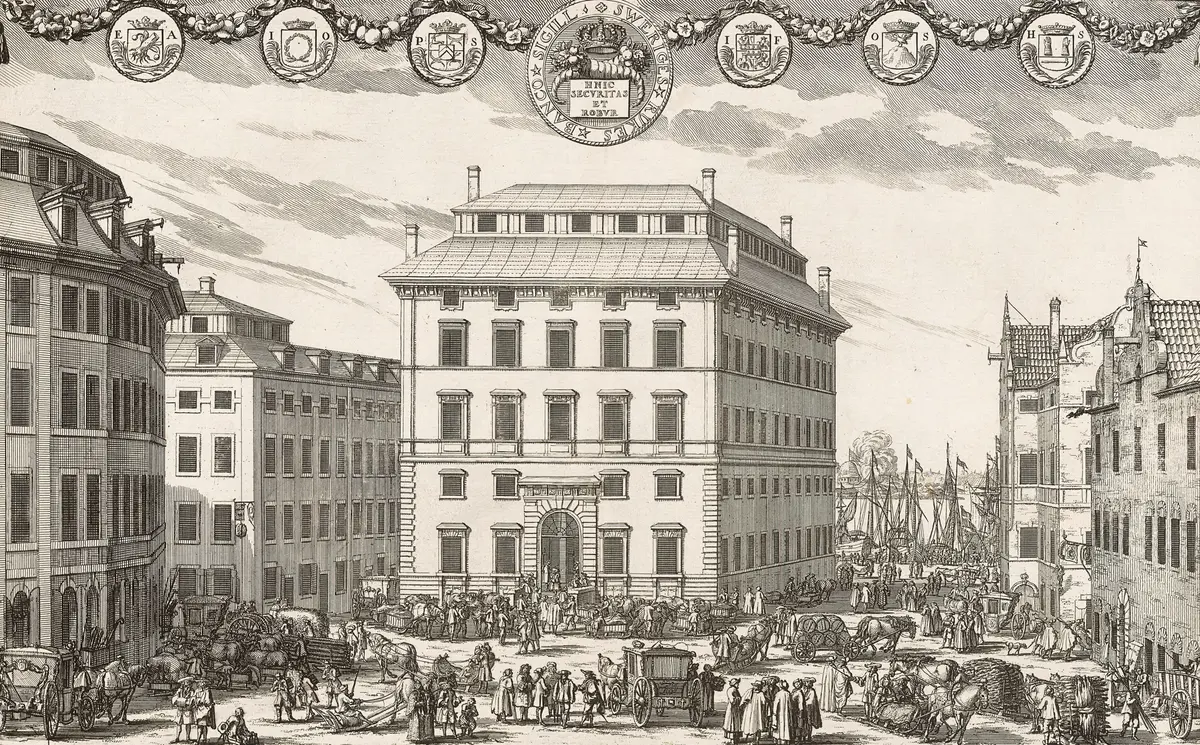
The bank of 1668 kept much of Palmstruch's design but not his notes, which the Estates banned. Its rules told it to keep the country's coin 'at its right and fair value', a duty that stayed in its law until 1897. It opened in rented rooms in the palace of the late chancellor Axel Oxenstierna in Stockholm's old town, and in 1680 moved into a house of its own at Järntorget, designed by Nicodemus Tessin the Elder: the first building in northern Europe made only for banking, which it used until 1906. Its independence was soon tested. Karl XI, ruling as an absolute king, made it clear in 1689 that the bank answered to him too, and his son Karl XII borrowed from it to pay for the Great Northern War. Paper money came back by the side door, as bank receipts that people passed from hand to hand, until the bank itself issued transfer notes from 1701.
For two centuries it was above all a bank that lent to the nobility and the state. When the Riksdag of the Estates was abolished in 1866, it took the name Sveriges Riksbank in 1867, and an act of 1897 made it the only issuer of banknotes from 1904 and turned it into a modern central bank. Its early history holds two lessons that central banks still live by: paper money is worth only as much trust as stands behind it, and the bank that issues it should be kept at arm's length from the government's needs. Britannica dates the history of the modern central bank from its founding; the Bank of England followed in 1694. For its 300th anniversary, in 1968, the Riksbank founded the Prize in Economic Sciences in Memory of Alfred Nobel, first awarded in 1969.
What happened
- 1656
At his army headquarters in Marienburg, in the war with Poland, King Karl X Gustav signs charters for an exchange bank and a loan bank for Johan Palmstruch and his partners: Sweden's first bank, Stockholms Banco. The king asks it to protect the value of Sweden's copper coin.
Marienburg (Malbork, Poland): Karl X Gustav's headquarters in the war with Poland, where he signed the charter of Sweden's first bank on 30 November 1656- 1657
Stockholms Banco opens in a rented house at the end of Västerlånggatan, by the bridge to Norrmalm. The councillor Seved Bååt makes the first deposit, 13,763 daler in copper money; merchants leave their heavy copper plates and pay each other by transfer.
Tre Kronor, the royal castle in Stockholm (burned in 1697; the Royal Palace stands on its site): Stockholms Banco's first house stood just west of it, at the end of Västerlånggatan by the bridge to Norrmalm- 1660
Weeks after Karl X Gustav's death, the Council of State, ruling for the young Karl XI, makes new copper plates lighter for the same value, and again in November. Depositors rush to take their old, heavier plates back; the bank runs short and calls in its loans.
- 1661
In July or August Palmstruch begins to issue kreditivsedlar, printed notes the bank promises to pay in coin to whoever holds them. They are not tied to any deposit and are handed out as loans: the first banknotes in Europe. People ask for them 'with such an appetite' that the bank can hardly keep up.
The Council of State raises no objection to the notes. A proclamation making them good for paying taxes is drafted, but the chancellor De la Gardie thinks they can manage 'without any public announcement', and it is never issued.
Tre Kronor, the royal castle in Stockholm (burned in 1697; the Royal Palace stands on its site): Stockholms Banco's first house stood just west of it, at the end of Västerlånggatan by the bridge to Norrmalm- 1663
In 1663 the bank lends freely in notes: the crown borrows 500,000 daler, De la Gardie 255,000 and the tar company 200,000. On 12 September the bank's secretary writes to Palmstruch that less than 4,000 daler in cash is left, with a depositor asking for 10,000.
On De la Gardie's proposal the Council opens an inquiry into the bank. Paying with its notes now costs 6 to 10 per cent more than paying in coin, and prices are rising: Sweden's first bout of inflation.
- 1664
At the close of the Riksdag, the Estates praise the bank but order its loans called in and its credit notes withdrawn. Money becomes scarce, and borrowers are left to private moneylenders.
- 1668
The Riksdag meets in Stockholm. The Nobility takes up the question of the bank; the Burghers follow, the Clergy hold back, and the Peasants say they do not understand banking and want nothing to do with it.
Riddarhuset, the House of Nobility, Stockholm: the house of the estate that pushed the new bank through in 1668The Svea Court of Appeal dismisses Palmstruch as director, strips him of his privileges and banishes him for life; if he cannot make good the bank's losses within six months, he is to be put to death. He is reprieved the next year.
The Estates agree to 'defend, protect and be in charge of' the bank, and the government, in the name of the boy king Karl XI, formally hands it over to them; the bank's charter carries this date. Its board will be chosen by the Estates instead of a royal superintendent.
The Riksdag closes. The bank's regulations, signed six days later, are dated back to this day, which the Riksbank keeps as its founding day.
The Riksdag's committee meets for the last time and signs all the documents. The Bank of the Estates of the Realm is ready for business, in rented rooms in Axel Oxenstierna's palace.
Axel Oxenstierna's palace on Storkyrkobrinken, Stockholm: the bank's first home, in rented rooms, from 1668 to 1680