Television is demonstrated
“On 26 January 1926 John Logie Baird showed moving pictures to scientists in London; by 1939 all-electronic television, pioneered by Farnsworth and RCA, was on the air.”
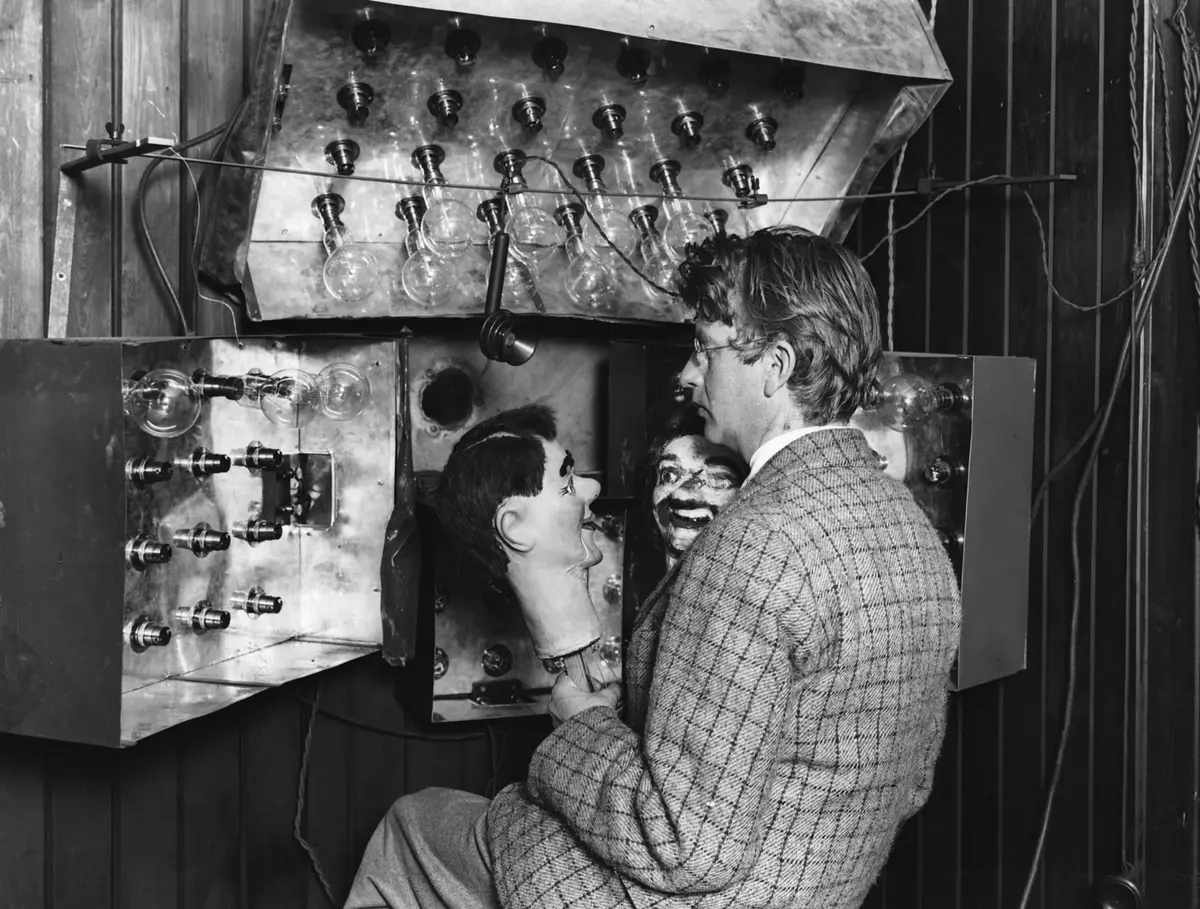
Television is the sending of moving pictures by electricity at the moment they happen. The idea was old: a picture could be cut into lines, sent as a changing current and put back together at the other end, and in 1884 a German, Paul Nipkow, patented a spinning disc with a spiral of holes that could do the cutting. What was missing were light-sensitive cells and amplifiers good enough to make it work. They arrived in the 1920s, and a race began. The first lap went to John Logie Baird, a sickly Scottish engineer with little money. From 1923, in Hastings on the English south coast, he built a machine from a hat box, a tea chest, bicycle-lamp lenses and darning needles. In March 1925 he showed outlines of shapes to shoppers at Selfridge's in London, and on 2 October 1925, in his attic at 22 Frith Street in Soho, he saw a face in light and shade: the head of a ventriloquist's dummy he called Stooky Bill.
On 26 January 1926 about forty members of the Royal Institution and a reporter from The Times climbed to Baird's rooms and watched the dummy's head and a man speaking, sent from one room to another. The picture was small, faint and often blurred, but it moved and it could be recognised; the IEEE and the Science Museum Group call it the first demonstration of television. Baird's system was mechanical, with spinning discs at both ends and only 30 lines to a picture. Others soon matched it. On 7 April 1927 the Bell Telephone Laboratories of AT&T, the American telephone company, let guests in New York see and hear Herbert Hoover, the Secretary of Commerce, speaking in Washington, with a 50-line picture sent over about 285 miles of telephone wire. Baird answered with pictures from London to Glasgow that May and across the Atlantic by short-wave radio in February 1928; from 1929 the BBC carried his programmes, and his company sold the first 'Televisor' sets.
The future, though, belonged to electrons, not discs. On 7 September 1927, at 202 Green Street in San Francisco, Philo T. Farnsworth, a 21-year-old who had grown up on farms in Utah and Idaho and had only a high-school education, sent the first picture made wholly by electronic means, a single line, from his 'image dissector' camera tube to a receiver in the next room. In the east, Vladimir Zworykin, who had come to America from Russia in 1919 and had filed a patent for electronic television in 1923, showed his picture tube, the 'kinescope', in 1929. With money from David Sarnoff's Radio Corporation of America (RCA), his team had a sensitive camera tube, the iconoscope, by 1931. RCA and Farnsworth fought for years over who had invented electronic television. The US Patent Office ruled for Farnsworth in 1935, and in 1939 RCA, for the first time in its history, agreed to pay royalties to another company.
Electronic television won. On 2 November 1936 the BBC opened what it billed as the world's first regular high-definition service, from Alexandra Palace in north London, letting Baird's 240-line system and the all-electronic 405-line system of Marconi-EMI take turns; a coin toss sent Baird first. Less than a month later fire destroyed the Crystal Palace, where Baird's company had most of its laboratories, and in February 1937 the BBC dropped his system. In America, Sarnoff opened RCA's pavilion at the New York World's Fair on 20 April 1939, and on 30 April RCA's network NBC televised President Franklin D. Roosevelt opening the fair, the first American president seen on television. Few people owned sets yet, and on 1 September 1939 the BBC switched off for the Second World War, not to return until 1946.
No single person invented television. Baird showed it first and made the public believe in it; Bell Laboratories showed that pictures could travel long distances by wire and by radio; Farnsworth and Zworykin made it electronic; RCA and the BBC turned it into a service. What they built, pictures broadcast from a central station to sets in people's homes on the model of radio, became the most powerful mass medium of the twentieth century, the window through which people watched coronations, wars, elections and, in 1969, men walking on the Moon. Its basic trick, a scene scanned line by line, sent as a signal and rebuilt on a screen, still lies under the video images we watch today.
What happened
- 1923
Ill and short of money, John Logie Baird settles in Hastings on the English south coast and starts to build a television machine from scraps: a hat box, a tea chest, bicycle-lamp lenses and darning needles, in a workshop in Queens Arcade.
Queens Arcade, Hastings: Baird's first workshop, where he built his apparatus in 1923-24 and sent his first silhouettesVladimir Zworykin, a Russian-born engineer at Westinghouse in Pittsburgh, applies for an American patent on an all-electronic television system; he cannot yet build it, and the patent is granted only in December 1938.
- 1924
In his Hastings workshop Baird sends the shadow of a Maltese cross across ten feet, his first moving silhouette. After surviving a 1,000-volt shock he is asked to leave, and late in the year he moves to two attic rooms at 22 Frith Street in Soho, London.
Queens Arcade, Hastings: Baird's first workshop, where he built his apparatus in 1923-24 and sent his first silhouettes - 1925
For three weeks Baird gives three shows a day at Selfridge's department store on Oxford Street: one at a time, shoppers look down a funnel at crude outlines of shapes sent a few yards. It is the first public showing of television, but not yet of faces or shades of grey.
Selfridge's, Oxford Street, London: Baird's first public shows of television, March 1925In the Frith Street attic Baird at last gets a picture with light and shade: the head of his dummy, Stooky Bill. He then pays an office boy from downstairs, William Taynton, half a crown to sit under the hot lamps, and Taynton becomes the first person seen on television.
22 Frith Street, Soho, London: Baird's attic laboratory; the first face on 2 October 1925 and the first demonstration of television on 26 January 1926- 1926
About forty members of the Royal Institution and a reporter from The Times watch Baird send the moving head of a dummy and a man speaking from one room of his Frith Street laboratory to another. The image is 'faint and often blurred', The Times reports two days later, but it moves: the first demonstration of television.
22 Frith Street, Soho, London: Baird's attic laboratory; the first face on 2 October 1925 and the first demonstration of television on 26 January 1926- 1927
Philo T. Farnsworth, 20, files his patent application for an all-electronic 'Television System' built around a camera tube with no moving parts; it is granted on 26 August 1930 as US patent 1,773,980.
In the auditorium of the Bell Telephone Laboratories on West Street, New York, AT&T's president Walter Gifford talks by telephone with Herbert Hoover, the Secretary of Commerce, in Washington, and sees him: Hoover's 50-line image, sent over about 285 miles of wire, appears on a disc and then on a large neon grid before the audience. Hoover speaks of 'the transmission of sight, for the first time in the world's history'. Singers follow by radio from Whippany, New Jersey.
Bell Telephone Laboratories, West Street, New York (now Westbeth): Hoover seen from Washington on 7 April 1927Six weeks after Bell Labs, Baird sends television pictures over 438 miles of telephone line from London to Glasgow.
At 202 Green Street, San Francisco, the 21-year-old Farnsworth and his assistants send the first picture made wholly by electronic means from his image dissector tube to a receiver in another room: a single, barely visible line.
202 Green Street, San Francisco: Farnsworth's laboratory, where the first all-electronic picture appeared on 7 September 1927- 1928
Baird's company sends television across the Atlantic by short-wave radio: in a darkened cellar at Hartsdale, outside New York, a group watches a man and a woman in London turn their heads, in images the New York Times calls 'crude, imperfect, broken'.
Hartsdale, New York: where Baird's pictures from London were watched on 8 February 1928- 1929
The BBC lets Baird's company broadcast experimental 30-line television from its studio at 133 Long Acre through the BBC's London transmitter, outside normal hours; at first picture and sound must take turns. Baird sells ready-made 'Televisor' sets, about a thousand in all, and many more people build their own.
At a convention of radio engineers Vladimir Zworykin demonstrates a receiver built around his cathode-ray picture tube, the 'kinescope'. That year David Sarnoff of RCA agrees to fund his work on a complete electronic system.
- 1936
The BBC broadcasts its first organised television programme from Alexandra Palace, ahead of the official opening; at Waterloo Station the Southern Railway shows it to passengers in a waiting room.
Alexandra Palace, London: the BBC Television Service from 2 November 1936The BBC Television Service opens at Alexandra Palace, billed as the world's first public, regular, high-definition television station. Baird's 240-line system, which partly uses film developed in seconds, and Marconi-EMI's all-electronic 405-line system take turns; a coin toss lets Baird's studio go first.
Alexandra Palace, London: the BBC Television Service from 2 November 1936Fire destroys the Crystal Palace in south London, where Baird Television has most of its laboratories, studios and spare parts. Farnsworth, who had come to London that year to help Baird's company with his electronic camera, picks a melted image dissector out of the ruins.
Crystal Palace Park, London: site of the Crystal Palace, Baird's laboratories until the fire of 30 November 1936- 1937
The BBC ends the trial: it keeps the Marconi-EMI system and stops broadcasting with Baird's.
Alexandra Palace, London: the BBC Television Service from 2 November 1936- 1939
David Sarnoff dedicates RCA's pavilion at the New York World's Fair, ten days before the fair opens, and launches regular electronic television in the United States; RCA offers four models of receiver for sale that year.
Flushing Meadows-Corona Park, New York: the 1939 World's Fair, where RCA and NBC launched regular television in April 1939RCA's network NBC televises President Franklin D. Roosevelt opening the New York World's Fair, the first American president seen on television; by one museum's count only about a thousand people owned a set to watch it on.
Flushing Meadows-Corona Park, New York: the 1939 World's Fair, where RCA and NBC launched regular television in April 1939