The Daventry experiment proves radar works
“On 26 February 1935, in a van in a Northamptonshire field, Wilkins and Watson-Watt saw a bomber's echo of the BBC's Daventry signal on a cathode-ray tube: the test that made Britain build radar.”
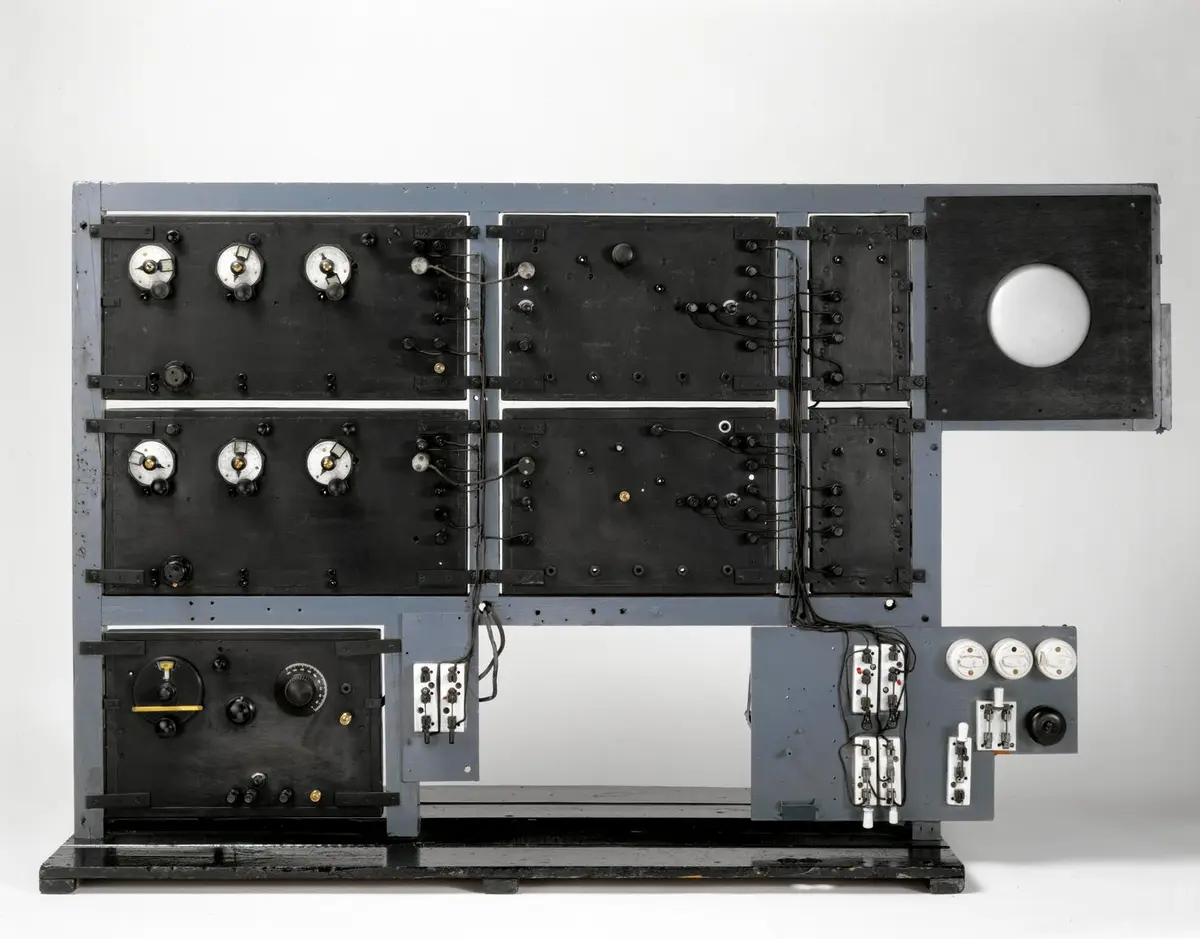
The Daventry experiment was a field test on the morning of 26 February 1935 that showed, for the first time in Britain, that an aircraft could be detected by the radio waves it reflected. Arnold Wilkins of the Radio Research Station at Slough parked the station's Morris van in a farmer's field near Upper Stowe, south of Weedon in Northamptonshire, and strung two simple wire aerials on poles. About eight kilometres away the BBC's Empire short-wave transmitter on Borough Hill, Daventry, was broadcasting on a wavelength of 49 metres. An RAF Handley Page Heyford bomber, flown by Flight Lieutenant R. S. Blucke from the Royal Aircraft Establishment at Farnborough, flew up and down the beam, and on its passes a green spot on a cathode-ray tube in the van began to rise and fall. The echo could be followed for up to about eight miles (13 km).
The test answered a question nobody had meant to ask. In January 1935 Harry Wimperis, the Air Ministry's director of research, asked Robert Watson-Watt, the superintendent at Slough, whether a radio 'death ray' could disable an aircraft or its pilot. Wilkins worked out that it would need impossible amounts of power, but suggested that radio might at least find aircraft: Post Office engineers had noticed planes disturbing their reception. A new committee under Henry Tizard, set up to look for scientific answers to the bomber, heard this on 28 January, and on 12 February Watson-Watt sent it a memorandum, 'Detection and location of aircraft by radio methods', that laid out pulses, echoes and range finding. Air Marshal Hugh Dowding would release £10,000 only after a practical demonstration, so Wilkins proposed borrowing the BBC's transmitter.
Only three men watched: Wilkins at the set, Watson-Watt, and A. P. Rowe, the committee's secretary, as its observer. Watson-Watt remembered saying that Britain had become an island again; Rowe wrote that reflection from an aircraft had been 'demonstrated beyond doubt'. The money came, and in May a small team moved in secret to Orford Ness on the Suffolk coast to build a real pulse radar. On 17 June it caught a flying boat 17 miles away, by the end of the year it reached about 100 kilometres, and in December the Treasury approved the first five coastal stations. Early in 1936 the team moved into Bawdsey Manor nearby, which became the world's first radar research station.
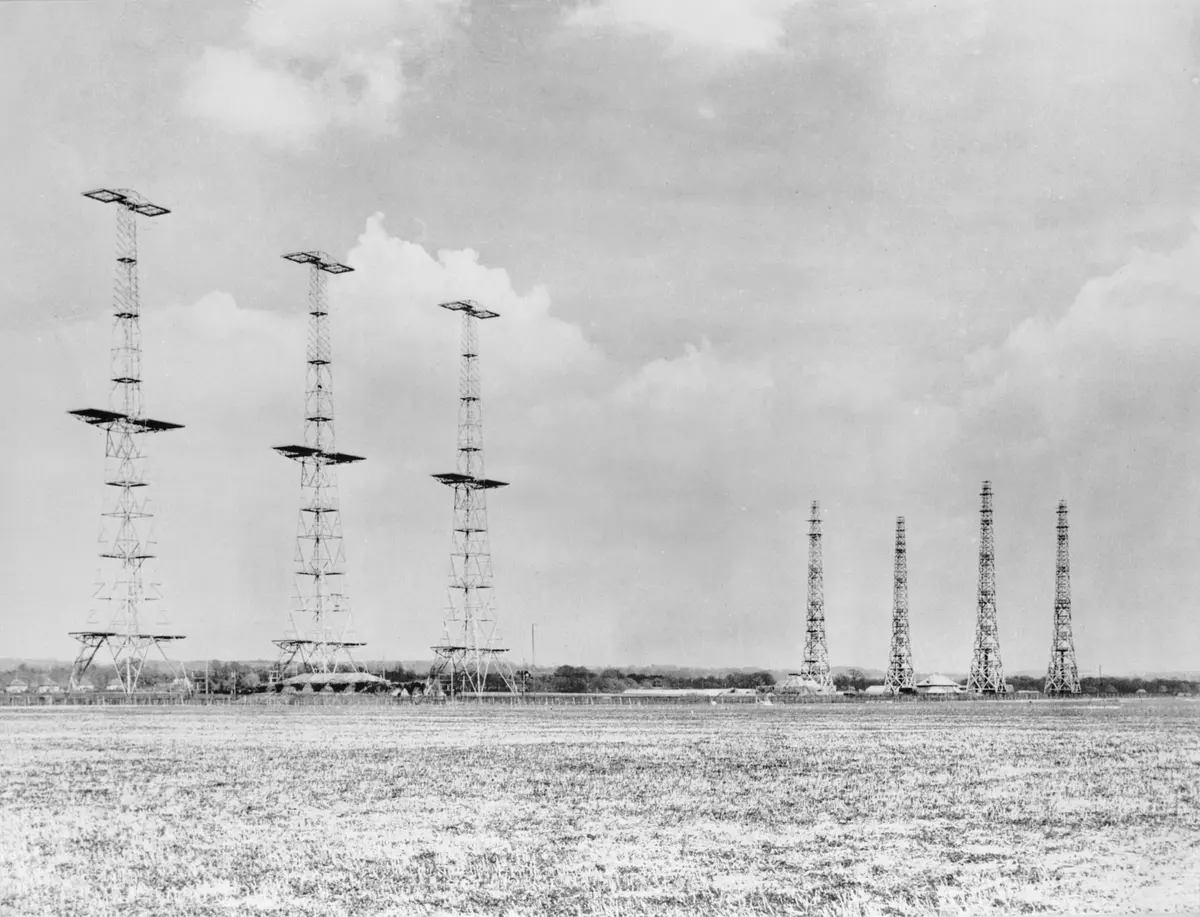
Nothing new was invented at Daventry: the receiver was an ionosphere set, the transmitter a broadcasting station. What changed was the decision. Within four years twenty Chain Home stations watched the coast, and in the summer of 1940 they gave Fighter Command the warning that let it win the Battle of Britain. A stone memorial, put up in 2001, stands by the road across from the field.
What happened
- 1935
Harry Wimperis, the Air Ministry's director of scientific research, asks Robert Watson-Watt at the Radio Research Station whether a radio 'death ray' could disable an aircraft or its pilot. Watson-Watt passes it to Arnold Wilkins as a sum: how much radio power would heat eight pints of water from 98 to 105 °F at 5 km? Wilkins finds it hopeless, and suggests instead that aircraft might be detected by the radio waves they reflect.
Ditton Park, Slough: the Radio Research Station where Watson-Watt and Wilkins worked and wrote the memorandumThe new Committee for the Scientific Survey of Air Defence, chaired by Henry Tizard, holds its first meeting and hears Watson-Watt's answer: no death ray, but 'the still difficult, but less unpromising, problem of radio detection'. Its secretary, A. P. Rowe, is told to get numbers.
Through February, as the committee studies the figures, Wimperis asks Air Marshal Hugh Dowding, the Air Member for Supply and Research, for £10,000 to pursue the idea. Dowding is interested but wants a simple practical demonstration first. Wilkins proposes using the BBC's powerful Empire short-wave station at Daventry as the transmitter, and the committee names Rowe as its observer.
Watson-Watt forwards the memorandum written with Wilkins's figures, 'Detection of aircraft by radio methods', soon redrafted as 'Detection and location of aircraft by radio methods': the echo strength of a bomber, the best wavelength, range from the time of short pulses, bearing by a cathode-ray direction finder. Hanbury Brown called it the birth certificate of radar.
Ditton Park, Slough: the Radio Research Station where Watson-Watt and Wilkins worked and wrote the memorandumWilkins and the driver of the Radio Research Station's van drive from Slough to Northamptonshire and, the evening before the test, put up two aerials on poles in a co-operative farmer's field, about eight kilometres from the Daventry masts.
The field near Upper Stowe, Northamptonshire, where Wilkins's van and aerials stood on 26 February 1935; the Birth of Radar memorial is across the roadAt Daventry the BBC's Empire transmitter radiates its usual 10 kW on 49 metres, in a beam about 30 degrees wide aimed for the Empire; the Heyford is to fly along it.
The BBC's Daventry transmitting station on Borough Hill, whose Empire short-wave transmitter lit up the bomberWatson-Watt, Wilkins and Rowe are the only witnesses. Watson-Watt later recalled saying that Britain had become an island again; Rowe, outwardly calm, reports that reflection from an aircraft has been 'demonstrated beyond doubt' and that no one seeing it could fail to be hopeful.
The field near Upper Stowe, Northamptonshire, where Wilkins's van and aerials stood on 26 February 1935; the Birth of Radar memorial is across the road- 9:45 a.m.
Flight Lieutenant R. S. Blucke brings a Heyford bomber from Farnborough and flies up and down the beam, from about 6,000 ft down to 1,000 ft. On the first pass he is too far east and nothing shows; on the next ones the spot on Wilkins's cathode-ray tube swings in a 'rhythmic beating'. The echo is followed out to about eight miles, three times, for some four minutes in all.
The field near Upper Stowe, Northamptonshire, where Wilkins's van and aerials stood on 26 February 1935; the Birth of Radar memorial is across the road With the money granted and the work secret, a small party from Slough, Wilkins, E. G. Bowen and L. H. Bainbridge-Bell, moves to old Air Ministry huts at Orford Ness, ostensibly to study the ionosphere, to build a true pulse radar.
Orford Ness, Suffolk: where the team built the first pulse radar from May 1935 and saw its first aircraft echo on 17 JuneFive weeks after arriving, the Orford Ness set shows a clear echo from a Supermarine Scapa flying boat 17 miles (27 km) away: the first aircraft seen by a British pulse radar.
Orford Ness, Suffolk: where the team built the first pulse radar from May 1935 and saw its first aircraft echo on 17 JuneThe range reaches 40 miles; in August Wilkins begins measuring height by comparing aerials at different heights, and in October Watson-Watt proposes taking bearings with crossed aerials and a goniometer.
Orford Ness, Suffolk: where the team built the first pulse radar from May 1935 and saw its first aircraft echo on 17 JuneThe Treasury sanctions a chain of five radar stations covering the approaches to London, from Bawdsey in the north to South Foreland in the south: the start of Chain Home.
Bawdsey Manor, Suffolk: the radar research station from early 1936 and the first Chain Home station- 1936
The growing team moves from Orford Ness into Bawdsey Manor, which the Air Ministry has bought with its 180 acres; as Bawdsey Research Station it becomes the first establishment devoted entirely to radar.
Bawdsey Manor, Suffolk: the radar research station from early 1936 and the first Chain Home station