The first Olympic Games in Greece
“By the Greeks' own count the Olympic Games began in 776 BCE with a single 192-metre sprint at Zeus's sanctuary of Olympia, won by Coroebus of Elis, and were then held every four years for more than a thousand years.”
In the summer of 776 BCE, by the Greeks' own reckoning, a man from Elis named Coroebus, a cook according to later tradition, won a footrace at Olympia, the sanctuary of Zeus where the Kladeos stream meets the river Alpheios in the western Peloponnese. The race was the stade, a single sprint of about 192 metres on level ground beside the great altar of Zeus, a mound built up from the ash of sacrifices. It was the only contest, and Coroebus is the first name on the list of Olympic victors. The Greeks said that Iphitus, king of Elis, had renewed the festival on the advice of the Delphic oracle, together with Lycurgus of Sparta and Cleosthenes of Pisa, and had proclaimed a sacred truce so that athletes and pilgrims could travel in safety. Pausanias, a travel writer of the second century CE, saw its terms written in a circle round Iphitus's discus, kept in the Temple of Hera.
The date is a learned reconstruction. The list of victors was put together late in the fifth century BCE by the scholar Hippias of Elis, and the biographer Plutarch already warned that Hippias had no fully reliable basis for it. Olympia itself is older: bronze tripod cauldrons and hundreds of small bronze and clay animals offered to Zeus go back to the ninth century, and the games may be as old. The Greeks told older stories too: that Heracles founded the Games for his father Zeus, or that the hero Pelops won the land, and the king's daughter, in a deadly chariot race against Oinomaos of Pisa. What 776 marks is the start of an unbroken record. The four-year span between two festivals, the Olympiad, later became the way Greek historians counted years.
For thirteen festivals the stade was the only event. Then, the later lists say, came a race of two lengths in 724, a long-distance race in 720, the pentathlon and wrestling in 708, boxing in 688, the four-horse chariot race in 680, the pankration, a fight with almost no rules, and the horse race in 648, contests for boys from 632, and a race in armour in 520. The athletes competed naked, a custom later writers traced to a runner of 720. The early champions came mostly from the Peloponnese, many of them Spartans, but soon also from Smyrna in Asia Minor and Syracuse in Sicily. The only prize was a wreath of wild olive, but a winner went home a hero. Elis had to fight for its festival: its neighbour Pisa held the Games with Pheidon, tyrant of Argos, and again in 644, until Elis crushed Pisa and, by about 570, ran the sanctuary alone. The Eleans built the Temple of Hera around 600 BCE and a first stadium around the middle of the sixth century.
The Games gave a people of hundreds of quarrelling city-states, with no common government, a place to meet as Greeks. Delphi added athletic races to its Pythian festival in 582 BCE in imitation of Olympia, Nemea opened its games to all Greeks in 573, and with the Isthmian Games at Corinth they formed a circuit of four great 'crown' festivals. In 480, while Leonidas held the pass of Thermopylae, Sparta's allies sent only advance guards because the Olympic festival was on; Herodotus tells how a Persian noble, hearing that the Greeks competed for a crown of olive, cried out that these were men who fought 'not for money but for glory'. At the next Games, in 476, the crowd spent the day gazing at Themistocles, the victor of Salamis, instead of the athletes, and Pindar wrote odes for the winning horses of the rulers of Syracuse and Acragas. In 472 the Eleans fixed the order of the events, and about then they began the great Temple of Zeus, for which Phidias later made his gold-and-ivory statue of the god.
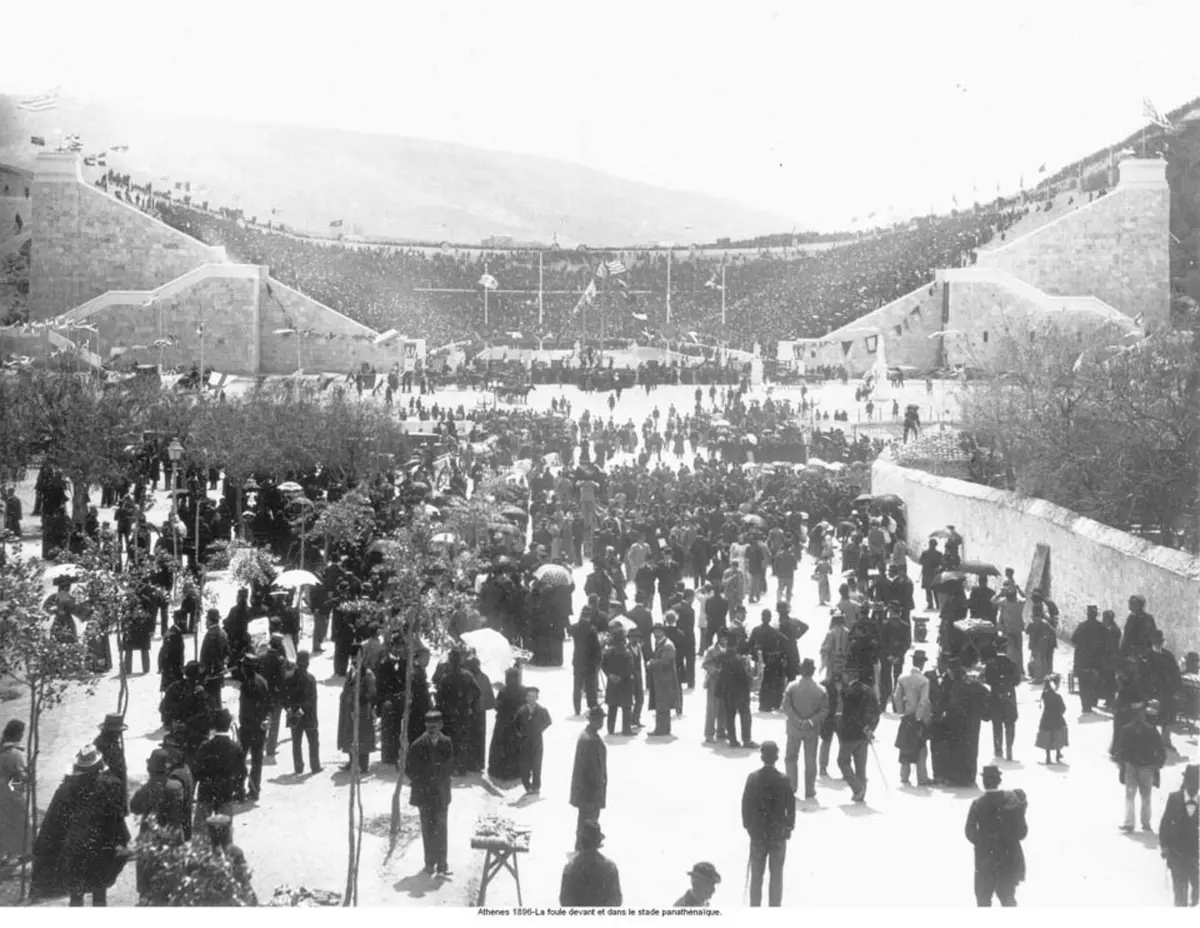
The festival was held every four years for more than a thousand years. The last Games on record were in 393 CE: the Christian emperor Theodosius I banned pagan festivals, his grandson Theodosius II had the sanctuary destroyed in 426, and floods and earthquakes buried it under five to seven metres of mud. German archaeologists uncovered it between 1875 and 1881, and their finds helped inspire Pierre de Coubertin, whose congress at the Sorbonne voted in 1894 to revive the Games; the first modern Olympics were held in Athens in 1896. The torch relay of every modern Games still starts at Olympia, at the Temple of Hera, although the relay itself was invented for Berlin in 1936, and the English word 'stadium' comes from the stade that Coroebus ran.
What happened
- 776 BCE
The first Olympic Games by the traditional count: Coroebus of Elis wins the stade, a sprint of one length, about 192 metres, run on level ground beside the great altar of Zeus. It is the only event, and his is the first name on the list of victors; Pausanias says his grave lay on the border of Elis.
The great altar of Zeus: a mound of sacrificial ash, now gone, near which the first footraces were runIphitus, king of Elis, told by the Delphic oracle to renew the festival, does so with Lycurgus of Sparta and Cleosthenes of Pisa, and proclaims the sacred truce that lets athletes and visitors travel to Olympia in safety; its terms are later inscribed round Iphitus's discus in the Temple of Hera.
The sanctuary of Zeus at Olympia: the walled grove of the Altis with its altars, temples and treasuries, and the athletes' buildings around it, between the Kladeos and the Alpheios- 748 BCE
At the eighth festival the people of Pisa bring in Pheidon, tyrant of Argos, and hold the Games with him; the Eleans strike these Games from their list. Many historians put Pheidon later, about 668.
The sanctuary of Zeus at Olympia: the walled grove of the Altis with its altars, temples and treasuries, and the athletes' buildings around it, between the Kladeos and the Alpheios - 724 BCE
A second race is added at the fourteenth festival, the diaulos, up the track and back; Hypenus of Pisa is the first to win it.
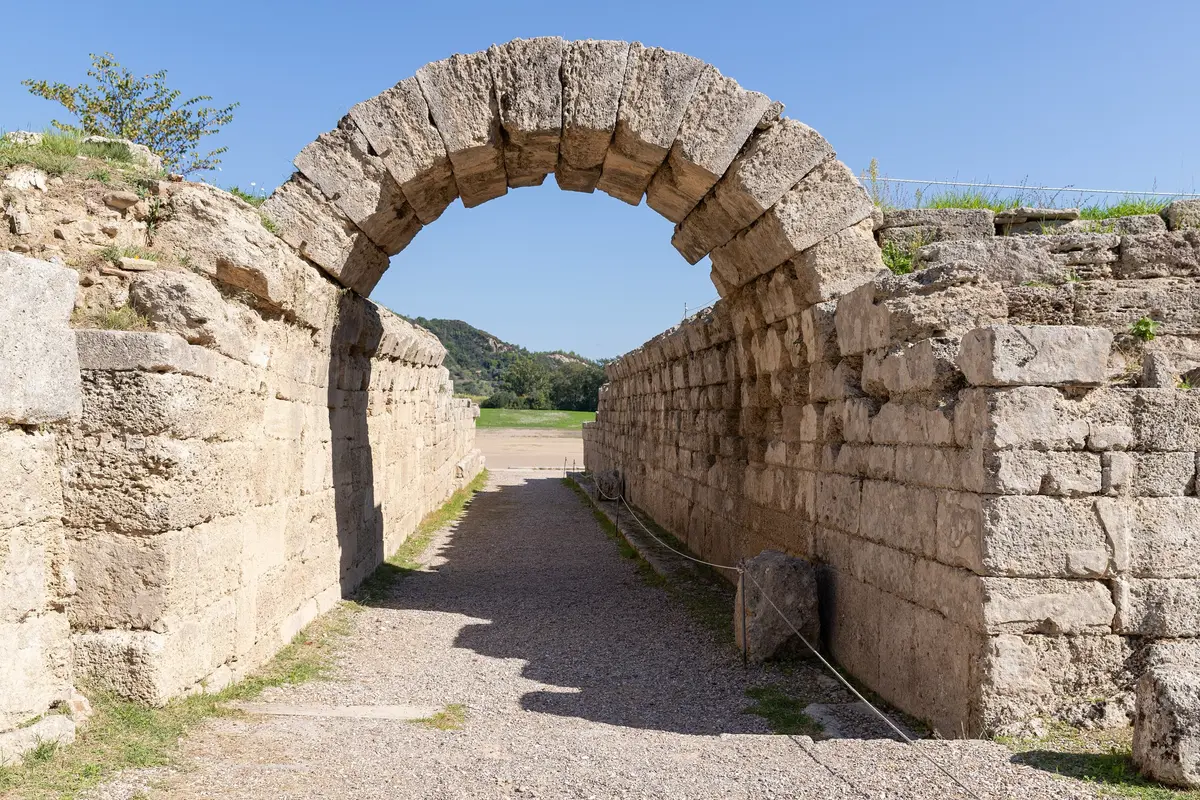
The stadium: the track with stone starting and finishing lines one stade apart, about 192 metres, in its classical place east of the Altis - 720 BCE
The long-distance race, the dolichos, is added and won by Acanthus of Sparta. Dionysius of Halicarnassus says Acanthus was the first to run naked at Olympia; Pausanias gives the honour to Orsippus of Megara, who he thought let his loincloth slip on purpose. Greek athletes competed naked from then on.
The stadium: the track with stone starting and finishing lines one stade apart, about 192 metres, in its classical place east of the Altis - 708 BCE
Wrestling and the pentathlon (a footrace, the long jump, the discus, the javelin and wrestling) join the program; the first winners, Lampis and Eurybatus, are both Spartans.
The stadium: the track with stone starting and finishing lines one stade apart, about 192 metres, in its classical place east of the Altis - 688 BCE
Boxing is added. The first champion, Onomastus, comes from Smyrna in Ionia, across the Aegean: the Games now draw Greeks from overseas.
The stadium: the track with stone starting and finishing lines one stade apart, about 192 metres, in its classical place east of the Altis - 680 BCE
The four-horse chariot race begins, in the hippodrome south of the stadium, and Pagondas of Thebes is proclaimed the first winner; only the rich can afford a team, and it becomes the most prestigious event.
The hippodrome: the course of the chariot and horse races from 680 and 648 BCE, south of the stadium, washed away by the Alpheios - 648 BCE
The pankration, a fight of boxing and wrestling in which only biting and gouging are banned, is added and won by Lygdamis of Syracuse in Sicily; the horse race is added too, won by Crauxidas of Crannon in Thessaly.
The stadium: the track with stone starting and finishing lines one stade apart, about 192 metres, in its classical place east of the Altis - 644 BCE
The people of Pisa, under their king Pantaleon, raise an army and hold the Games themselves instead of the Eleans, who later count this festival, like Pheidon's, as a 'non-Olympiad'.
Pisa: Olympia's nearest neighbour, which seized the Games with Pheidon of Argos and again in 644 BCE until Elis destroyed it - 632 BCE
Contests for boys begin, a footrace and wrestling, won by Polyneices of Elis and Hipposthenes of Sparta; boxing for boys follows in 616.
The stadium: the track with stone starting and finishing lines one stade apart, about 192 metres, in its classical place east of the AltisIn Athens, while the Olympic festival is held, the noble Cylon, himself an Olympic victor, seizes the Acropolis to make himself tyrant, taking the oracle's 'grand festival of Zeus' to mean the Olympic one; the coup fails.
- 600 BCE
About this time the Temple of Hera is built at the foot of the hill of Kronos, Olympia's first monumental building and one of the oldest temples in Greece; its wooden columns are replaced in stone over the centuries.
The Temple of Hera: Olympia's first monumental building, about 600 BCE, where the discus of Iphitus with the truce was kept - 582 BCE
Delphi makes its Pythian festival four-yearly and adds athletic races 'in emulation of the Olympic Games', with a laurel wreath as the prize; the Nemean Games are opened to all Greeks in 573. With the Isthmian Games at Corinth they form, with Olympia, the circuit of the four great festivals.
- 580 BCE
At the fiftieth festival the single president of the Games gives way to two judges, chosen by lot from all the Eleans.
The sanctuary of Zeus at Olympia: the walled grove of the Altis with its altars, temples and treasuries, and the athletes' buildings around it, between the Kladeos and the Alpheios - 570 BCE
Around this time Elis crushes Pisa and its allies and takes the Alpheios valley; from now on the Eleans run the sanctuary alone.
Pisa: Olympia's nearest neighbour, which seized the Games with Pheidon of Argos and again in 644 BCE until Elis destroyed it - 550 BCE
About the middle of the century a first stadium is laid out inside the sanctuary, below the hill of Kronos and the terrace where the cities are building their treasuries, its west end facing the altar of Zeus; until now the races had been run on open ground beside the terrace.
The sanctuary of Zeus at Olympia: the walled grove of the Altis with its altars, temples and treasuries, and the athletes' buildings around it, between the Kladeos and the Alpheios - 520 BCE
The race in armour, run in helmet and greaves with a shield, is the last of the major events to be added; Damaretus of Heraea is its first winner.
The stadium: the track with stone starting and finishing lines one stade apart, about 192 metres, in its classical place east of the Altis - 480 BCE
The Games are held while Leonidas holds Thermopylae against Xerxes, and Sparta's allies have sent only advance guards because 'the Olympiad coincided'. After the battle Arcadian deserters tell the Persians the Greeks are watching contests for a crown of olive, and the Persian Tigranes exclaims that these men compete not for money but for glory.
The sanctuary of Zeus at Olympia: the walled grove of the Altis with its altars, temples and treasuries, and the athletes' buildings around it, between the Kladeos and the Alpheios - 476 BCE
At the first Games after the Persian defeat the crowd ignores the athletes all day to gaze at Themistocles, the victor of Salamis. Pindar celebrates Hieron of Syracuse's win in the horse race and Theron of Acragas's in the chariot race in his first and third Olympian odes.
The sanctuary of Zeus at Olympia: the walled grove of the Altis with its altars, temples and treasuries, and the athletes' buildings around it, between the Kladeos and the Alpheios - 472 BCE
The pancratiasts have to fight on into the night, because the chariot races and the pentathlon ran long (Callias of Athens wins); the Eleans change the order of events so that the pentathlon and the horse races no longer crowd out the other contests, and the festival keeps this order for centuries.
The sanctuary of Zeus at Olympia: the walled grove of the Altis with its altars, temples and treasuries, and the athletes' buildings around it, between the Kladeos and the AlpheiosAbout this time the Eleans begin the Temple of Zeus, paid for with the spoils of their war against their neighbours and designed by Libon of Elis; it is finished by 456.
The Temple of Zeus: built by the Eleans from about 470 to 456 BCE, home of Phidias's gold-and-ivory Zeus